
Prof. Mauritz Kop Analyzes the Quantum Race on The Prode: Q-Day Timelines, Europe's Road to 2035, and Layered Quantum Governance
By our Editor
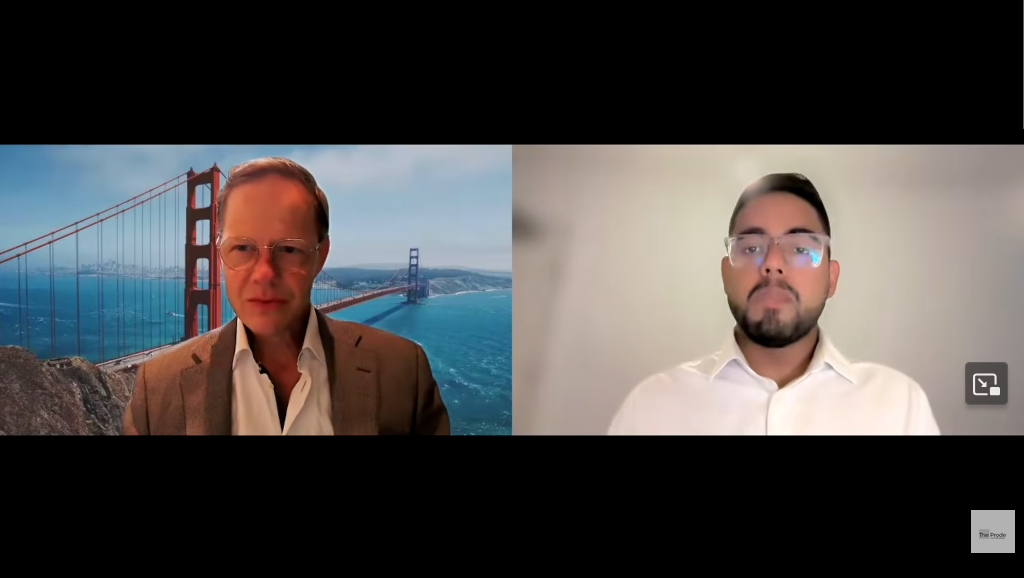
August 31, 2026 – The Prode released its interview with Prof. Mauritz Kop on the emerging quantum race and its implications for defense and national security. In a thirty-five-minute conversation with host Ritwij Raj, Kop compares the quantum-safe programs of the United States, the United Kingdom, and the European Union, explains why nobody can date Q-Day, and sets out the layered governance approach he has developed since his early work on quantum ethics. For European readers the interview lands at a specific moment: the EU moves toward a coordinated post-quantum roadmap, its member states start from twenty-seven different positions, and 2035 is the shared target horizon. The full conversation is embedded below.
The Prode: an Independent, Non-Monetized Platform Founded by Journalist Ritwij Raj in 2020
The Prode is an independent interview platform founded in 2020 by Indian author and journalist Ritwij Raj, who publishes under the pen name Ritwij Shandilya and holds a journalism diploma from the London School of Journalism. The channel runs without monetization, and its guest list spans continents and convictions: former US National Security Advisor John Bolton, Air Marshal R.G.K. Kapoor of the Indian Air Force, technology policy veteran Sam Pitroda, energy specialists, and European security scholars. On August 31, 2026, the featured Bolton episode and the fresh Kop interview stand together on the channel's front page. That range across governments, parties, and continents gives the channel a broad, nonpartisan international remit: the format is the long-form conversation, and the recurring thread is whether a topic matters internationally.
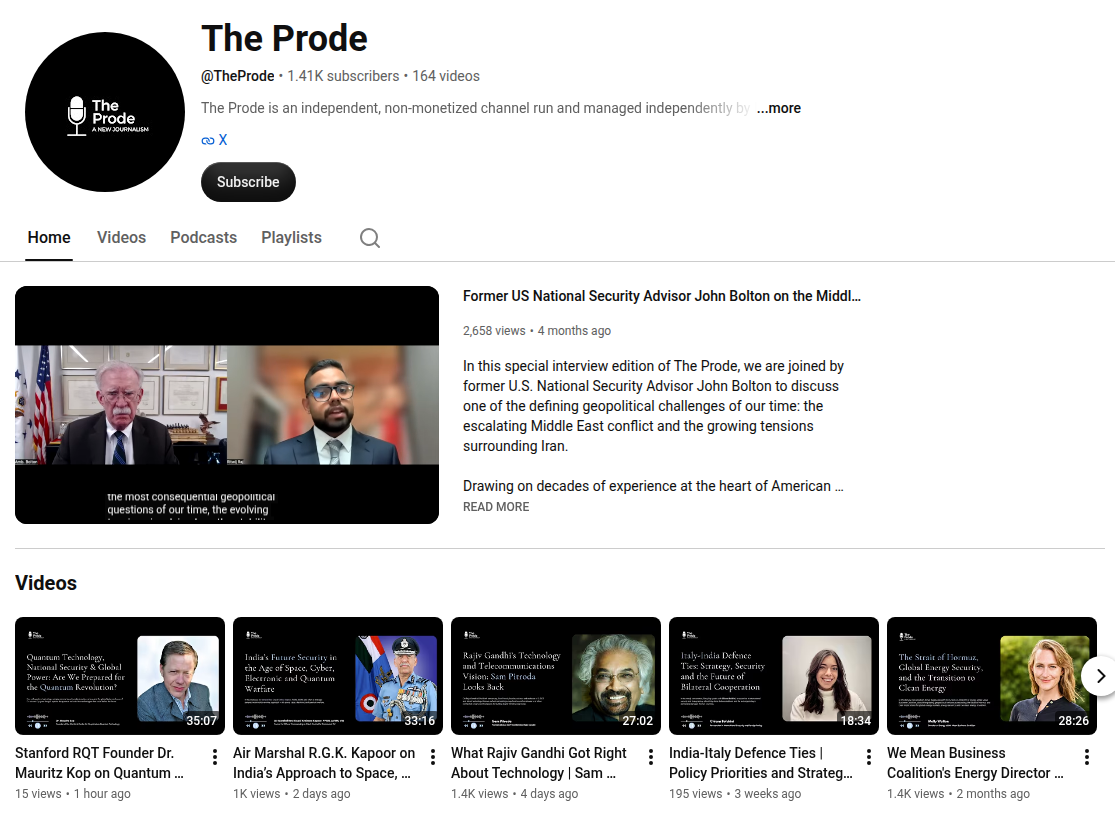
The Prode’s channel front page on August 31, 2026: the featured John Bolton episode above the videos row that opens with the new Prof. Mauritz Kop interview.
One Deadline, Twenty-Seven Starting Points: How Kop Reads the EU's Road to 2035
Asked to compare the public quantum-safe programs, Kop resists a league table for classified networks — open sources cannot rank what they cannot see — and compares what is genuinely public. America's strength is its standards machinery: NIST's algorithms already shape the global market, and the June 2026 executive order gives parts of the federal government dates of 2030 and 2031, a mechanism airecht examined when a FAR rule due in December moved post-quantum cryptography toward US federal contracts. Britain published a clear sequence: discovery and planning by 2028, priority migration by 2031, completion by 2035, laid out in the NCSC migration timelines. The European Union, Kop notes, has a coordinated implementation roadmap plus sectoral regulatory tools in finance and cybersecurity that can move whole industries at once. The difficulty he names is coordination — post-quantum migration across twenty-seven member states with different starting points. The target year is shared; the distance to it is unevenly distributed.
PQC as the Broad Foundation, QKD Where Its Costs Make Sense: Reading China's Backbone from Europe
China has built substantial quantum-communications infrastructure, including the Beijing-Shanghai backbone and the Micius satellite. Kop's assessment separates strategic weight from technical scope: quantum key distribution requires specialized hardware and solves a narrower problem than the public-key systems Shor's algorithm threatens, which is why he sees post-quantum cryptography as the broad foundation, with QKD reserved for links where its cost and limitations make sense, combined with hardware-based entropic random number generation. For Europe, which funds quantum communication infrastructure of its own, that ordering is a procurement principle: standardized PQC migrates the whole estate, and physics-based links protect the few connections that warrant them. What Western debates underestimate about China, Kop adds, is its capacity to absorb and scale technology — and the democratic counterweight he names is strong frontier research, trusted standards, and alliances that widen the talent and manufacturing base.
Standards Are Institutional Power: Who Interoperates, Who Enters the Market, Whose Assumptions Become Global
Before comparing countries, Kop takes the step back that gives the interview its analytical spine: a cryptographic standard is a technical specification with institutional consequences. It determines who can interoperate, which vendors can enter a market, how quickly institutions can migrate, and whose security assumptions become global. Technical interoperability and safety standards are where principles and power meet — an argument Kop has developed for quantum in the scholarship now indexed by Harvard–Smithsonian's NASA Astrophysics Data System. Data being collected today may still matter in twenty years: the harvest-now-decrypt-later pattern makes the migration clock a European compliance question long before a cryptographically relevant machine exists.
From Quantum-ELSPI to a Layered Framework: Kop's Answer to the One-Grand-Quantum-Law Question
Asked whether quantum needs an AI Act of its own, Kop answers with sequence and proportion. Governance begins with values — human dignity, security, fairness, scientific freedom, sustainability, democratic control — and translates them through the Quantum-ELSPI framework he developed with philosopher Luciano Floridi and colleagues across Stanford, the framework he taught to Technical University of Munich students the week before this interview, together with Urs Gasser and Fabienne Marco. Standards encode security and interoperability requirements; procurement requires benchmarks and independent validation; quantum impact assessments surface dual-use, data, environmental, and equity risks before deployment; existing intellectual property, competition, and cybersecurity law does much of the remaining work, with targeted legislation where real gaps remain. A quantum system for molecular simulation raises different questions from a navigation sensor, so the principles stay horizontal and the intervention fits the vertical. He favors a layered, innovation-friendly framework over one grand quantum law — the position his Columbia Law School study "Towards a European Quantum Act" works out in statute form for the EU.
The Cognitive Dimension: Why Kop Wants Norms for Neural Quantum Sensing Before the Capability Matures
One sensing frontier in the interview speaks directly to European institutions. Wearable quantum magnetometers can already record the brain's magnetic fields — with sensors on the scalp inside heavy shielding, nowhere near a standoff capability — and NATO, Kop notes, already treats the cognitive domain as an operational space, a subject he recently discussed with NATO's Strategic Communications Centre of Excellence. He puts the readiness level plainly: the building blocks exist, operational mind-reading does not. Kop's point is about timing, the same timing argument that runs through his whole governance program: the moment to set norms for neural quantum sensing is now, while the capability is immature and the design choices remain open. Europe, with its fundamental-rights tradition and its standards infrastructure, is well placed to help shape those norms early.
What European Organizations Can Do Now: Mosca's Theorem as a Boardroom Instrument
The practical instrument Kop hands every planner is Michele Mosca's theorem: add the years your information must stay secret to the years your migration takes, and compare the sum with the uncertain arrival of a capable quantum computer. For a European organization that means a cryptographic inventory first — find the vulnerable public-key components, identify the data whose sensitivity outlives the decade, flag the systems that are hardest to replace — then crypto-agility in software and hardware, so the organization can change algorithms again without rebuilding its systems. Kop's closing line on The Prode doubles as the European agenda: begin with the values worth protecting, test scientific claims carefully, and build practical safeguards while the technology is still shapeable.
Last updated: August 31, 2026