
From the Golden Triangle to Jagged Horizon: Mauritz Kop Speaks at the Gathering Produced by Sygaldry and Rock Yard Ventures in Partnership with Y Combinator
By our Editor
In 2018 a technology lawyer and legal scholar from the Netherlands began to argue that quantum technology needs its own law, ethics and policy before the machines are finished. Eight years later, on Monday, December 14, 2026, Mauritz Kop will speak at Jagged Horizon in San Francisco. The organizers call it "an invitation-only research gathering at the intersection of quantum, AI, and what comes next." It is produced by Sygaldry and Rock Yard Ventures, in partnership with Y Combinator and five further investment firms.
This post follows the road that brought Kop, Founder of the Stanford Center for Responsible Quantum Technology and Senior Fellow at the Centre for International Governance Innovation (CIGI), to a stage he shares with AI researchers, drug discovery scientists and venture investors. The road runs through universities, companies and governments on three continents.
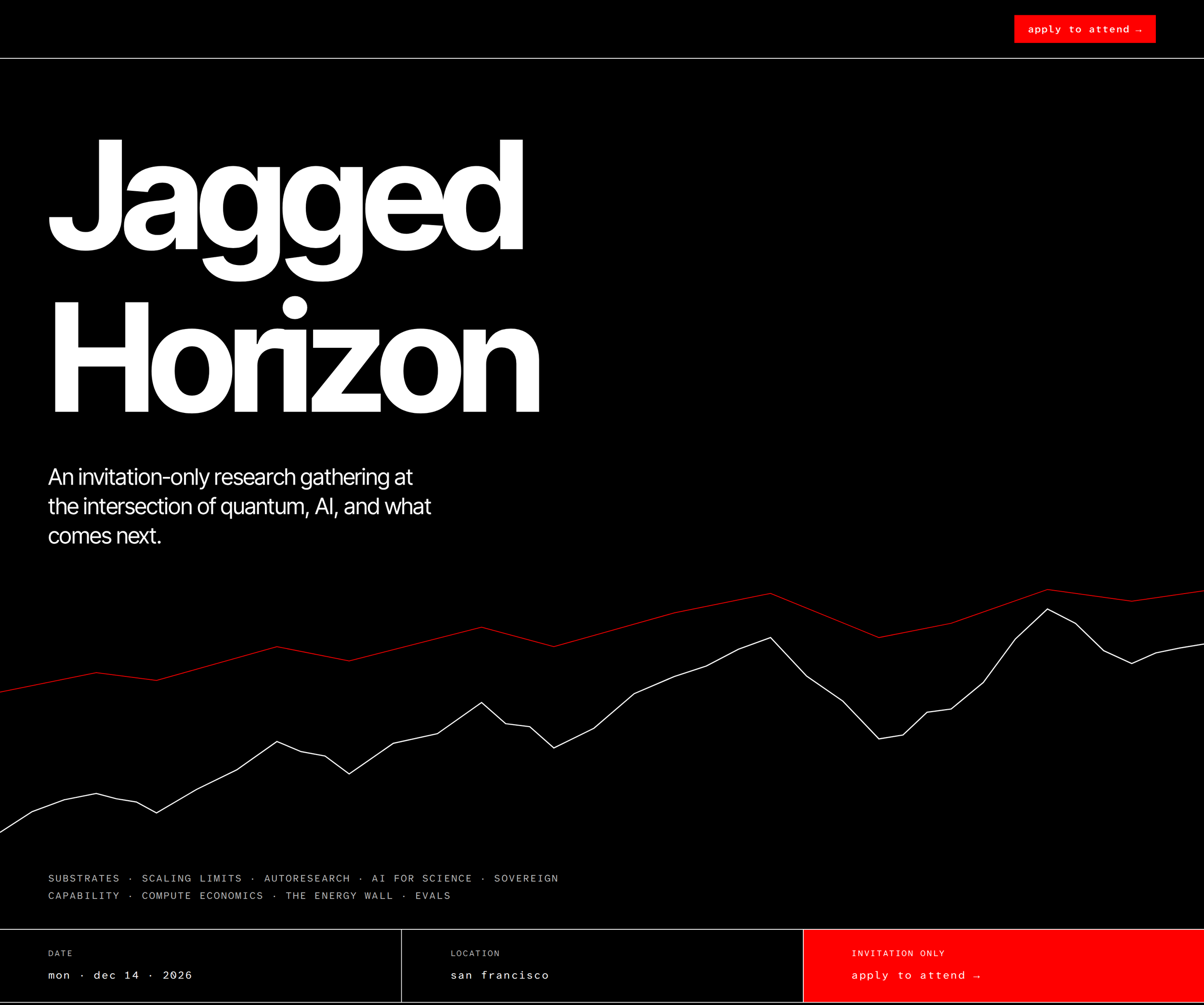
Jagged Horizon, San Francisco, Monday, December 14, 2026: an invitation-only research gathering at the intersection of quantum, AI, and what comes next. Screenshot: jaggedhorizon.ai.
A Golden Triangle on Three Continents
Kop's method has a name of its own, the golden triangle of academia, industry and policy. Scientists know what the machines can do. Companies know what the market will pay for. Governments answer for security and the public interest. A technology as consequential as quantum needs all three at one table from the start, and Kop has spent his career seating them there.
He added a second requirement early on: the best people from every continent must contribute. He works on three continents. In the United States he advises the U.S. Government, including the Pentagon and the Department of State, on quantum strategy and policy, is a Guest Professor at the U.S. Air Force Academy, and leads a Stanford initiative on quantum sensing for clinical imaging. In Europe he teaches and conducts research at the Technical University of Munich, is a Subject Matter Expert at NATO StratCom, and advises organizations including the OECD, UNESCO and CERN. In Asia he lectures in Japan. He has also spoken at the United Nations during the International Year of Quantum Science and Technology.
Readers of this site know the written side of that work. In 2025 Science published the standards-first approach to quantum governance, with Mateo Aboy, Urs Gasser, I. Glenn Cohen and Kop as authors. The paper offers engineers a certifiable quality management system for quantum technology, modeled on the standards that medicine and aerospace already use. In July 2026 War on the Rocks published Before Q-Day: The Race to Quantum First, which Kop wrote with Joseph Federici. With scientists from Genentech and Xaira Therapeutics on the program, his essay Hippocratic Quantum: The Ethics of Biomedical Discovery in the Quantum Age, published at Harvard Law School's Petrie-Flom Center in February 2026, is the piece to read before the day.
From a Center to an Incubator
In December 2023 Stanford launched the Center for Responsible Quantum Technology, which Kop founded. It was inaugurated by Mark Rutte, then Prime Minister of the Netherlands and now Secretary General of NATO. A research center produces ideas, and companies carry a technology to patients and customers. In March 2024 Kop therefore started the Stanford Quantum Incubator at Stanford Law School, a place where startups, spin-offs and investors meet the scientists and the policy community.
The idea traveled quickly. Others around the world have since taken it up, with incubators and hackathons of their own. For a legal scholar this was a deliberate step into industry. A law school is a natural home for such an incubator, because founders of quantum companies meet questions of intellectual property, standards, export rules and financing in their earliest months, and answers found at the start save a company years.
From the Jagged Horizon to the Quantum Event Horizon
The title of the San Francisco gathering describes uneven progress. Sensing reaches patients before computing reaches utility scale, and AI accelerates both. AI and quantum technology are converging, and each accelerates the other. Kop has watched that unevenness from inside academia, industry and government, and it connects to a concept from his own writing, the Quantum Event Horizon.
In astrophysics an event horizon is the boundary beyond which events can no longer reach an observer. Kop uses the image for the point where developments in quantum technology and AI, their applications and their effects on society become ever harder to foresee. A sudden "ChatGPT moment" for quantum could arrive without warning. The jagged horizon is the uneven front of progress that a field sees today, and the Quantum Event Horizon is the boundary toward which that front advances.
For builders and investors the concept has a practical use. Choices made early in a technology's life, about standards, architectures and the values built into a system, tend to stay. A founder who makes those choices well before the horizon keeps the freedom to steer afterwards. Kop offers the concept as the way he sees the field, and he brings it to San Francisco as an opening for conversation with the people who design the hardware and the models.
The Room on December 14
The event page lists eight themes: substrates, scaling limits, autoresearch, AI for science, sovereign capability, compute economics, the energy wall and evals. Six select speakers have been announced, and Kop appears on the page for Stanford University.
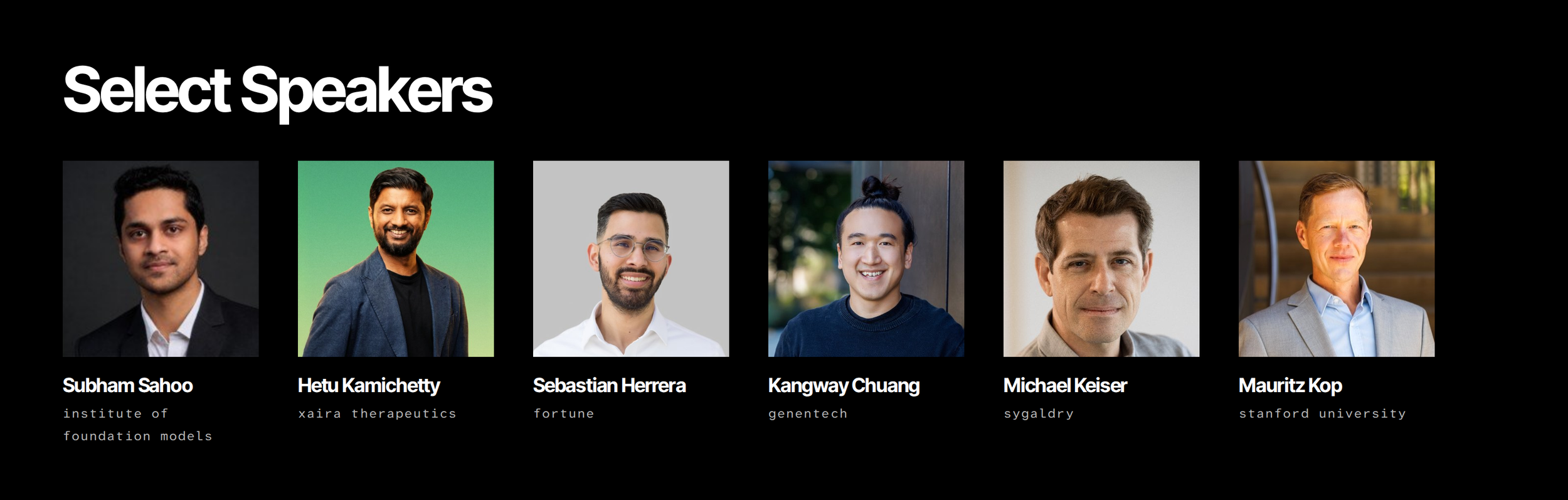
The select speakers of Jagged Horizon: Subham Sahoo, Hetu Kamichetty, Sebastian Herrera, Kangway Chuang, Michael Keiser and Mauritz Kop. Screenshot: jaggedhorizon.ai.
The Other Speakers
Subham Sahoo of the Institute of Foundation Models, part of MBZUAI, works on diffusion language models. He wrote his doctoral thesis at Cornell Tech on their foundations, and he is first author of the NeurIPS 2024 paper on masked diffusion language models.
Hetu Kamichetty is Chief Technology Officer of Xaira Therapeutics, the company that came out of stealth in April 2024 to apply AI across the discovery and development of medicines. Nobel laureate David Baker is Xaira's scientific co-founder.
Sebastian Herrera reports on the largest technology companies for Fortune from San Francisco. His reporting centers on how artificial intelligence changes the way people work and live, and he wrote about Amazon for the Wall Street Journal for many years.
Kangway Chuang of Genentech holds a doctorate in chemistry from Caltech and was a Beckman Fellow at UCSF, where he developed deep learning approaches for molecular design. At Genentech he is Senior Director of Machine Learning in Computational Sciences.
Michael Keiser co-founded Sygaldry after his laboratory at UCSF spent more than a decade on AI for scientific problems, from drug discovery to pathology images and enzyme evolution.

Jagged Horizon is produced by Sygaldry and Rock Yard Ventures, in partnership with Y Combinator, Liquid 2, Breakthrough Energy, Initialized, IQT and Rackhouse Venture Capital. Screenshot: jaggedhorizon.ai.
Producers and Partners
Sygaldry is the company of Chad Rigetti, Idalia Friedson and Michael Keiser. It describes its work as building quantum-accelerated AI servers, and on April 14, 2026 it announced $139 million in seed and Series A financing. Its website states the vision behind the servers as "affordable, sustainable, personalized, and secure superintelligence." The program Sygaldry has assembled is generous in scope, and it gives scientists from several disciplines a day to compare what they see.
Rock Yard Ventures, the co-producer, is the seed-stage firm of general partner Daniel Dart. It backs founders in robotics, supply chain, manufacturing, energy, infrastructure and healthcare, and counts quantum and chip design among its frontier technology interests.
The partners form a cross-section of American venture capital. Y Combinator is the San Francisco startup program whose alumni include Airbnb, Stripe and Coinbase. Liquid 2 Ventures is the seed firm where Joe Montana, the former quarterback, is managing partner. Breakthrough Energy Ventures belongs to Breakthrough Energy, which Bill Gates founded, and it led Sygaldry's $105 million Series A. Initialized Capital, founded by Y Combinator partners and independent since 2016, led the $34 million seed round. IQT is the not-for-profit strategic investor that the CIA set up in 1999 to bring new technology to national security users. Rackhouse Venture Capital was founded by Kevin Novak, who invented Uber's dynamic pricing product, and invests in early-stage companies that apply AI to the physical world.
What Professor Kop Brings, and What Comes Next
Kop brings to San Francisco what he has learned in every corner of the golden triangle: the frameworks he has written, his work with governments, and the incubator. Each connects to a theme of the day.
The incubator and the work with governments on three continents run side by side. Each grows faster with partners who share the ambition, and a room of researchers, founders and investors is a good place to find them. Within the next five years, quantum technology will affect the work of everyone in that room.
Last updated: November 24, 2026