Innovation, Quantum-AI Technology & Law

Blog over Kunstmatige Intelligentie, Quantum, Deep Learning, Blockchain en Big Data Law

Blog over juridische, sociale, ethische en policy aspecten van Kunstmatige Intelligentie, Quantum Computing, Sensing & Communication, Augmented Reality en Robotica, Big Data Wetgeving en Machine Learning Regelgeving. Kennisartikelen inzake de EU AI Act, de Data Governance Act, cloud computing, algoritmes, privacy, virtual reality, blockchain, robotlaw, smart contracts, informatierecht, ICT contracten, online platforms, apps en tools. Europese regels, auteursrecht, chipsrecht, databankrechten en juridische diensten AI recht.

Berichten met de tag Mauritz Kop
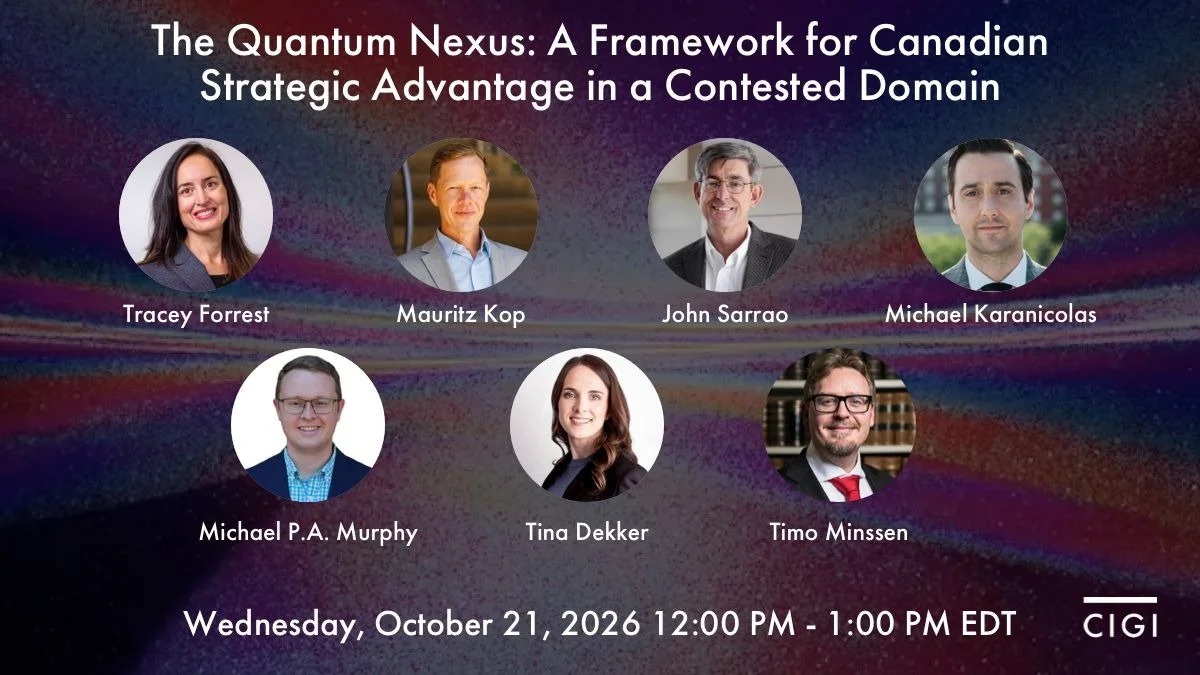
Call for Applications: CIGI Quantum Nexus Emerging Scholars Program for Canadian Strategic Advantage

The Centre for International Governance Innovation (CIGI) is accepting applications for a competitive emerging scholars program attached to The Quantum Nexus: A Framework for Canadian Strategic Advantage in a Contested Domain, a research project supported by the Department of National Defence's MINDS program and led by CIGI Senior Fellow Mauritz Kop. The deadline is July 15, 2026.

A mentorship cohort with a mission

Four to six emerging scholars from across Canada—undergraduates through post-docs, from any discipline—join a virtual program from September to December 2026. The format is deliberately personal: a one-on-one mentorship session with the Principal Investigator, an online international expert workshop in October, and a group masterclass on emerging-technology governance and publication development in November. No prior quantum expertise is required, and applications from equity-deserving groups are strongly encouraged; the program is built on the conviction that good governance of emerging technologies needs many kinds of minds. It is the same conviction that brought a Canadian quantum governance delegation to Stanford to prepare Canada's G7 presidency.

From analytical note to CIGI report

This is a publication program, not a lecture series. Every participant develops a 1,200–1,500-word analytical note on an assigned subtopic within one of six themes—spanning intellectual property and export controls, post-quantum cryptography migration, critical materials and supply chains, quantum-AI convergence, standards and allied interoperability, and the application of the LSI test (least trade-restrictive, security-sufficient, innovation-preserving) to a real case. The notes are contributed to the project's final CIGI report as a dedicated Emerging Scholars annex—a substantive contribution at the start of a research career.

Dates and deadlines

Applying takes one PDF: a 300–500-word expression of interest naming the theme you want to work on, a CV, and one reference letter, sent to programs@cigionline.org (subject line: Emerging Scholars Application: DND MINDS Project). Applications close July 15, 2026; acceptances follow in mid-August; the program runs September through December. For emerging scholars who want to help shape how the quantum age is governed, this is the opening.

Meer lezen
NATO StratCom Features Mauritz Kop as Subject Matter Expert in Workshop Video on Quantum and Cognitive Sovereignty

The NATO Strategic Communications Centre of Excellence engaged Mauritz Kop as a subject-matter expert for its Riga workshop The Integrity of Reality and Cognitive Sovereignty—via a thirty-minute video interview recorded as study material for participants and as input to the Centre's threatcasting work.

A video briefing for Riga

Held in early June 2026, in the week of the Centre's flagship Riga StratCom Dialogue, the workshop examined what happens to shared truth when both conflict and communication are increasingly automated. Kop's recorded interview adds the layer the strategic-communications field is only beginning to map: the quantum layer. His opening line does the analytical work of a whole briefing—the past is not yet stable. The argument extends the case he made when the Hoover Institution invited him to speak on quantum, democracy, and authoritarianism.

Three quantum pressures on the mind's privacy

The interview names three converging pressures on cognitive sovereignty: civic-scale quantum sensing that, in principle, could resolve subsurface and interior spaces from public rights-of-way—what Kop calls the X-Ray City scenario; quantum-enhanced biosensing and brain-computer interfaces that open the inference of mental states; and the temporal instability of the cryptographic record under harvest-now, decrypt-later collection. For the first two, Kop argues for capability protection—prohibition-grade guardrails at the infrastructure layer, not consent forms after deployment.

Why communicators should care about cryptography

An adversary who can retroactively forge or contest the signed record does not need to fabricate convincingly—only to seed doubt at scale. The interview's prescription is precision over speed: the LSI test for every proposed control, standards-first governance, and verifiable allied migration to post-quantum cryptography as the strategic-communications measure rarely recognized as one.

Meer lezen
OECD Recommendation on Quantum Technologies Builds on Responsible Quantum Principles Developed at Stanford RQT

On May 28, 2026, the OECD Council adopted OECD/LEGAL/0508, the Recommendation of the Council on Quantum Technologies—the first intergovernmental standard to set shared principles for the responsible development and use of trusted quantum technologies. Its four high-level principles and five policy recommendations will read as familiar to anyone who has followed responsible-quantum scholarship, because the instrument's core ideas track work that the Stanford Center for Responsible Quantum Technology and its founder, Mauritz Kop, helped build over the previous half-decade.

The first intergovernmental quantum standard

Developed through a multistakeholder process—forty-seven experts from twenty-six nationalities across four scoping meetings in 2025, building on the OECD's January 2025 Quantum Technologies Policy Primer—the Recommendation asks all Actors to promote innovation that respects democratic values, to prevent and mitigate harms across the technology lifecycle, to promote secure and broad access, to facilitate collaboration, and to foster accountability and trustworthiness. It is non-binding but normatively weighty: thirty-eight adherents are now expected to implement it through their own legal frameworks. The OECD's broader responsible-quantum-technology agenda has long argued that the field needs exactly this kind of shared, anticipatory baseline.

A visible lineage, not a formal citation

The Recommendation names no academic source, and nothing in its text formally credits Stanford RQT. What it shows is conceptual lineage. Its lifecycle-embedded, values-first framing echoes the Ten Principles for Responsible Quantum Innovation; its post-quantum-cryptography and quantum-resilient-infrastructure language draws on the same concern with cryptanalysis that animated Kop's 2021 Yale legal-ethical framework; its accountability-and-trustworthiness principle parallels families in the World Economic Forum Quantum Computing Governance Principles he helped conceptualize; and its call for science-based standards mirrors the standards-first program he and colleagues set out in Science. Kop was among the experts consulted in the course of the OECD's quantum-policy work, an engagement that sits within a longer record of peer-reviewed calls for responsible quantum technology.

Why anticipation is the right posture

Both the Recommendation and the scholarship it echoes favor agile, forward-looking, evidence-based governance—and the physics explains why. Quantum technologies draw their power from superposition and entanglement, phenomena that do not scale gently: an entanglement-enabled sensor can cross a sensitivity threshold, and a cryptanalytically relevant machine can render trusted public-key cryptography suddenly breakable, in ways that arrive nonlinearly. Governance that waits for a capability to mature arrives too late by construction. This is the case the responsible-quantum field, including the Quantum-ELSPI research agenda, has pressed since 2021—and the case OECD/LEGAL/0508 now encodes for thirty-eight economies.

What comes next

The Recommendation tasks the OECD's Digital Policy Committee and Committee for Scientific and Technological Policy to develop practical guidance and to report back within five years, so the standard is built to evolve with the technology. Its arrival signals that these responsible-quantum arguments have reached the institutions that set international norms—a quiet but consequential validation of work begun years earlier at Stanford.

Meer lezen
CNAS Interviews Mauritz Kop for The Entanglement Edge Quantum Networking Report

The Center for a New American Security has published The Entanglement Edge: U.S. Strategic Priorities in Quantum Networking—and Mauritz Kop briefed the CNAS research team on quantum networking and cybersecurity in November 2025, as part of the expert interviews behind it.

The entanglement edge, soberly measured

The report by Constanza M. Vidal Bustamante and Morgan Peirce declines the hype on both sides. Quantum key distribution is a niche complement, not a replacement, for post-quantum cryptography; China's 10,000-kilometer QKD network is real infrastructure but not next-generation readiness; and America's task is to fund what compounds—interconnects, benchmarks, supply chains, PQC migration—while declining to subsidize theater.

Where Kop's briefing landed

Kop gave the researchers an administrable rule: "PQC by default"—QKD only where incremental assurance can be proven over cost and complexity, quantum random-number generators widely for stronger entropy. His briefing pressed the shift from guidance to verifiable outcomes: a federal transition lead with a public dashboard, procurement requiring validated FIPS 203/204/205 modules, crypto-agility drills, and allied "one test, many markets" certification so the coalition's cryptographic baseline cannot fracture into a quantum splinternet. It is the operational sequel to the positions he brought to the U.S. Department of State on quantum technology and foreign policy.

What planners should take away

The harvest-now, decrypt-later campaigns are already running; the contest that decides their outcome is over verification—whose security architecture can be tested, certified, and trusted across an alliance. Reports built on dozens of expert interviews, rather than vendor decks, are how that architecture gets designed before the deadline arrives.

Meer lezen
Mauritz Kop Interviewed for IDC PeerScape Report on Quantum Computing Governance Practices

International Data Corporation (IDC), the global IT market-intelligence firm, has published IDC PeerScape: Practices for Quantum Computing Governance (May 2026, Doc # US54518926), by David Weldon and Heather West, PhD. The report distills how forward-thinking organizations are building governance for quantum computing on top of their existing data and risk-management practices—and Mauritz Kop, Founder of the Stanford Center for Responsible Quantum Technology, was interviewed and contributed expert responses for attribution.

A buyer-side discipline, not a research curiosity

The PeerScape genre is peer-learning guidance: IDC collects what organizations already moving on a problem are doing and packages it for the technology buyer—the CIO, CISO, and risk owner. By treating quantum governance this way, an established IT-research house signals that quantum readiness has become a present-tense program for enterprises, not a topic reserved for policy seminars. The organizations profiled include the Stanford Center for Responsible Quantum Technology, an academic center, alongside industry organizations.

The two-pronged risk

IDC frames the urgency around the cryptographic clock. Sensitive data needs protection now against "harvest now, decrypt later" attacks, in which encrypted traffic captured today is unsealed once a sufficiently capable quantum computer exists; and migrating critical infrastructure to post-quantum cryptographic standards is complex enough that it must begin now. The arithmetic is unforgiving: any data whose confidentiality must outlast the arrival of cryptographically relevant quantum machines is at risk, which is why migration is a near-term governance obligation rather than a deferred IT task.

Governance engineered as an operating system

Kop's contribution carries the through-line of his work at Stanford RQT: turning quantum governance from principles into implementable operating models. He describes strategies that are operational (decision rights, controls, assurance, lifecycle gates), strategic (dual-use posture and geopolitics), and domain-aware (post-quantum cryptography, intellectual property, and sectoral use cases in medicine, finance, and space). Principles alone, he argues, do not scale—governance must be engineered with explicit RACI, stage-gates, documentation, and assurance, and a standards-based quantum-technology quality management system gives organizations an auditable, repeatable baseline.

Part of a widening practitioner record

The IDC interview joins a pattern of bringing responsible-quantum research to the people who must implement it, complementing Kop's policy work such as the global quantum policy brief published by CIGI. The same operating-system thesis recurs across audiences—from risk professionals to IT buyers to states—because it is designed to scale across functions. The deeper lesson is that quantum governance is best treated as an asset to build now: organizations that map their use cases, stage-gate their controls, adopt standards-first assurance, and plan for regulatory interoperability convert a long-horizon threat into resilience and license to operate. Readers can find more on the underlying scholarship through Kop's profile and selected works.

Meer lezen
BioLawLaPaLooZa: Mauritz Kop on Hippocratic Quantum and the End of Stable Records at Stanford Law School

At BioLawLaPaLooZa, the annual law-and-biosciences conference convened at Stanford Law School by Henry T. "Hank" Greely and co-hosted with the Journal of Law and the Biosciences, Mauritz Kop delivered a talk that fused two strands of his recent work: the biomedical-ethics argument of his Harvard-published Hippocratic Quantum project and the security lens of his NATO Strategic Communications advisory work. It was his third appearance at the gathering, which builds on his earlier BioLawLaPaLooZa remarks.

The past is not yet stable

Kop's organizing line was that "the past is not yet stable." Rather than treating the quantum threat as a future event, he argued that today's authenticated, confidential records are contingent on a cryptographic transition still under way: adversaries can harvest encrypted data now and decrypt it once a Shor-capable machine factors the large integers beneath RSA. Confidentiality, in this reading, must be defended retroactively as well as prospectively—making the migration to post-quantum cryptography, for hospitals and biobanks, a clinical duty rather than an IT preference. The point reframes a familiar threat model: the danger is not only what a future machine will decrypt, but what is being copied and stored today against that day.

Four classical principles, recomputed

The talk recast the four principles of biomedical ethics—autonomy, beneficence, non-maleficence, and justice—for a quantum register. Quantum does not replace them, Kop said; it changes what applying them requires. Autonomy comes to demand data sovereignty and a credible right not to know as quantum-AI systems build finer probabilistic patient models. Dual-use simulators that design therapeutics can also lower the barrier to designing pathogens, which is where his LSI test—least trade-restrictive, security-sufficient, innovation-preserving—supports tiered disclosure over blanket secrecy. And the justice problem is a widening one: the quantum divide, he warned, may prove steeper than the digital divide.

The X-Ray City and a constitution for medicine

Widening the lens, Kop described civic-scale quantum gravimetric and magnetic sensors moving from the laboratory toward infrastructure pilots—able, from public rights-of-way, to resolve subsurface and interior spaces, and so to reach into the privacy of the home. He calls this prospect the X-Ray City, and said he had told NATO it needs a Hippocratic Quantum posture of its own. He closed with a "quantum constitution for medicine" in four standards of care: quantum-safe encryption, sovereignty over patient digital twins, human oversight in the loop, and tiered disclosure under the LSI test. The premise the room had not heard before, he suggested, was simply that the past itself is not yet settled.

Meer lezen
Stanford and Los Alamos Researchers Publish Critical Quantum Minerals Dashboard

Quantum computers are usually discussed in the vocabulary of physics—qubits, coherence, error correction. A new Stanford–Los Alamos preprint argues that the decisive vocabulary of the next decade may instead be geological: niobium, nickel, indium, tantalum, helium-3. Min-Ha Lee, Alan J. Hurd, Jolante Wieke van Wijk, and Mauritz Kop map the critical minerals and materials that every serious quantum platform silently depends on, and show how concentrated mining, refining, and qualification chokepoints can convert commercial dependence into strategic vulnerability.

Why a dashboard, and why now

The Stanford–Los Alamos team's central proposal is a Quantum Criticality and Critical Minerals (QCCM) dashboard: a continuously updated, allied decision-support instrument—grounded in the preprint's two-level criticality screening—that tracks concentration, substitutability, qualification bottlenecks, stockpiling gaps, and geopolitical stress signals across quantum computing, sensing, and networking. The argument is institutional rather than technical—static national critical-minerals lists, however valuable, refresh on bureaucratic timelines, while administrative export-control actions move markets in weeks. When China added bismuth to its dual-use control list in February 2025, the spot price rose roughly tenfold within two months. An instrument that registers such signals continuously is the difference between awareness and resilience.

Two use cases, one lesson

The authors develop the argument through two concrete cases. The first is niobium, the backbone of superconducting qubits: roughly ninety percent of world production comes from Brazil, the United States imports all of it, and Chinese state-linked groups have spent a decade quietly acquiring the assets. The second is the space-qualified single-photon detector, where radiation and thermal stress can degrade a quantum communications link into insecurity long before the hardware visibly fails. The lesson is the same in both: criticality lives at every layer of the stack—ore, refining, isotopes, components, qualification—and a strategy that only counts qubits will miss it. The same blind spot extends to national stockpiles, which exclude by statute the gases and isotopes—helium-3 above all—on which dilution refrigeration and quantum sensing actually run.

Materials policy as quantum statecraft

What elevates this preprint beyond supply-chain analysis is its placement of materials within the architecture of quantum statecraft: supply assurance and post-quantum cryptography migration as twin pillars of security, standards-aligned governance as the multiplier, and allied coordination as the operating system. It is a natural companion to the geostrategic analysis in the Oxford lecture on quantum threats, extending that argument from algorithms and adversaries down to the periodic table. For governments drafting quantum strategies, for industry qualifying components, and for scholars of economic security, the message is direct: the quantum age will be built from materials the democratic world does not currently control—and managing that fact deserves an instrument of its own.

Meer lezen
Quantum Computing and Competition Law: Gasser, Aboy et al. Submit Comments to Italian Competition Authority AGCM

Seven scholars—Urs Gasser, Mateo Aboy, I. Glenn Cohen, Mauritz Kop, Fabienne Marco, Timo Minssen, and John Palfrey—have submitted comments to the Italian Competition Authority's public consultation on quantum computing — an early move by a major competition regulator into a market still being formed.

Five dimensions, one variable

The AGCM asked about market structure, competitive dynamics, intellectual property, consolidation, and strategic dependencies. The submission's answer: all five run through interoperability—who sets the interfaces, who governs the benchmarks, and whether early cloud-access arrangements harden into path dependence before conventional indicators of dominance ever appear. Quantum architectures are incommensurable, not merely incompatible, which makes the usual platform-market playbook an imperfect guide and benchmark governance a first-order competition issue.

Measured on the evidence

The scholars are deliberately unalarmist: the submission reports that current patent data shows no anticommons, with concentration below mature classical-computing markets. The genuine risk is narrower—rights over interface-critical elements becoming unavoidable as standards crystallize, and three compounding forms of lock-in (technical, administrative, organizational) closing a market that still looks open on paper. The team's years of groundwork, from Ten Principles for Responsible Quantum Innovation to the patent-landscape studies, supplies the empirical base.

Process before prescription

The recommendations are staged: monitoring and transparency first, disclosure-oriented safeguards where dependencies form, intervention only on demonstrated exclusion—plus competition safeguards built directly into quantum standard-setting, from ISO/IEC JTC 3 to the emerging EU Quantum Act. In a market still being formed, the scholars argue, the right question is not what the market should look like, but whether the processes shaping it remain open, revisable, and not prematurely foreclosed.

Meer lezen
Quantum Nexus LSI Test Published by Vanderbilt JET Law

Most technology law arrives too late: the architecture ships, the market consolidates, and legislators are left regulating what already exists. A new essay in Vanderbilt's Journal of Entertainment & Technology Law argues that quantum technology presents the opposite—and far rarer—situation, and explains what the law should do with it. Quantum law is being written before quantum technology has fully arrived, and that timing is not a defect to apologize for but an opportunity to seize.

A test with three prongs

At the center of the essay stands the LSI test, a doctrinal instrument for dual-use governance that asks of every state intervention whether it is the least trade-restrictive, security-sufficient, and innovation-preserving measure available. The shift in emphasis is subtle but consequential: the question is no longer whether a government possesses a restrictive tool—export control, outbound investment screening, patent secrecy—but whether it is deploying the narrowest one that actually works. Between the romantics of total openness and the reflexes of total restriction, the test stakes out a defensible middle ground the essay calls security-sufficient openness.

Patents and export controls, one system

The essay's second contribution is diagnostic. Intellectual property and national security are conventionally treated as separate fields with separate experts and separate statutes. In quantum practice they behave as one entangled legal control plane: a single patent disclosure can simultaneously raise eligibility questions under Alice, research-security questions under the export-control regime, and commercialization questions under Bayh-Dole and the federal acquisition rules. Reading them together is not an academic nicety—it is the only way to see where over-securitization would quietly strangle the startups, standards participation, and allied interoperability on which democratic quantum leadership depends, a dynamic explored across the MINDS quantum strategy research at CIGI.

From a six-paragraph essay to a coalition playbook

Behind the essay stands the full Quantum Nexus Article—a book-length treatment on arXiv that develops the LSI test into an implementable coalition playbook: empirically anchored criteria, differentiated guardrails with red-zone domains where denial is the default, and secure closed-loop enclaves for high-sensitivity collaborative research. The stakes are framed without euphemism: U.S. assessments now call for a Quantum First posture by 2030, China's program advances under military-civil fusion, and the choice before democratic legislators is whether the coming wall of quantum regulation will be disciplined by doctrine or improvised under pressure. For lawyers, the essay is a preview of their next decade; for policymakers, it is a usable standard; and for the quantum community, it is an argument that the rules now being written deserve the same precision as the systems they will govern.

Meer lezen
StateScoop Interviews Mauritz Kop About Ohio House Bill 650 on Quantum Technology

When a statehouse starts asking serious questions about quantum computing, something has shifted. StateScoop—the Washington outlet that covers state and local government technology—has interviewed Mauritz Kop, Founder of the Stanford Center for Responsible Quantum Technology, about Ohio House Bill 650: legislation, passed unanimously by the Ohio House and now before the Senate, that would create a Frontier Technologies and Quantum Commission to study quantum computing, artificial intelligence, cybersecurity, and robotics, and report recommendations to the General Assembly by the end of 2026.

A statehouse turns to the quantum age

The commission would seat members of both chambers and draw on outside experts—an institutional answer to a structural problem. Emerging technologies now advance faster than traditional legislative cycles, and the gap between innovation and regulation widens every session a legislature waits. Ohio's answer is to build standing expertise before quantum systems are woven into procurement, infrastructure, and security frameworks, rather than legislating after the fact. It is, as Kop puts it in the interview, the role of state commissions to serve as "an essential laboratory for anticipatory governance."

Three messages from the interview

Kop's advice to Ohio distills into three propositions. First, anticipatory governance works: states that organize knowledge early write better rules later. Second, post-quantum cryptography migration is "really a country wide effort"—state agencies hold health records, tax data, and election infrastructure whose confidentiality must outlive the arrival of cryptographically relevant quantum machines, and migration timelines are measured in years, not budget cycles. Third, ethics embedded smartly in regulation does not slow innovation—it propels it, by giving industry predictable rules and the public reasons to trust what is being built.

Why state-level quantum policy matters now

Ohio is not moving alone. California, Texas, New Mexico, and Maryland have each launched quantum initiatives of their own, and the federal picture is evolving in parallel—terrain Kop knows from advising the U.S. Department of State on quantum technology and foreign policy strategy. The emerging pattern is federalism doing what it does best: fifty laboratories testing governance designs for a technology whose economic and security consequences will be national. The full StateScoop article includes Kop's remarks on commissions, cryptography, and the innovation case for ethics—and this post walks through its key arguments.

Meer lezen
EPJ Quantum Technology Publishes Quantum Criticality Index Study by Cho, Kop and Lee

EPJ Quantum Technology has published a peer-reviewed framework by Dongyoun Cho, Mauritz Kop, and Min-Ha Lee that gives policymakers something the quantum field has lacked: a Quantum Criticality Index designed to flag supply-chain chokepoints before they harden into strategic crises.

A tri-axial index for fragile supply chains

Quantum hardware depends on inputs most governments have never inventoried—helium-3, isotopically enriched silicon-28, thin-film lithium niobate, superconducting niobium, dilution refrigerators from a handful of specialist suppliers. The QCI scores each input on supply risk, substitutability, and strategic significance, then adds an artificial neural network foresight layer that detects trend shifts and stress-tests scenarios: demand surges, export restrictions, regional shocks. Static critical-minerals lists update too slowly for a technology that scales architecture by architecture; the QCI is built to move at the field's own pace.

The molybdenum case

Preliminary QCI results flagged molybdenum's concentration risk publicly in May 2024; in February 2025, China placed the metal under export licensing, with global price effects the paper documents. The index had flagged the chokepoint before the shock—one episode that neatly illustrates the argument for criticality-based foresight. The same anticipatory logic drives the geostrategic work Kop contributes to the Eric Schmidt-backed von Neumann Commission on quantum-AI geostrategy.

Hardware shield, software shield

The framework's strategic claim is that supply-chain assurance and post-quantum cryptography migration are twin pillars of quantum security: PQC protects the data, the QCI protects the physical capability to build the machines. Diagnosis feeds decision feeds delivery—allied procurement, targeted licensing, calibrated stockpiling, verifiable assurance. Quantum statecraft, the paper argues, begins with knowing your own dependencies better than your rivals know them.

Meer lezen
Mauritz Kop Consults Amgen on Quantum-Biomedical Discovery

Invited by Howard Chang—the physician-scientist who led a renowned genomics laboratory at Stanford and now serves as Senior Vice President, Global Research, and Chief Scientific Officer at Amgen—Mauritz Kop consulted with Amgen's research organization on quantum-biomedical discovery: a disciplined exchange of ideas about where quantum methods can genuinely improve the way medicines are found.

An invitation from Amgen's chief scientist

The conversation paired deep biology with quantum strategy and governance. Its anchor was the Hippocratic Quantum approach Kop published at Harvard: accelerate discovery with quantum and quantum-classical methods, but under guardrails medicine itself would prescribe—validation, privacy, security, and patient trust from the first experiment. The same translational seriousness ran through the responsible-quantum lecture and workshop Kop gave at SandboxAQ.

Six use cases, one discipline

From computational chemistry for de novo discovery and lead optimization, through protein structure and selected omics analytics, metabolism and toxicity simulation, blood-brain-barrier hypotheses validated in organoid and lab-on-a-chip systems, operational optimization, and a watchlist for quantum neural networks—every candidate use case answers to the same rule: benchmark hard against strong classical baselines from day one, and let the evidence decide which pilots earn the next dollar.

Guardrails before hype

The strategy's quiet half is security and governance: a post-quantum cryptography roadmap for long-lived patient and research data, vendor diversification across qubit modalities, trade-secret and IP protection, and standards alignment. What the exchange was about, in the end, is decision quality—smarter discovery pipelines, better-protected data, and medicines that reach patients sooner.

Meer lezen