
Quantum Law Goes Mainstream: Our Stanford RQT Scholarship in Forbes, MIT Sloan, Yahoo Finance, Foreign Policy, The Quantum Insider, and Fortune
At the frontier of quantum & AI — from breakthrough to strategy. For the boards, general counsel, and founders deciding the quantum decade: a guide to the responsible-quantum-technology research behind the headlines — from the foundational Berkeley paper on quantum IP to a Nature Physics framework, a Harvard medical-ethics doctrine, and a Los Alamos supply-chain dashboard — and where the world's leading outlets picked it up.
Why is responsible quantum technology now business news?
For most of the last decade, the law, ethics, and policy of quantum technology lived in journals no executive ever opened. That has changed. Research from the Stanford Center for Responsible Quantum Technology (Stanford RQT), founded and directed by Mauritz Kop as founding director from 2023 to 2025 — also founder of AIRecht and Quentir — has now been featured, cited, or authored across Foreign Policy, Fortune, Yahoo Finance, MIT Sloan Management Review, the Forbes Technology Council, and, three separate times, The Quantum Insider.
That migration from footnote to front page matters. Quantum computing, quantum sensing, and quantum communication are moving out of the physics lab and into patent portfolios, procurement decisions, compliance functions, and national-security strategy. The executive's question is no longer "Is quantum real?" but "What do we do about it — legally, commercially, and ethically — before our competitors and adversaries do?" Responsible quantum technology and quantum law are the disciplines that answer it. Here is the scholarship behind the coverage.

The Stanford Center for Responsible Quantum Technology (2023–2025), and its annual Stanford RQT Conferences.
Published at the summit: Science and Nature Physics
This is not opinion journalism — this is scholarship published at the very top of the scientific literature. In Science, Kop and colleagues make the case for a standards-first future for quantum governance: technical standards, not improvised rules, as the backbone of how the world governs quantum. In Nature Physics, A call for responsible quantum technology sets out the interdisciplinary vision — anticipation, engagement, and safeguards built in from the design stage.
Those two flagship venues sit atop a body of work published across the world's leading institutions. Mauritz Kop's quantum-law and quantum-IP scholarship appears in Science, Nature Physics, Stanford, Harvard, Yale, Columbia, Berkeley, Oxford, Cambridge, UCLA, Vanderbilt, and the Max Planck Institute — including a legal-ethical framework for quantum technology in the Yale Journal of Law & Technology and a study toward a European Quantum Act at Columbia Law. Few fields have a governance literature this deep this early; quantum law does, and it is being written across the Ivy League and Europe's top research houses.
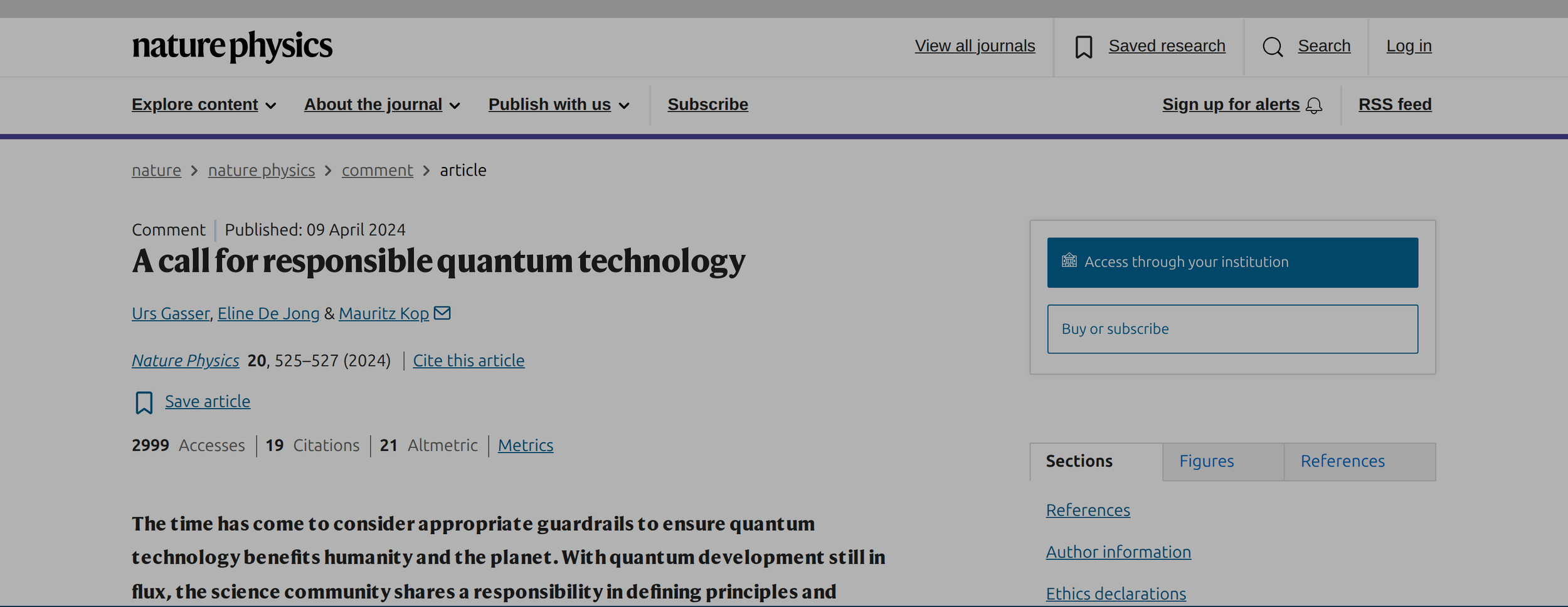
“A call for responsible quantum technology” — Gasser, De Jong & Kop, Nature Physics 20, 525–527 (2024).
The foundational quantum intellectual property scholarship
Long before responsible quantum became a headline, the groundwork was a trilogy of quantum intellectual property papers — the work that outlets such as MIT Sloan now cite when they map the commercial quantum landscape.
1. The foundational Berkeley paper. Kop's Quantum Computing and Intellectual Property Law, published in the Berkeley Technology Law Journal (2021–2022), is the field-defining starting point. It asks which IP rights can vest in the components of a scalable quantum computer, whether market incentives suffice to develop and disseminate quantum hardware and software, and whether we need open-source ecosystems, a richer public domain, and democratised access. Its warning is precise and durable: strategically stacking a mixture of IP rights can extend protection over a quantum computer's stack toward protection in perpetuity — a competition problem hiding inside an IP strategy.
2. Patents (Max Planck / Springer). With Mateo Aboy and Timo Minssen, Kop co-authored Mapping the Patent Landscape of Quantum Technologies: Patenting Trends, Innovation and Policy Implications in IIC – International Review of Intellectual Property and Competition Law, the journal of the Max Planck Institute for Innovation and Competition (Springer). This is the empirical backbone: who is actually patenting across quantum computing, simulation, sensing/metrology, and communication — the evidence base for any serious quantum IP or innovation policy.
3. Market power (Oxford University Press). The companion study, Intellectual property in quantum computing and market power: a theoretical discussion and empirical analysis (Kop, Aboy & Minssen), appeared in OUP's Journal of Intellectual Property Law & Practice. It asks whether portfolio strategies risk an anticommons and unhealthy concentrations of first-mover market power — and sets out proactive responses to keep quantum innovation both protected and open.
Together, these three papers helped change why quantum IP is now discussed as a board-level, not a back-office, question.
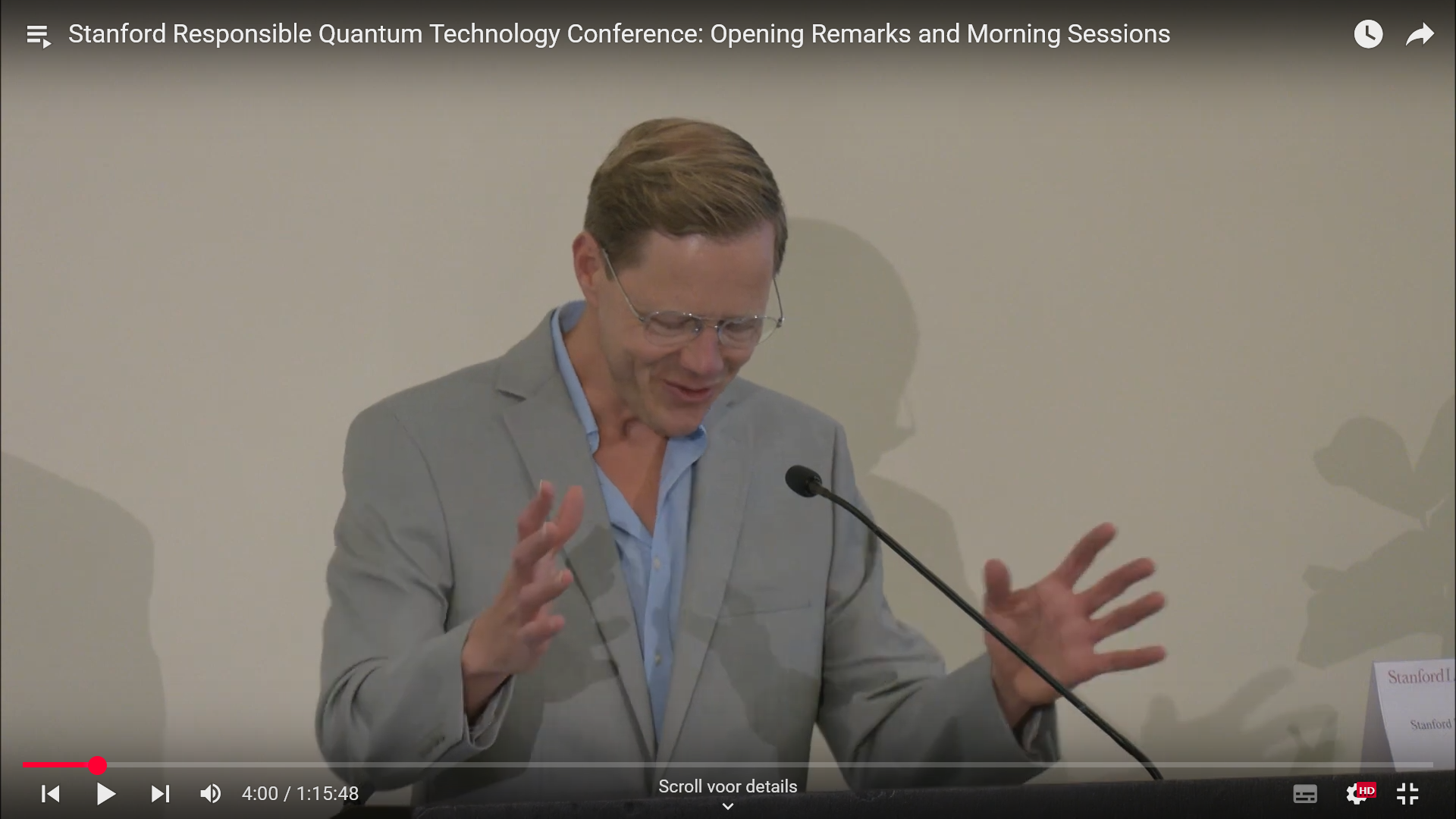
Founder Mauritz Kop Chairs the annual Stanford RQT Conference, with its trademark musical interludes and opera aria's.
Foreign Policy and Fortune: two op-eds with Vivek Wadhwa
The mainstream breakthrough came through two collaborations with technologist Vivek Wadhwa.
First, in Foreign Policy: Why Quantum Computing Is Even More Dangerous Than Artificial Intelligence (August 2022, Wadhwa & Kop; we also republished it on the AIRecht blog). The argument: to avoid repeating the governance failures of AI and machine learning, democratic nations must institute controls matched to the predicted power of quantum technologies — while respecting human rights and fundamental freedoms.
The follow-up ran in Fortune: How to Prevent Quantum-A.I. Hybrids from Taking Over the World (May 2023, Kop & Wadhwa), syndicated by Yahoo Finance and spotlighted by Stanford Law School. It focuses on quantum-AI hybrids, invokes the Collingridge dilemma (a technology is easiest to steer before we understand its impact, hardest once we do), and prescribes the Stanford RQT toolkit: the four pillars of Responsible Research and Innovation (anticipation, inclusion, reflexivity, responsiveness), the 10 Principles for Responsible Quantum Innovation, public-private partnerships, technology-impact assessments, and a quantum-ready workforce. Its motto-worthy line: "The existence of a technical possibility doesn't always warrant pursuing it."

Stanford RQT was inaugurated by NATO Chief Mark Rutte in 2023
MIT Sloan Management Review: the business case — built on our patent research
MIT Sloan Management Review framed the opportunity in The Business Case for Quantum Computing (also via the MIT Initiative on the Digital Economy). Its insight: quantum computers can deliver quantum economic advantage even on tasks classical machines can already do — once they run them thousands of times faster, in drug discovery, logistics, portfolio optimisation, and quantum chemistry. And when the authors turn to competitive positioning, they cite the Aboy–Minssen–Kop quantum patent landscape research directly. Business strategy and responsible governance read from the same evidence base.
Forbes Technology Council: the practitioner's playbook — citing our patent research
The commercial thread continues in the Forbes Technology Council piece How to Create and Protect Quantum Intellectual Property. Under the heading "Avoid Getting Fenced Out", it cites our patent-landscape research directly: quantum patent filings are rising rapidly, with the USPTO and the EPO granting around 2,000 quantum-technology patents per year — the upward trend documented in the Aboy–Minssen–Kop patent-landscape study. And the strategic point is sharper now than when that piece ran: quantum value is no longer a distant promise — it is being created today, in algorithms, devices, and materials, while patents last 20 years. The IP moves that decide the 2030s are being made now. The practitioner's playbook, in other words, is being written from the research our quantum IP trilogy established — and the clock is already running.
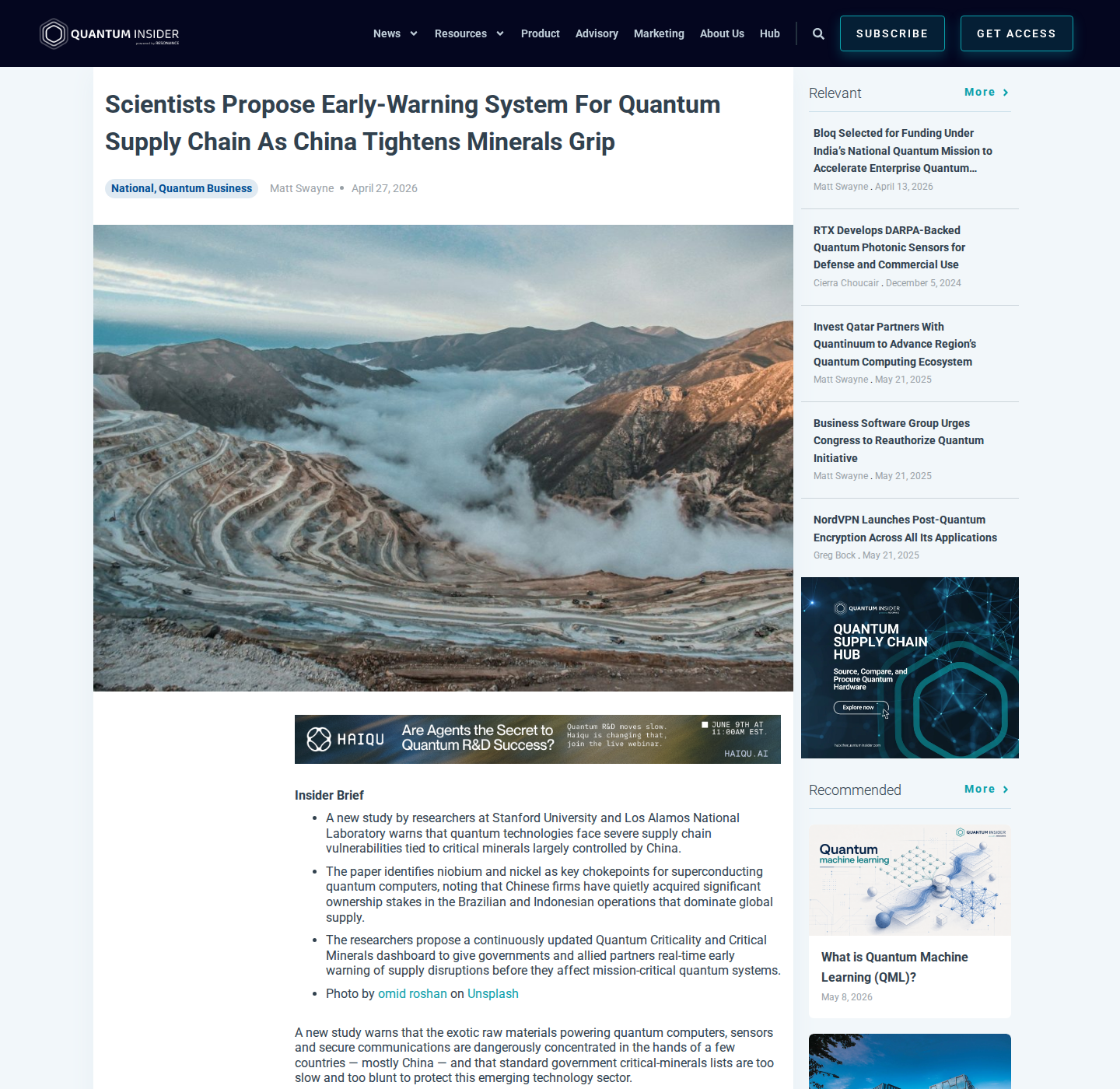
The Quantum Insider covers work from the Stanford RQT Teram collaborating with Los Alamos Labs on quantum supply chains.
The Quantum Insider (three features): framework, medical ethics, supply chain
The trade press the quantum sector reads about itself — The Quantum Insider — has featured Stanford RQT research three times.
1. The governance framework. Researchers Outline Framework for Responsible Quantum Technology (April 2024) covered Towards Responsible Quantum Technology — a Harvard Berkman Klein Center paper echoed in Nature Physics — introducing the SEA method (Safeguard, Engage, Advance) and its ten actionable principles.
2. Medical ethics. Quantum Medicine's Promise Raises New Privacy and Governance Risks (February 2026) covered our Hippocratic Quantum essay for Harvard's Petrie-Flom Center, adapting autonomy, beneficence, non-maleficence, and justice to digital twins, quantum-broken encryption, and post-quantum cryptography migration.
3. Supply-chain resilience. Scientists Propose Early-Warning System for Quantum Supply Chain (April 2026) covered our EPJ Quantum Technology paper with Min-Ha Lee (Stanford CISAC) and Alan Hurd and Jolante van Wijk (Los Alamos National Laboratory), proposing a Quantum Criticality Index and live dashboard for niobium/nickel chokepoints.

Fortune featured article by Mauritz Kop & Vivek Wadhwa
What this means for your organisation — start with your own contracts
Read together, the coverage tells one story: quantum is now a governance, IP, and strategy problem as much as a physics problem — and it is arriving now. Algorithms, devices, and materials are advancing today, which is exactly why the IP, security, and dual-use decisions in your agreements matter today.
The fastest way to see where you stand is not a meeting — it is your own paperwork. Run your AI and ICT contracts through the AIRecht Contract Scanner: a self-serve tool that reads your actual agreements, flags the quantum- and AI-relevant IP, security, and dual-use clauses, and returns a structured report in minutes. Start there, with your real documents.
For context, recent AIRecht analysis develops exactly these threads:

Mauritz Kop speak at Oxford on Quantum Emerging Threats
Frequently asked questions
Who is Mauritz Kop?
Founding director (2023–2025) of the Stanford Center for Responsible Quantum Technology, founder of AIRecht and Quentir, and CIGI senior fellow & principal investigator, working across quantum technology, AI, intellectual property, and responsible innovation.
What is responsible quantum technology?
A framework integrating ethical, legal, social, and policy considerations into quantum R&D — the SEA method (Safeguard, Engage, Advance) and the 10 Principles for Responsible Quantum Innovation.
Where can I read the foundational quantum IP research?
Start with "Quantum Computing and Intellectual Property Law" (Berkeley Technology Law Journal), the IIC patent-landscape study (Max Planck/Springer), and the market-power analysis (Oxford University Press).
Why should businesses act on quantum IP now?
Because quantum value is being created now — in algorithms, devices, and materials — while patents last 20 years. Today's filings and contract terms decide tomorrow's competitive edge, so the window to act is open today. The fastest first step is to run your own AI and ICT contracts through the AIRecht Contract Scanner.