
OECD Recommendation on Quantum Technologies Builds on Responsible Quantum Principles Developed at Stanford RQT
By Editor
Paris, France, May 28, 2026—The OECD Council has adopted the Recommendation of the Council on Quantum Technologies (OECD/LEGAL/0508), the first intergovernmental standard establishing shared principles and policy guidance for the responsible development and use of trusted quantum technologies. For readers who have followed the responsible-quantum field, the instrument's architecture is familiar: four high-level principles built around democratic values, harm prevention across the technology lifecycle, accountability, and trustworthiness, paired with five forward-looking policy recommendations. It is a vocabulary that the responsible-quantum-technology community—including the Stanford Center for Responsible Quantum Technology (Stanford RQT) and the work of its founder, Mauritz Kop—has been developing in the scholarly and standards literature for half a decade.

An interlocking quantum-lattice and entanglement motif converging onto a clean treaty-table and policy-document form in a cool institutional palette.
What the Recommendation says
OECD/LEGAL/0508 was adopted on May 28, 2026 on the proposal of the Digital Policy Committee and the Committee for Scientific and Technological Policy. Its stated purpose is "to guide the responsible development and use of trusted quantum technologies across all stages of development, in line with democratic values, human rights and fundamental freedoms, and to strengthen cross-border collaboration." Section 1 sets out four complementary principles for all Actors—public and private—and Section 2 directs five policy recommendations specifically at adhering states. The Recommendation defines quantum technologies as those that "leverage the quantum mechanical properties of particles to achieve specific goals," and it was developed through a broad multistakeholder process: forty-seven experts from twenty-six nationalities across four scoping meetings in 2025, building on the OECD's January 2025 Quantum Technologies Policy Primer. The instrument is non-binding, but as an OECD Recommendation it carries real normative weight: thirty-eight Members have already adhered, and adherents are expected to implement it through their own legal and institutional frameworks.
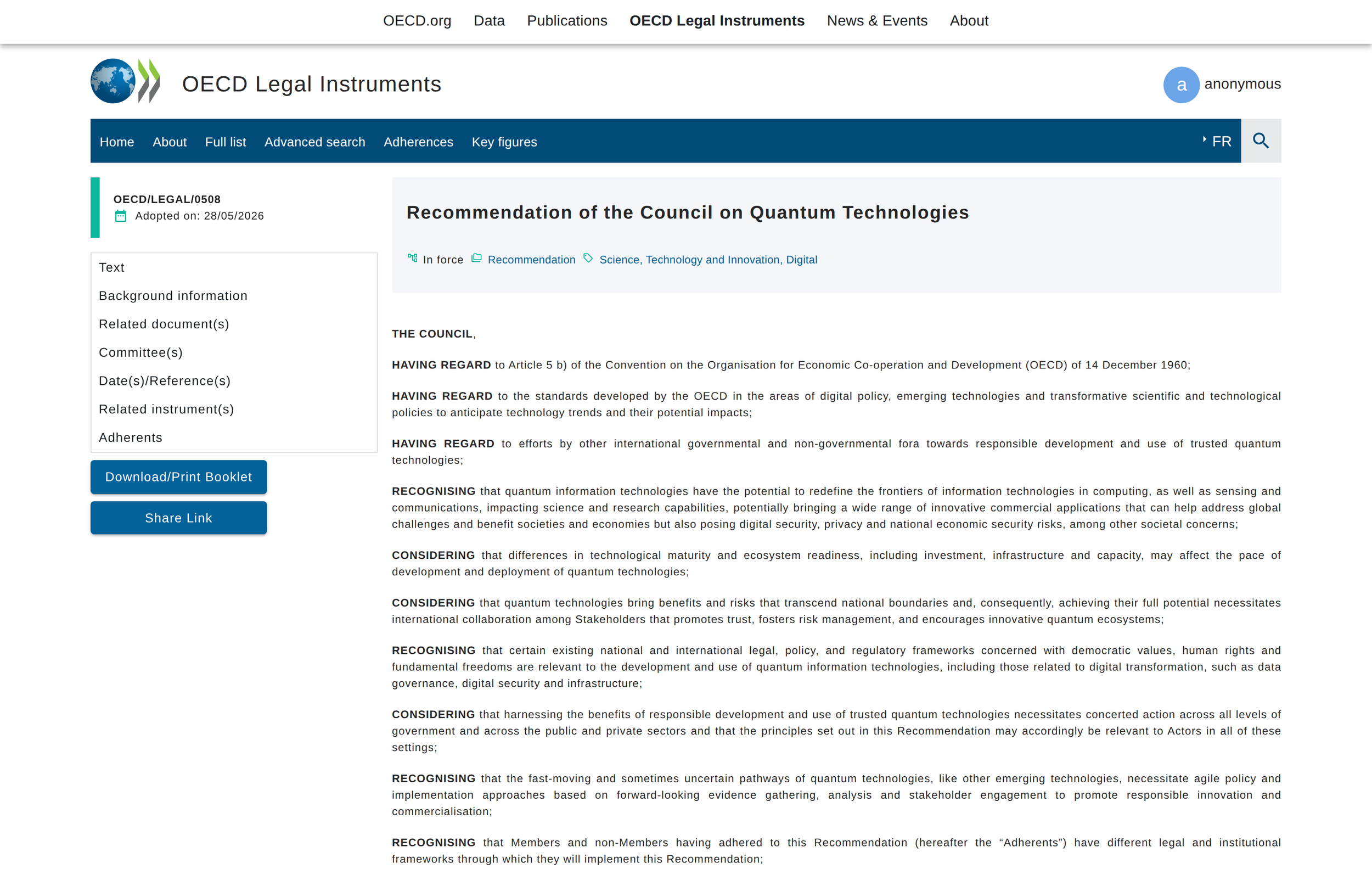
OECD Legal Instruments, OECD/LEGAL/0508, adopted 28/05/2026.
A lineage in responsible quantum scholarship
The Recommendation does not name any single academic source—OECD instruments rarely do—and nothing in its text formally credits Stanford RQT. What is visible, instead, is conceptual lineage: the document's load-bearing ideas track a body of work that Kop and his collaborators built over the preceding years, and into which the OECD reached. Kop was among the experts the organization consulted in the course of its quantum-policy work; that engagement is recorded in his consultations with UNESCO and the OECD on ethics and quantum technology policy. Read alongside the published scholarship, several of the Recommendation's principles echo positions that the responsible-quantum literature articulated first.
Four principle-level correspondences
Responsible innovation across the lifecycle. The Recommendation's first principle asks Actors to "promote innovation in quantum ecosystems that respect democratic values, human rights and fundamental freedoms" and to "prevent and mitigate potential harms… applying agile approaches and prevention measures at all stages of the technology lifecycle." That lifecycle-embedded, values-first posture is the organizing claim of the Ten Principles for Responsible Quantum Innovation, published in IOP Quantum Science and Technology, and it draws on the same lineage as the earlier legal-ethical framework for quantum technology that Kop set out in the Yale Journal of Law & Technology in 2021—an argument that ethics, law, and policy belong inside the design of the technology rather than bolted on after deployment. The same lifecycle argument was set out for a wider audience in Towards Responsible Quantum Technology, published by Harvard's Berkman Klein Center in 2023.
Quantum-resilient infrastructure and post-quantum cryptography. Principle 1.1 instructs Actors to take steps including "promoting quantum-resilient critical infrastructure to safeguard security and privacy, including by adopting post-quantum cryptography standards." The cryptanalytic threat that motivates this language—the prospect that a sufficiently capable quantum computer breaks the public-key cryptography securing today's communications—was a central concern of the Yale framework, which treated quantum's disruption of cryptography as a first-order legal-policy problem rather than a distant technicality.
Accountability and trustworthiness. The fourth OECD principle, "foster accountability and trustworthiness," asks that quantum technologies be developed "through practices that are transparent, comprehensive, and accountable" and that Stakeholders receive "clear and reliable information about the capabilities, limitations, potential risks… and development timelines of these technologies." Accountability and trustworthiness, together with transparency about real-world capability and timelines, are recurring families in the World Economic Forum Quantum Computing Governance Principles, which Kop helped conceptualize as part of a multidisciplinary team over roughly an eighteen-month process originating at Davos—an early attempt to give the field a shared governance vocabulary.
Standards based on science. Principle 1.3 calls for "the development of common terminology, benchmarks, and technical standards, based on science and including through industry-led processes… appropriate to the stage of technological maturity." A standards-first orientation—governing quantum technology through measurable, science-based standards rather than premature prohibition—is precisely the program Kop and colleagues advanced in their Science piece on a standards-first future for quantum governance.
Why anticipatory governance is the right posture
The thread running through both the Recommendation and the earlier scholarship is anticipation. The OECD repeatedly favors "agile policy and implementation approaches based on forward-looking evidence gathering" and asks adherents to "anticipate opportunities and risks" through "rigorous and forward-looking assessments." The physics is what makes that posture more than a slogan. Quantum technologies derive their power from superposition and entanglement—phenomena with no classical analogue—and those resources do not scale gently: an entanglement-enabled quantum sensor can cross a sensitivity threshold, and a cryptanalytically relevant quantum computer can render long-trusted public-key cryptography suddenly breakable, in ways that arrive nonlinearly rather than through smooth incremental gains. A capability can be safely distant one year and consequential the next. Governance designed to react after a capability matures arrives too late by construction; governance designed to anticipate is the only kind that fits the curve. That is the argument the responsible-quantum literature has pressed since 2021, and it is the logic the Recommendation now encodes for thirty-eight adhering economies.
What it means for the field
For practitioners in quantum computing, sensing, and communications, OECD/LEGAL/0508 converts a set of academic principles into a reference point that governments, funders, and standards bodies can now cite—and that enterprises are already operationalizing, as the IDC PeerScape on quantum-computing governance practices illustrates. The Recommendation tasks the Digital Policy Committee and the Committee for Scientific and Technological Policy to iterate practical guidance and to report to Council within five years, so the standard is meant to evolve with the technology. Where it ends up will depend on implementation. But the direction is set, and it is one the responsible-quantum community will recognize: govern early, govern by evidence, and keep democratic values inside the engineering rather than outside it. That a leading intergovernmental economic forum has arrived at a framework so consonant with work begun years earlier at Stanford RQT and with collaborators is, at minimum, a sign that these responsible-quantum arguments have reached the institutions that set international norms.
Last updated: June 5, 2026.