
Geopolitical Risk to Critical Raw Materials in Quantum Computing: Stanford GTG White Paper by Lee, Grotto and Kop
By our Editor
Every qubit rests on a supply chain, and that supply chain runs through a small number of countries. A 2025 Stanford GTG white paper from the Program on Geopolitics, Technology, and Governance, Methodology for Assessing Geopolitical Risk to Critical Raw Materials Supply Chains and Its Application to Quantum Computing, by Min-Ha Lee, Andrew J. Grotto, and Mauritz Kop, examines that dependency in detail: the specialty materials quantum hardware requires, the few jurisdictions that control them, and what this concentration means for Western quantum ambitions. Kop, Lee, Hurd, and van Wijk wrote a related Stanford and Los Alamos paper that introduces the Critical Quantum Minerals Dashboard. Both papers build on the Quantum Criticality Index project that Lee carried out at the Stanford Center for Responsible Quantum Technology under the supervision of Kop.

Choke points in the quantum supply chain: production and processing of several materials used in leading qubit modalities are concentrated in a few jurisdictions.
Which minerals each qubit technology depends on
The report opens with an inventory that should give every quantum strategist pause. The industry has yet to converge on a single qubit technology. Superconducting circuits, photonics, trapped ions, neutral atoms, and topological designs all remain in the race, and every pathway runs through critical raw materials. Neutral-atom processors use strontium and ytterbium. Superconducting processors depend on niobium, roughly 90 percent of which is mined in a single country, Brazil. Indium for wafer bump-bonds is largely processed in China, and tantalum thin films provide high-quality oscillators. The dependencies extend beyond the chip. Dilution refrigerators circulate a mixture of the scarce isotope helium-3 with helium-4 to cool superconducting processors to millikelvin temperatures. Silicon qubits require isotopically enriched silicon-28, and the lasers, optics, and magnets around them consume rare-earth elements, of which close to 70 percent are mined and nearly 90 percent processed in China, according to figures the report compiles from U.S. Geological Survey and International Energy Agency data.
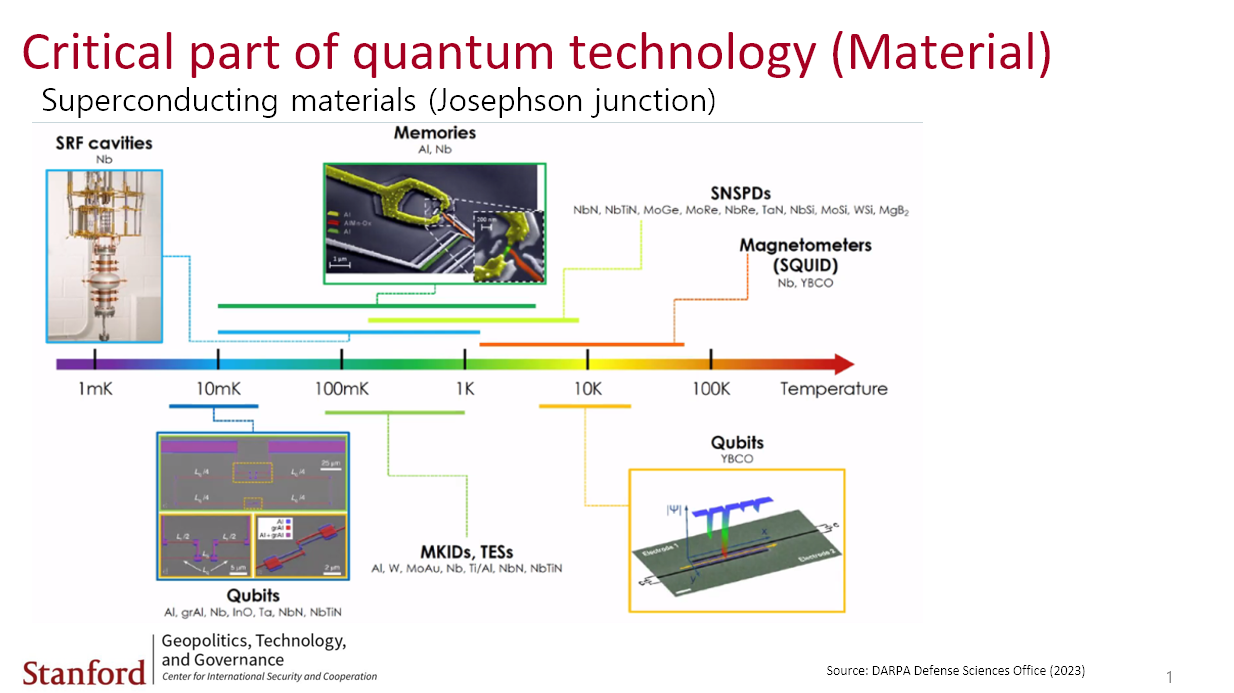
Superconducting materials in a Josephson-junction device stack, the materials layer of superconducting qubits. Illustration from the authors' quantum-materials research.
How the paper scores supply risk: vulnerability, exploitability, and strategic impact
The paper's core contribution is analytic. National critical-minerals lists, such as the fifty-material USGS inventory, are cross-sectoral by design and can miss the distinctive dependencies of one sector. Lee, Grotto, and Kop therefore propose a sector-specific risk methodology that scores each material along three dimensions: supply-chain vulnerability, exploitability (how easily a supplier state can weaponize its position), and strategic impact. Applied to quantum computing, the framework flags the rare earths as expected. It also surfaces a quieter choke point: high-purity molybdenum, which the report singles out as an under-examined enabler in the device and substrate supply chain that resilience debates have largely overlooked. The authors point toward a dynamic index as potential future work. That agenda has since been taken further in the Springer journal EPJ Quantum Technology by Cho, Kop, and Lee, as covered in our post on the Quantum Criticality Index study.
China's 2024 and 2025 export controls show the risk is already active
Concentrated supply invites the same instruments now reshaping the semiconductor world, and the report documents that this stage has arrived. China introduced export controls on gallium and germanium in 2023 and on antimony in 2024, tightened them with US-specific restrictions in December 2024, added bismuth, indium, molybdenum, tellurium, and tungsten in February 2025, and restricted seven heavy rare-earth elements in April 2025. Antimony and bismuth prices rose sharply in response. For quantum technology, the report's logic points to acting before the industry scales: building alternative sources, recycling routes, and allied coordination such as the Minerals Security Partnership while volumes are still small and choke points can still be negotiated. The authors add a caution in the same breath: unilateral export controls can backfire by pushing rivals toward self-sufficiency and fracturing fragile supply chains. Industrial policy as preventive medicine works best multilaterally, in line with the alliance argument of Democratic Countries Should Form a Strategic Tech Alliance.
Why technology counsel should read the mineral layer of the quantum stack
Materials risk reaches legal work sooner than most counsel expect. It appears as force majeure exposure in hardware contracts, export-control compliance in component sourcing, foreign-direct-investment screening of supplier acquisitions, and security-of-supply conditions in government procurement. The same mineral layer underpins the artificial intelligence stack: AI accelerators and quantum processors compete for overlapping inputs, so a supply shock in one frontier technology propagates into the other. Counsel who understand the mineral layer of the quantum computing stack will read those clauses, and their clients' risk registers, differently.
For policymakers, the white paper's message is practical. Quantum supply-chain policy has to assess dependencies material by material, and the time to run that assessment is before the first large-scale fault-tolerant machine turns every choke point into a crisis.
Last updated: September 3, 2026