
Quantum Computing Use Cases in 2026: Simulation, Optimization, Machine Learning, and Cryptanalysis Ranked by Maturity
By our Editor
Quantum computing has four canonical families of use cases: simulation, optimization, machine learning, and cryptanalysis. Each sits at a different point on the maturity curve, each rests on different physics, and each carries a distinct legal and governance profile. For the healthcare slice of this map, among the most consequential for human welfare, see our analysis of the law, ethics and policy of quantum and AI in healthcare and life sciences.
This field map follows one editorial rule: it separates what has been demonstrated in peer-reviewed experiments on real hardware this decade from what is projected. Quantum technology attracts more speculative claims per press release than almost any other field, and the convergence with AI adds to the temptation. Boards, regulators, and procurement teams need the maturity curve as it stands, with dates and sources, because that is the version on which sound strategy and sound regulation are built.

The four families of quantum computing use cases, simulation, optimization, machine learning, and cryptanalysis, each sit at a different point on the maturity curve.
Simulation: why molecules and materials are the strongest case for quantum advantage
Nature is quantum-mechanical, and simulating molecules, materials, and chemical reactions on classical machines scales brutally: the resources needed to represent strongly correlated electrons grow exponentially with system size. Quantum simulation attacks that wall with hardware that obeys the same physics as the system under study. This family carries a strong theoretical motivation for quantum advantage on selected simulation problems, with the size of the advantage depending on the problem and the algorithm, and it carries the largest societal upside. Potential applications include parts of drug discovery, battery and catalyst chemistry, fertilizer research, and materials science, although practical advantage has not yet been demonstrated for these industrial workloads.
What has been demonstrated is advancing fast, and it deserves precise statement. In December 2024, Google Quantum AI's Willow chip showed for the first time that enlarging a surface code, from distance 3 to 5 to 7, cut the logical error rate roughly in half at each step. This is the long-sought "below threshold" regime in which quantum error correction improves as machines grow. In May 2025, a Quantinuum team posted a preprint, later published in PRX Quantum, reporting the first end-to-end quantum chemistry calculation run with real-time error correction on logical qubits: the ground-state energy of molecular hydrogen. Read that soberly. Molecular hydrogen is trivial for a laptop, so the result matters as an engineering proof that the full fault-tolerant chemistry workflow runs, and as nothing more than that in chemical terms. Resource estimates for genuinely useful quantum chemistry vary with the molecule, the accuracy target, the algorithm, and the logical error rate; useful chemistry is a planning horizon, and it rules out revenue promises.
The governance profile follows the application. When quantum-assisted pipelines start feeding drug candidates and diagnostic models into regulated healthcare markets, evidence standards, validation, and post-market surveillance must become quantum-literate. The regulatory design questions are mapped in How Quantum Technologies May Be Integrated Into Healthcare and in our proposal for adaptive, risk-based oversight in Quantum Trials: An FDA for Quantum Technology.

Quantum simulation targets molecules and materials, including drug candidates, battery chemistry, and catalysts, with a strong physical case for quantum advantage on selected problems.
Optimization: where vendor marketing runs furthest ahead of the evidence
Routing fleets, scheduling crews, balancing power grids, structuring portfolios: combinatorial optimization is everywhere in the economy, which is exactly why it dominates vendor marketing. The physics deserves a caution the marketing rarely carries. Quantum computers do not "try all answers in parallel." For unstructured search, Grover's algorithm offers a provable but merely quadratic speedup, and for most practical optimization no exponential quantum advantage has been proven at all.
The empirical picture is bracing. An extensive 2025 benchmark of quantum portfolio optimization found that classical mixed-integer programming solved every test instance to proven optimality in seconds, and that a problem-tailored classical heuristic consistently beat the quantum approaches. In the authors' words, this leaves only very limited room for potential quantum advantage in that domain. Quantum annealing and variational gate-based methods remain worth watching, and hybrid quantum-classical workflows may yet find niches on problem structures that defeat classical heuristics. Near-term wins, where they come, will be incremental and hybrid.
For financial supervisors and procurement lawyers the operational rule is simple: treat quantum advantage claims in optimization as unverified until they are benchmarked against the best classical baseline, on the buyer's own problem instances, with the methodology disclosed. Risk professionals are already being briefed on exactly this discipline; see the GARP interview on quantum governance strategies for risk professionals.
Quantum machine learning: why the most speculative family still needs governance now
Quantum machine learning (QML), which spans quantum kernel methods, variational quantum circuits, and quantum-enhanced sampling, is where quantum computing meets artificial intelligence. It remains the most speculative of the four families. The theoretical appeal is real: quantum feature maps can embed data into state spaces that classical kernels cannot efficiently reach. The obstacles are equally real, and the field deserves credit for documenting them itself.
Chief among them are barren plateaus. For wide classes of variational circuits, gradients vanish exponentially as systems scale, which makes training practically impossible. Recent theory adds a genuine dilemma: architectures that provably avoid barren plateaus may, for that very reason, admit efficient classical simulation, as examined in the widely discussed analysis "Does provable absence of barren plateaus imply classical simulability?". The status report as of 2026: no demonstrated, commercially relevant QML advantage exists, and the search for one has become a careful hunt for problem classes where quantum data or quantum structure genuinely matters.
Why govern something so immature? Because the quantum-AI convergence raises control and safety questions with long lead times, and those questions are better answered before capability arrives. We set out that argument in our analysis of the quantum-AI control problem and quantum-resistant constitutional AI.
Cryptanalysis: the one use case that already carries a compliance deadline
The fourth family needs no futurology, because its legal consequences arrived before the hardware. Shor's algorithm, run on a sufficiently large fault-tolerant quantum computer, breaks RSA and elliptic-curve cryptography, the mathematics beneath most of today's digital trust. Grover's algorithm merely halves the effective strength of symmetric ciphers, which is why AES-256 survives the transition while public-key infrastructure must be rebuilt. No machine that can run Shor at cryptographically relevant scale exists today, and that fact offers no comfort for data with a long confidentiality horizon.
The operative threat is harvest-now-decrypt-later: adversaries record encrypted traffic today and decrypt it when the hardware matures. Any data whose confidentiality must outlive the transition, including health records, state secrets, trade secrets, and genomic data, is already at risk if adversaries can intercept and retain it for later decryption. The policy response has moved from recommendation to standard. On August 13, 2024, NIST finalized its first three post-quantum cryptography standards: FIPS 203 (ML-KEM) for key encapsulation and FIPS 204 (ML-DSA) and 205 (SLH-DSA) for digital signatures. Migration duties are hardening through security regulation on both sides of the Atlantic. Cryptographic inventory, migration planning, and crypto-agility are board-level obligations today, years before Q-day; the threat landscape is surveyed in Mauritz Kop's Oxford University lecture on quantum threats.
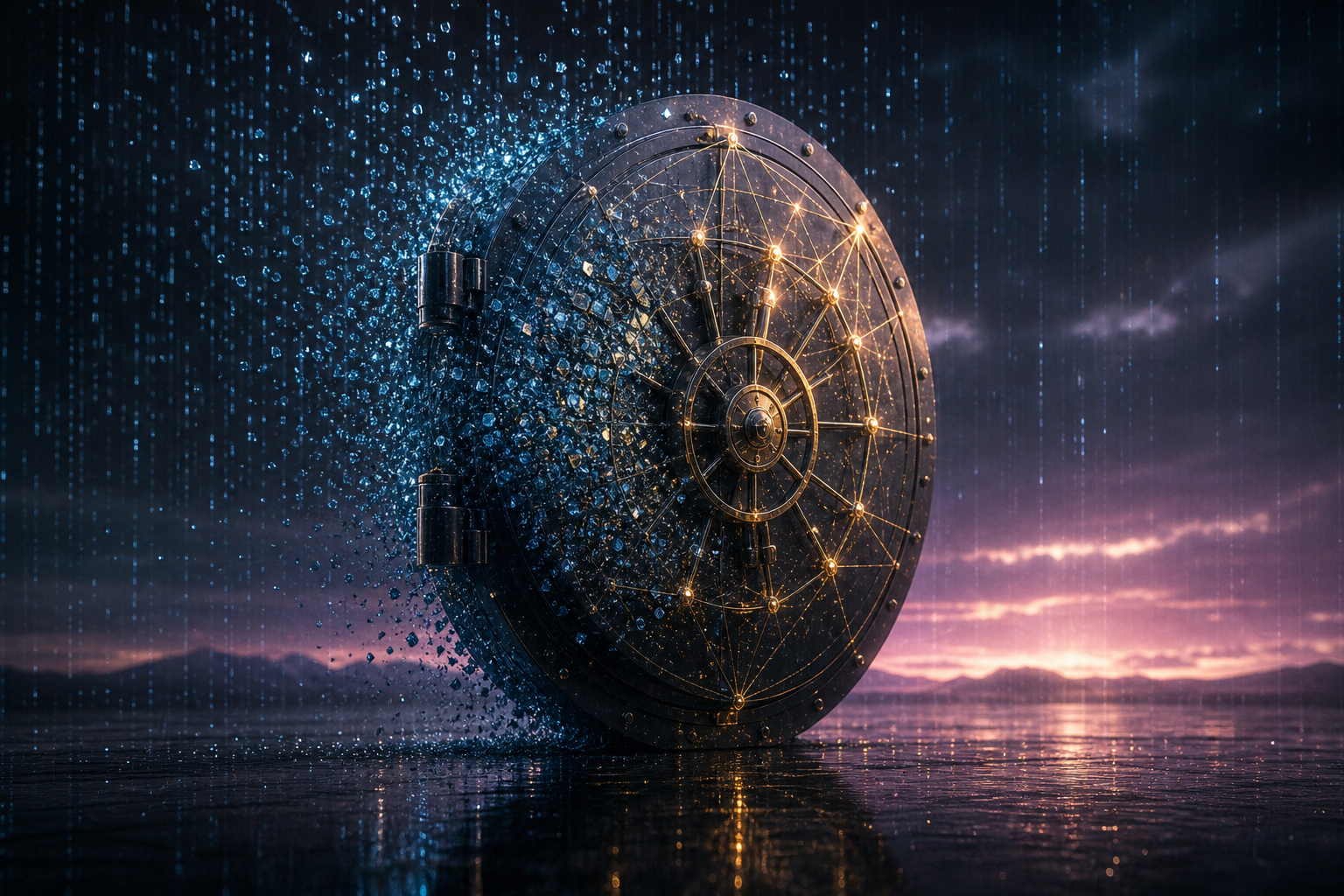
Cryptanalysis is the quantum use case with a deadline: harvested ciphertext can be decrypted later, so post-quantum migration is a present-day duty.
What the maturity curve means for boards, regulators, and general counsel
Laid side by side, the four families resolve into a usable picture. Demonstrated today: below-threshold error correction, error-corrected chemistry on a toy molecule, beyond-classical sampling experiments, and finalized post-quantum standards. A plausible medium-term objective, without a firm deadline: useful molecular simulation. Contested or unproven: broad optimization advantage and commercially relevant quantum machine learning. That triage is the information a general counsel, an investor, or a minister actually needs, and misstating it is increasingly a legal risk in itself, from securities disclosure to unfair-commercial-practice rules.
Each family also lands in a different regulatory lane. Simulation walks into healthcare and life-sciences regulation. Optimization walks into financial supervision and benchmark-transparency duties in public procurement. QML inherits the whole architecture of AI governance, from the EU AI Act outward. Cryptanalysis sits squarely in national-security law: since September 2024, the United States and a widening circle of allies subject quantum computers and key components to dual-use export controls, and the supply chain beneath all four families, from cryostats to isotopes and specialty materials, is geopolitically thin, as our coverage of the Critical Quantum Minerals Dashboard shows.
The practical conclusion for policymakers and counsel is to govern quantum computing use case by use case, on what has been demonstrated, with the press release set aside. Regulators should assess each use case against demonstrated capabilities, credible classical baselines, and the applicable cryptographic migration timetable.
Last updated: September 3, 2026