
Stanford and Los Alamos Researchers Publish Critical Quantum Minerals Dashboard
By Editor
Stanford, CA / Los Alamos, NM, April 2026—Researchers affiliated with Stanford University and Los Alamos National Laboratory have posted a new preprint—circulated ahead of peer review—titled Towards Geostrategic Critical Minerals and Materials Resilience: Secure Supply-Chain and Criticality Analyses for Quantum Technologies in Arctic and Space Environments. The manuscript—authored by Dr. Min-Ha Lee of Stanford's Center for International Security and Cooperation (CISAC) and the Korea Institute of Industrial Technology, Dr. Alan J. Hurd and Dr. Jolante Wieke van Wijk of Los Alamos National Laboratory, and Mauritz Kop, Senior Fellow at the Centre for International Governance Innovation (CIGI) and Founder of Stanford RQT—maps the critical minerals and materials (CMM) dependencies beneath quantum computing, sensing, networking, and secure communications, and proposes a dedicated Quantum Criticality and Critical Minerals (QCCM) dashboard as a living early-warning instrument for governments and allied partners.
The paper advances a proposition that is becoming increasingly difficult for quantum strategists to ignore: whether the United States and its allies capture the benefits of quantum computing at industrial scale will depend not only on qubit counts and error-correction milestones, but on the unglamorous question of who mines, refines, and qualifies the materials those systems are made of. The flagship processors announced over the past three years tell the same story in different elements: IBM's devices reportedly use niobium, Google's Willow uses indium bump bonds, Microsoft's Majorana 1 is built on indium arsenide–aluminum and indium phosphate, Amazon's Ocelot oscillators are made from thin-film tantalum, and Atom Computing's neutral-atom machines use strontium and ytterbium. Different architectures, one shared exposure.
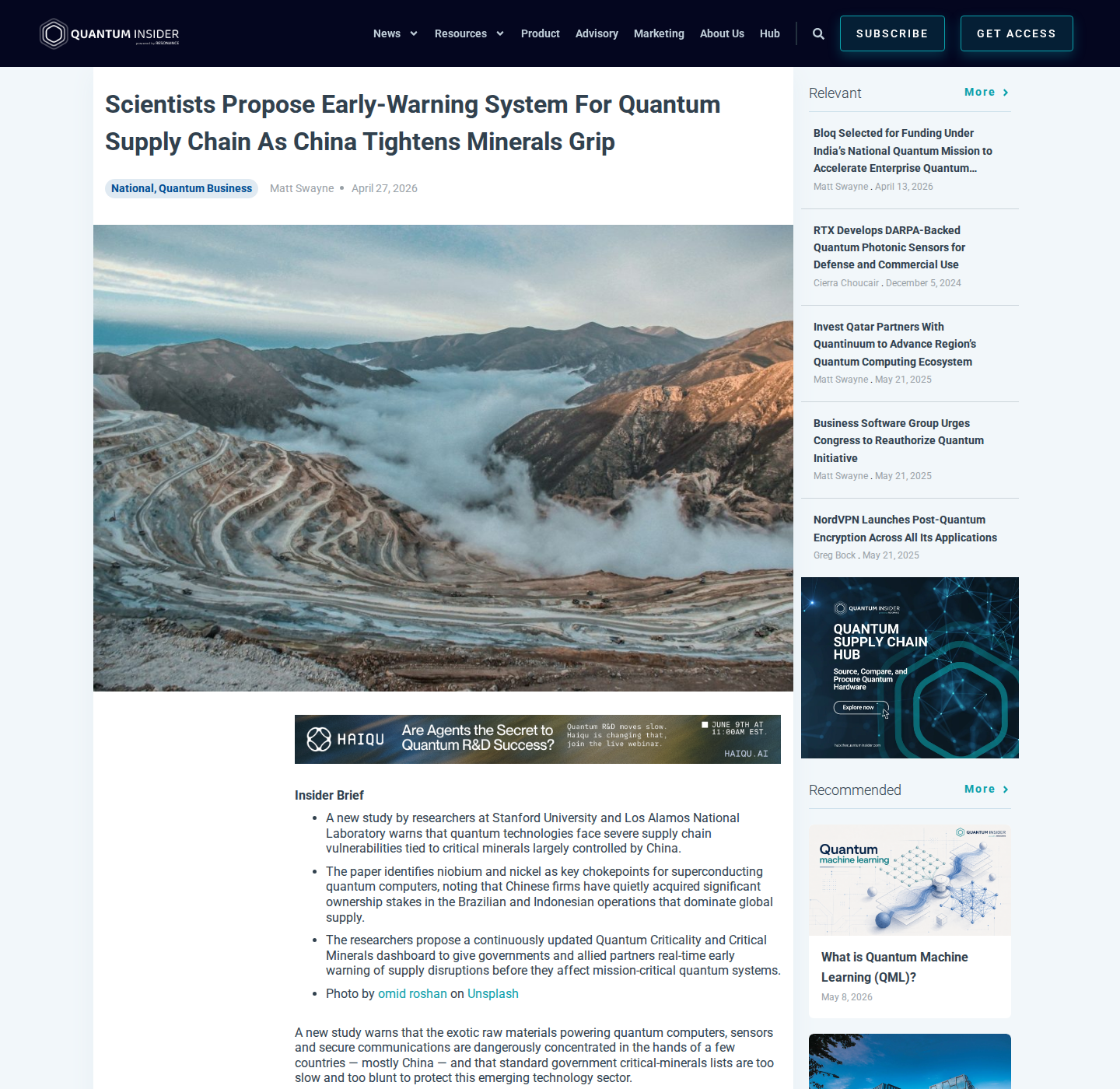
The Quantum Insider's April 2026 feature on the Stanford–Los Alamos early-warning proposal for the quantum supply chain.
From static critical minerals lists to a living QCCM dashboard
The analytical core of the preprint is an argument about institutional speed. National critical-minerals lists—such as the fifty-mineral inventory the U.S. Geological Survey publishes by statutory mandate—provide an indispensable macroeconomic baseline, but they are, in the authors' phrase, too blunt for mission-relevant quantum technology. They can miss dependencies that are small in tonnage yet decisive in system effect: helium-3, silicon-28, rubidium isotopes, specialty detector materials, and other niche inputs with years-long qualification timelines.
What is needed instead, the authors argue, is a living, sector-specific criticality method, made visible through a continuously updated QCCM dashboard that tracks material concentration, processing exposure, substitutability, qualification bottlenecks, stockpiling gaps, and geopolitical stress signals across mission-relevant quantum platforms. In policy terms, the dashboard would function as an operational early-warning and prioritization tool: a decision-support interface linking upstream materials risk to downstream deployment consequences, enabling governments and allied partners to move from static awareness to dynamic resilience management. The proposal extends the Quantum Criticality Index research line that Dr. Lee has been developing at the Stanford Center for Responsible Quantum Technology—a heuristic, data-driven method that applies machine learning and artificial intelligence, in the project's methodology artificial neural networks over large sets of techno-political indicators, to flag potential chokepoints faster than conventional list cycles permit.
Niobium: the chokepoint beneath superconducting quantum computing
The first of the paper's two use cases is niobium, the workhorse of superconducting qubits, Josephson junctions, and superconducting radio-frequency cavities. Approximately 90 percent of global niobium mine production comes from Brazil, dominated by a single producer, and the United States is 100 percent net import-reliant for its supply. The geopolitical layer is what makes this more than a procurement inconvenience: China Molybdenum Company acquired Anglo American's Brazilian niobium operations in 2016, and China Nonferrous Metal Mining Group followed with a Brazilian niobium-asset acquisition in late 2024. The authors' conclusion is precise and sobering: China, they write, is steadily gaining strategic leverage over a material it does not mine on its own soil.
The same logic extends to magnetic shielding. Mu-metal, the nickel–iron alloy that shields quantum processors and sensors from ambient magnetic fields, is roughly four-fifths nickel; the paper reports that Indonesia produces about two-thirds of the world's nickel and that Chinese firms control at least three-quarters of Indonesia's refining capacity. Criticality, the paper stresses, can arise at any layer of the stack: ore, refining, isotopic enrichment, component fabrication, system integration, or maintenance.
Space-qualified single-photon detectors: where degradation becomes a security problem
The second use case moves from the mine to the mission. Superconducting nanowire single-photon detectors (SNSPDs)—among the highest-performing detectors used in quantum communications and quantum key distribution, with laboratory detection efficiencies above 90 percent—must survive radiation, thermal cycling, vibration, and electromagnetic interference when deployed in orbit or in Arctic conditions. The paper's insight is that in communications settings, degradation is not merely an engineering nuisance: rising dark counts and error rates can threaten what the authors call the continuity of security of a quantum link, well before the device visibly fails. Materials choices, shielding strategies, and qualification-by-design therefore belong in the same analytical frame as encryption policy—an argument the authors connect to the emerging security logic of quantum networking.

From ore to qubit: the geostrategic supply chain beneath quantum technology (illustration).
Export controls and the weaponization precedent
The preprint situates these dependencies within an escalating sequence of Chinese export-control actions: the December 2024 prohibition on gallium, germanium, and antimony exports to the United States; the February 2025 controls on bismuth, indium, molybdenum, tellurium, and tungsten; and the April 2025 licensing restrictions on gadolinium and six further heavy rare earths—samarium, terbium, dysprosium, lutetium, scandium, and yttrium—over which China holds a near-monopoly. The market consequences were immediate. Antimony rose 250 percent in the wake of the controls, for a cumulative three-year increase of roughly 450 percent. Bismuth, added to China's dual-use export control list on February 4, 2025, spiked from a baseline of approximately $12 per kilogram to a peak of $108.15 on April 2, 2025—roughly an order of magnitude in under sixty days.
The sequencing is analytically important, the authors note: it was the February licensing regime, not the April reciprocal-tariff announcement, that drove the bismuth dislocation. A dominant, near-monopoly supplier can convert commercial dependence into pricing leverage through administrative rather than tariff instruments—China does not need to physically block exports to inflict economic damage. The 2010 rare-earth restrictions against Japan during the Senkaku dispute are widely treated as the precedent; the 2024–2025 sequence shows the playbook maturing into recurring statecraft.
Twin pillars: supply assurance and post-quantum cryptography
Perhaps the paper's most consequential framing for policymakers is its insistence that quantum supply-chain assurance and post-quantum cryptography migration are twin pillars of security that must be advanced together. The first protects the physical substrate on which mission-relevant quantum capability depends; the second protects long-lived data and critical infrastructure against harvest-now, decrypt-later campaigns. A national strategy that funds PQC migration while leaving niobium, helium-3, and detector materials exposed—or vice versa—secures only half the problem.
The same holds for stockpiling. The paper traces a century of American stockpile history, from the Federal Helium Reserve of 1925—whose sale was completed in 2024—to Project Vault, the 2026 U.S. initiative to expand strategic stockpiles across fifty critical minerals and materials, and draws a structural lesson: stockpiling is only as good as the prioritization logic behind it, and under the governing U.S. statutory definition, fuel materials, gases, and man-made isotopes sit outside the critical-minerals framework altogether. For quantum technologies that depend on isotopically pure inputs—helium-3, for which tritium decay remains the only practical production pathway, silicon-28, deuterium, and lithium-6 and -7—that statutory gap is itself a strategic exposure.
From criticality analysis to allied resilience
The preprint concludes with a mitigation agenda—substitution, diversification, stockpiling, shielding, qualification-by-design, and standards-aligned governance—that connects materials policy to the broader architecture of responsible quantum statecraft. Readers of this blog will recognize the through-line: the standards-first approach to quantum governance published in Science, the CIGI policy brief on global quantum governance, and the quantum-AI geostrategy work of the von Neumann Commission all argue, from different angles, that durable quantum advantage is built on institutions rather than announcements. The materials question now joins that canon: supply-chain resilience, the authors write, is a constitutive element of responsible quantum technology design—because concentrated, brittle, or strategically exploitable material dependencies undermine the long-horizon trustworthiness that responsible innovation requires.
The work was featured by The Quantum Insider, which described the proposed dashboard as an early-warning system for the quantum supply chain at a moment when China is tightening its grip on critical minerals. The preprint is available on SSRN, ResearchGate, and arXiv; as the authors note, it is a framework paper, posted ahead of peer review, and explicit about its own limits—platform-specific bills of materials are not public, substitution pathways remain to be validated empirically, and the human-capital dimension of quantum supply chains deserves a study of its own.
For policymakers, the message is one sentence long: a quantum strategy that cannot see its own materials is not yet a strategy—it is a liability. The instrument that creates that visibility, continuously and across allies, is now on the table.
Last updated: June 5, 2026.