Quantum Superposition, Entanglement, and Tunneling Explained for Law and Policy
By our Editor
Three quantum-mechanical phenomena carry almost the entire promise of quantum technology, and almost its entire governance challenge: superposition, entanglement, and tunneling. Anyone who wants to understand why quantum computing demands its own legal-ethical framework, as argued in Establishing a Legal-Ethical Framework for Quantum Technology, should start with the physics itself, with what laboratories have actually demonstrated rather than with metaphors about boxed cats. The physics is a century old. The experiments that matter for policy are startlingly recent.
The timing is fitting. The United Nations declared 2025 the International Year of Quantum Science and Technology, one hundred years after Werner Heisenberg wrote down the first consistent formulation of quantum mechanics. What was long a theory of the very small has become an engineering discipline and, increasingly, a subject of law. This explainer walks through each of the three phenomena, what experimentalists have recently shown, and the governance consequence each one carries.

Superposition, entanglement, and tunneling are the three quantum phenomena that carry both the promise and the governance challenge of quantum technology.
Superposition: how probability amplitudes power quantum computing, and why it sets the encryption clock
A classical bit is 0 or 1. A qubit can occupy a superposition of both states at once, described by probability amplitudes: complex numbers that a quantum algorithm choreographs so that amplitudes leading to wrong answers cancel and amplitudes leading to right answers reinforce. A measurement then yields one classical outcome, with probabilities set by the state; "collapse" is the operational description, and its interpretation differs across formulations of quantum mechanics. Note what this is not: a quantum computer does not "try all answers in parallel" and read them all out. It exploits interference among amplitudes, and extracting an answer requires algorithmic ingenuity. That is precisely why only certain problems, such as factoring and quantum simulation, are known to enjoy dramatic speedups, superpolynomial in the case of factoring.
Superposition is no longer confined to single particles. In 2023, researchers at ETH Zurich placed a vibrating sapphire crystal of roughly 16 micrograms, billions of times heavier than an atom, into a superposition of two opposing oscillation states by coupling a bulk acoustic-wave resonator to a superconducting qubit, as described in the ETH Zurich announcement and reported by Scientific American as, at the time, the heaviest "Schrödinger cat" ever prepared. Matter-wave interferometers, meanwhile, routinely hold entire atoms and large organic molecules in superpositions of spatially separated trajectories. The quantum-to-classical boundary keeps receding as engineering improves. So far, no wall has appeared.
The governance consequence is concrete. Superposition and interference are what allow Shor's algorithm, running on a future fault-tolerant machine, to factor the large numbers underpinning RSA encryption and to break the elliptic-curve schemes protecting most of today's internet traffic, e-signatures, and digital identities. Because adversaries can copy encrypted traffic now and decrypt it once such a machine exists (the harvest-now-decrypt-later attack), the migration to quantum-resistant cryptography is urgent today, years before the hardware arrives. Mauritz Kop made this argument to security practitioners when he spoke at Oxford University on quantum threats. Superposition also makes quantum computation intrinsically probabilistic: the same program yields a distribution of outcomes rather than one guaranteed answer, so verification, certification, and liability doctrines built for deterministic software will need rethinking.
Entanglement: what the Bell tests proved and what it means for networks and jurisdiction
When two qubits become entangled, their measurement outcomes are correlated more strongly than any classical mechanism, any story of pre-agreed values or hidden signals, can explain. John Bell showed in 1964 that this difference is testable, and the Bell inequality experiments that followed are among the most consequential in the history of physics. One caution against a common trap: measuring one entangled particle does not send a usable signal to the other. Each local outcome is random, and the correlation only becomes visible when results are compared over an ordinary classical channel. Entanglement therefore does not permit faster-than-light communication. Relativity survives intact.
Experiment settled the matter in stages. John Clauser ran the first Bell test in 1972. Alain Aspect closed the crucial timing loophole in 1982 by switching measurement settings after the photons were in flight. Anton Zeilinger's group tightened the locality loophole in 1998 and pioneered entanglement-based quantum communication. In 2015, several groups closed the last major loopholes simultaneously in so-called loophole-free Bell tests. For this body of work the three received the 2022 Nobel Prize in Physics, "for experiments with entangled photons, establishing the violation of Bell inequalities and pioneering quantum information science," per the Nobel Committee's citation.
Entanglement is the raw material of quantum networks, entanglement-based quantum key distribution, and distributed quantum sensing. A related result, the no-cloning theorem, follows from the linearity of quantum mechanics: an unknown quantum state cannot be copied. Key distribution can run on prepare-and-measure protocols such as BB84 or on entanglement-based protocols, and in both, a properly implemented system reveals disturbance associated with interception through its error statistics, subject to protocol assumptions, authentication, and side-channel defenses. That property unsettles surveillance statutes premised on covert lawful intercept. Quantum-derived evidence will ordinarily reach a court as classical records, measurement results, and metadata, so the evidentiary questions concern validation, provenance, and preservation rather than duplication. And a future quantum internet whose nodes, repeaters, and operators sit in different countries, Delft and The Hague or Beijing and Vienna, raises jurisdictional questions about infrastructure location, operators, users, and applicable interception law. These are the questions the responsible-quantum research agenda, including the call for responsible quantum technology in Nature Physics, was built to answer.
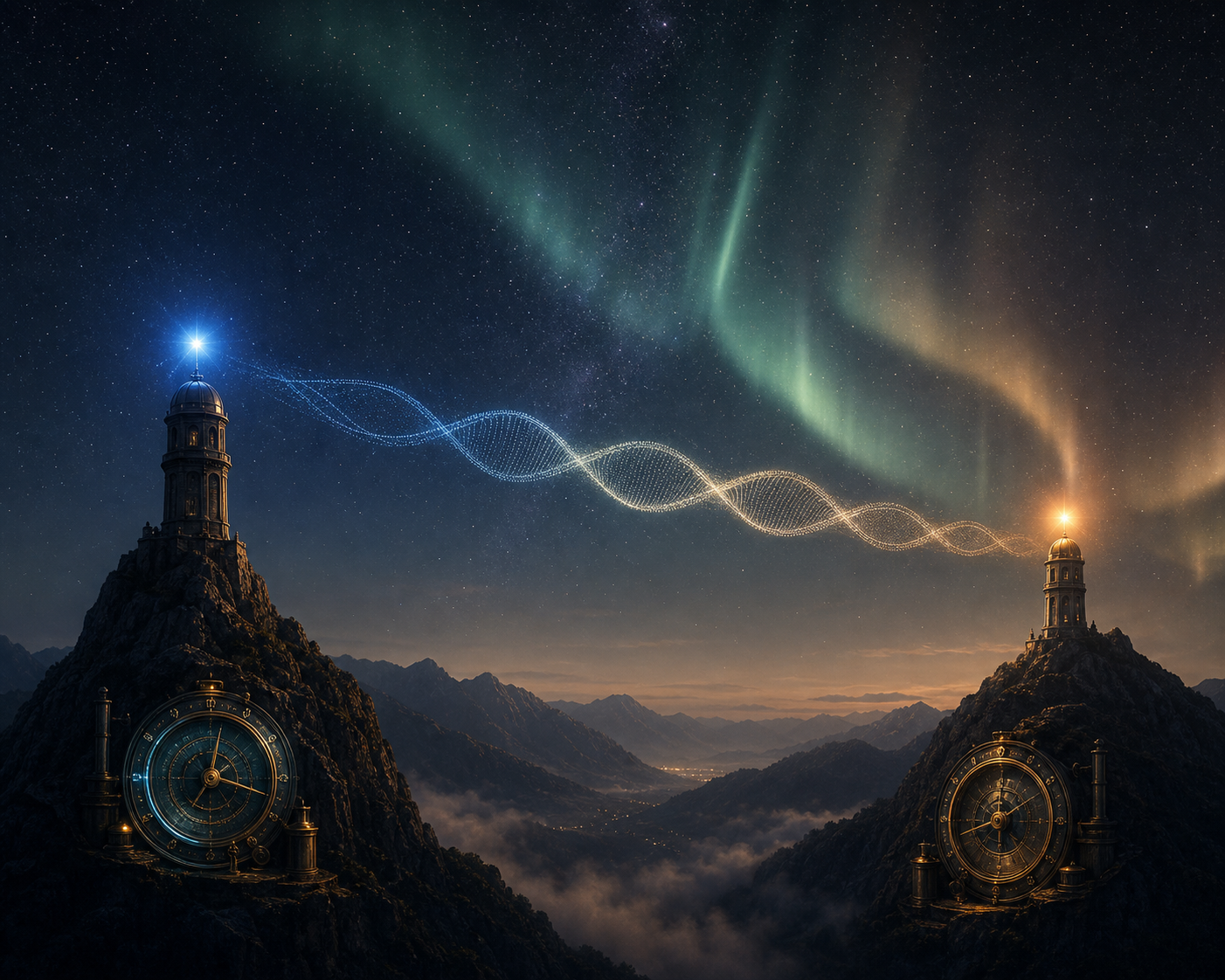
Entangled photon pairs produce the correlations behind the Bell tests, the 2022 Nobel Prize in Physics, and interception-detecting quantum key distribution.
Tunneling: the quantum effect already inside flash memory, superconducting processors, and sensors
Quantum tunneling lets a particle traverse an energy barrier that classical physics declares impassable. The particle's wavefunction does not stop at the wall; it decays exponentially inside it, leaving a small but nonzero amplitude on the far side. Tunneling is everyday physics. It is why the sun shines (fusing protons tunnel through their electrostatic repulsion), how flash memory in every phone writes and erases charge through an insulating oxide layer, how tunnel diodes switch, and how the scanning tunneling microscope images and manipulates individual atoms. Of the three phenomena, tunneling is the one already embedded in trillion-dollar product categories.
Even here, experiment keeps refining intuition. In 2020, physicists at the University of Toronto used rubidium atoms cooled to nanokelvin temperatures as a "Larmor clock" to time how long atoms spend inside a laser-generated barrier while tunneling: about 0.6 milliseconds, the first such direct measurement for atoms, as described in the University of Toronto's account of the work and analyzed further in Physics World. The question "how long does tunneling take?", long considered ill-posed, has become a precision measurement program, with attosecond-scale experiments on tunneling electrons still fueling lively debate.
For governance, tunneling matters twice. First, it is the hardware physics itself: the Josephson junctions at the heart of superconducting quantum processors are tunneling devices, so export-control and supply-chain conversations about quantum computing are, at bottom, conversations about engineered tunnel barriers. Second, tunneling-based and other quantum sensors promise sensitivity to fields, gravity, and structure that raises privacy, security, and dual-use questions long before large fault-tolerant computers arrive. Mapping such second-order effects is exactly the task of Quantum ELSPI, the ethical, legal, social and policy implications of quantum technology.
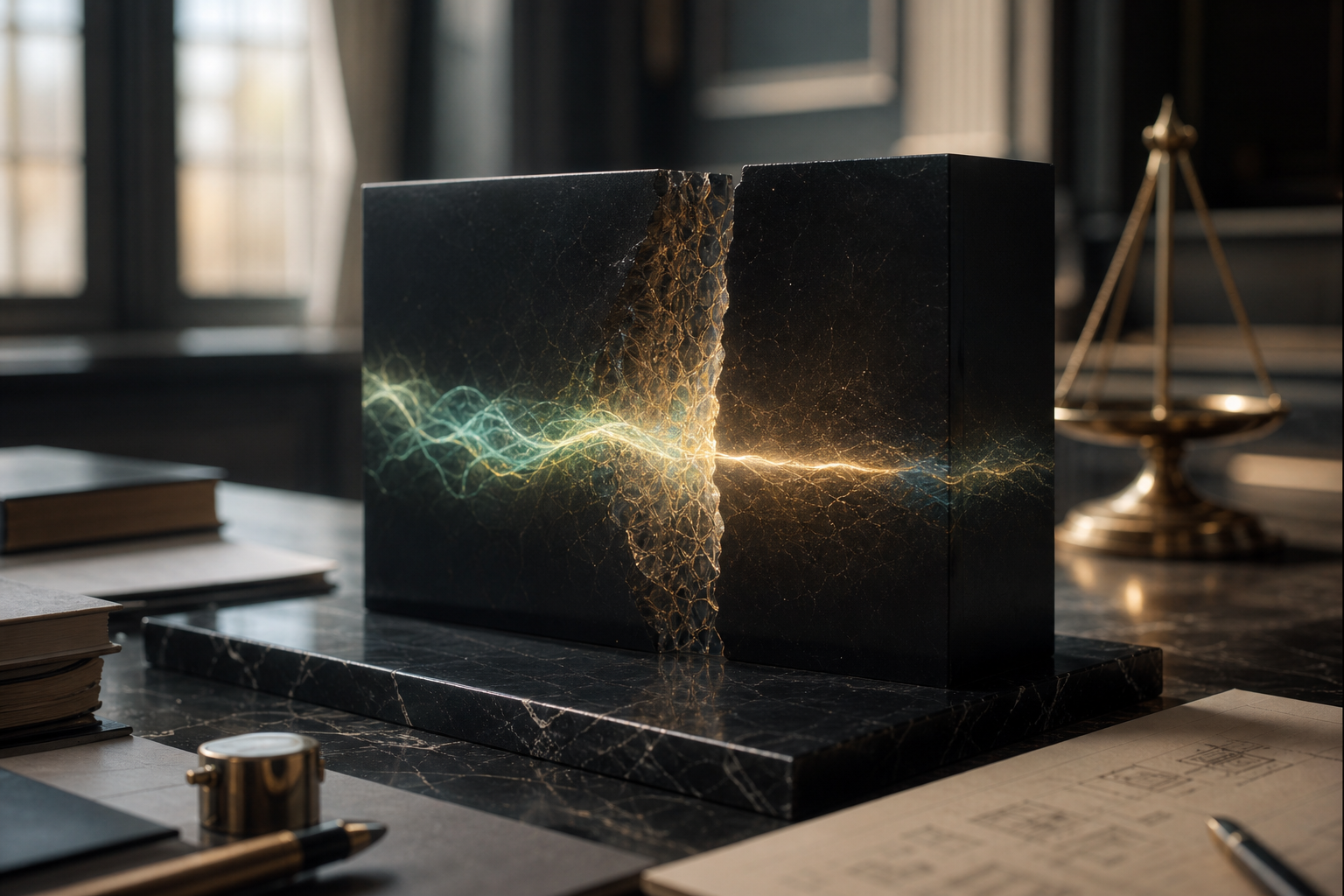
Tunneling at work, from flash memory cells to the Josephson junctions inside superconducting quantum processors.
Why the physics sets the agenda for quantum law and policy
These three phenomena are the policy argument. Superposition explains why cryptanalytic capability will arrive nonlinearly, and why anticipatory governance beats reactive repair. Entanglement and no-cloning explain why quantum communication rewrites the security and evidence landscape rather than merely accelerating it. Tunneling explains why the hardware itself, and the sensors it enables, deserve regulatory attention now. The comparison with artificial intelligence is instructive: AI governance had to be retrofitted onto systems already deployed at scale, whereas quantum technology offers lawmakers the rare advantage of lead time. Frameworks that use it exist, from the peer-reviewed call for responsible quantum technology in Nature Physics to the Ten Principles for Responsible Quantum Innovation developed at Stanford.
Policymakers should use the available lead time. Superposition sets the cryptographic migration clock, entanglement sets the network and jurisdiction agenda, and tunneling sets the hardware and sensing agenda, and all three are running today. Legislators who address cryptographic migration, network governance, hardware controls, and sensing risks now will regulate quantum technology on their own timetable.
Last updated: September 3, 2026