
Public Property from the Machine published in Harmonizing Intellectual Property Law for a Trans-Atlantic Knowledge Economy
By Editor
Leiden, The Netherlands, May 6, 2024—Brill | Nijhoff has published Harmonizing Intellectual Property Law for a Trans-Atlantic Knowledge Economy, an edited volume that includes a chapter by Mauritz Kop—founder of the Stanford Center for Responsible Quantum Technology (Stanford RQT)—titled Public Property from the Machine. The chapter takes up one of the hardest questions that artificial intelligence poses for intellectual property law: who, if anyone, should own what a machine makes. Its answer is a proposed new legal category for autonomously generated output—Res Publicae ex Machina, public property from the machine—a permission-free public-domain space rather than a fresh layer of private rights.

Public Property from the Machine: AI-generated output entering the public domain (illustrative editorial image).
The volume: a trans-Atlantic legal history of harmonization
The volume is edited by Péter Mezei (University of Szeged), Hannibal Travis (Florida International University), and Anett Pogácsás (Pázmány Péter Catholic University), with a foreword by Maciej Szpunar, First Advocate General at the Court of Justice of the European Union. It appeared in Brill | Nijhoff's spring-2024 catalogue—the e-book on April 30 and the hardback on May 1, 2024; the editors announced its full release in early May. In announcing it, the editors described the book in their own words: "This book gathers and builds on research into distinct national and regional traditions in regulating innovation. It is an early attempt at a comprehensive legal history of the uneven trans-Atlantic harmonization of IP law. Authors explore harmonization as a legal mandate and a progressive ideal, and imagine areas in which coherent regulatory webs could build a more vibrant trans-Atlantic knowledge economy."
Kop's chapter sits among contributions from Laura Ford, Ana Lazarova, Dénes Legeza, Caterina Sganga, Lucius Klobučník, Giulia Dore, Karolina Sztobryn, David Linke, Peter S. Menell, Ioanna Lapatoura, Bohdan Widła, and Luis-Javier Capote-Pérez, alongside the editors. The volume was commended by Giovanni Maria Riccio, John Cross, and Peter Yu. Placing an argument about AI and the public domain inside a project about trans-Atlantic harmonization is itself a choice: it frames the autonomy of machine output not as a curiosity of a single jurisdiction but as a coordination problem for the United States and Europe together.
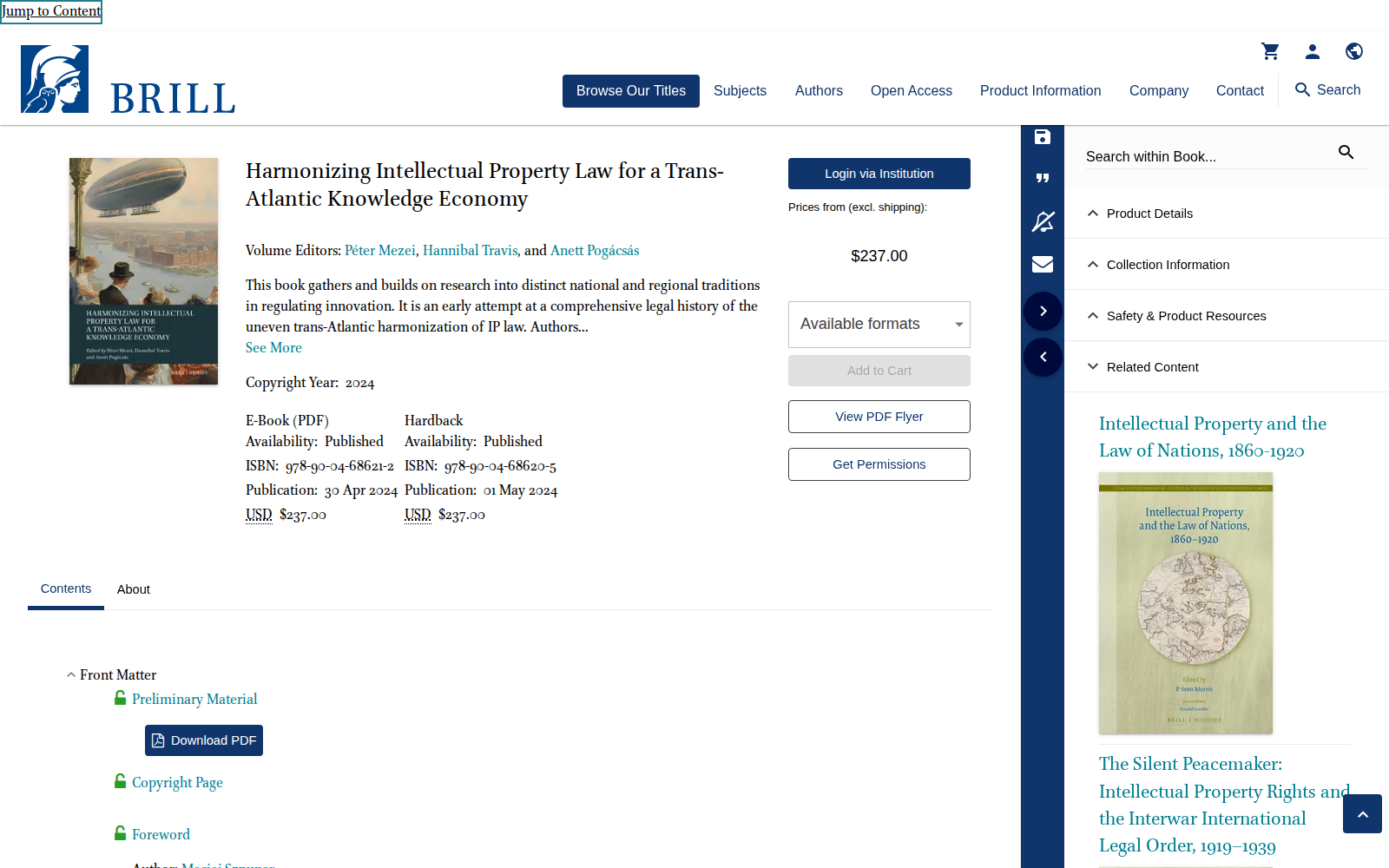
The Brill | Nijhoff volume page for Harmonizing Intellectual Property Law for a Trans-Atlantic Knowledge Economy (2024).
Res Publicae ex Machina: the public-domain proposal
The chapter's central contention is that human authorship and inventorship remain the normative wellsprings of intellectual property law. Copyright and patent systems exist to give human creators incentives and recognition; they were not designed to reward a process that runs without a human author behind any particular output. From that premise Kop argues that extending copyrights and patents to fully AI-generated works would do more harm than good—among the harms the chapter identifies are dampened downstream innovation, narrowed cultural diversity, and pressure on fundamental freedoms—because it would enclose, behind private rights, material that no human actually authored.
The proposed alternative is a dedicated public-domain regime for creations and inventions that have crossed what the chapter calls the autonomy threshold: the point at which output is generated without meaningful human creative or inventive contribution. Such output would fall not into private ownership and not into an unmanaged void, but into Res Publicae ex Machina—a deliberately designed, permission-free public-domain category. Kop frames the introduction of this category as a Pareto improvement: a move from which many actors stand to benefit while no legal person is left worse off, since rights that were never warranted are simply never created.
Building on the Articulated Public Domain
The proposal does not arrive from nowhere. It develops a line of work Kop opened earlier in AI & Intellectual Property: Towards an Articulated Public Domain, published in the Texas Intellectual Property Law Journal in 2020. That article introduced the idea of an articulated public domain—a public domain designed on purpose, with structure and rules, rather than left as the residual category of whatever rights happen not to attach. Public Property from the Machine restates and sharpens that foundation for the era of generative systems, turning the earlier framing into a concrete category for output that clears the autonomy threshold. Readers tracing the intellectual lineage should keep the two distinct: the 2020 article is the foundational statement of the articulated public domain; the 2024 chapter is its application to machine-generated subject matter under a named regime.
The same instinct—design the public domain deliberately, rather than treat it as an afterthought—runs through Kop's broader writing on transformative technology, including his work on regulating transformative technology in the quantum age, where intellectual property, standardization, and sustainable innovation are treated as one connected system rather than separate silos.
Why a public-domain category, not stronger rights
The deeper claim of the chapter is that the reflexive answer to a new kind of output—create a new kind of right—is the wrong default. Intellectual property is, in this account, an instrument calibrated to human creativity and its incentives; bolting machine output onto that instrument risks both over-rewarding the holders of generative infrastructure and starving the commons that future creators draw on. A purpose-built public domain for autonomous output protects that commons directly. It also keeps the line between human and machine contribution legally meaningful, which is precisely the line that copyright and patent doctrine increasingly struggle to hold.
This concern with assessing a technology's effects before rights and infrastructure ossify is a recurring method in Kop's work, traceable back to his artificial intelligence impact assessment—the proposition that the social consequences of AI are best examined upstream, as a design input, rather than litigated downstream once defaults have hardened.
An open question for trans-Atlantic IP
Whether courts and legislatures on either side of the Atlantic will adopt anything resembling Res Publicae ex Machina is, of course, unsettled; the chapter is a scholarly proposal, not a statement of existing law. Its value lies in reframing the debate. The dominant questions—can an AI be an author, can an AI be an inventor—presuppose that ownership is the only available category. Public Property from the Machine insists that public property is a category too—one the chapter argues is more defensible for output no human authored. In a volume devoted to harmonizing IP across the trans-Atlantic knowledge economy, that is a proposal aimed exactly where coordination matters most: at what the United States and Europe choose to leave free.
The chapter appears in Harmonizing Intellectual Property Law for a Trans-Atlantic Knowledge Economy, available from Brill. A description of the chapter is maintained on the Stanford Law School publications page.
Last updated: June 6, 2026.