Innovation, Quantum-AI Technology & Law

Blog over Kunstmatige Intelligentie, Quantum, Deep Learning, Blockchain en Big Data Law

Blog over juridische, sociale, ethische en policy aspecten van Kunstmatige Intelligentie, Quantum Computing, Sensing & Communication, Augmented Reality en Robotica, Big Data Wetgeving en Machine Learning Regelgeving. Kennisartikelen inzake de EU AI Act, de Data Governance Act, cloud computing, algoritmes, privacy, virtual reality, blockchain, robotlaw, smart contracts, informatierecht, ICT contracten, online platforms, apps en tools. Europese regels, auteursrecht, chipsrecht, databankrechten en juridische diensten AI recht.

Berichten met de tag Intellectual Property
Call for Applications: CIGI Quantum Nexus Emerging Scholars Program for Canadian Strategic Advantage

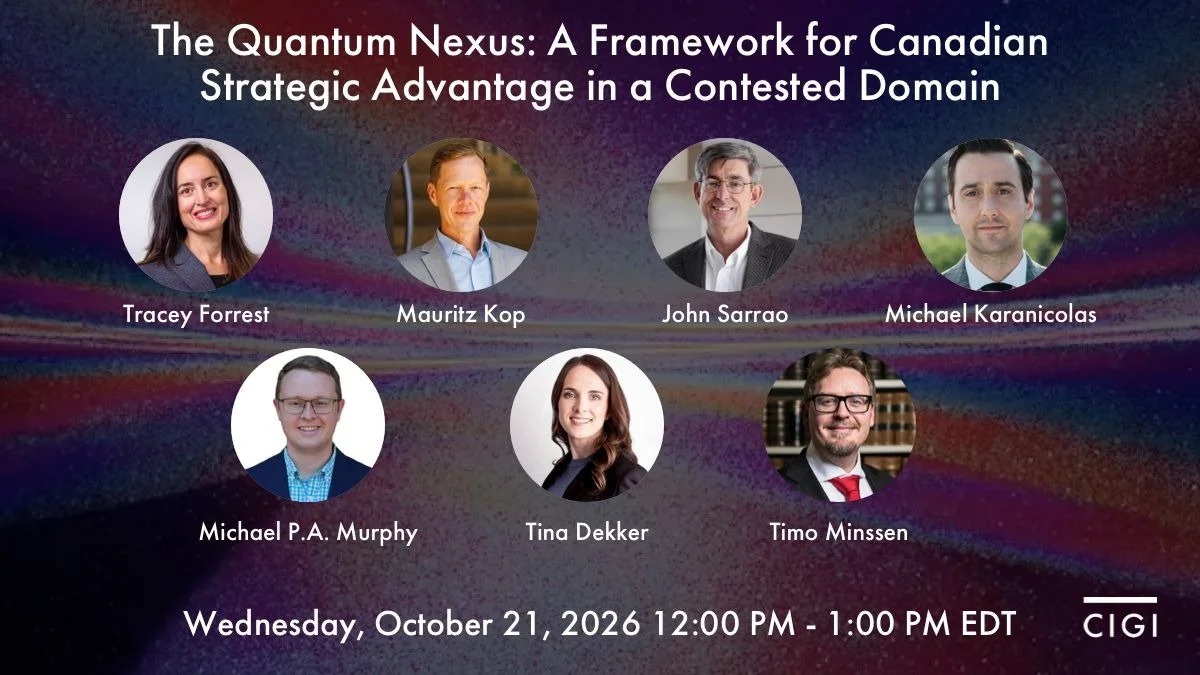
The Centre for International Governance Innovation (CIGI) is accepting applications for a competitive emerging scholars program attached to The Quantum Nexus: A Framework for Canadian Strategic Advantage in a Contested Domain, a research project supported by the Department of National Defence's MINDS program and led by CIGI Senior Fellow Mauritz Kop. The deadline is July 15, 2026.

A mentorship cohort with a mission

Four to six emerging scholars from across Canada—undergraduates through post-docs, from any discipline—join a virtual program from September to December 2026. The format is deliberately personal: a one-on-one mentorship session with the Principal Investigator, an online international expert workshop in October, and a group masterclass on emerging-technology governance and publication development in November. No prior quantum expertise is required, and applications from equity-deserving groups are strongly encouraged; the program is built on the conviction that good governance of emerging technologies needs many kinds of minds. It is the same conviction that brought a Canadian quantum governance delegation to Stanford to prepare Canada's G7 presidency.

From analytical note to CIGI report

This is a publication program, not a lecture series. Every participant develops a 1,200–1,500-word analytical note on an assigned subtopic within one of six themes—spanning intellectual property and export controls, post-quantum cryptography migration, critical materials and supply chains, quantum-AI convergence, standards and allied interoperability, and the application of the LSI test (least trade-restrictive, security-sufficient, innovation-preserving) to a real case. The notes are contributed to the project's final CIGI report as a dedicated Emerging Scholars annex—a substantive contribution at the start of a research career.

Dates and deadlines

Applying takes one PDF: a 300–500-word expression of interest naming the theme you want to work on, a CV, and one reference letter, sent to programs@cigionline.org (subject line: Emerging Scholars Application: DND MINDS Project). Applications close July 15, 2026; acceptances follow in mid-August; the program runs September through December. For emerging scholars who want to help shape how the quantum age is governed, this is the opening.

Meer lezen
Quantum Computing and Competition Law: Gasser, Aboy et al. Submit Comments to Italian Competition Authority AGCM

Seven scholars—Urs Gasser, Mateo Aboy, I. Glenn Cohen, Mauritz Kop, Fabienne Marco, Timo Minssen, and John Palfrey—have submitted comments to the Italian Competition Authority's public consultation on quantum computing — an early move by a major competition regulator into a market still being formed.

Five dimensions, one variable

The AGCM asked about market structure, competitive dynamics, intellectual property, consolidation, and strategic dependencies. The submission's answer: all five run through interoperability—who sets the interfaces, who governs the benchmarks, and whether early cloud-access arrangements harden into path dependence before conventional indicators of dominance ever appear. Quantum architectures are incommensurable, not merely incompatible, which makes the usual platform-market playbook an imperfect guide and benchmark governance a first-order competition issue.

Measured on the evidence

The scholars are deliberately unalarmist: the submission reports that current patent data shows no anticommons, with concentration below mature classical-computing markets. The genuine risk is narrower—rights over interface-critical elements becoming unavoidable as standards crystallize, and three compounding forms of lock-in (technical, administrative, organizational) closing a market that still looks open on paper. The team's years of groundwork, from Ten Principles for Responsible Quantum Innovation to the patent-landscape studies, supplies the empirical base.

Process before prescription

The recommendations are staged: monitoring and transparency first, disclosure-oriented safeguards where dependencies form, intervention only on demonstrated exclusion—plus competition safeguards built directly into quantum standard-setting, from ISO/IEC JTC 3 to the emerging EU Quantum Act. In a market still being formed, the scholars argue, the right question is not what the market should look like, but whether the processes shaping it remain open, revisable, and not prematurely foreclosed.

Meer lezen
Quantum Nexus LSI Test Published by Vanderbilt JET Law

Most technology law arrives too late: the architecture ships, the market consolidates, and legislators are left regulating what already exists. A new essay in Vanderbilt's Journal of Entertainment & Technology Law argues that quantum technology presents the opposite—and far rarer—situation, and explains what the law should do with it. Quantum law is being written before quantum technology has fully arrived, and that timing is not a defect to apologize for but an opportunity to seize.

A test with three prongs

At the center of the essay stands the LSI test, a doctrinal instrument for dual-use governance that asks of every state intervention whether it is the least trade-restrictive, security-sufficient, and innovation-preserving measure available. The shift in emphasis is subtle but consequential: the question is no longer whether a government possesses a restrictive tool—export control, outbound investment screening, patent secrecy—but whether it is deploying the narrowest one that actually works. Between the romantics of total openness and the reflexes of total restriction, the test stakes out a defensible middle ground the essay calls security-sufficient openness.

Patents and export controls, one system

The essay's second contribution is diagnostic. Intellectual property and national security are conventionally treated as separate fields with separate experts and separate statutes. In quantum practice they behave as one entangled legal control plane: a single patent disclosure can simultaneously raise eligibility questions under Alice, research-security questions under the export-control regime, and commercialization questions under Bayh-Dole and the federal acquisition rules. Reading them together is not an academic nicety—it is the only way to see where over-securitization would quietly strangle the startups, standards participation, and allied interoperability on which democratic quantum leadership depends, a dynamic explored across the MINDS quantum strategy research at CIGI.

From a six-paragraph essay to a coalition playbook

Behind the essay stands the full Quantum Nexus Article—a book-length treatment on arXiv that develops the LSI test into an implementable coalition playbook: empirically anchored criteria, differentiated guardrails with red-zone domains where denial is the default, and secure closed-loop enclaves for high-sensitivity collaborative research. The stakes are framed without euphemism: U.S. assessments now call for a Quantum First posture by 2030, China's program advances under military-civil fusion, and the choice before democratic legislators is whether the coming wall of quantum regulation will be disciplined by doctrine or improvised under pressure. For lawyers, the essay is a preview of their next decade; for policymakers, it is a usable standard; and for the quantum community, it is an argument that the rules now being written deserve the same precision as the systems they will govern.

Meer lezen
Mauritz Kop Principal Investigator of MINDS Quantum Strategy Grant at CIGI

Waterloo, February 18, 2026—The Centre for International Governance Innovation (CIGI) has awarded Mauritz Kop a new leadership role as Principal Investigator (incoming) of a MINDS Targeted Engagement Grant on Quantum Strategy. The grant advances a central proposition of his recent work: quantum technologies are no longer best understood as a narrow scientific frontier or a conventional innovation file. They have become a strategic domain in which law, industrial policy, intellectual property, defense planning, and geopolitical competition now converge.

That convergence matters because quantum capability is being built in an era of systemic rivalry, supply-chain vulnerability, and technological coercion. In that environment, democratic states cannot afford to treat quantum merely as a research ecosystem problem. They must govern it as part of a broader strategy for safeguarding the democratic industrial commons: the shared base of talent, infrastructure, know-how, trusted supply chains, standards, and institutions on which long-run security, prosperity, and coalition advantage depend.

What MINDS in Defence and Security Is and Why This Grant Fits

The MINDS program—Mobilizing Insights in Defence and Security—is a Canadian Department of National Defence initiative designed to strengthen evidence-based defense policy thinking and foster the next generation of defense and security experts. Its Targeted Engagement Grants provide non-recurring support for projects such as workshops, roundtables, research, and publications, and they are assessed primarily against the annual Defence Policy Challenges.

The current 2025-2026 MINDS challenge set is especially well aligned with the subject matter of this grant. The official challenge framework emphasizes several critical priorities: securing Canada’s sovereignty and continental defense posture; attracting advanced-technology talent across the defense sector; and strengthening the defense industrial base through resilient supply chains and dual-use technologies such as quantum and artificial intelligence. Furthermore, the framework addresses the pressures of strategic competition—including adversarial exploitation of vulnerabilities—and the accelerating adoption of pan-domain, emerging technologies where interoperability, trust, and responsible governance must be preserved.

Strategic Leadership and Human Capital

Kop’s fellowship at CIGI has centered on the governance of transformative technologies, especially quantum technology, AI, dual-use export controls, national security, and intellectual property. The new grant builds directly on that portfolio, but with a more operational mandate. As incoming Principal Investigator, his role will be to provide the project’s strategic and intellectual leadership: conceptualizing the workshop, defining the central themes and policy questions, structuring the panels for direct relevance to Canadian defense audiences, chairing the main event, moderating key expert sessions, identifying high-level contributors, and guiding the project’s analytical outputs.

The Quantum Nexus Paper Behind the Grant

The grant builds on Kop’s recent paper, The Nexus of Quantum Technology, Intellectual Property, and National Security: An LSI Test for Securing the Quantum Industrial Commons, now available on arXiv.

In that paper, he argues that quantum technologies have moved from laboratory structures to the geopolitical stage, and that democratic states therefore need a governance model that is neither naively open nor reflexively protectionist. The paper's contribution is an implementable coalition playbook, offering empirically anchored criteria, templates, and differentiated guardrails - including red zone domains where denial is the default - to avoid both over-securitization and under-securitization. Properly applied, LSI reduces the risk of a self-defeating hard decoupling from China while establishing standards-first interoperability as a stabilizing eigenstate of the international order and enabling RQT by design to shape trusted adoption pathways beyond the coalition, including in the majority world.

Meer lezen
An LSI Test for Securing the Quantum Industrial Commons

Mauritz Kop—Founder of the Stanford Center for Responsible Quantum Technology and a CIGI Senior Fellow—has posted as a preprint a book-length Article that reframes quantum strategy as a problem of disciplined openness. The Nexus of Quantum Technology, Intellectual Property, and National Security argues that democracies should pursue neither closure nor laissez-faire, but "security-sufficient openness," screened through a single administrable test. It is a strategic companion to the cryptographic argument set out in "A Bletchley Park for the Quantum Age."

Deterrence by denial for democratic resilience

The Article's organizing idea is responsible quantum technology reframed as values-based deterrence by denial: a legal, ethical, and institutional control plane that protects the shared "quantum industrial commons"—talent, tooling, standards, supply chains, and the research base—against authoritarian appropriation. Deterrence by denial aims to make hostile gains too slow or costly to be worthwhile, rather than relying on the threat of retaliation, and the Article presents it as the least escalatory way to preserve crisis stability. It situates the analysis against an approaching strategic "event horizon," citing the U.S.-China Economic and Security Review Commission's call for a "Quantum First by 2030" posture and parallel White House initiatives to secure critical inputs.

The LSI test

The central contribution is the LSI test, which asks whether any given control is least-trade-restrictive, security-sufficient, and innovation-preserving. The test is built to avoid two failure modes: over-securitization, which chills publication, standards leadership, and venture formation, and under-securitization, which leaks crown-jewel capabilities that are slow to reacquire. LSI is applied across a "pillarized" quantum stack—computing, sensing, simulation, networking, communication, quantum-AI hybrids, and enabling materials—and to its upstream dependencies in patent and trade-secret doctrine, government-funded IP and data rights, export controls, investment screening, and cryptographic baselines including post-quantum cryptography and crypto-agility. The framing borrows from physics with care: because the relevant systems are genuinely probabilistic, the Article uses the "Eight Worlds" scenario method to keep governance robust across divergent futures.

A coalition playbook against a "Silicon Curtain"

Rather than stop at theory, the Article assembles an implementable coalition playbook—administrable criteria, templates, and differentiated guardrails, including red-zone domains where denial is the default—and integrates instruments of economic statecraft such as a strategic critical-minerals reserve and a Quantum Criticality Index. Its closing warning is that mishandled securitization could raise a self-defeating "Silicon Curtain" between allied innovators; the constructive alternative is standards-first interoperability treated as a stabilizing feature of the international order. The work has been posted as a preprint on arXiv and is announced on AIRecht in the Nexus paper announcement.

Meer lezen
The Nexus of Quantum Technology, Intellectual Property, and National Security

Some moments in technology policy demand a text that turns scattered anxieties into administrable law. For the collision of quantum technology, intellectual property, and national security, Mauritz Kop's book-length Article on arXiv makes that move: The Nexus of Quantum Technology, Intellectual Property, and National Security: An LSI Test for Securing the Quantum Industrial Commons—a work that reads today's probabilistic security environment like a wavefunction of plausible futures, and asks which policy choices will collapse it into an outcome democracies can live with.

The claim: security-sufficient openness

The Article's central claim is that the United States and its allies should pursue security-sufficient openness, operationalized through an LSI test: every intervention—an export control, an outbound-investment screen, a patent-secrecy order—must be the least trade-restrictive, security-sufficient, innovation-preserving measure available, whether the actor is a state or a private firm. Between total openness, which hands strategic capabilities to rivals mobilized under military-civil fusion, and total restriction, which strangles the science, the test stakes out the only ground that is defensible in both senses of the word.

Red zones, enclaves, and economic statecraft

What makes the work more than a framework essay is its machinery. The Article delivers an implementable coalition playbook: empirically anchored criteria, templates, and differentiated guardrails—including red-zone domains where denial is the default—plus secure closed-loop enclaves where allied researchers can pursue high-sensitivity R&D without choosing between secrecy and collaboration. The instruments of economic statecraft that democracies have increasingly been deploying are integrated here into a single disciplined doctrine, with the U.S. assessments calling for a Quantum First posture by 2030 supplying the deadline.

What is at stake

The Article names the twin failure modes precisely. Over-securitize, and democracies erect a self-defeating Silicon Curtain—suppressing publication, standards participation, and startup formation until the alliance walls itself off from its own innovation. Under-securitize, and strategically meaningful capabilities in computing, sensing, and cryptanalysis diffuse to adversaries faster than open societies can respond. Threading that needle is the geostrategic design problem of the decade—the same problem Kop works on as an expert at the Eric Schmidt-backed von Neumann Commission on quantum-AI geostrategy. Properly applied, the LSI test secures the quantum industrial commons without suffocating the scientific commons beneath it—and extends trusted adoption pathways to the majority world. This post walks through the Article's argument, its playbook, and what both mean for the lawyers and legislators who will write the quantum statutes of the late 2020s.

Meer lezen
Music Law and Artificial Intelligence: From Cloned Artists to AI-Generated Works

The rise of artificial intelligence (AI) in the music industry is sparking a revolution, profoundly changing how music is created. This development raises complex legal questions concerning AI and copyright, including related rights. How can we protect the creative rights of artists and composers while simultaneously allowing room for technological innovation? In this comprehensive yet accessible legal overview, we explore key issues regarding AI and music. These include whether AI can legally train on copyrighted materials without consent, TDM exceptions, how various rights organizations (such as Buma/Stemra and Sena) approach AI, the status of AI-generated musical works, the threshold of human creativity required, protection against AI voice cloning via privacy laws and moral rights, contractual implications, new obligations under the EU AI Act, differences between European and American law, and ongoing lawsuits. This article is tailored for artists, composers, music publishers, labels, voice actors, producers, and AI companies seeking clarity on their legal standing.

AI Training on Protected Music and Video Materials: Legal Framework and Debate

Can an AI model in the Netherlands and the EU train on copyrighted material (such as music or video) without permission from the rights holders? Generally, using protected material beyond private use or citation requires permission. Scraping or using data for AI training without permission is typically considered infringement unless a specific legal exception applies.

Buma/Stemra’s Opt-Out Policy

In the Netherlands, Buma/Stemra explicitly uses its opt-out rights, requiring prior consent for TDM on its repertoire, thus ensuring fair compensation for composers and lyricists.

EU AI Act: Transparency Obligations and System Monitoring

The EU AI Act, effective from August 2025, introduces important transparency requirements, obliging generative AI model developers to:

  1. Disclose training data used, including copyrighted music or texts.

  2. Maintain policies ensuring compliance with EU copyright law.

  3. Respect explicit opt-out signals from rights holders during training.

The Act doesn't prohibit using protected material for training outright but enforces transparency and compliance through oversight and penalties.

Composition, Lyrics, and Master Recordings: Different Rights Regimes

Music rights in the Netherlands broadly split into:

A. Copyright: Protects compositions and lyrics, managed by organizations like Buma/Stemra.

B. Neighboring Rights: Protect recordings and performances, managed by Sena.

AI-Generated Compositions and Lyrics: Completely AI-generated works often fail to meet traditional copyright criteria, as human creativity is essential.

Neighboring Rights: It remains uncertain whether AI-generated performances and recordings attract neighboring rights, as these typically rely on human involvement.

Copyright Status of AI-Generated Music

In the U.S., fully AI-generated works explicitly do not receive copyright protection. While Europe hasn't clarified explicitly, the prevailing legal view aligns with this stance—AI-generated works likely fall into the public domain unless there's significant human creativity involved.

Hybrid Creations: Music combining human and AI input may qualify for copyright protection depending on the human creative contribution's significance.

AI Voice Cloning: Personality Rights and Privacy

AI voice cloning technology poses challenges regarding personal rights and privacy. Artists may invoke:

  1. Privacy rights under EU law (Article 8 ECHR).

  2. Personality rights.

  3. Potential trademark and image rights analogously.

The EU AI Act mandates transparency in AI-generated content, aiming to mitigate unauthorized use and deepfake concerns.

Music Contracts in the AI Era

Existing music contracts require updates addressing AI-specific matters, including (1) Explicit licensing terms for AI training; (2) Ownership clarity of AI-generated content; and (3) Liability assignment for copyright infringements involving AI.

Conclusion: Balancing Innovation and Rights—Be Prepared

The intersection of AI and music law presents both opportunities and challenges. Stakeholders should proactively:

  1. Clearly define rights in AI-generated music contractually and update existing music contracts.

  2. Specify permissions (licenses) and restrictions (opt-out) regarding AI training explicitly.

  3. Seek specialized music & AI legal advice to navigate evolving regulations.

By strategically addressing these issues, artists, companies, and AI developers can legally and effectively harness AI innovations, maintaining both creative and commercial control.

Meer lezen

Public Property from the Machine published in Harmonizing Intellectual Property Law for a Trans-Atlantic Knowledge Economy

Brill | Nijhoff's edited volume Harmonizing Intellectual Property Law for a Trans-Atlantic Knowledge Economy—edited by Péter Mezei, Hannibal Travis, and Anett Pogácsás, with a foreword by Maciej Szpunar—includes a chapter by Mauritz Kop, founder of the Stanford Center for Responsible Quantum Technology, titled Public Property from the Machine. The chapter confronts the question generative artificial intelligence forces on intellectual property law: who should own what a machine makes when no human authored it.

A new category, not a new right

Kop's answer breaks with the reflex to meet new output with new ownership. He argues that human authorship and inventorship remain the normative basis of copyright and patent law, and that—on the chapter's account—extending those rights to fully AI-generated works would chill innovation, narrow cultural diversity, and crowd the commons. In their place he proposes Res Publicae ex Machina—public property from the machine—a deliberately designed, permission-free public-domain regime for creations and inventions that have crossed the autonomy threshold, the point at which output is produced without meaningful human creative contribution. He frames the move as a Pareto improvement: many gain access, and no legal person loses a right that was ever warranted.

Rooted in the articulated public domain

The proposal develops Kop's earlier AI & Intellectual Property: Towards an Articulated Public Domain, published in the Texas Intellectual Property Law Journal in 2020, which argued for designing the public domain deliberately rather than treating it as the leftover of whatever rights fail to attach. The 2024 chapter applies that foundation to machine-generated subject matter under a named regime—so the two are best read as a sequence: the foundational article first, the autonomous-output application second. The same design-first instinct that animates Kop's responsible-innovation work, including the Ten Principles for Responsible Quantum Innovation, runs through the chapter: shape the rules before the defaults harden.

Why it matters for trans-Atlantic IP

Placing the argument inside a volume on trans-Atlantic harmonization is deliberate. The familiar questions—can an AI be an author, can an AI be an inventor—assume ownership is the only available category. Public Property from the Machine insists that public property is a category too—one the chapter argues is more defensible for output no human authored. For the United States and Europe, the practical question becomes not how to extend private rights to machines but what to agree to leave free. The fuller portrait of the scholar behind the proposal is set out in the Mauritz Kop profile. The chapter is a scholarly proposal rather than a statement of existing law—but it reframes a debate that has too often had only one answer on offer.

Meer lezen
Mauritz Kop Speaks on Quantum Ethics, Intellectual Property and Innovation at NASA SWEEEP Event

On October 3, 2022, a interdisciplinary dialogue on the future of quantum technology and its societal implications took place within a consortium focused on some of the most pressing environmental challenges of our time. Mauritz Kop, a visiting quantum and law scholar at Stanford University, was invited to address a workshop for the SouthWest Engine for Environment and Economic Prosperity (SWEEEP), a major initiative led by a consortium including NASA’s Jet Propulsion Laboratory (JPL), CalTech, and California State University, Northridge. The event, part of the National Science Foundation (NSF) Regional Innovation Engines program, provided a platform to discuss the intricate web of ethical, legal, socio-economic, and policy implications—termed "Quantum-ELSPI"—that must be navigated as quantum technologies are harnessed to address grand challenges like water scarcity and agricultural sustainability.

The Institutional Context: NASA and the SWEEEP Mission

The National Aeronautics and Space Administration (NASA), established in 1958, has a storied history of pushing the boundaries of science and technology for the benefit of humanity. While renowned for space exploration, its mission extends deeply into Earth science, utilizing its unique vantage point from space to understand and protect our home planet. From monitoring climate change and weather patterns to managing natural resources, NASA’s work is foundational to global environmental stewardship.

This commitment to terrestrial challenges is exemplified by its involvement in the SWEEEP initiative. SWEEEP is a direct response to the NSF Regional Innovation Engines program, a nationwide effort to catalyze and accelerate regional-scale, R&D-based innovation ecosystems. The program is designed to fund "Engines" that advance critical technologies, address societal challenges, promote economic growth, and cultivate regional talent, with potential funding of up to $160 million over ten years per Engine.

It was within this context of ambitious technological solution-building that Mauritz Kop was invited to provide a crucial perspective on governance and responsible innovation. The leaders of the initiative, including Edward Chow of NASA JPL and Bingbing Li of California State University Northridge, recognized that developing powerful new technologies carries a responsibility to proactively address their societal impact.

Quantum-ELSPI: A Framework for Responsible Innovation

In his address, Mauritz Kop introduced the comprehensive concept of Quantum-ELSPI, arguing for a multidisciplinary approach that integrates ethical, legal, socio-economic, and policy considerations directly into the R&D lifecycle. He stressed the importance of "building bridges between disciplines," enabling quantum physicists and engineers to communicate effectively with experts in the humanities and social sciences. The goal is not to give premature, all-encompassing answers, but to begin by asking the right questions.

For a project like SWEEEP, this means looking beyond the technical specifications of a quantum sensor to consider the legal frameworks for the data it collects, the ethical implications of its use in agriculture, and the socio-economic impact on farming communities. Kop noted that NSF reviewers would likely value such a forward-thinking awareness of the complex societal dimensions of the proposed technological interventions.

Intellectual Property in the Quantum Age: Fostering or Hindering Innovation?

A significant portion of the discussion was dedicated to the role of intellectual property (IP) in the quantum domain. Quantum computers and related systems are extraordinarily complex, comprising myriad components, each potentially protected by its own IP right. Kop described this as a "rainbow of IP rights," where patents, copyrights, trade secrets, and trademarks can create a dense and overlapping landscape.

While IP is designed to incentivize invention, he cautioned that an over-reliance on exclusive rights could lead to "IP overprotection," potentially stifling the cumulative, follow-on innovation that is essential for a burgeoning field like quantum technology. The challenge is to balance the need to protect inventions with the goal of building an open, thriving global quantum ecosystem.

Meer lezen
Mauritz Kop and Mateo Aboy Present QT and Law Research at Lund Quantum Conference

When Lund University convened The Quantum Law Conference in late April 2022, the legal scholarship on quantum computing was still in its infancy. Organized by Valentin Jeutner under the WASP-HS-funded Quantum Law Project, the gathering—formally titled The Legal Dimensions of Quantum Computing—gave an early home to a question that has only grown more urgent: whether intellectual property law is fit for the quantum age. Mauritz Kop, then a TTLF Fellow at Stanford Law School, and Mateo Aboy, Principal Research Scholar at the University of Cambridge, brought a distinctive answer—one built on data rather than intuition.

Theory meets the patent record

Kop's theoretical contribution warned of IP overprotection: a "rainbow" of overlapping rights that could entrench first movers and concentrate market power in a young field. Rather than rest on the argument, the team tested it. Aboy led a patent-landscape study of the quantum computing subfield, asking whether feared "thicket" and "anticommons" effects were actually appearing. The pairing of a normative framework with empirical patent analysis is what made the Lund presentation unusual—and useful to policymakers who need evidence, not assertion.

A counter-intuitive result

The data pointed the other way. The patent system in quantum computing was not, at that stage, generating innovation-choking overprotection; instead, a growing share of quantum patent information was entering the publicly available disclosure record through lapsed and non-granted filings, forming an expanding information commons. The important caveat was secrecy: trade secrets and state secrets ordinarily do not appear in patent datasets, so quantitative mapping must always be read alongside qualitative analysis. The conclusion was measured—IP law works best in concert with competition law, steering between under- and overprotection.

From a conference room toward the journals

The work is not staying in Lund. The theoretical and market-power strand is forthcoming as a peer-reviewed article in the Journal of Intellectual Property Law & Practice (Oxford University Press), and the companion patent-landscape study is forthcoming in IIC – International Review of Intellectual Property and Competition Law (Springer), with a transatlantic author team spanning Stanford, Cambridge, and CeBIL at the University of Copenhagen. Together they promise one of the earliest evidence-based treatments of quantum-IP policy. It is a quieter companion to Kop's better-known warning that quantum computing carries risks that rival those of artificial intelligence: here the concern is not catastrophe but market structure—who gets to build on quantum technology, and on what terms. The answer the Lund research offers is calibration, not maximalism: predictability enough to attract investment, openness enough to keep the field competitive.

Meer lezen
Mauritz Kop Consults Senator Mark Warner on AI & Quantum Technology Policy

Washington D.C., January 4, 2022—As the United States Congress grapples with the complex challenges of regulating artificial intelligence and quantum technology, leading policymakers are seeking expert guidance to inform a robust and forward-thinking national strategy. On January 4, 2022, Mauritz Kop, a distinguished scholar in the field of technology law and governance, was consulted by the legal team of U.S. Senator Mark Warner (D-VA) to provide strategic insights on both AI and quantum technology policy.

This consultation highlights the growing recognition in Washington of the need for deep, interdisciplinary expertise to navigate the geopolitical, economic, and security dimensions of these transformative technologies. Senator Warner's team reached out to Kop based on his influential scholarship, including his extensive work at Stanford on the EU AI Act and the need for a strategic democratic tech alliance, his advisory role for the European Commission led by Ursula von der Leyen on the AI Act and Data Act, and his foundational article in the Yale Journal of Law & Technology proposing a comprehensive legal-ethical framework for quantum technology.

Senator Mark Warner: A Leader on Technology and National Security

Senator Mark Warner's engagement on these issues is both significant and timely. As the Chairman of the Senate Select Committee on Intelligence, he is at the forefront of addressing the national security implications of emerging technologies. His work involves overseeing the U.S. Intelligence Community and ensuring it is equipped to handle the threats and opportunities of the 21st century, where technological competition with nations like China is a central concern.

The Senate Select Committee on Intelligence has a broad mandate that includes analyzing intelligence on the technological capabilities of foreign powers and assessing the vulnerabilities of U.S. critical infrastructure. Senator Warner has been a vocal proponent of developing a national strategy for AI and quantum to maintain the United States' competitive edge and to ensure that these technologies are developed and deployed in a manner consistent with democratic values. This consultation with Mauritz Kop reflects the Senator's commitment to drawing on leading academic research to shape sound, bipartisan policy.

AI Policy: A Transatlantic, Risk-Based Approach that Lets Innovation Breathe

A key focus of the consultation was Kop's analysis of the European Union's AI Act. His Stanford publications argue for a balanced, pro-innovation regulatory model that can serve as a blueprint for international cooperation. Good governance and sensible legislation should incentivize desired behavior and simultaneously create breathing room for sustainable, beneficial innovation to flourish.

Quantum Governance: Establishing a Legal-Ethical Framework

The discussion also delved into the governance of quantum technology, drawing on Kop's seminal work in the Yale Journal of Law & Technology. Recognizing that quantum is rapidly moving from the theoretical to the practical, he stressed the urgency of establishing a legal-ethical framework before the technology is widely deployed and locked-in.

The consultation with Senator Warner's office represents a critical intersection of academic scholarship and high-level policymaking. As the United States charts its course in the era of AI and quantum, the insights provided by experts like Mauritz Kop are invaluable in ensuring that the nation's strategy is not only competitive but also responsible, ethical, and firmly rooted in democratic principles.

Meer lezen
Music Law at the Royal Conservatoire The Hague

Returning to my old flame for 1 day: looking forward to teaching music law at the Royal Conservatoire The Hague tomorrow! https://www.koncon.nl/en/

It's nice not having to speak or write about AI, data or quantum technology for a change... ;)

Teaching music law at the Royal Conservatoire The Hague

I am giving an in person guest lecture to a small group of students at the Amare - Den Haag, and it is live streamed to the rest of the department. The Amare is home to Nederlands Dans Theater (NDT) as well, one of the world’s leading contemporary dance & ballet companies, dedicated to creation, research, innovation and talent development. https://www.ndt.nl/en/

Using self-produced audio fragments and practical examples, we cover 18 music law topics ranging from registering intellectual property rights to strategic contract negotiations. The tracks I prepared are played from my Powerpoint into a phenomenal pair of Bowers & Wilkins monitors, the ultimate sound system. https://www.muziekenrecht.nl/blog/2017/6/music-licensing-in-the-netherlands-movies-games-legal-aspects

Looking back in nostalgia to the cross-disciplinary masterclasses I had the pleasure of teaching in recent years inter alia at Leiden University, Utrecht University and Conservatorium Maastricht. https://www.musicajuridica.nl/blog/2017/5/gastcollege-intellectueel-eigendom-conservatorium-maastricht

CPO Radboud University seminar at Het Concertgebouw Amsterdam

Absolute highlight was the postgraduate CPO Radboud University seminar at Het Concertgebouw Amsterdam on music & law, which included a public domain quiz musically framed by an ad hoc ensemble of Koninklijk Concertgebouworkest musicians featuring the Chief Justice of the Supreme Court Maarten Feteris on piano and me (Mauritz Kop) on clarinet es/bes, performing bespoke Mozart, Beethoven and Bach arrangements. https://www.muziekenrecht.nl/blog/2018/cpo-seminar-muziek-recht-concertgebouw-amsterdam

Kudos to the KonCon management for making sure their talented students have firsthand access to vital information about the inner workings of the music & entertainment industry!

Meer lezen