Quantum-AI: Nondeterministic Computing and the Exponential-Speedup Claim, Audited
By our Editor
"Quantum computers will be exponentially faster at everything" is the most repeated sentence in the public quantum debate, and it is also the most misleading one. Exponentials sell. Quantum speedups, in reality, are algorithm-specific, hard-won, and for most workloads still unproven. The actual picture is more interesting than the slogan. Quantum computing rests on a physically nondeterministic paradigm: measurement outcomes are irreducibly random, a different notion from the textbook "nondeterministic" machines of computer science. Machine learning is a statistics-native discipline. Where the two genuinely reinforce each other, capability can grow faster than either field alone, and the control challenges grow with it, as we explored in Quantum Event Horizon: Addressing the Quantum-AI Control Problem.
This analysis audits the exponential claim against the mathematical results, explains why nondeterminism is the paradigm itself, surveys where quantum machine learning stands in 2026, and draws the governance consequences: what the quantum-AI convergence means for the EU AI Act's risk framing, for technical documentation, and for the standards bodies that will have to certify machines that answer in probability distributions.
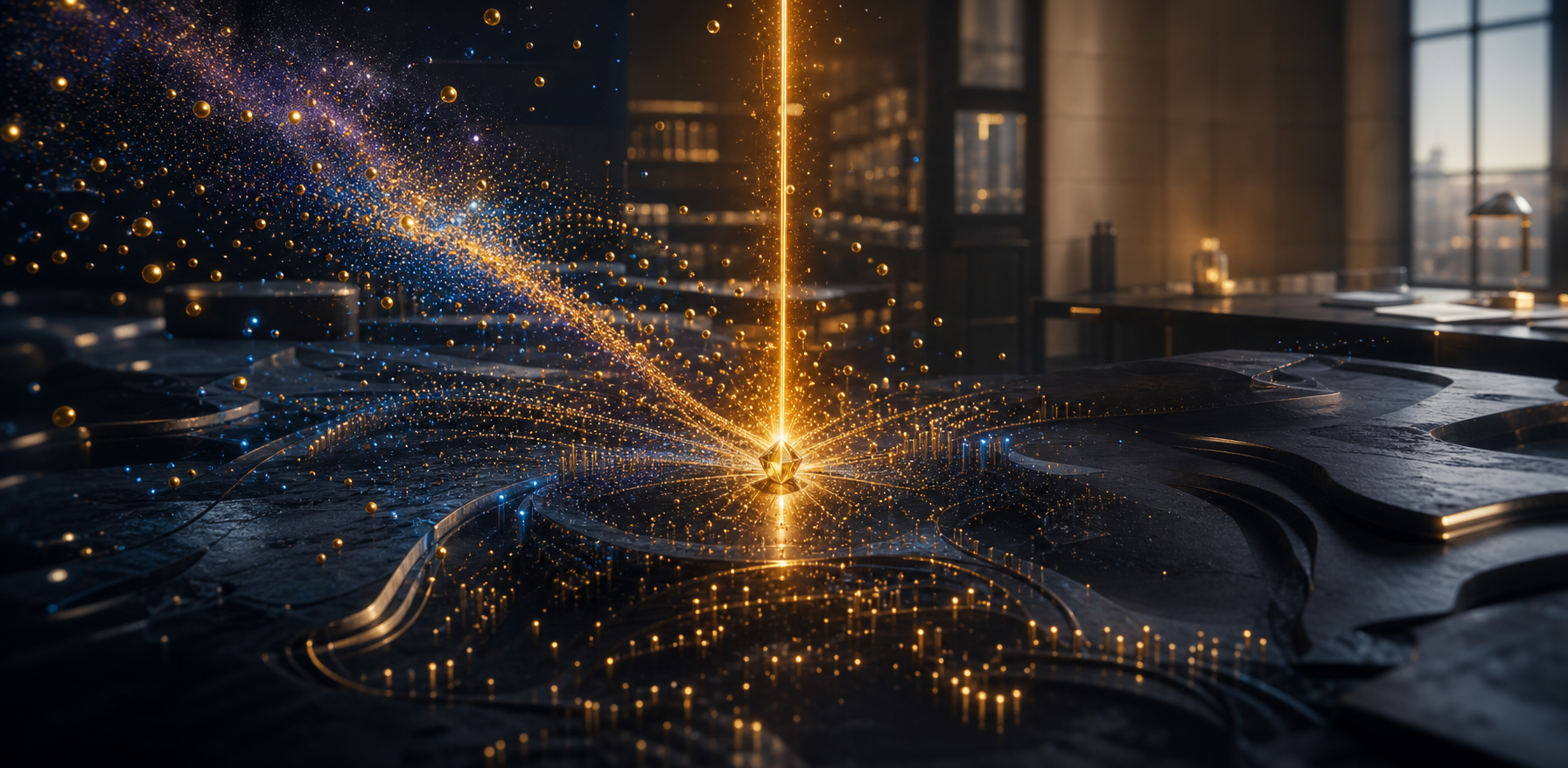
Quantum-AI couples a nondeterministic computing paradigm to machine learning, and the exponential story holds only where the mathematics supports it.
Which problems quantum computers provably speed up, and by how much
Quantum speedups are theorems about specific problems. They are never properties of the hardware as such. Shor's algorithm factors integers and computes discrete logarithms in polynomial time, a superpolynomial advantage over the best known classical algorithms, and the reason today's RSA and elliptic-curve cryptography carries an expiration condition. Grover's algorithm speeds up unstructured search quadratically: useful, and enough to halve the effective key length of symmetric ciphers, which 256-bit keys absorb comfortably. Most of the story lives between those two poles.
The strongest physical case for exponential advantage is quantum simulation of quantum systems themselves: molecular chemistry, correlated materials, nuclear physics. Richard Feynman's intuition of 1981 still holds. Nature is quantum-mechanical, an exact classical representation of a generic highly entangled many-body state can require resources that grow exponentially with system size, and a quantum processor represents that state natively. Approximations and structure-specific classical methods avoid that scaling in important cases, which is why the advantage is problem-specific.
Complexity theory then draws a line that marketing routinely crosses. The class of problems quantum computers solve efficiently, BQP, is not known to contain the NP-complete problems: scheduling, general optimization, Boolean satisfiability. A quantum computer does not "try all answers in parallel." It choreographs interference so that wrong answers cancel and right answers reinforce, and that choreography is only known to work for problems with exploitable structure. For everything else, the realistic expectation is polynomial gains at best.
Even celebrated results carry fine print. The HHL algorithm for linear systems, long advertised as an exponential accelerator for machine learning, requires efficiently preparable input states and well-conditioned sparse matrices, and it delivers its answer as a quantum state whose full readout can erase the speedup. Scott Aaronson's paper Quantum Machine Learning Algorithms: Read the Fine Print remains the indispensable checklist. Each caveat is survivable. Applications that survive all of them are rare.
Why every quantum answer is a probability distribution, and how a research collaboration certified it
A quantum computation ends in a measurement, and measurement outcomes follow probability distributions fixed by the state's amplitudes. Run the identical circuit twice and you may obtain different answers. The algorithm designer's art is to concentrate probability mass on correct answers and then to verify cheaply: checking a factorization takes microseconds even when finding it took a quantum computer. The evolution of the quantum state between measurements is fully deterministic; the randomness enters at measurement, and good engineering works with it. This physical nondeterminism differs from the nondeterministic machines of complexity theory, which explore branches rather than sample outcomes.
That intrinsic randomness has produced one of the first credible candidates for a practically useful quantum application. In March 2025, researchers from JPMorganChase, Quantinuum, Argonne National Laboratory, Oak Ridge National Laboratory, and the University of Texas at Austin demonstrated certified randomness on a trapped-ion quantum processor in Nature. A 56-qubit machine produced random bits whose freshness and unpredictability could be mathematically certified even if the hardware itself were untrusted, validated against more than an exaflop of classical computing. For cryptography, auditable lotteries, and compliance regimes that must prove their entropy sources, certified quantum randomness turns the paradigm's strangeness into an evidentiary asset. The certification step is still classically expensive. The direction of travel is clear.
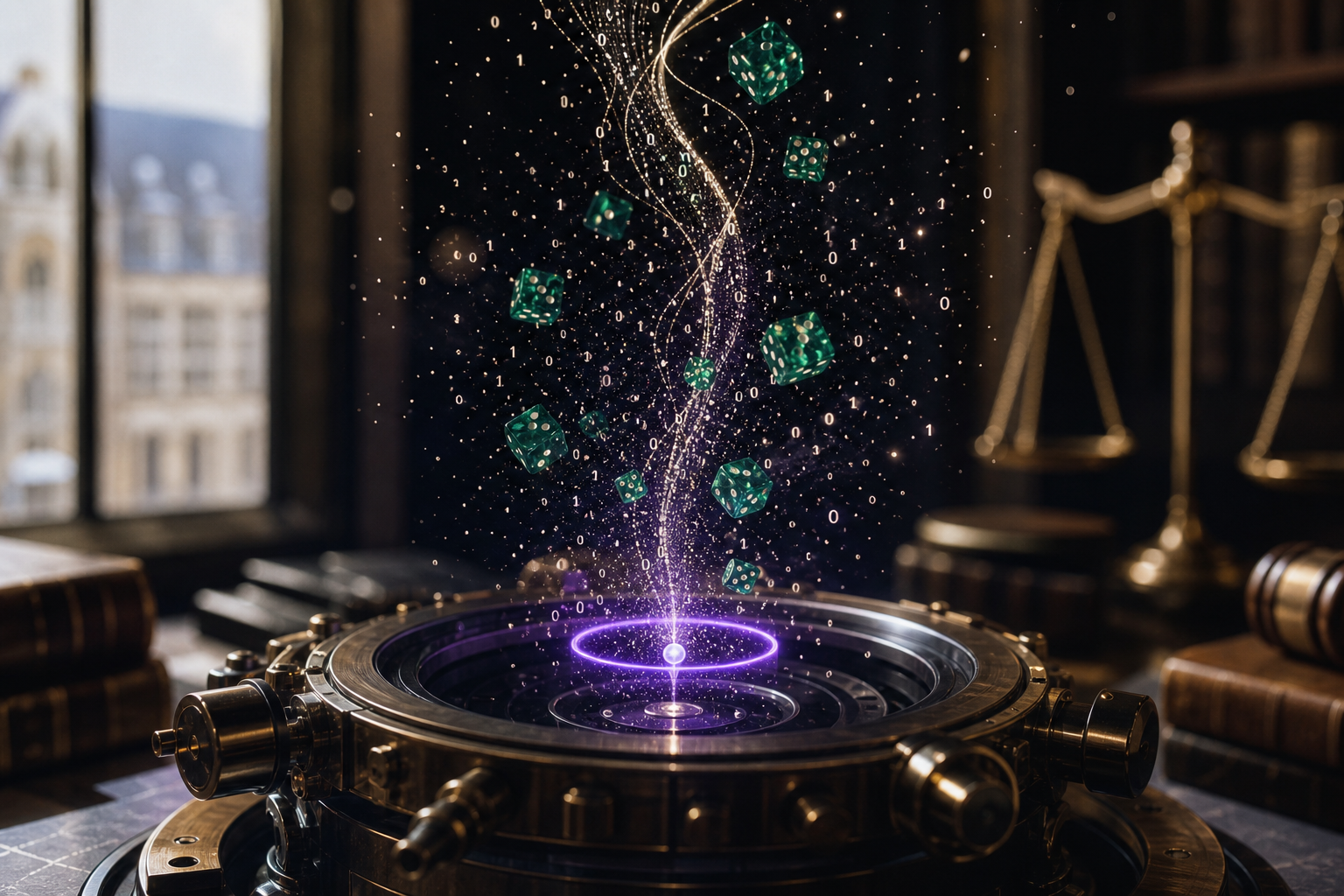
Measurement turns quantum indeterminacy into bits, and with the right protocol into certifiable randomness.
Where quantum machine learning stands in 2026: the approach, two obstacles, one rigorous result
The dominant near-term approach to quantum machine learning is the hybrid quantum-classical workflow: variational quantum circuits whose parameters a classical optimizer tunes, with the quantum processor evaluating a cost function that classical machines find hard. This division of labor suits noisy hardware, with short circuits and classical feedback, and it structurally resembles neural-network training, which is why artificial intelligence researchers found it immediately legible.
Two results temper the enthusiasm. First, barren plateaus: for wide classes of variational circuits, gradients vanish exponentially in the number of qubits, so the training landscape flattens into an untrainable desert precisely as the machine scales. Second, dequantization. Beginning with Ewin Tang's 2018 result on recommendation systems, classical algorithms with comparable sampling access to data have matched several claimed exponential quantum machine learning speedups up to polynomial factors. The advantage had lived in the data-access assumption all along.
The rigorous positive result is correspondingly narrow. Liu, Arunachalam and Temme proved a rigorous and robust quantum speed-up in supervised machine learning (Nature Physics, 2021): a quantum-kernel classifier that provably beats every classical learner, assuming the hardness of the discrete logarithm. It is an existence proof on an engineered problem. The status of quantum-enhanced AI in mid-2026 reads as follows: theoretically real, practically unproven, and closest to value where the data are themselves quantum, such as sensor outputs, chemistry, and materials.
AI for quantum: how machine learning already improves quantum hardware
Reverse the arrow and the picture sharpens considerably. Machine learning is already an engineering workhorse inside quantum technology. Google DeepMind's AlphaQubit, published in Nature in November 2024, is a transformer-based decoder, itself a classical machine-learning system, that identified errors on Google's surface-code experiments more accurately than the previous decoders tested in the study, a concrete case of quantum error correction being advanced by AI. Neural methods likewise calibrate control pulses, compile circuits into shallower forms, and denoise readout.
This is where the governance-relevant nonlinearity hides. If artificial intelligence keeps improving the machines that may one day accelerate artificial intelligence, capability gains can compound into a recursive loop. That prospect, more than any single benchmark, is why quantum-AI hybrids deserved governance attention years before the hardware matured, and why they deserve more of it now that the AI-for-quantum direction demonstrably works.
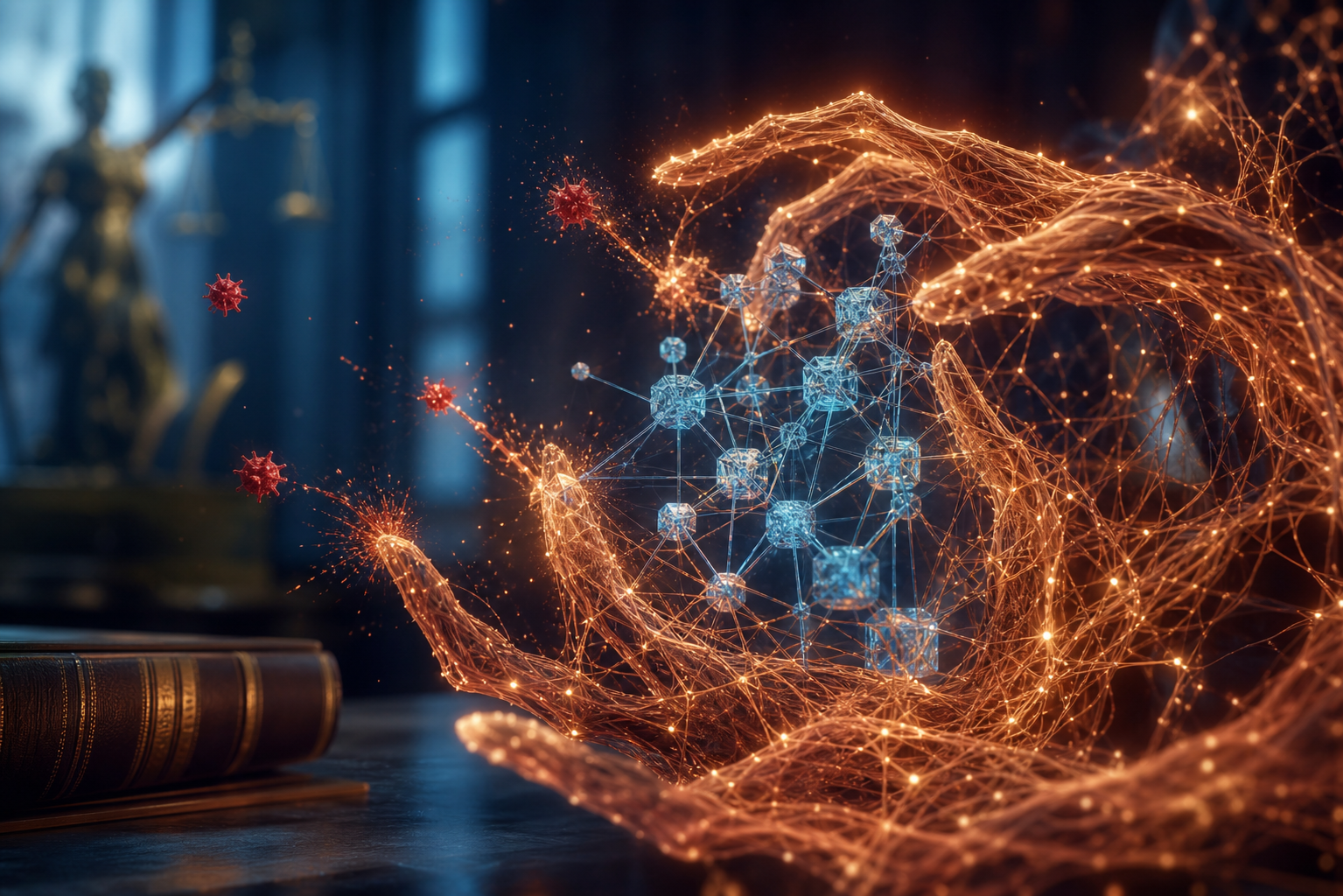
The convergence already runs in reverse: a classical machine-learning decoder, AlphaQubit, read quantum error-correction syndromes more accurately than the previous decoders in the study.
What regulators must change for machines that answer in distributions
For regulators, the quantum-AI convergence lands as three concrete problems. The first is risk framing. The EU's Artificial Intelligence Act (Regulation (EU) 2024/1689) classifies AI systems by risk and is deliberately technology-neutral: a quantum-accelerated credit model is regulated as a credit model. Its accuracy, robustness and cybersecurity requirements apply without demanding deterministic outputs, but they do presuppose that behavior can be tested. When neither the model nor the machine is deterministic, "did the system behave as specified?" becomes a claim about probability distributions, and conformity assessment must learn to sample, bound and certify distributions in place of replaying executions. That adaptation is better designed inside a dedicated institutional home than improvised regulator by regulator, the case made in Towards an Atomic Agency for Quantum-AI.
The second is technical documentation. A hybrid quantum-classical pipeline has two failure surfaces, statistical learning and quantum hardware noise, and the file that evidences compliance must describe both: circuit ansatz, shot counts, error-mitigation strategy, and decoder provenance, alongside the familiar training-data and evaluation documentation. That double-dossier logic is developed in our analysis of the dual technical file for quantum-AI systems.
The third is standards. Distribution-level verification, benchmark suites for quantum advantage claims, and entropy-source certification are exactly the artifacts standards bodies produce well, and producing them before the capability inflection is the heart of the standards-first approach to quantum governance. Certified randomness shows the template: a quantum property converted, by protocol and proof, into an auditable compliance object. The values-based scaffolding for that work exists in the Ten Principles for Responsible Quantum Innovation (Quantum Science and Technology, 2024). The task ahead is translating principles into test methods.
The practical counsel for policymakers is modest. Set unsupported exponential-speedup claims aside, and do not wait for them to come true either. Fund the unglamorous instruments, distributional conformity testing, dual technical documentation, and certified entropy standards, which keep their value whether quantum-AI arrives as a revolution or as a series of narrow, compounding wins. Anticipatory governance of quantum technology is cheap while the machines are small, and the nonlinearity will give no advance notice.
Last updated: September 3, 2026