Innovation, Quantum-AI Technology & Law

Blog over Kunstmatige Intelligentie, Quantum, Deep Learning, Blockchain en Big Data Law

Blog over juridische, sociale, ethische en policy aspecten van Kunstmatige Intelligentie, Quantum Computing, Sensing & Communication, Augmented Reality en Robotica, Big Data Wetgeving en Machine Learning Regelgeving. Kennisartikelen inzake de EU AI Act, de Data Governance Act, cloud computing, algoritmes, privacy, virtual reality, blockchain, robotlaw, smart contracts, informatierecht, ICT contracten, online platforms, apps en tools. Europese regels, auteursrecht, chipsrecht, databankrechten en juridische diensten AI recht.

Berichten met de tag quantum-AI
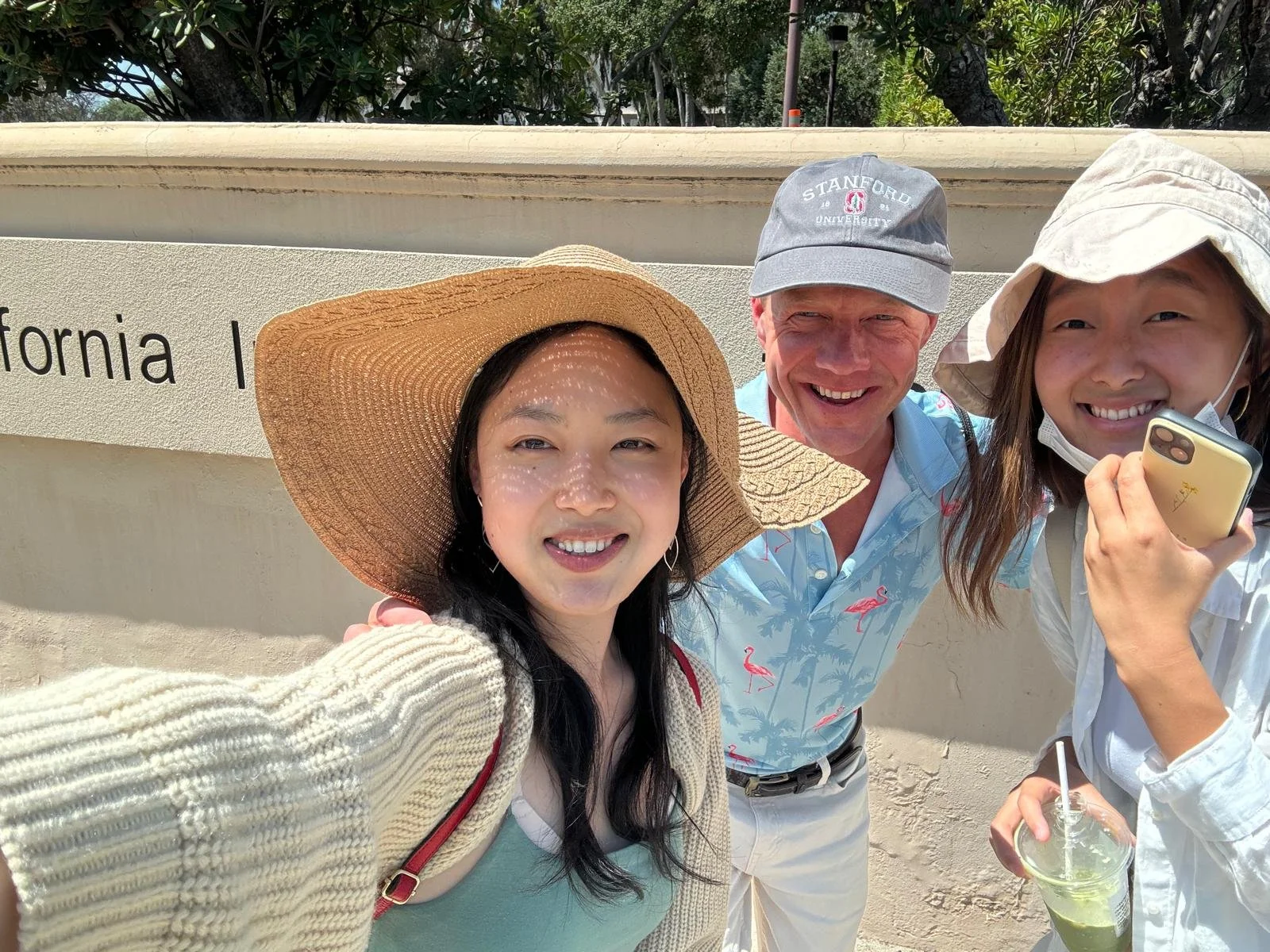
Stanford RQT Meets VR Lab Meets Classical Music Meets Fractal Art: Jin-Hee Lee, Katie Liu and Mauritz Kop at Stanford's VR Lab (Spring 2024)

Quantum mechanics is the most counterintuitive physics we have, and it deserves better than bullet points. An exploratory project presented in the spring of 2024 at Stanford's virtual-reality lab by Jin-Hee Lee, Katie Liu, and Mauritz Kop, titled Stanford RQT Meets VR Lab Meets Classical Music Meets Fractal Art, asks what happens when quantum-AI meets music in immersive space. It is at once an art project, a teaching experiment, and a governance strategy, and each part strengthens the others.

What the project imagines: from the conductor's podium to the qubit

The project's imagined applications are concrete: standing inside an orchestra and watching the conductor from the oboe's chair; sheet music that responds to touch, with tempo bending in real time; a classroom where students rehearse alongside a professional ensemble in virtual reality. Music turns out to be an ideal test bed because it is structured, emotional, and time-based, exactly the qualities that make abstract physics graspable. A carefully designed audiovisual model can introduce selected features of quantum measurement, provided its mapping to the physics is stated and its limits are explained.

Why governance scholars care about public intuition for quantum technology

Citizens are being asked to form opinions about quantum technology they cannot picture. Superposition and entanglement defy everyday intuition, and policy made on bad metaphors becomes bad policy. Immersive sound and space can offer a partial corrective: an intuitive introduction to quantum computing before the regulatory questions arrive. The Stanford responsible-quantum circle has long paired scholarship with performance, a musical orbit that reaches back to music-law teaching at the Royal Conservatoire in The Hague, because a community that plays together explains together.

Which legal questions quantum-AI-shaped music raises for copyright

When artificial intelligence and quantum processes help shape a composition, familiar doctrines wobble: authorship, originality, and the credit owed to human creative direction all need re-examination. The project sits on that fault line, with three collaborators who move between the law school, the laboratory, and the keyboard and treat art as a research instrument. Their earlier joint expedition to Caltech's quantum laboratories was the same instinct pointed at hardware; this project points it at perception.

The full post traces what the VR collaboration imagines for education, science, and the concert hall, why science communication is governance infrastructure, and how the musician-jurists of the Stanford quantum circle keep finding each other at the piano.

Meer lezen
Quantum-AI: Nondeterministic Computing and the Exponential-Speedup Claim, Audited

Every technology cycle has its incantation, and quantum computing's is "exponentially faster." The phrase is true just often enough to be dangerous. Quantum algorithms hold a superpolynomial advantage over the best known classical methods for factoring, may deliver substantial advantages on specific quantum-simulation problems, and have provable speedups on a handful of engineered learning problems; none of that establishes a general exponential speedup, and for most workloads the advantage is unproven. This analysis audits the exponential speedup claim against the mathematical results and asks what remains for boards, courts, and regulators once the slogan is stripped away.

Where the proven speedups are, and where they are missing

The scoreboard is more precise than the headlines. Shor's algorithm genuinely threatens public-key cryptography. Grover's algorithm delivers a quadratic gain. Quantum computers are not known to solve NP-complete problems efficiently: the machine does not "try all answers at once," it choreographs interference. We walk through the fine print that separates proven quantum advantage from investor prose, including the caveats attached to famous algorithms for linear algebra and machine learning.

How a bank-backed research collaboration demonstrated certified quantum randomness in 2025

A quantum state evolves deterministically between measurements, but the measurement that ends a computation is probabilistic: the same circuit, run twice, may return different answers, and correctness is a property of distributions. This nondeterministic behavior is physical randomness, distinct from the nondeterministic machines of complexity theory. That is comfortable for machine learning and uncomfortable for verification, audit, and liability. The strangeness is already monetizable. In 2025 a commercial trapped-ion processor produced certifiably random bits, converting physical indeterminacy into a compliance-grade evidentiary object. Meanwhile the reverse direction matured quietly: artificial intelligence now designs error-correction decoders and calibrates quantum hardware, closing a loop in which each field accelerates the other.

What the EU AI Act needs before quantum-AI systems reach the market

The governance stakes do not wait for quantum advantage. The EU AI Act imposes accuracy, robustness, and testing duties without requiring deterministic outputs, and hybrid quantum-classical pipelines will need validation suited to probabilistic behavior. They demand conformity assessment that samples and bounds distributions, plus technical documentation covering two failure surfaces at once, statistical learning and hardware noise. Transparency-first instruments are already the trend in AI regulation, as we analyzed for California's frontier-model disclosure regime in the Daiki SB-53 recipe for frontier AI transparency. Quantum-AI extends that logic to the physics itself.

The full analysis separates the three real speedup regimes, explains barren plateaus and dequantization in plain language, and closes with a concrete agenda for governing quantum technology before the inflection point: distributional testing, dual technical files, and certified entropy standards.

Meer lezen