
Statute-Led Quantum Governance: A Legislative Blueprint for the United States
By our Editor
On June 22, 2026, the White House signed two quantum executive orders in a single afternoon. Executive Order 14413, "Ushering in the Next Frontier of Quantum Innovation," directs a national effort to accelerate quantum computing, sensing, and networking toward a machine capable of enabling scientific discovery. Executive Order 14412, "Securing the Nation Against Advanced Cryptographic Attacks," forces the federal government's overdue migration to post-quantum cryptography. Together they form a significant expansion of federal executive action on American quantum policy since the National Quantum Initiative Act of 2018. They also show the limits of executive action: a later administration can revoke it far more easily than Congress can repeal a statute, and it cannot appropriate a dollar or settle the values by which a foundational technology is governed.
This essay argues for a different default: statute-led governance, meaning deliberate federal legislation with values-based guardrails, drafted before the capability inflection and in place before the disputes reach the courts. Europe is already walking that road, as analyzed in Towards a European Quantum Act, the Columbia Law study by Mauritz Kop that mapped what a dedicated quantum statute could look like. What follows is the American counterpart: why statutes serve quantum technology better than accreted agency guidance, what Congress already has in motion, and a concrete blueprint for a United States quantum act.
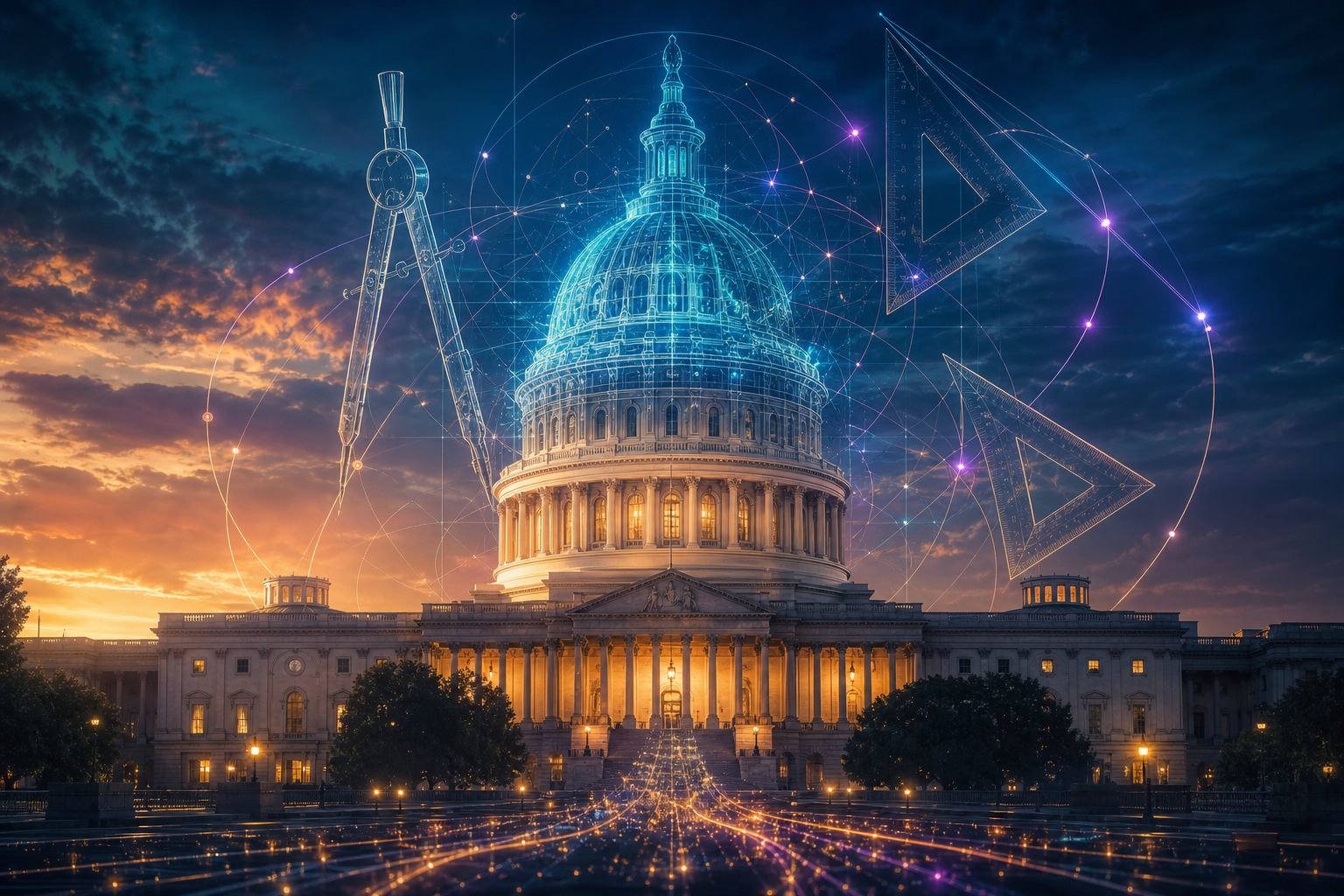
A legislative blueprint for the quantum decade: a statute supplies the durable architecture that executive orders cannot.
Why agency-led governance leaves quantum policy revocable
American technology governance defaults to the agency-led mode: executive orders, guidance documents, enforcement priorities, and standards that accrete around statutes written for earlier technologies. The mode is fast and adaptable, and everything it produces is revocable. An executive order survives as long as the next president wants it to, guidance generally lacks the binding force of a statute or a legislative rule, and enforcement priorities shift with personnel. For technologies whose build-out horizon is measured in decades, regulatory durability is the substance of investment certainty.
The American experience with artificial intelligence shows what fills the vacuum when Congress stays silent. States moved first, and moved erratically. The Colorado AI Act of 2024, the first comprehensive state statute on algorithmic discrimination, was delayed and then rewritten as SB 26-189, signed in May 2026 with duties taking effect from January 1, 2027, before the original framework ever operated. California meanwhile legislated frontier-model transparency through SB-53, dissected in our analysis of AI regulation in California. Quantum technology is entering the same pattern. Ohio's House Bill 650, discussed in StateScoop's interview on quantum legislation, is an early marker. A state-by-state patchwork for a dual-use technology with national-security stakes produces fragmentation for industry and gaps for security at the same time.
What Congress and the White House have on the table in 2026
Congress has been incremental. The National Quantum Initiative Act of 2018 built the coordination machinery: a national office, research centers across NSF, NIST, and the Department of Energy, and an advisory committee. Its funding authorizations lapsed in 2023. A reauthorization was approved by the House Science Committee in late 2023, only to die with the 118th Congress. The 119th Congress is trying again on a bipartisan basis. Senators Cantwell and Young introduced the National Quantum Initiative Reauthorization Act on January 8, 2026, and the Senate Commerce Committee passed it on April 14, 2026; the House Science Committee favorably reported its companion, H.R. 8462, on April 29, 2026. Both versions shift the federal focus from pure research toward commercialization, workforce, and supply-chain resilience.
Alongside them sits the Department of Energy Quantum Leadership Act, a bipartisan bill authorizing more than $2.5 billion over five years for DOE quantum research, national research centers, supply-chain work, and commercialization pathways. The June 2026 executive orders add the executive layer. Executive Order 14413 directs a national effort toward a quantum computer capable of enabling scientific discovery, quantum sensor and network deployment plans within five years, workforce development institutes, and domestic supply-chain measures. Its companion, Executive Order 14412, accelerates federal migration to NIST's post-quantum cryptography standards against the harvest-now-decrypt-later threat, with key establishment on high-value assets to migrate by the end of 2030 and digital signatures by 2031.
In September 2024, the Commerce Department's Bureau of Industry and Security issued an interim final rule imposing worldwide license requirements on quantum computers, components, software, and technology, coordinated with allied jurisdictions running parallel export controls. Research authorizations, appropriations bills, executive orders, and export rules are capable instruments, and every one of them is revocable, expirable, or reversible. The United States has federal quantum legislation in the National Quantum Initiative Act of 2018. It does not yet have a comprehensive quantum statute that integrates capability governance, post-quantum migration, research security, standards, and application-specific safeguards.

Reauthorization bills, appropriations, executive orders, and export rules are capable instruments, and none of them is an architecture.
Why foundational technologies need statutes rather than accreted guidance
The case for legislation is a claim about fit. Foundational technologies create risks that outlast administrations, cut across agency jurisdictions, and allocate power in ways that deserve democratic sanction. Quantum Trials: An FDA for Quantum Technology proposes statutory, evidence-based approval pathways: risk-tiered market authorization for quantum applications, modeled on how the law already handles technologies whose failure modes society refuses to discover in production.
The values layer is equally statutory work. The Ten Principles for Responsible Quantum Innovation, developed at the Stanford Center for Responsible Quantum Technology and organized around safeguarding, engaging, and advancing, read today like a drafting checklist for a legislature: information security by design, dual-use precaution, access equity, standards participation. Guardrails of this kind are innovation policy. They give investors, allies, and the public reasons to trust the ecosystem being built, and responsible quantum innovation written into statute outlasts the officials who happen to believe in it.
National security completes the argument. Quantum's dual-use character entangles commerce with defense, since the fault-tolerant capabilities that will simulate molecules could also support cryptanalysis, and the harvest-now-decrypt-later asymmetry creates present-day harms from future capabilities that after-the-fact enforcement cannot reach. Statutes can mandate deadlines that outlive administrations and integrate the intellectual-property, export, and research-security levers coherently, as argued in Integrating Bespoke IP Regimes for Quantum Technology into National Security Policy. Executive orders can start that integration. Legislation supplies the appropriations, the durable mandates, and the democratically enacted limits that finish it.
What the European Union's statute-led approach means for the United States
The European Union has made statute-led governance its brand. The EU AI Act, whatever one thinks of its compliance weight, proved that a legislature can define risk tiers, prohibited practices, and conformity obligations for a general-purpose technology in advance. Quantum is next on the same conveyor. The Commission published its Quantum Europe Strategy in July 2025 and has consulted on an EU Quantum Act, with a legislative proposal expected in 2026 aimed at coordinating research investment, building industrial capacity, and securing quantum supply chains.
The American answer should be interoperability. The United States brings standards institutions, private capital, and national laboratories that complement the European Union's legislative and conformity-assessment experience, and a US statute should press those strengths through the standards-first logic argued in A Standards-First Future for Quantum Governance, published in Science. Shared risk concepts, mutual recognition of conformity assessment, and aligned export regimes would multiply the value of both frameworks, and allied coordination bodies of the kind proposed in A Bletchley Park for the Quantum Age would give transatlantic interoperability an institutional home.

Two statute-led frameworks, one American and one European, designed to interoperate across the Atlantic.
Eight elements of a United States quantum act
A workable legislative blueprint has eight elements:
- Capability-based definitions. Define regulated quantum computing, sensing, and communication by what systems can do, such as cryptanalytic relevance and sensing precision thresholds, so the statute survives hardware generations.
- Risk-tiered obligations. Reserve real regulatory weight for genuinely high-risk applications (cryptanalysis, critical-infrastructure sensing, quantum-AI hybrids) and leave research and benign commercial uses light-touch, with an FDA-style trials pathway for the top tier.
- Statutory PQC deadlines. Codify the June 2026 migration order into binding, funded deadlines for federal systems and critical infrastructure, with reporting duties, so that cryptographic inventories become board-level dossiers.
- A standing standards mandate. Task and fund NIST to lead quantum benchmarking, assurance, and interoperability standards, making standards America's regulatory export.
- Regulatory sandboxes. Give agencies explicit authority to run supervised quantum pilots in finance, health, and energy, so evidence accumulates inside the law.
- Calibrated research security. Write the export-control and research-security balance into statute using a least-trade-restrictive, security-sufficient, innovation-preserving test, so scientists no longer navigate shifting interim rules.
- Mission goals and software. Set national quantum-advantage missions in cryptography, drug discovery, and materials science, and stand up a quantum software engineering institute so American hardware is matched by a trusted software supply chain.
- Workforce and alliances. Fund apprenticeships, fellowships, and talent exchange with allies, and authorize the executive to negotiate mutual recognition with the EU, UK, Japan, Canada, and Australia.
None of this requires a new agency. It requires merging what already exists, the NQI reauthorization's coordination machinery, the DOE bill's appropriations, the executive orders' missions and PQC mandate, and the BIS rule's control logic, into one coherent act of Congress that adds the values layer none of those instruments currently carries.
Why the 2026 reauthorization vehicles are the moment to legislate
Timing decides the cost. A quantum statute drafted before the capability inflection shapes markets cheaply, because it channels investment that has not yet committed to bad equilibria. A statute drafted afterwards will be expensive, rushed, and litigated, as the state AI experience shows. The reauthorization bills moving through both chambers give Congress a live legislative vehicle this session, a rare moment when ambition costs little more than drafting.
For US policymakers the message is direct. The executive orders of June 2026 opened the quantum decade, and only Congress can give it a durable legal architecture: a quantum act that fixes the definitions, the risk tiers, the PQC deadlines, and the values while the technology is still young enough to be shaped by them.
Last updated: September 3, 2026