
StateScoop Interviews Mauritz Kop About Ohio House Bill 650 on Quantum Technology
By Editor
Washington, D.C., March 19, 2026—StateScoop, the Washington-based news outlet covering state and local government technology, has published an interview with Mauritz Kop, Founder of the Stanford Center for Responsible Quantum Technology (Stanford RQT), Senior Fellow at the Centre for International Governance Innovation, and Guest Professor at the U.S. Air Force Academy. The article by technology reporter Sophia Fox-Sowell, Ohio Senate considers bill to form Frontier Technologies and Quantum Commission, examines Ohio House Bill 650—legislation that would establish a bipartisan commission to study quantum computing, artificial intelligence, cybersecurity, and robotics, and their impact on the state's economy, security, and workforce. The Ohio House passed the bill unanimously earlier in March 2026; the measure now heads to the Ohio Senate for further consideration.
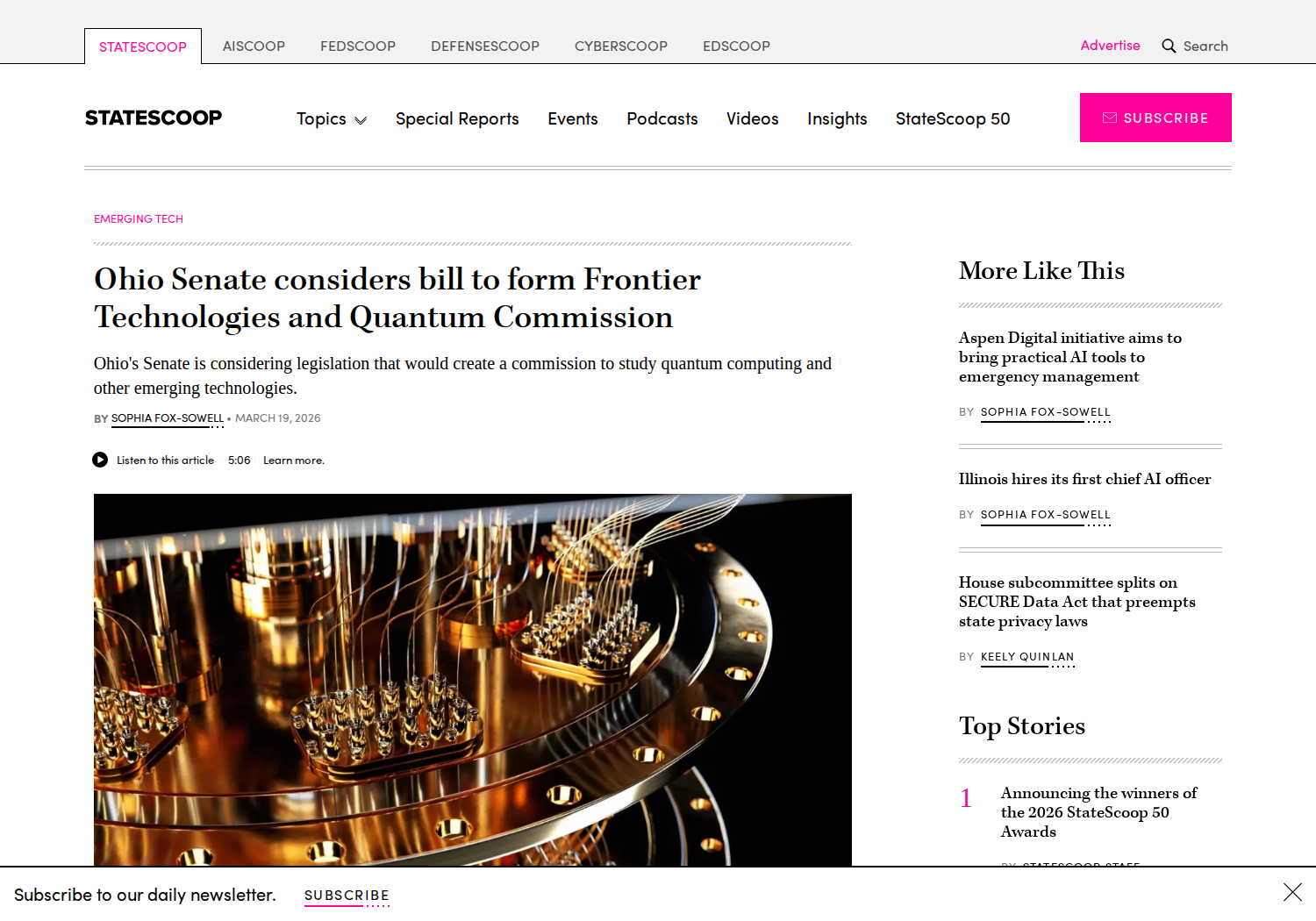
StateScoop's March 19, 2026 report on Ohio House Bill 650 and the Frontier Technologies and Quantum Commission, featuring Mauritz Kop (screenshot: StateScoop / Scoop News Group)
What House Bill 650 would do
The proposed body, the Frontier Technologies and Quantum Commission, would include members of both the Ohio House and Senate and gather input from outside experts to analyze technology trends and their policy implications. Under the bill, the commission must deliver recommendations to the General Assembly by the end of 2026, informing future legislation on quantum computing and adjacent frontier technologies. State Representative Heidi Workman, the bill's sponsor, framed the stakes in the language of urgency when the House passed the measure: "We all feel this tectonic shift. Innovation races ahead, rewriting workplaces, economies, and security in months, not decades."
That a state legislature is organizing itself around quantum technology at all is notable. Most emerging-technology lawmaking has historically been reactive—drafted after a technology has shipped, consolidated, and produced its first harms. A standing study commission inverts that sequence: it builds legislative expertise while the technology is still taking shape.
An essential laboratory for anticipatory governance
In the interview, Kop places Ohio's initiative in a broader conceptual frame, describing state commissions as "an essential laboratory for anticipatory governance." Emerging fields like quantum computing, he notes, advance faster than traditional legislative cycles, creating a widening gap between innovation and regulation. States that build dedicated institutional capacity now—before quantum systems are embedded in procurement, infrastructure, and security frameworks—will be better positioned to write informed rules later.
The argument extends a research program on anticipatory quantum governance that Kop and colleagues have been developing since the field's earliest policy debates, including the Ten Principles for Responsible Quantum Innovation—which the StateScoop article notes Kop co-authored—and the foundational work on establishing a legal-ethical framework for quantum technology. The through-line is consistent: governance designed concurrently with the technology, not retrofitted after deployment.
Post-quantum cryptography: a country-wide effort
The interview's most operational message concerns cryptography. "PQC migration is really a country wide effort," Kop told StateScoop, urging states to prioritize the migration of sensitive data to quantum-resistant encryption. The National Institute of Standards and Technology finalized its first post-quantum cryptography standards in August 2024, but standards alone do not migrate systems—agencies do. State governments hold some of the most sensitive long-lived data in the country: health records, tax filings, election infrastructure, driver and identity databases. Data harvested today can be decrypted tomorrow by a sufficiently capable quantum machine, which is why post-quantum cryptography migration belongs on every state's near-term agenda rather than its someday list—a strategic argument developed at length in the War on the Rocks essay "A Bletchley Park for the Quantum Age".

Anticipatory governance under the dome: quantum technology arrives in the statehouse (illustration)
Embedding ethics to propel responsible innovation
A third theme cuts against a common assumption in technology policy—that ethical guardrails and economic competitiveness pull in opposite directions. "If you embed your ethics in a smart way into your federal or state level regulations, it will actually foster and propel responsible innovation," Kop said. Smart regulation, on this view, is not a brake but a design specification: it gives industry predictable rules, gives investors confidence, and gives the public reasons to trust the systems being built. The position mirrors the advisory work Kop has done for international institutions on quantum ethics and policy, including consultations for UNESCO and the OECD on ethics and quantum technology policy—where the same principle holds in multilateral policy settings: values, embedded early, become infrastructure.
Ohio joins a national pattern of state quantum initiatives
The StateScoop article situates House Bill 650 within a quickening national pattern. California has launched its "Quantum California" initiative; Texas enacted the Texas Quantum Initiative through House Bill 4571; New Mexico has partnered with DARPA; and Maryland recently saw the announcement of a Microsoft quantum research center. Statehouses, in other words, are no longer waiting for Washington to define quantum policy—they are building their own institutional capacity, much as they did a decade earlier for AI. Kop has also engaged with federal policymakers on quantum and artificial intelligence questions, including consulting Senator Mark Warner on AI and quantum technology policy—experience that informs the interview's central advice to Ohio's legislators.
For policymakers, the takeaway is straightforward: the states that treat quantum technology as a present-tense governance question—standing up commissions, migrating cryptography, and embedding ethics into statute—are likely to shape the terms on which the quantum economy arrives. Ohio's commission, if the Senate concurs, would be a credible first move.
Last updated: June 5, 2026.