Innovation, Quantum-AI Technology & Law

Blog over Kunstmatige Intelligentie, Quantum, Deep Learning, Blockchain en Big Data Law

Blog over juridische, sociale, ethische en policy aspecten van Kunstmatige Intelligentie, Quantum Computing, Sensing & Communication, Augmented Reality en Robotica, Big Data Wetgeving en Machine Learning Regelgeving. Kennisartikelen inzake de EU AI Act, de Data Governance Act, cloud computing, algoritmes, privacy, virtual reality, blockchain, robotlaw, smart contracts, informatierecht, ICT contracten, online platforms, apps en tools. Europese regels, auteursrecht, chipsrecht, databankrechten en juridische diensten AI recht.

Berichten in Policy
Industriepolitiek en quantumrecht: de Amerikaanse decreten van juni 2026

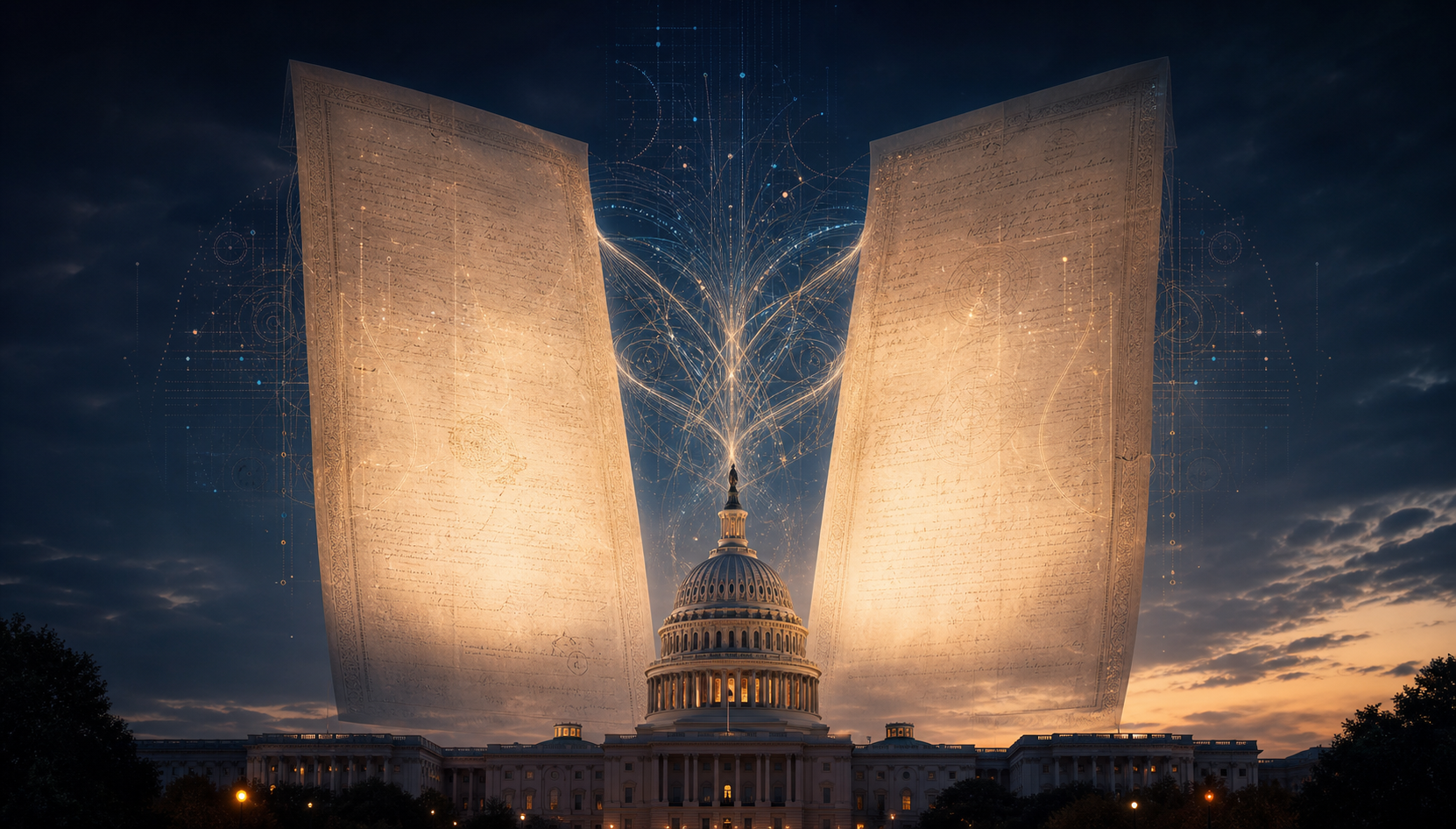
Op 22 juni 2026 tekende het Witte Huis twee presidentiële besluiten die samen één beweging vormen: de Verenigde Staten verheffen quantumtechnologie tot instrument van industriepolitiek. Het eerste besluit lanceert een nationaal programma voor de eerste quantumcomputer die het tijdperk van quantum-gedreven wetenschappelijke ontdekking moet inluiden; het tweede legt de federale overheid harde deadlines op voor de migratie naar post-quantumcryptografie. Wie de twee naast elkaar legt, ziet geen losse beleidsdaden maar een strategie — en die strategie heeft juridische gevolgen tot ver buiten de Amerikaanse grens.

Wat er verandert voor exportcontrole en investeringstoetsing

Zodra een staat een opkomende technologie tot industriepolitiek verheft, bewegen exportcontrole, onderzoeksbeveiliging en buitenlandse-investeringstoetsing mee. Quantum belandt daarmee in dezelfde categorie als halfgeleiders: een dual-use-technologie waar nationale veiligheid en economische zekerheid samenvallen. Voor Europese onderzoekers en bedrijven die met Amerikaanse partners samenwerken, verandert de context waarin afspraken over intellectuele eigendom, data en personeel tot stand komen — ook zonder dat er één regel Europees recht wijzigt.

De cryptografische klok tikt tot 2030

Het tweede besluit zet de scherpste juridische klok: federale high-value assets en high-impact-systemen moeten uiterlijk eind 2030 over op door NIST goedgekeurde post-quantumcryptografie. De achterliggende dreiging is harvest-now-decrypt-later: data die vandaag wordt onderschept, is straks alsnog leesbaar. Voor organisaties met langlevende vertrouwelijke gegevens verschuift de migratie daarmee van ICT-project naar zorgplichtvraag — een verschuiving die via artikel 32 AVG ook de Europese praktijk raakt. Hoe u die inventarisatie bestuurlijk aanpakt, leest u in onze analyse van de cryptografische inventaris als bestuursdossier.

Een transatlantische maatstaf in plaats van twee reflexen

De Verenigde Staten sturen via missiegericht overheidsgeld en beveiligingsmaatregelen; de Europese Unie reguleert kunstmatige intelligentie (artificiële intelligentie) en straks mogelijk ook quantum via horizontale kaders die innovatie en grondrechten in balans houden. Beide logica's hebben een gedeelde maatstaf nodig. In deze analyse leggen we uit waarom de LSI-toets — het smalste effectieve, innovatiebehoudende instrument — die maatstaf kan zijn, wat de Amerikaanse termijnen betekenen voor Nederlandse en Europese organisaties, en waarom wie nu begint met exportclassificatie en een cryptografisch migratieplan straks minder last heeft van een deadline die via een ander rechtsstelsel toch op de mat valt.

Meer lezen
From Kananaskis to Évian: Will the G7 Govern Quantum, or Keep Describing It?

When G7 leaders meet in Évian-les-Bains from June 15 to 17, 2026, quantum technology sits on the leaders' table for a second consecutive year. In a new CIGI op-ed, Stanford and CIGI legal scholar Mauritz Kop argues that the era of shared values and summit language has run its course: between the Kananaskis Common Vision and the OECD Recommendation on Quantum Technologies, the conceptual groundwork is done. What remains is implementation — and implementation is what voluntary coordination delivers slowly, unevenly, or never.

From a Common Vision to Working Machinery

Kananaskis named the right concerns in June 2025 but built light machinery — no timelines, no benchmarks, no procurement commitments. A year on, Kop puts the question to Évian directly: does the G7 intend to govern quantum, or to keep describing it? His answer is not another principles instrument but a delivery body with named products and deadlines, reporting back to leaders at the 2027 summit.

Five Decisions for Évian

The piece sets out five decisions leaders can take in France: post-quantum cryptography migration milestones for critical infrastructure; trusted and resilient quantum supply chains; standards-based governance backed by procurement; dual-use coordination through a least trade-restrictive, security-sufficient and innovation-preserving (LSI) test; and vigilance on the market structure of an industry already concentrating around a few compute-, patent- and talent-rich incumbents.

Each decision turns a value into something auditable. The "harvest-now, decrypt-later" threat makes cryptographic migration a present-tense problem with an unknown deadline; when Google gives itself until 2029, governments that have given themselves ten years should take notice. The same logic runs through supply-chain chokepoints, technical standards and export controls — defaults that will be written by someone, and better written deliberately than by accident.

The Window Is Still Open

Quantum is leaving the laboratory and becoming strategic infrastructure, a shift central banks already treat as systemic. The window for writing the rules of the road remains open, Kop warns, but it will not stay open forever. For the legal and policy background to the dual-use argument, see our coverage of the LSI test for securing the quantum industrial commons.

Meer lezen
StateScoop Interviews Mauritz Kop About Ohio House Bill 650 on Quantum Technology

When a statehouse starts asking serious questions about quantum computing, something has shifted. StateScoop—the Washington outlet that covers state and local government technology—has interviewed Mauritz Kop, Founder of the Stanford Center for Responsible Quantum Technology, about Ohio House Bill 650: legislation, passed unanimously by the Ohio House and now before the Senate, that would create a Frontier Technologies and Quantum Commission to study quantum computing, artificial intelligence, cybersecurity, and robotics, and report recommendations to the General Assembly by the end of 2026.

A statehouse turns to the quantum age

The commission would seat members of both chambers and draw on outside experts—an institutional answer to a structural problem. Emerging technologies now advance faster than traditional legislative cycles, and the gap between innovation and regulation widens every session a legislature waits. Ohio's answer is to build standing expertise before quantum systems are woven into procurement, infrastructure, and security frameworks, rather than legislating after the fact. It is, as Kop puts it in the interview, the role of state commissions to serve as "an essential laboratory for anticipatory governance."

Three messages from the interview

Kop's advice to Ohio distills into three propositions. First, anticipatory governance works: states that organize knowledge early write better rules later. Second, post-quantum cryptography migration is "really a country wide effort"—state agencies hold health records, tax data, and election infrastructure whose confidentiality must outlive the arrival of cryptographically relevant quantum machines, and migration timelines are measured in years, not budget cycles. Third, ethics embedded smartly in regulation does not slow innovation—it propels it, by giving industry predictable rules and the public reasons to trust what is being built.

Why state-level quantum policy matters now

Ohio is not moving alone. California, Texas, New Mexico, and Maryland have each launched quantum initiatives of their own, and the federal picture is evolving in parallel—terrain Kop knows from advising the U.S. Department of State on quantum technology and foreign policy strategy. The emerging pattern is federalism doing what it does best: fifty laboratories testing governance designs for a technology whose economic and security consequences will be national. The full StateScoop article includes Kop's remarks on commissions, cryptography, and the innovation case for ethics—and this post walks through its key arguments.

Meer lezen
Mauritz Kop Principal Investigator of MINDS Quantum Strategy Grant at CIGI

Waterloo, February 18, 2026—The Centre for International Governance Innovation (CIGI) has awarded Mauritz Kop a new leadership role as Principal Investigator (incoming) of a MINDS Targeted Engagement Grant on Quantum Strategy. The grant advances a central proposition of his recent work: quantum technologies are no longer best understood as a narrow scientific frontier or a conventional innovation file. They have become a strategic domain in which law, industrial policy, intellectual property, defense planning, and geopolitical competition now converge.

That convergence matters because quantum capability is being built in an era of systemic rivalry, supply-chain vulnerability, and technological coercion. In that environment, democratic states cannot afford to treat quantum merely as a research ecosystem problem. They must govern it as part of a broader strategy for safeguarding the democratic industrial commons: the shared base of talent, infrastructure, know-how, trusted supply chains, standards, and institutions on which long-run security, prosperity, and coalition advantage depend.

What MINDS in Defence and Security Is and Why This Grant Fits

The MINDS program—Mobilizing Insights in Defence and Security—is a Canadian Department of National Defence initiative designed to strengthen evidence-based defense policy thinking and foster the next generation of defense and security experts. Its Targeted Engagement Grants provide non-recurring support for projects such as workshops, roundtables, research, and publications, and they are assessed primarily against the annual Defence Policy Challenges.

The current 2025-2026 MINDS challenge set is especially well aligned with the subject matter of this grant. The official challenge framework emphasizes several critical priorities: securing Canada’s sovereignty and continental defense posture; attracting advanced-technology talent across the defense sector; and strengthening the defense industrial base through resilient supply chains and dual-use technologies such as quantum and artificial intelligence. Furthermore, the framework addresses the pressures of strategic competition—including adversarial exploitation of vulnerabilities—and the accelerating adoption of pan-domain, emerging technologies where interoperability, trust, and responsible governance must be preserved.

Strategic Leadership and Human Capital

Kop’s fellowship at CIGI has centered on the governance of transformative technologies, especially quantum technology, AI, dual-use export controls, national security, and intellectual property. The new grant builds directly on that portfolio, but with a more operational mandate. As incoming Principal Investigator, his role will be to provide the project’s strategic and intellectual leadership: conceptualizing the workshop, defining the central themes and policy questions, structuring the panels for direct relevance to Canadian defense audiences, chairing the main event, moderating key expert sessions, identifying high-level contributors, and guiding the project’s analytical outputs.

The Quantum Nexus Paper Behind the Grant

The grant builds on Kop’s recent paper, The Nexus of Quantum Technology, Intellectual Property, and National Security: An LSI Test for Securing the Quantum Industrial Commons, now available on arXiv.

In that paper, he argues that quantum technologies have moved from laboratory structures to the geopolitical stage, and that democratic states therefore need a governance model that is neither naively open nor reflexively protectionist. The paper's contribution is an implementable coalition playbook, offering empirically anchored criteria, templates, and differentiated guardrails - including red zone domains where denial is the default - to avoid both over-securitization and under-securitization. Properly applied, LSI reduces the risk of a self-defeating hard decoupling from China while establishing standards-first interoperability as a stabilizing eigenstate of the international order and enabling RQT by design to shape trusted adoption pathways beyond the coalition, including in the majority world.

Meer lezen
Mauritz Kop Consults UNESCO and OECD on Ethics and Quantum Technology Policy

Paris, January 9, 2025— As quantum technologies advance at a rapid pace, global institutions are turning to leading experts to help shape the ethical and policy frameworks that will govern this transformative era. Mauritz Kop, a prominent scholar in the field of quantum law and governance Founding Director of the Stanford Center for Responsible Quantum Technology, has been actively consulting with two of the world's foremost international bodies: the United Nations Educational, Scientific and Cultural Organization (UNESCO) and the Organisation for Economic Co-operation and Development (OECD). His contributions are helping to build a global consensus on the responsible development and deployment of quantum technologies.

Expert Opinions for UNESCO and its World Commission on the Ethics of Scientific Knowledge and Technology (COMEST)

UNESCO, through its World Commission on the Ethics of Scientific Knowledge and Technology (COMEST), is at the forefront of establishing global ethical norms for emerging technologies. COMEST is an advisory body composed of leading international scholars tasked with formulating ethical principles to guide decision-makers beyond purely economic considerations.

Recognizing his expertise, COMEST invited Mauritz Kop to an exclusive Expert Hearing on May 13, 2024. This session was convened to gather insights for the Commission's forthcoming landmark report on the "Ethics of the Research, Development and Deployment of Quantum Computing Technologies." Together with three other experts who each presented different perspectives, Kop was asked to present his research on Responsible Quantum Technology, quantum-ELSPI (Ethical, Legal, Societal, and Policy Implications), and bespoke governance frameworks for Quantum Information Science (QIS). His scholarship - often co-authored with RQT Fellows such as Mateo Aboy, Eline de Jong, Mark Brongersma, and Raymond Laflamme, provides the Commission with state-of-the-art analysis of the ethical and governance challenges, helping to enrich the foundation of their upcoming report.

Stanford Law’s Mauritz Kop Provides Recommendations on UNESCO Preliminary Draft: 'Ethics of Quantum Computing'

Following the request to participate in the expert hearing, Stanford Law’s Mauritz Kop was formally invited to provide written recommendations on the "Preliminary Draft Report on the Ethics of Quantum Computing" on January 9, 2025. This invitation underscores the value of his contributions to the Commission's work. While the draft itself remains confidential, its direction can be understood through its public predecessor, the "Concept note of the World Commission on the Ethics of Scientific Knowledge and Technology (COMEST) on the ethics of quantum computing," published on July 24, 2024.

The concept note lays out a comprehensive vision for the ethical governance of quantum computing. It correctly asserts that while quantum technology is still in its early stages, the time to establish ethical guardrails is now, learning from the reactive approach taken with other technologies like social media. The note emphasizes that quantum technology is not neutral; its development and use have profound social and political impacts.

Mauritz Kop Invited by OECD to Speak on Global Policy and National Strategies for Responsible Quantum Technology Development

In addition to his work with UNESCO, Mauritz Kop was invited by the OECD to contribute his expertise to its Global Forum on Technology (GFTech) event, "Future in flux? Global policy issues and national strategies for responsible quantum technology development," held in November 2023. The event was originally scheduled to take place in Tel Aviv, Israel, but was moved to a virtual format due to regional unrest.

Looking Ahead: The International Year of Quantum Science and Technology 2025

The work of UNESCO and the OECD is particularly timely, as the United Nations has officially declared 2025 the International Year of Quantum Science and Technology (IYQ 2025). This global initiative, led by UNESCO, marks the 100th anniversary of the development of modern quantum mechanics and aims to raise global awareness of the importance of quantum science and its applications.

Meer lezen
Mauritz Kop and Mark Lemley Host Canadian Quantum Governance Delegation at Stanford RQT to Inform its G7 Presidency

Stanford, CA, May 8, 2024—Today, the Stanford Center for Responsible Quantum Technology (RQT) had the privilege of hosting a distinguished Canadian delegation for a critical dialogue on the future of quantum governance. The meeting, held at Stanford Law School, was a pivotal moment for shaping the international policy landscape for these transformative technologies. Professor Mark Lemley and Executive Director Mauritz Kop were honored to welcome senior officials from Global Affairs Canada, the nation’s foreign ministry, for a conversation designed to inform Canada’s quantum policy development efforts ahead of its G7 Presidency in 2025.

A Convergence of Expertise in Law, Technology, and Diplomacy

The success of such a dialogue hinges on the diverse expertise of its participants. On behalf of the Stanford Center for Responsible Quantum Technology, its Founding Director Mauritz Kop was pleased to co-host the session. Professor Kop’s work, which focuses on the ethical, legal, social, and policy implications (ELSPI) of quantum technologies, AI, and cybersecurity, has included serving as a member of the Expert Panel on the Responsible Adoption of Quantum Technologies for the Council of Canadian Academies (CCA). This role provided a direct link to the foundational research shaping Canada's domestic and international quantum strategy.

Kop was joined by his esteemed colleague, Mark Lemley, the William H. Neukom Professor of Law at Stanford Law School and the Director of the Stanford Program in Law, Science, and Technology. As one of the world's preeminent scholars in intellectual property and technology law, Professor Lemley’s insights into innovation, competition, and the legal structures that govern emerging technologies were indispensable to our discussions on incubating startups and navigating the complex IP landscape of the quantum sector.

A Foundation in Evidence: The Council of Canadian Academies' Quantum Potential Report

Our discussions at Stanford did not occur in a vacuum. They were built upon a solid foundation of evidence-based analysis, most notably the 2023 Quantum Potential report from the Council of Canadian Academies (CCA). As a member of the expert panel that authored this report, chaired by the esteemed Professor Raymond Laflamme of the University of Waterloo, Professor Kop was able to directly infuse its findings into our dialogue.

The CCA’s Quantum Potential report was commissioned by the National Research Council of Canada (NRC) and Innovation, Science and Economic Development Canada (ISED) to assess the opportunities and challenges of quantum adoption in Canada. The report provided a clear-eyed assessment, warning that while the potential is transformative, significant scientific and engineering obstacles remain. It highlighted critical national security risks, particularly the potential for a fault-tolerant quantum computer to "undermine the digital infrastructure that underpins key areas of everyday life" and "jeopardize data privacy and security".

Crucially, the report championed a proactive and responsible approach to governance, framed through the lens of "Quantum ELSPI"—the ethical, legal, social, and policy implications of the technology.

The Culmination: The G7 Kananaskis Common Vision on Quantum

The journey from academic analysis and focused diplomatic engagement to international consensus reached its apex on June 17, 2025. Drawing upon the preparatory work from the CCA, the insights from our meeting at Stanford, and extensive multilateral consultations, the Government of Canada, during its G7 Presidency, unveiled the Kananaskis Common Vision for the Future of Quantum Technologies.

This declaration represents a landmark achievement in global technology governance and directly reflects the principles and priorities discussed at our Center. The document acknowledges both the "transformative benefits" of quantum technologies and their "far-reaching implications for national and international security". Echoing the core themes of our dialogue and scholarship, the G7 leaders committed to a set of shared principles that build directly on the work of the RQT community and the CCA report.

G7 Joint Working Group on Quantum Technologies

The meeting with the Canadian delegation at the Stanford Center for Responsible Quantum Technology was a profound demonstration of how academia can effectively inform and shape public policy on a global scale. It showcased a direct pathway from flagship scholarship like the “Ten principles for Responsible Quantum Innovation” and foundational reports like the CCA's Quantum Potential, through focused expert dialogues, to the codification of international norms in a G7 leaders' declaration. We are proud to have played a role in this vital process and look forward to continued collaboration with our Canadian partners and the new G7 Joint Working Group on Quantum Technologies to build a future where quantum technology unfolds responsibly, securely, and for the benefit of all humanity.

Meer lezen
IOP Quantum Science and Technology publishes Ten Principles for Responsible Quantum Innovation

Stanford, April 22, 2024—The leading peer-reviewed journal Quantum Science and Technology has published the open-access article, "Ten Principles for Responsible Quantum Innovation," a significant paper that offers actionable guidance for the ethical development of quantum technologies. The publication is the result of a two-year, deeply interdisciplinary study by a transatlantic group of leading scholars and represents a major step forward in operationalizing a framework for responsible quantum innovation.

This work builds upon the foundational research of the group, including the "Towards Responsible Quantum Technology" paper published by the Harvard Berkman Klein Center, and will be central to the mission of the Stanford Center for Responsible Quantum Technology.

A Global, Interdisciplinary Collaboration

The paper is a testament to the power of global, interdisciplinary collaboration. Authored by a spectacular team of leading lights in law, philosophy & ethics, socioeconomics, data science, quantum physics, materials science & engineering, and innovation policy, the study brings together a wealth of expertise from the world's most prestigious academic institutions.

The author group, led by Mauritz Kop of Stanford University, includes Mateo Aboy (University of Cambridge), Eline De Jong (University of Amsterdam), Urs Gasser (Technical University of Munich), Timo Minssen (University of Copenhagen), I. Glenn Cohen (Harvard University), Mark Brongersma (Stanford University), Teresa Quintel (Maastricht University), Luciano Floridi (University of Oxford and Yale University), and Raymond Laflamme (University of Waterloo). This formidable team provides a holistic and robust foundation for the quantum governance principles outlined in the paper.

A Framework for Responsible Quantum Innovation

The paper's central contribution is a set of ten guiding principles designed to operationalize a framework for Responsible Quantum Technology (RQT). This framework seeks to integrate considerations of the Ethical, Legal, Social, and Policy Implications (ELSPI) of quantum technologies directly into the research and development lifecycle, while also responding to the core dimensions of Responsible Research and Innovation (RRI): anticipation, inclusion, reflection, and responsiveness.

The principles are organized into three functional categories, termed the SEA framework, which provides a methodological guide for the quantum community:

  • Safeguarding: This pillar focuses on the proactive identification and mitigation of risks associated with quantum technologies.

  • Engaging: This principle emphasizes the critical need for inclusive and continuous dialogue among all stakeholders, from researchers and industry to policymakers and the public.

  • Advancing: This pillar is dedicated to ensuring that quantum technology is actively steered towards desirable societal outcomes and contributes to addressing the world's most pressing challenges.

The Ten Principles for Responsible Quantum Innovation

The Ten Principles paper proposes the following ten actionable principles to help address the risks, challenges, and opportunities associated with the entire suite of second-generation quantum technologies:

  1. Information Security: Make information security an integral part of QT, proactively addressing security threats, including the risk quantum computers pose to current encryption standards.

  2. Dual Use: Proactively anticipate the malicious use of quantum applications by addressing the risks of dual-use technologies that can be employed for both beneficial and harmful purposes.

  3. Quantum Race: Seek international collaboration based on shared values to address the winner-takes-all dynamics of a potential quantum arms race.

  4. Quantum Gap: Consider our planet as the sociotechnical environment in which QT should function, engaging states to ensure equitable access and prevent a "quantum divide."

  5. Intellectual Property: Incentivize innovation while being as open as possible and as closed as necessary, engaging institutions to find the right balance between protecting intellectual property and fostering an open research environment.

  6. Inclusion: Pursue diverse R&D communities in terms of disciplines and people, engaging a wide range of voices to ensure a holistic approach to innovation.

  7. Societal Relevance: Link quantum R&D explicitly to desirable societal goals, advancing society by focusing on applications that address pressing needs.

  8. Complementary Innovation: Actively stimulate sustainable, cross-disciplinary innovation, advancing technology by exploring synergies with other fields like AI and biotechnology.

  9. Responsibility: Create an ecosystem to learn about the possible uses and consequences of QT applications, advancing our understanding of Responsible QT through continuous feedback and assessment.

  10. Education and Dialogue: Facilitate dialogues with stakeholders to better envision possible quantum futures, advancing our collective thinking and education about QT and its impact.

A Catalyst for a Values-Based Quantum Future

The overarching objective of this interdisciplinary effort is to steer the development and use of quantum technology in a direction that is not only consistent with a values-based society but also actively contributes to solving its most significant challenges. The "Ten Principles for Responsible Quantum Innovation" provides a crucial foundation for this work.

The paper is a call to action for the entire quantum community—researchers, industry leaders, policymakers, and the public—to engage in the vital work of building a responsible quantum ecosystem. As the authors conclude, the goal is to develop and operationalize these guiding principles into the best practices and real-world applications that will define the quantum future. The annual Stanford RQT Conference, among other initiatives, will continue to provide a forum for these critical, interdisciplinary discussions.

Meer lezen

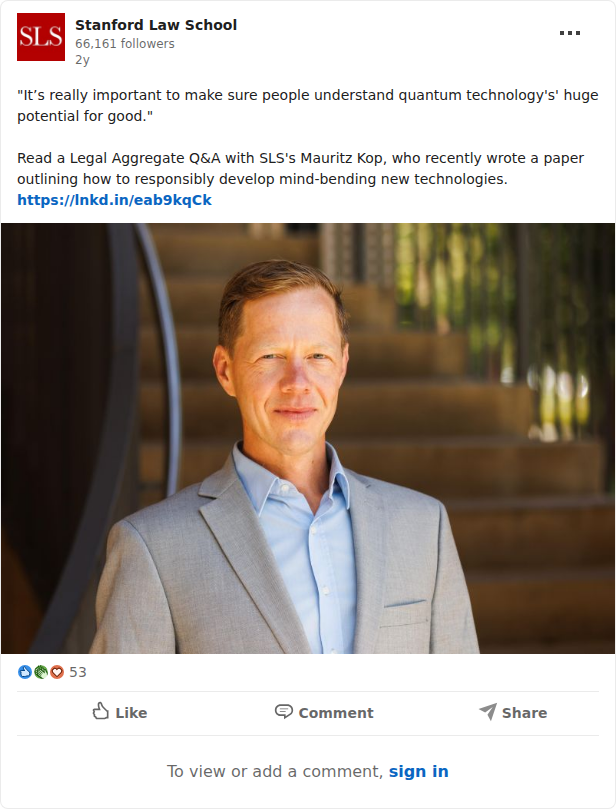
Stanford Law School Legal Aggregate Q&A with SLS's Mauritz Kop on Quantum Technologies

Stanford Law School's Legal Aggregate blog has run a Q&A with Mauritz Kop—SLS's Mauritz Kop Discusses Quantum Technology and the Need for Legal and Policy Guardrails—published a day after his Nature Physics comment A Call for Responsible Quantum Technology, co-authored with Urs Gasser and Eline De Jong. The conversation translates a scholarly argument for responsible quantum technology into terms a general readership can act on.

Guardrails as a design choice

The interview's frame is constructive rather than alarmist: the case for legal and policy guardrails is the case for capturing quantum technology's benefits responsibly, while the field's commercial and strategic shape is still being set. Because qubits can hold superpositions of states and become entangled, quantum systems unsettle long-standing assumptions—about what can be measured, copied, or kept secret—that current law and infrastructure quietly rely on. Addressing that upstream, the argument runs, is cheaper and more credible than reacting to harms after deployment. The piece is equally careful about timing: much of the field's most consequential promise depends on advances in error correction and the management of decoherence, and it is exactly that gap between current machines and eventual capability that makes early, revisable governance the prudent course.

Scholarship built to be cited

A distinctive thread is Kop's publication strategy: placing work in both scientific and legal journals so that policymakers can cite it and build durable policy on top of it—across national security, export controls, supply chains, intellectual property, and standardization. The Nature Physics comment makes the foundational move, calling on the research community to take shared responsibility for defining the principles and practices of responsible quantum technology rather than leaving that to after-the-fact regulation.

Institution-building at Stanford

The Q&A situates the argument inside the work then underway at Stanford Law School—a newly launched center for responsible quantum technology, a quantum incubator, and an annual conference, the second edition of which was covered in the 2nd Annual Stanford Responsible Quantum Technology Conference summary. The fuller portrait of the scholar behind the program is set out in the Mauritz Kop profile. The result is a single message in two registers: responsible governance of quantum technology is an upstream design choice, best made while the technology, the market, and the law are all still forming. It is a message that echoes a recurring theme in the parallel governance of artificial intelligence: that durable rules tend to rest on a credible evidentiary record assembled before the technology matures. The Legal Aggregate Q&A reads, in that light, as an attempt to apply that insight to quantum technology one cycle earlier.

Meer lezen
Nature Physics publishes A Call for Responsible Quantum Technology by Urs Gasser, Eline De Jong and Mauritz Kop

The leading journal Nature Physics has published "A Call for Responsible Quantum Technology," a significant Comment piece authored by a transatlantic team of scholars: Urs Gasser, Eline De Jong, and Mauritz Kop. Published on April 9, 2024, the article serves as a manifesto of the Stanford Center for Responsible Quantum Technology (RQT). It presents a compelling argument for proactively establishing ethical and societal guardrails for quantum technology (QT) while the field is still in its formative stages.

Citation: Gasser, U., De Jong, E. & Kop, M. A call for responsible quantum technology. Nat. Phys. 20, 525–527 (2024). https://doi.org/10.1038/s41567-024-02462-8

This foundational work builds upon the Stanford Center for RQT's prior scholarship, including the foundational paper "Towards Responsible Quantum Technology" published at Harvard and the University of California, and the "10 Principles for Responsible Quantum Innovation" published at IOP Science & Technology. All three authors are members of the Stanford RQT Center, which is founded and directed by Kop, who also served as the senior and corresponding author on the Nature publication. The article crystallizes the Center's crucial mission: to guide the development of quantum technologies in a direction that is safe, ethical, and beneficial for humanity and the planet.

Watch Urs Gasser and Eline De Jong present their Nature publication at the Stanford Responsible Quantum Technology Conference here: https://youtu.be/2vA9fID-7SA?si=MV67C9jN34UlsmuW&t=1279

The Core Argument: A Proactive Stance on Quantum Governance

The central thesis of "A Call for Responsible Quantum Technology" is both clear and urgent: the time to consider and implement governance frameworks for QT is now. The authors draw a crucial lesson from the history of other powerful innovations, such as nuclear fission and artificial intelligence (AI), where ethical, legal, and social considerations were often addressed reactively, "once the genie is already out of the bottle." Given the potentially transformative and disruptive power of quantum, the article argues that repeating this mistake is not an option.

A Framework for Responsible Quantum Innovation

To navigate this complex landscape, the authors propose a comprehensive framework for Responsible Quantum Technology. This is not a call for premature, heavy-handed legislation but for a systematic approach to anticipate and manage the ethical, legal, social, and policy implications (ELSPI) throughout the entire QT lifecycle.

The framework is designed to be operationalized through a set of quantum-specific guiding principles, which the authors organize into three functional categories, known as the SEA principles:

  • Safeguarding: Principles focused on mitigating downside risks, requiring that issues like information security and malicious dual-use scenarios are considered from the outset of research and development.

  • Engaging: Principles designed to foster robust interaction between innovators and diverse stakeholders to address complex issues like intellectual property, market competition, and equitable access.

  • Advancing: Principles that prioritize and incentivize the development of QT applications that serve desirable societal goals and the common good.

This layered approach, spanning technical, ethical, and socio-legal considerations, provides a navigational aid for researchers, funders, policymakers, and industry leaders, offering both an "issue spotter" to identify potential challenges and a "compass" to guide the technology's trajectory.

The Authors of the Nature Publication on Responsible Quantum Technology

The Nature article is a product of deep interdisciplinary expertise, authored by three leading figures at the Stanford Center for Responsible Quantum Technology:

Urs Gasser is a distinguished Professor at the Technical University of Munich (TUM), where he is Dean of the TUM School of Social Sciences and Technology. A Fellow at the Stanford RQT Center, he was previously the Executive Director of the Berkman Klein Center for Internet & Society at Harvard University. His research focuses on the societal and regulatory implications of emerging technologies, bringing a wealth of experience in technology law and policy.

Eline De Jong is a Dutch philosopher and ethicist serving as a Fellow at the Stanford RQT Center. She is currently a PhD candidate at the University of Amsterdam, specializing in the philosophy and ethics of quantum technology. Her background includes advising the Netherlands Scientific Council for Government Policy on the societal impact of AI, providing a deep understanding of the co-evolution of technology and society.

Mauritz Kop, the Founding Director of the Stanford RQT Center and the article's senior and corresponding author, is a tech lawyer, policy advisor, and academic whose work focuses on creating sui generis governance frameworks for exponential technologies like AI and quantum. His scholarship, published by leading institutions globally, aims to integrate risk management, regulatory compliance, and safety standards directly into the innovation process.

This collaboration between legal, policy, and ethics scholars underscores the article's central message: ensuring a responsible quantum future requires a concerted, interdisciplinary, and international effort. As the manifesto for the Stanford Center for RQT, Nature’s "A Call for Responsible Quantum Technology" is a foundational text, setting a clear and principled agenda for the global quantum community.

Meer lezen
Mauritz Kop Reviews Der Derian’s Project Q: War, Peace and Quantum Mechanics

Stanford University, April 1, 2024—In an era defined by rapid technological acceleration, the quantum revolution looms as perhaps the most profound and least understood transformation on the horizon. It is a domain where the esoteric principles of physics—superposition, entanglement, and uncertainty—are migrating from theoretical blackboards to the geopolitical chessboard. It is this critical, and often unsettling, intersection of science, society, and security that James Der Derian’s consequential new documentary, Project Q: War, Peace and Quantum Mechanics, masterfully explores. Having been graciously invited by the film’s producers at Bullfrog Films to review this important work as the Founding Director of the Stanford Center for Responsible Quantum Technology, Mauritz Kop found it to be an essential primer for what may well be the defining technological challenge of the 21st century.

The film serves as a crucial vehicle for fostering what Mauritz Kop calls ‘quantum literacy’—a foundational understanding of not just the science, but the societal, ethical, and political ramifications of quantum technologies, and their inherent dual-use nature. Der Derian, a distinguished scholar of international relations and director of the Centre for International Security Studies at the University of Sydney, is uniquely positioned to guide this inquiry. He eschews a purely technical exposition, instead weaving a narrative that brings together a diverse chorus of voices: leading physicists, philosophers, national security experts, artists, and historians. This multidisciplinary approach is the film’s greatest strength, transforming a subject that could easily be arcane and inaccessible into a deeply human and urgent conversation.

A Summary of the Film: The Quantum Conundrum

Project Q dives headfirst into the rapidly advancing world of quantum science, highlighting the massive investments by governments, corporations, and universities while probing the unanswered questions about humankind's quantum future. The documentary skillfully unpacks the foundational elements of quantum mechanics for a lay audience. It introduces concepts like complementarity, Niels Bohr’s principle that objects can exhibit contradictory properties, such as being both a wave and a particle, but not simultaneously. It visualizes superposition through the famous Schrödinger's cat analogy, where a particle—or a cat in a box—can exist in multiple states at once until the moment it is observed.

Project Q in Sydney: A Conclave for the Quantum Age

The documentary is inextricably linked to the real-world initiative from which it takes its name. Project Q, based at the University of Sydney, is an ambitious undertaking to bridge the gap between the scientists building the quantum future and the humanists, policymakers, and public who will inhabit it. A ‘quantum risk lab’'. The project’s home is the Q Station in Sydney, a former quarantine station with a history of isolating and managing existential threats. This setting serves as a poignant backdrop, a physical manifestation of the need to grapple with the potentially world-altering implications of quantum technology before they arrive unchecked.

A Must-Watch Call for Quantum Literacy

Project Q is a documentary of profound importance and timeliness. It is a wake-up call, an invitation to a global conversation that has been largely confined to laboratories and classified government briefings. Der Derian has crafted a film that is both intellectually rigorous and deeply accessible, challenging its audience to think critically about the path we are on. By exploring both the risks and benefits of quantum innovation, the film offers a vital multidisciplinary perspective on how this emerging suite of technologies might reshape global peace, security, and politics.

Meer lezen
Council of Canadian Academies Publishes Quantum Potential Report

The Council of Canadian Academies has released Quantum Potential, the report of an independent expert panel on the responsible adoption of quantum technologies in Canada. Chaired by physicist Raymond Laflamme, the thirteen-member panel included Mauritz Kop—one panel member among the thirteen, whose listed expertise covered the ethical, legal, and policy dimensions—on a question Canada's federal departments had put to the academies: how to turn quantum research strength into broad, responsible adoption.

A national academy weighs in on quantum

Commissioned by Innovation, Science and Economic Development Canada and the National Research Council of Canada, the assessment treats quantum technology as an economic opportunity inseparable from its governance. The panel's reach across physics, economics, and law reflects a recurring premise of quantum policy: the hard questions—data security, market power, regulatory uncertainty, public trust—sit at the seams between disciplines, and the report frames quantum capabilities as advancing ahead of the institutions meant to steer them.

Promise and the adoption gap

The economics are striking. Quantum technologies, the report finds, may account for up to 3% of Canada's GDP by 2045, with quantum computing making the most significant contribution; the sectors most likely to be transformed range from defense and finance to chemistry and materials science. Yet the panel is candid about structural weakness: Canada's quantum expertise is clustered rather than diffused, rival countries are pulling ahead on research output, and there are few programs to encourage end-user adoption. The challenge, in short, is not only invention but diffusion—and anticipating the outcomes of technological change before they arrive.

Responsible adoption, two-handed

The report's normative center is its prescription for responsible adoption: a deliberately two-handed mix of state-sanctioned and self-regulating measures, reaching for anticipatory instruments—quantum impact assessments, soft-law mechanisms, and stakeholder consultation—rather than waiting for harms to crystallize. That posture echoes a recurring theme in the responsible-quantum literature, where governance is framed as a graduated toolbox calibrated to a technology whose risks are still taking shape. The convergence is not an endorsement of any one framework, but it helps explain why the panel drew on members working at the intersection of quantum science and law and policy.

Why it carries weight

National academies do not legislate; their authority is the authority of independent expert synthesis offered to governments deciding how to act. Quantum Potential functions as exactly that—structured evidence and options for Canadian policymakers as the country set its quantum course. Kop's engagement with Canadian and allied quantum governance is of a piece with his wider advisory work, which later included his 2024 consultations with the U.S. Department of State on quantum technology and foreign-policy strategy. For readers tracing how responsible-quantum thinking moves from scholarship into national policy, the report—and the broader body of work catalogued on the Mauritz Kop profile—is a useful waypoint: a moment when an independent panel told a government, in plain terms, that getting both the state-sanctioned and the self-regulating instruments in place early is the practical work of responsible quantum adoption.

Meer lezen
Quantum Days Canada: CCA Panel on Quantum Technologies

When the Council of Canadian Academies brought its quantum expert panel to Quantum Days in January 2023, it did something unusual for a national academy: it opened an unfinished study to public input. Mauritz Kop joined the session to frame the ethical, legal, social, and policy stakes of quantum adoption—and to invite the audience to help shape the questions, not just receive the answers.

A government-commissioned panel, in public

The panel had been formed at the request of federal sponsors, including the National Research Council of Canada and Innovation, Science and Economic Development Canada, and was chaired by the physicist Raymond Laflamme. The Quantum Days appearance gathered members of that panel—Laflamme, Jeff Kinder, Mauritz Kop, and Jacqueline Bartlett among the named participants—to discuss the panel's mandate, key questions, and priorities while its assessment of Canadian quantum adoption was still being written. It was a national study opened up mid-draft, with its conclusions deliberately still open.

Live polls and equitable access

The session's signature move was procedural: the audience was invited to feed the eventual report through live polls, under the banner of helping Canada build a quantum ecosystem. That design choice carries an argument. Responsible quantum governance, on Kop's reading, treats equitable access to quantum-enabled prosperity as a question to be settled by deliberation rather than left to the market, and asks how codes of conduct and design guidelines can be agreed across cultures whose ethical intuitions differ. Live audience input is well suited to surfacing exactly the trade-offs that have no single technically correct answer—and it reflects the distributive themes that run through Kop's broader scholarship on responsible technology.

Why the policy lens belongs at a physics conference

Quantum systems invite governance because their behavior is genuinely unfamiliar. Superposition and entanglement change what computation can do, with consequences for cryptography and security that existing law did not anticipate. The case for an ethical, legal, social, and policy lens at a technical conference is that the rules must be drafted while the science is still moving—a position consistent with the standards-and-principles direction Kop and colleagues set out in the Ten Principles for Responsible Quantum Innovation.

A panel on its way to a report

The Quantum Days session is one step in a longer process. The same panel, under the same chair, is carrying its study through 2023 toward a national assessment of quantum adoption in Canada, with Kop among its members. The sequence—open the questions in public, gather input through live polls, then translate that deliberation into evidence for decision-makers—offers a working model of quantum governance that is both expert-led and publicly grounded, an early example of treating quantum policy as a question worked out in the open rather than a finished product to be announced. (That study became the CCA's Quantum Potential report, published November 30, 2023.)

Meer lezen