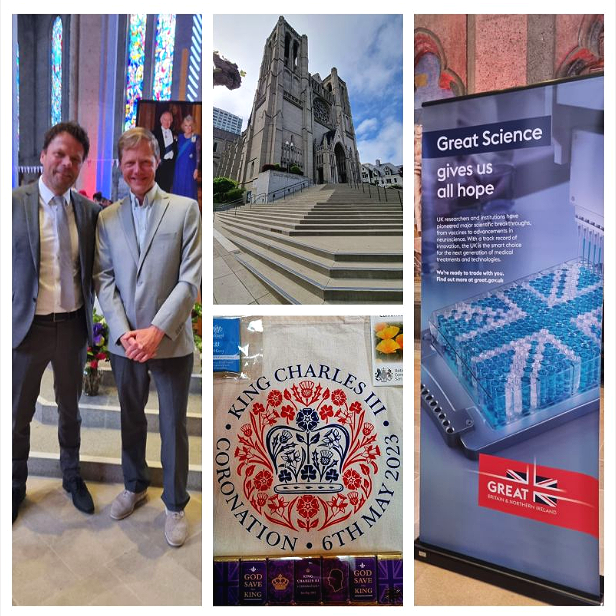
Around coronation weekend in May 2023—as King Charles III and Queen Camilla were crowned at Westminster Abbey—the British Consulate General in San Francisco hosted a coronation celebration at Grace Cathedral. The afternoon paired royal pageantry, screened from London, with a performance by the Saint Helena Unified School District choir. It was also, for the diplomats and scientists present, an unstructured space in which the governance of emerging technology could be raised informally—a cultural moment that doubled as quiet science diplomacy.
A celebration that became a conversation
Stanford legal scholar Mauritz Kop, who works on responsible quantum technology and trustworthy artificial intelligence, used the gathering to discuss pathways toward responsible quantum technology (RQT) and trustworthy AI with government representatives from an array of countries. Consular receptions rarely produce communiqués; what they produce is shared vocabulary and durable relationships—the connective tissue on which later cooperation depends. A coronation party is, on its surface, a cultural moment; for the people in the room, it was also a rare unstructured setting in which the substance of technology policy could be raised without the apparatus of a formal summit.
Science diplomacy, defined
Science diplomacy is the deliberate use of scientific cooperation to build relationships and inform policy across borders. The questions raised that afternoon were genuinely interdisciplinary: because an arbitrary unknown quantum state cannot be perfectly copied—the no-cloning theorem—quantum technologies reshape what secure communication and intercept attacks can even mean, with direct consequences for cryptography, security, and the legal frameworks that must keep pace. Raising such questions with diplomats from several governments, in a room built for conversation rather than negotiation, is exactly how interdisciplinary governance work begins.
The hosts and the guests
Among the representatives present were Dutch Innovation Consul Walter de Wit and Consul General Dirk Janssen. The event was organized by the UK Science & Innovation Network; Kop thanked Joe White MBE, then His Majesty's Consul General in San Francisco, and Florence Chaverneff of the Network, for convening it. The lesson is a small one with large implications: a guest list is also an agenda, and cultural occasions are among the better instruments of technology diplomacy.
Why it matters
Responsible quantum technology and trustworthy AI will not be governed by any country acting alone, but by networks of people who trust one another enough to disagree productively. Those networks are sometimes built in conference halls and sometimes in a cathedral, on a celebratory afternoon—between a screening of a coronation and a choir's last song. Read alongside the formal record of conferences and consultations, the afternoon is a reminder that some of the most consequential governance work happens in the margins of cultural events. Related reading: AIRecht's coverage of the Stanford Center for Responsible Quantum Technology.
Meer lezen