
Innovation, Quantum-AI Technology & Law

Blog over Kunstmatige Intelligentie, Quantum, Deep Learning, Blockchain en Big Data Law

Blog over juridische, sociale, ethische en policy aspecten van Kunstmatige Intelligentie, Quantum Computing, Sensing & Communication, Augmented Reality en Robotica, Big Data Wetgeving en Machine Learning Regelgeving. Kennisartikelen inzake de EU AI Act, de Data Governance Act, cloud computing, algoritmes, privacy, virtual reality, blockchain, robotlaw, smart contracts, informatierecht, ICT contracten, online platforms, apps en tools. Europese regels, auteursrecht, chipsrecht, databankrechten en juridische diensten AI recht.

Berichten met de tag Quantum Technology
From Kananaskis to Évian: Will the G7 Govern Quantum, or Keep Describing It?

When G7 leaders meet in Évian-les-Bains from June 15 to 17, 2026, quantum technology sits on the leaders' table for a second consecutive year. In a new CIGI op-ed, Stanford and CIGI legal scholar Mauritz Kop argues that the era of shared values and summit language has run its course: between the Kananaskis Common Vision and the OECD Recommendation on Quantum Technologies, the conceptual groundwork is done. What remains is implementation — and implementation is what voluntary coordination delivers slowly, unevenly, or never.

From a Common Vision to Working Machinery

Kananaskis named the right concerns in June 2025 but built light machinery — no timelines, no benchmarks, no procurement commitments. A year on, Kop puts the question to Évian directly: does the G7 intend to govern quantum, or to keep describing it? His answer is not another principles instrument but a delivery body with named products and deadlines, reporting back to leaders at the 2027 summit.

Five Decisions for Évian

The piece sets out five decisions leaders can take in France: post-quantum cryptography migration milestones for critical infrastructure; trusted and resilient quantum supply chains; standards-based governance backed by procurement; dual-use coordination through a least trade-restrictive, security-sufficient and innovation-preserving (LSI) test; and vigilance on the market structure of an industry already concentrating around a few compute-, patent- and talent-rich incumbents.

Each decision turns a value into something auditable. The "harvest-now, decrypt-later" threat makes cryptographic migration a present-tense problem with an unknown deadline; when Google gives itself until 2029, governments that have given themselves ten years should take notice. The same logic runs through supply-chain chokepoints, technical standards and export controls — defaults that will be written by someone, and better written deliberately than by accident.

The Window Is Still Open

Quantum is leaving the laboratory and becoming strategic infrastructure, a shift central banks already treat as systemic. The window for writing the rules of the road remains open, Kop warns, but it will not stay open forever. For the legal and policy background to the dual-use argument, see our coverage of the LSI test for securing the quantum industrial commons.

Meer lezen


BioLawLaPaLooZa: Mauritz Kop on Hippocratic Quantum and the End of Stable Records at Stanford Law School

At BioLawLaPaLooZa, the annual law-and-biosciences conference convened at Stanford Law School by Henry T. "Hank" Greely and co-hosted with the Journal of Law and the Biosciences, Mauritz Kop delivered a talk that fused two strands of his recent work: the biomedical-ethics argument of his Harvard-published Hippocratic Quantum project and the security lens of his NATO Strategic Communications advisory work. It was his third appearance at the gathering, which builds on his earlier BioLawLaPaLooZa remarks.

The past is not yet stable

Kop's organizing line was that "the past is not yet stable." Rather than treating the quantum threat as a future event, he argued that today's authenticated, confidential records are contingent on a cryptographic transition still under way: adversaries can harvest encrypted data now and decrypt it once a Shor-capable machine factors the large integers beneath RSA. Confidentiality, in this reading, must be defended retroactively as well as prospectively—making the migration to post-quantum cryptography, for hospitals and biobanks, a clinical duty rather than an IT preference. The point reframes a familiar threat model: the danger is not only what a future machine will decrypt, but what is being copied and stored today against that day.

Four classical principles, recomputed

The talk recast the four principles of biomedical ethics—autonomy, beneficence, non-maleficence, and justice—for a quantum register. Quantum does not replace them, Kop said; it changes what applying them requires. Autonomy comes to demand data sovereignty and a credible right not to know as quantum-AI systems build finer probabilistic patient models. Dual-use simulators that design therapeutics can also lower the barrier to designing pathogens, which is where his LSI test—least trade-restrictive, security-sufficient, innovation-preserving—supports tiered disclosure over blanket secrecy. And the justice problem is a widening one: the quantum divide, he warned, may prove steeper than the digital divide.

The X-Ray City and a constitution for medicine

Widening the lens, Kop described civic-scale quantum gravimetric and magnetic sensors moving from the laboratory toward infrastructure pilots—able, from public rights-of-way, to resolve subsurface and interior spaces, and so to reach into the privacy of the home. He calls this prospect the X-Ray City, and said he had told NATO it needs a Hippocratic Quantum posture of its own. He closed with a "quantum constitution for medicine" in four standards of care: quantum-safe encryption, sovereignty over patient digital twins, human oversight in the loop, and tiered disclosure under the LSI test. The premise the room had not heard before, he suggested, was simply that the past itself is not yet settled.

Meer lezen
StateScoop Interviews Mauritz Kop About Ohio House Bill 650 on Quantum Technology

When a statehouse starts asking serious questions about quantum computing, something has shifted. StateScoop—the Washington outlet that covers state and local government technology—has interviewed Mauritz Kop, Founder of the Stanford Center for Responsible Quantum Technology, about Ohio House Bill 650: legislation, passed unanimously by the Ohio House and now before the Senate, that would create a Frontier Technologies and Quantum Commission to study quantum computing, artificial intelligence, cybersecurity, and robotics, and report recommendations to the General Assembly by the end of 2026.

A statehouse turns to the quantum age

The commission would seat members of both chambers and draw on outside experts—an institutional answer to a structural problem. Emerging technologies now advance faster than traditional legislative cycles, and the gap between innovation and regulation widens every session a legislature waits. Ohio's answer is to build standing expertise before quantum systems are woven into procurement, infrastructure, and security frameworks, rather than legislating after the fact. It is, as Kop puts it in the interview, the role of state commissions to serve as "an essential laboratory for anticipatory governance."

Three messages from the interview

Kop's advice to Ohio distills into three propositions. First, anticipatory governance works: states that organize knowledge early write better rules later. Second, post-quantum cryptography migration is "really a country wide effort"—state agencies hold health records, tax data, and election infrastructure whose confidentiality must outlive the arrival of cryptographically relevant quantum machines, and migration timelines are measured in years, not budget cycles. Third, ethics embedded smartly in regulation does not slow innovation—it propels it, by giving industry predictable rules and the public reasons to trust what is being built.

Why state-level quantum policy matters now

Ohio is not moving alone. California, Texas, New Mexico, and Maryland have each launched quantum initiatives of their own, and the federal picture is evolving in parallel—terrain Kop knows from advising the U.S. Department of State on quantum technology and foreign policy strategy. The emerging pattern is federalism doing what it does best: fifty laboratories testing governance designs for a technology whose economic and security consequences will be national. The full StateScoop article includes Kop's remarks on commissions, cryptography, and the innovation case for ethics—and this post walks through its key arguments.

Meer lezen
CIGI Publishes Global Quantum Policy Brief by Mauritz Kop and Tracey Forrest

Waterloo, 5 February 2026—The Centre for International Governance Innovation (CIGI) has published a new policy brief, Global Quantum Governance: From Principles to Practice, authored by Mauritz Kop and Tracey Forrest. The brief is written for policy makers, regulators, standards bodies, and industry actors facing a practical transition: quantum technologies are moving from laboratory milestones toward deployment pathways where governance choices—especially around cybersecurity and cross-border infrastructure—become difficult to reverse.

Download the Policy Brief here: https://www.cigionline.org/documents/3746/PB_No.222_Kop_and_Forrest.pdf

Why this brief on quantum governance, and why now

The brief’s central timing claim is that near-term milestones—particularly post-quantum cryptography (PQC) migration and quantum networking—create a governance tipping point. After that point, certain security and societal harms may be costly (or impossible) to remediate. In the brief’s framing, PQC migration is not merely an engineering update; it is a “temporal rights and resilience” imperative because present-day decisions about crypto-agility, key life-cycle management, and data minimization determine whether sensitive data remains protected against future adversaries.

This urgency is paired with a structural diagnosis: national initiatives—including the EU’s proposed Quantum Act—are important, but insufficient on their own given quantum’s dual-use characteristics, global supply chains, and asymmetric capabilities across states and firms. The authors argue for a governance architecture that is “standards-first” and internationally coordinated, capable of sustaining what they call “security-sufficient openness,” and overseen by an International Quantum Agency.

The brief’s recommendations in practical terms

The brief concludes with a multi-pronged path “from principles to practice,” emphasizing four implementable priorities:

  1. Strengthen foundations through standards and PQC execution: align cryptographic profiles across sectors; update procurement so crypto-agility, key life-cycle management, and “harvest now, decrypt later” mitigation become baseline requirements; and adopt “cryptographic resilience” via agile standards, testing, and incident playbooks.

  2. Harmonize among allies: coordinate export controls, investment screening, and supply-chain security via mechanisms such as a proposed G7 Quantum Technology Point of Contact Group and narrowly scoped license-exception approaches in Five Eyes/AUKUS-style arrangements, while avoiding poorly designed measures that impose high compliance costs and chill benign collaboration.

  3. Incentivize global collaboration and capacity building: federate national quantum clouds, SDG-oriented demonstrators, and regional test networks under common governance rules; and consider, longer-term, a “CERN for Quantum” that provides shared access anchored in transparency and equitable access, including for Global South partners.

  4. Institutionalize foresight and bounded algorithmic regulation: resource international foresight capacities—within an IQA-type body or linked observatories—to update risk scenarios and stress-test legal frameworks, while experimenting with limited, well-governed AI-assisted monitoring and red-teaming to inform accountable human decision makers.

Takeaway for AIRecht’s readership

For legal and policy practitioners, the brief’s message is that quantum governance is entering a phase where operational artifacts—standards, benchmarks, procurement baselines, and interoperability profiles—will increasingly determine real-world rights, liabilities, and security outcomes. PQC migration and quantum networking are treated as the near-term proving ground for whether democracies can coordinate “security-sufficient openness” at scale.

For innovators and investors, the brief underscores that governance is not a brake on quantum progress but a design constraint that—if addressed early—can preserve global interoperability, reduce fragmentation, and support responsible diffusion of quantum capability without deepening geopolitical divides.

Meer lezen
A Principled Approach to Quantum Technology: The Stanford RQT Framework and Its Ten Principles

Quantum hardware is advancing faster than the rules meant to govern it. In A Principled Approach to Quantum Technologies (posted as a preprint on SSRN), Mauritz Kop—Founder of the Stanford Center for Responsible Quantum Technology—surveys the 2024–2025 wave of breakthroughs from Google, IBM, D-Wave, Quantinuum, and Microsoft, and argues that the governance gap should be closed now, through the Stanford RQT framework and its Ten Principles for Responsible Quantum Innovation, rather than by waiting for comprehensive regulation.

Capability is outpacing governance

The paper reads the hardware moment carefully: Google's 105-qubit Willow crossing the below-threshold error-correction milestone; IBM's modular roadmap; D-Wave's 4,400-plus-qubit Advantage2 and its 2025 supremacy claim on a materials-simulation problem; Quantinuum and Microsoft's progress on logical qubits; and Microsoft's Majorana 1 topological chip, presented as a scientific advance still facing real scaling challenges. The trajectory—rising capability across computing, simulation, sensing, networking, and quantum/AI hybrids—is what makes governance urgent, because the field still lacks unified interoperability standards, certification, benchmarking, and quantum-ready quality-management systems.

Quantum-ELSPI and dual use

The governance frame is Quantum-ELSPI: the ethical, legal, socio-economic, and policy implications of quantum technology. Because second-generation quantum systems directly harness superposition, entanglement, and tunneling, their dual-use character is acute—quantum simulation can yield vaccines or weapons, sensors can serve the environment or surveillance—and a sufficiently capable machine could break today's encryption, making preparation for "Q-day" through post-quantum cryptography and NIST standards a present-tense task. The paper draws an explicit lesson from nuclear technology—society justifies medical and energy uses while doing little about the destructive extreme—an asymmetry quantum governance should not repeat. The deeper lessons come from a community Kop helped build, surveyed in the second annual Stanford Responsible Quantum Technology Conference.

The RQT framework and SEA

The constructive answer is Responsible Quantum Technology, operationalized through Ten Principles organized under safeguarding, engaging, and advancing (SEA) quantum technologies, society, and humankind—the aim being to safeguard society through advancing quantum technology, a responsible but pro-innovation stance. The framework also folds in the four dimensions of Responsible Research and Innovation—anticipation, reflexivity, inclusion, and responsiveness—and treats regulation as a balancing act, invoking the Collingridge dilemma to argue for anticipatory governance before the technology becomes locked in. Absent formal regulation beyond security and export controls, stakeholders are urged to adopt self-regulatory quantum-technology-assessment tools to monitor, validate, and audit applications across their life cycle—an approach the paper frames as both a public good and a first-mover advantage. Kop developed this institutional home as the center's founder, whose launch at Stanford set the agenda the paper now systematizes. Its governing maxim—quantum R&D kept "as open as possible, and as closed as necessary"—frames a deliberate path through the current regulatory vacuum.

Meer lezen
The Innovator Features Mauritz Kop in Interview on Responsible Quantum Governance

In its weekly long-form feature, the Paris-based digital media outlet The Innovator sat down with Mauritz Kop—Founder and Executive Director of the Stanford Center for Responsible Quantum Technology and a Stanford Law School TTLF Fellow—to ask a deceptively simple question: how close is quantum technology, and who will it actually serve? The interview, conducted by founding editor Jennifer L. Schenker after Kop's appearance at the XPANSE conference in Abu Dhabi, is notable for refusing the two easy answers. It neither dismisses quantum as decades-distant nor inflates it into magic. Instead it offers a branch-by-branch reading—in Kop's own terms—of a technology arriving faster than the rules meant to govern it.

A family of technologies, not a single arrival

Kop's central move is to treat quantum as a family—computing, sensing, networking, cryptography—rather than a monolith. Useful, scalable quantum computing, on his estimate, is the nearest of the branches; secure quantum networking sits roughly a decade out; and quantum-AI hybrids are already under active development. Each branch keeps its own governance clock, and conflating them is precisely how policy goes wrong. The interview's discipline in separating the timelines is what makes it useful to the corporate readers The Innovator serves.

The divide, and the duty to close it

The conversation does not stop at capability. Kop is candid that quantum hardware is "difficult and expensive to develop," raising the prospect of a quantum divide that deepens existing inequalities rather than easing them. Set against that risk is a large, genuinely planetary upside: combined with AI and advances in energy, quantum tools could help address climate-scale problems in materials and chemistry. The gap between those two futures, in Kop's telling, is governance—which is why he calls for "planetary thinking" tied to values-laden standards, the same anticipatory posture that animates his broader scholarship on the ethical, legal, social, and policy implications of quantum technology.

Advice for the early movers

For business leaders, the interview delivers a clear thesis: invest early, but build governance capability in step with technical capability. Quantum literacy, Kop argues, is a first-mover advantage, and the discipline responsible adoption requires today is the same discipline compliance is likely to require as regulatory expectations develop. That conviction runs through the body of work documented on Kop's scholar profile, where standards developed early give organizations something concrete to build toward before binding law settles. Featured in the aftermath of a deep-tech summit, the interview captures a field at its inflection point—and a scholar insisting that the responsible path and the strategic path are, increasingly, the same road.

Meer lezen
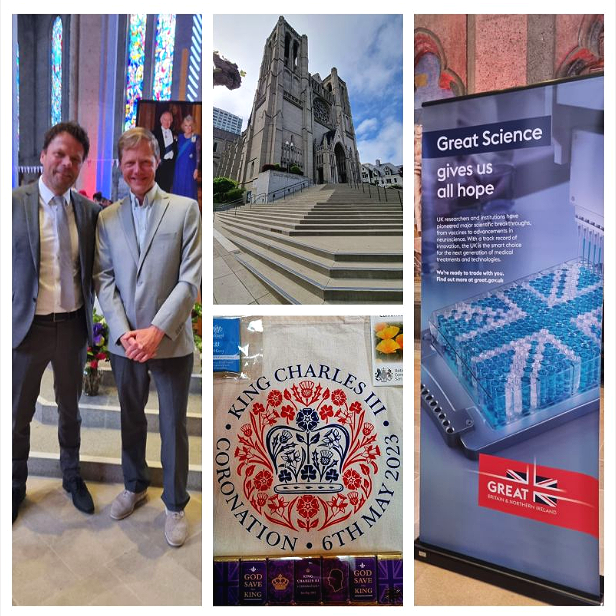
Celebrating the Coronation of King Charles III and Queen Consort Camilla at the British Consulate General Team in San Francisco

Around coronation weekend in May 2023—as King Charles III and Queen Camilla were crowned at Westminster Abbey—the British Consulate General in San Francisco hosted a coronation celebration at Grace Cathedral. The afternoon paired royal pageantry, screened from London, with a performance by the Saint Helena Unified School District choir. It was also, for the diplomats and scientists present, an unstructured space in which the governance of emerging technology could be raised informally—a cultural moment that doubled as quiet science diplomacy.

A celebration that became a conversation

Stanford legal scholar Mauritz Kop, who works on responsible quantum technology and trustworthy artificial intelligence, used the gathering to discuss pathways toward responsible quantum technology (RQT) and trustworthy AI with government representatives from an array of countries. Consular receptions rarely produce communiqués; what they produce is shared vocabulary and durable relationships—the connective tissue on which later cooperation depends. A coronation party is, on its surface, a cultural moment; for the people in the room, it was also a rare unstructured setting in which the substance of technology policy could be raised without the apparatus of a formal summit.

Science diplomacy, defined

Science diplomacy is the deliberate use of scientific cooperation to build relationships and inform policy across borders. The questions raised that afternoon were genuinely interdisciplinary: because an arbitrary unknown quantum state cannot be perfectly copied—the no-cloning theorem—quantum technologies reshape what secure communication and intercept attacks can even mean, with direct consequences for cryptography, security, and the legal frameworks that must keep pace. Raising such questions with diplomats from several governments, in a room built for conversation rather than negotiation, is exactly how interdisciplinary governance work begins.

The hosts and the guests

Among the representatives present were Dutch Innovation Consul Walter de Wit and Consul General Dirk Janssen. The event was organized by the UK Science & Innovation Network; Kop thanked Joe White MBE, then His Majesty's Consul General in San Francisco, and Florence Chaverneff of the Network, for convening it. The lesson is a small one with large implications: a guest list is also an agenda, and cultural occasions are among the better instruments of technology diplomacy.

Why it matters

Responsible quantum technology and trustworthy AI will not be governed by any country acting alone, but by networks of people who trust one another enough to disagree productively. Those networks are sometimes built in conference halls and sometimes in a cathedral, on a celebratory afternoon—between a screening of a coronation and a choir's last song. Read alongside the formal record of conferences and consultations, the afternoon is a reminder that some of the most consequential governance work happens in the margins of cultural events. Related reading: AIRecht's coverage of the Stanford Center for Responsible Quantum Technology.

Meer lezen
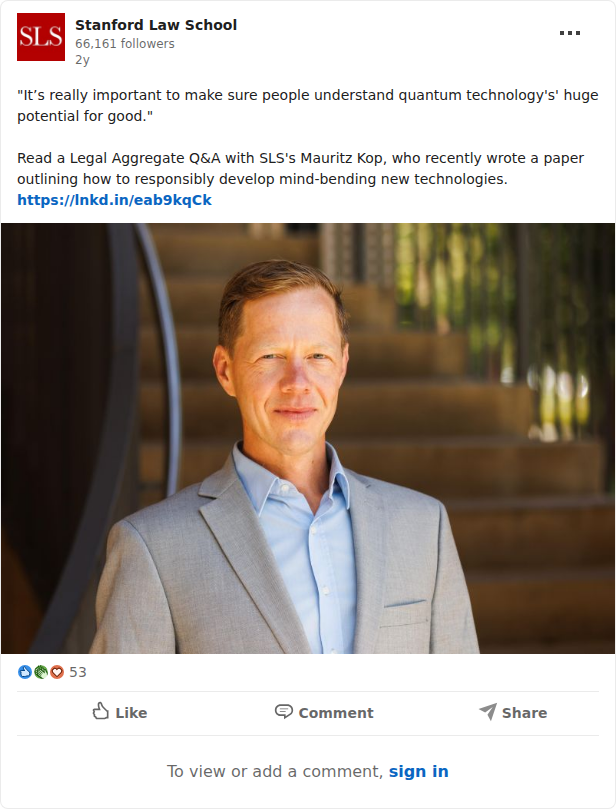
Stanford Law School Legal Aggregate Q&A with SLS's Mauritz Kop on Quantum Technologies

Stanford Law School's Legal Aggregate blog has run a Q&A with Mauritz Kop—SLS's Mauritz Kop Discusses Quantum Technology and the Need for Legal and Policy Guardrails—published a day after his Nature Physics comment A Call for Responsible Quantum Technology, co-authored with Urs Gasser and Eline De Jong. The conversation translates a scholarly argument for responsible quantum technology into terms a general readership can act on.

Guardrails as a design choice

The interview's frame is constructive rather than alarmist: the case for legal and policy guardrails is the case for capturing quantum technology's benefits responsibly, while the field's commercial and strategic shape is still being set. Because qubits can hold superpositions of states and become entangled, quantum systems unsettle long-standing assumptions—about what can be measured, copied, or kept secret—that current law and infrastructure quietly rely on. Addressing that upstream, the argument runs, is cheaper and more credible than reacting to harms after deployment. The piece is equally careful about timing: much of the field's most consequential promise depends on advances in error correction and the management of decoherence, and it is exactly that gap between current machines and eventual capability that makes early, revisable governance the prudent course.

Scholarship built to be cited

A distinctive thread is Kop's publication strategy: placing work in both scientific and legal journals so that policymakers can cite it and build durable policy on top of it—across national security, export controls, supply chains, intellectual property, and standardization. The Nature Physics comment makes the foundational move, calling on the research community to take shared responsibility for defining the principles and practices of responsible quantum technology rather than leaving that to after-the-fact regulation.

Institution-building at Stanford

The Q&A situates the argument inside the work then underway at Stanford Law School—a newly launched center for responsible quantum technology, a quantum incubator, and an annual conference, the second edition of which was covered in the 2nd Annual Stanford Responsible Quantum Technology Conference summary. The fuller portrait of the scholar behind the program is set out in the Mauritz Kop profile. The result is a single message in two registers: responsible governance of quantum technology is an upstream design choice, best made while the technology, the market, and the law are all still forming. It is a message that echoes a recurring theme in the parallel governance of artificial intelligence: that durable rules tend to rest on a credible evidentiary record assembled before the technology matures. The Legal Aggregate Q&A reads, in that light, as an attempt to apply that insight to quantum technology one cycle earlier.

Meer lezen
Quantum Trials: An FDA for Quantum Technology

What if the United States regulated emerging quantum technology the way it regulates new medicines? That is the provocation at the center of Quantum Trials: An FDA for Quantum Technology, a Stanford Law School working paper by Alexandra Waldherr, I. Glenn Cohen, and Mauritz Kop, posted as a preprint and first presented at the 2023 Stanford Responsible Quantum Technology Conference. The paper proposes a phased, documentation-driven pipeline for second-generation quantum technology, modeled on the FDA's clinical-trials regime.

A phased pipeline for quantum

The framework maps the FDA's four stages onto quantum research and development. Phase I captures a theoretical idea or laboratory proof-of-concept in a concise technical one-pager; Phase II adds a proof-of-principle validation with an ethical checklist; Phase III is a confirmatory stage whose findings are condensed into a Summary of Quantum Characteristics for regulatory assessment; and Phase IV follows the authorized technology through its public lifecycle, with failure reports and audits. Throughout, "efficacy" is reread as technical innovation and "safety" as the absence of unresolved ethical and legal concerns. A binding registry ties the phases together, serving regulators, engineers, educators, and the public from one shared record.

SEA TURTLE and the registry-first first step

Over the phases sits the SEA TURTLE checklist—a six-point barometer distilling the Ten Principles for Responsible Quantum Innovation and the broader Responsible Quantum Technology paradigm into a quick test of whether a technology is both innovative and responsibly developed. Its "SEA" element names a commitment to Safeguarding, Engaging, and Advancing quantum technology, society, and humankind. The authors are realistic about the political capital a full "FDA for Quantum" would demand, so they single out one immediate, low-cost step: making the registration of quantum developments mandatory by law, in the spirit of the legislation that produced clinicaltrials.gov. A standardized registry, they argue, gives regulators the evidence they need to balance underregulation against overregulation.

Why the analogy matters for governance

The deeper argument is structural. A young, dual-use, exponentially developing field is better served by an evidence-generating, phased pipeline than by either premature prohibition or laissez-faire. The same logic animates the authors' work on law, ethics, and policy of quantum and AI in healthcare and the ethics of biomedical discovery in Hippocratic Quantum. The paper does not claim the drug-approval analogy is settled; it invites the physics community to test its feasibility and the legislative branch to adopt, evaluate, and refine it. As an opening move in the design of quantum-specific regulatory institutions, it is less a verdict than a carefully argued invitation.

Meer lezen
Mauritz Kop and Urs Gasser at the TUM Festival of Ideas: A Live Quantum-Art Demonstration (November 2023)

In November 2023, the inaugural Festival of Ideas gathered scholars, technologists, and policymakers at the Technical University of Munich and its historic Science & Study Center at Raitenhaslach Monastery to ask how society should design a new "operating system" for an age of artificial intelligence and quantum computing. I took part as a Stanford Center for Responsible Quantum Technology participant, alongside Professor Urs Gasser of TUM.

Quantum governance on the agenda

Quantum technology ran through the program rather than sitting at its edge. A closing use-case session on responsible technology—focused on quantum, AI, and immersive tools—was moderated by Urs Gasser, Rector of TUM's Hochschule für Politik. It was the same collaboration that soon produced the Nature Physics call for responsible quantum technology that Gasser, Eline de Jong, and I co-authored, making the Festival an early working session for that line of scholarship.

A live demonstration of quantum intuition

My contribution went beyond a conventional talk. I gave a live demonstration using my own photo, video, and music as input to a real-time, beat-synced audiovisual system inspired by fractal geometry, with a generative-AI element in the loop. Fractal patterns recur in nature—and have been observed in quantum materials—so inviting the audience to become the input data made an abstract idea tangible: that art can foster the quantum intuition an interdisciplinary, double-educated quantum workforce will need.

From Abu Dhabi to a Munich grand piano

The Munich demonstration was one public instance of a format I have also performed in Abu Dhabi, on exponential-technology stages of the kind I later addressed as a speaker at XPANSE 2024. As a working musician, I added an unscripted piano interlude on the venue's grand piano—of a piece with the Festival's argument that creativity is a method, and that the most durable guardrails for fast-moving technology are designed where law, ethics, science, and art are allowed to meet.

Meer lezen
Mauritz Kop and Mateo Aboy Present QT and Law Research at Lund Quantum Conference

When Lund University convened The Quantum Law Conference in late April 2022, the legal scholarship on quantum computing was still in its infancy. Organized by Valentin Jeutner under the WASP-HS-funded Quantum Law Project, the gathering—formally titled The Legal Dimensions of Quantum Computing—gave an early home to a question that has only grown more urgent: whether intellectual property law is fit for the quantum age. Mauritz Kop, then a TTLF Fellow at Stanford Law School, and Mateo Aboy, Principal Research Scholar at the University of Cambridge, brought a distinctive answer—one built on data rather than intuition.

Theory meets the patent record

Kop's theoretical contribution warned of IP overprotection: a "rainbow" of overlapping rights that could entrench first movers and concentrate market power in a young field. Rather than rest on the argument, the team tested it. Aboy led a patent-landscape study of the quantum computing subfield, asking whether feared "thicket" and "anticommons" effects were actually appearing. The pairing of a normative framework with empirical patent analysis is what made the Lund presentation unusual—and useful to policymakers who need evidence, not assertion.

A counter-intuitive result

The data pointed the other way. The patent system in quantum computing was not, at that stage, generating innovation-choking overprotection; instead, a growing share of quantum patent information was entering the publicly available disclosure record through lapsed and non-granted filings, forming an expanding information commons. The important caveat was secrecy: trade secrets and state secrets ordinarily do not appear in patent datasets, so quantitative mapping must always be read alongside qualitative analysis. The conclusion was measured—IP law works best in concert with competition law, steering between under- and overprotection.

From a conference room toward the journals

The work is not staying in Lund. The theoretical and market-power strand is forthcoming as a peer-reviewed article in the Journal of Intellectual Property Law & Practice (Oxford University Press), and the companion patent-landscape study is forthcoming in IIC – International Review of Intellectual Property and Competition Law (Springer), with a transatlantic author team spanning Stanford, Cambridge, and CeBIL at the University of Copenhagen. Together they promise one of the earliest evidence-based treatments of quantum-IP policy. It is a quieter companion to Kop's better-known warning that quantum computing carries risks that rival those of artificial intelligence: here the concern is not catastrophe but market structure—who gets to build on quantum technology, and on what terms. The answer the Lund research offers is calibration, not maximalism: predictability enough to attract investment, openness enough to keep the field competitive.

Meer lezen
Een IPCC voor AI en opkomende technologie: het IPREDICT-voorstel aan de VN

IPREDICT is de oproep aan de Secretaris-Generaal van de Verenigde Naties om een internationaal panel voor verantwoorde ontwikkeling van opkomende technologie op te richten — naar het model van het klimaatpanel IPCC. AIRecht-oprichter Mauritz Kop behoorde tot de internationale experts die het voorstel voorbereidden en leverde de inbreng over quantumtechnologie.

Een IPCC voor opkomende technologie

De kern is coördinatie: één onafhankelijke, interdisciplinaire bron die kunstmatige intelligentie, robotica, biotechnologie en quantumtechnologie beoordeelt vóórdat de gevolgen onomkeerbaar zijn. Het voorgestelde mandaat omvat betrouwbare informatie, expert-aanbevelingen, het aanmoedigen van verantwoorde innovatie in alle ontwikkelfasen en publieke betrokkenheid via een tweejaarlijks World Forum.

Internationale participanten

Het initiatief werd voorbereid door een breed gezelschap van wetenschappers uit recht, ethiek, robotica, AI en biotechnologie — van Princeton en Yale tot UNESCO-bioethici en SIPRI. Het is precies die multidisciplinaire mengeling die een panel als IPREDICT beoogt.

De bijdrage van AIRecht

Mauritz Kop leverde de quantum-expertise, in lijn met zijn werk aan een juridisch-ethisch kader voor verantwoorde quantumtechnologie. De achterliggende gedachte is dat anticiperende governance past bij technologie die met sprongen arriveert. Verder lezen over dat kader kan in Establishing a Legal-Ethical Framework for Quantum Technology.

Meer lezen