Mauritz Kop Interviewed by Al Jazeera on Responsible Quantum AI Computing at Stanford University
By Editor
Stanford, CA, May 17, 2023—Al Jazeera English, reporting from a Silicon Valley technology summit on the next wave of computing, featured an interview with Mauritz Kop on the responsible development of quantum computing and quantum artificial intelligence (QAI) at Stanford University. The segment—correspondent Rob Reynolds's "US quantum computing summit looks for next tech revolution"—carries the interview. By his own account on LinkedIn, the conversation centered on three themes: the societal benefits and risks of quantum computing, the need for guardrails for Quantum Artificial Intelligence, and his legal-futurist scenario of a Quantum Event Horizon.
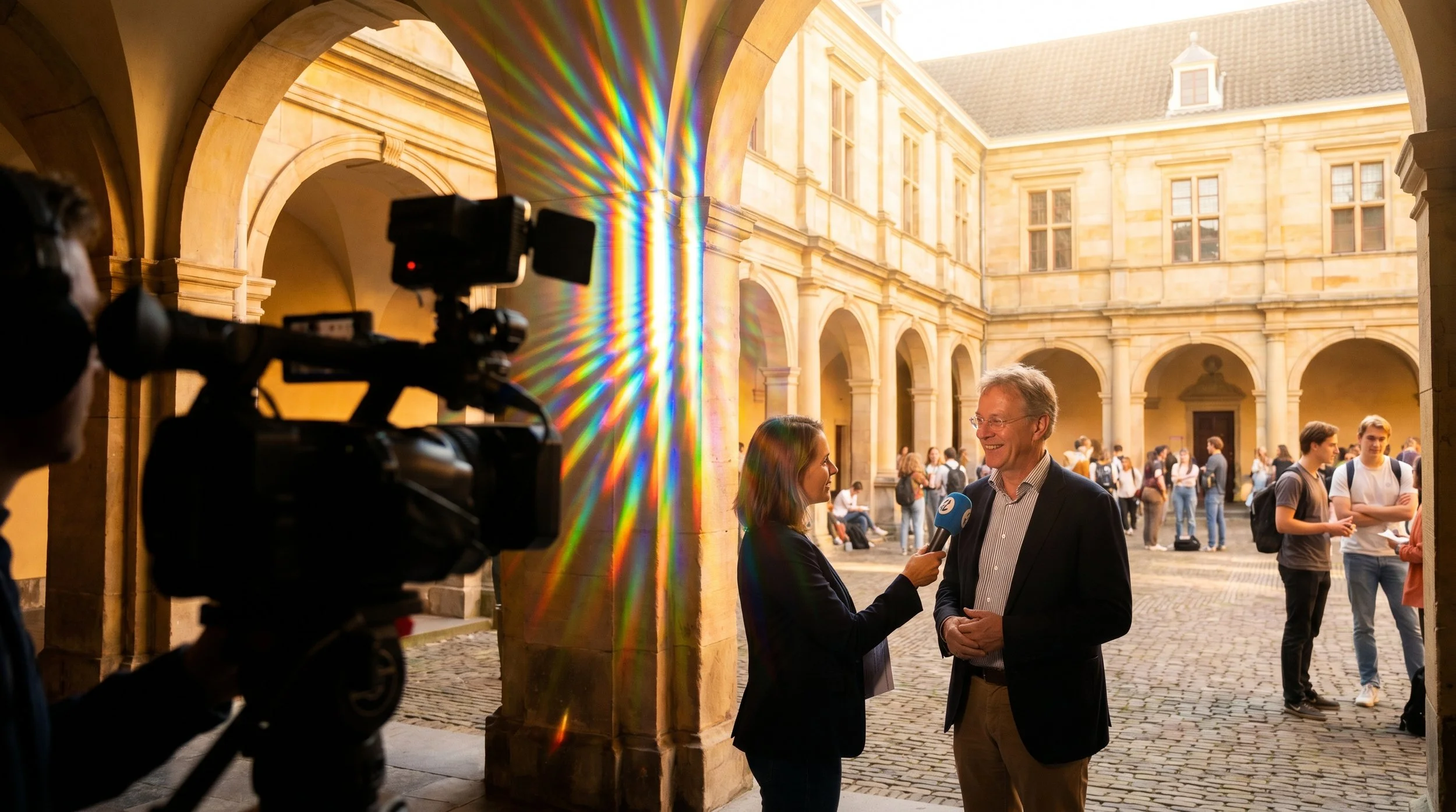
Al Jazeera English coverage of quantum computing featuring an interview at Stanford (illustrative editorial image).
A summit, a correspondent, and a lawyer's question
The Al Jazeera English report situates the interview where the technology actually lives: among the demonstrations, prototypes, and venture pitches of a Silicon Valley expo searching for the field's next breakthrough. That framing matters. Quantum computing is no longer a thought experiment confined to a physics department—it is an industry forming in real time, with capital, talent, and national strategy already flowing toward it. Kop's contribution to the segment was not to dampen the enthusiasm but to ask the question that the enthusiasm tends to skip: as these machines move from the laboratory bench into commerce and statecraft, what legal, ethical, and policy architecture should travel with them?
At the time of the interview, in the spring of 2023, Kop was a Fellow of the Transatlantic Technology Law Forum (TTLF) at Stanford Law School, where he had been working on responsible quantum technology since beginning his TTLF fellowship in 2019. The Stanford Center for Responsible Quantum Technology (Stanford RQT)—which he would go on to found and direct—was still taking shape that year; its inaugural Stanford Responsible Quantum Technology Conference was held on the Stanford campus in 2023, and the Center's formal launch was announced later that year. The Al Jazeera interview thus caught the work at an early, formative moment, when the case for responsible quantum technology still had to be made to a general audience rather than assumed.
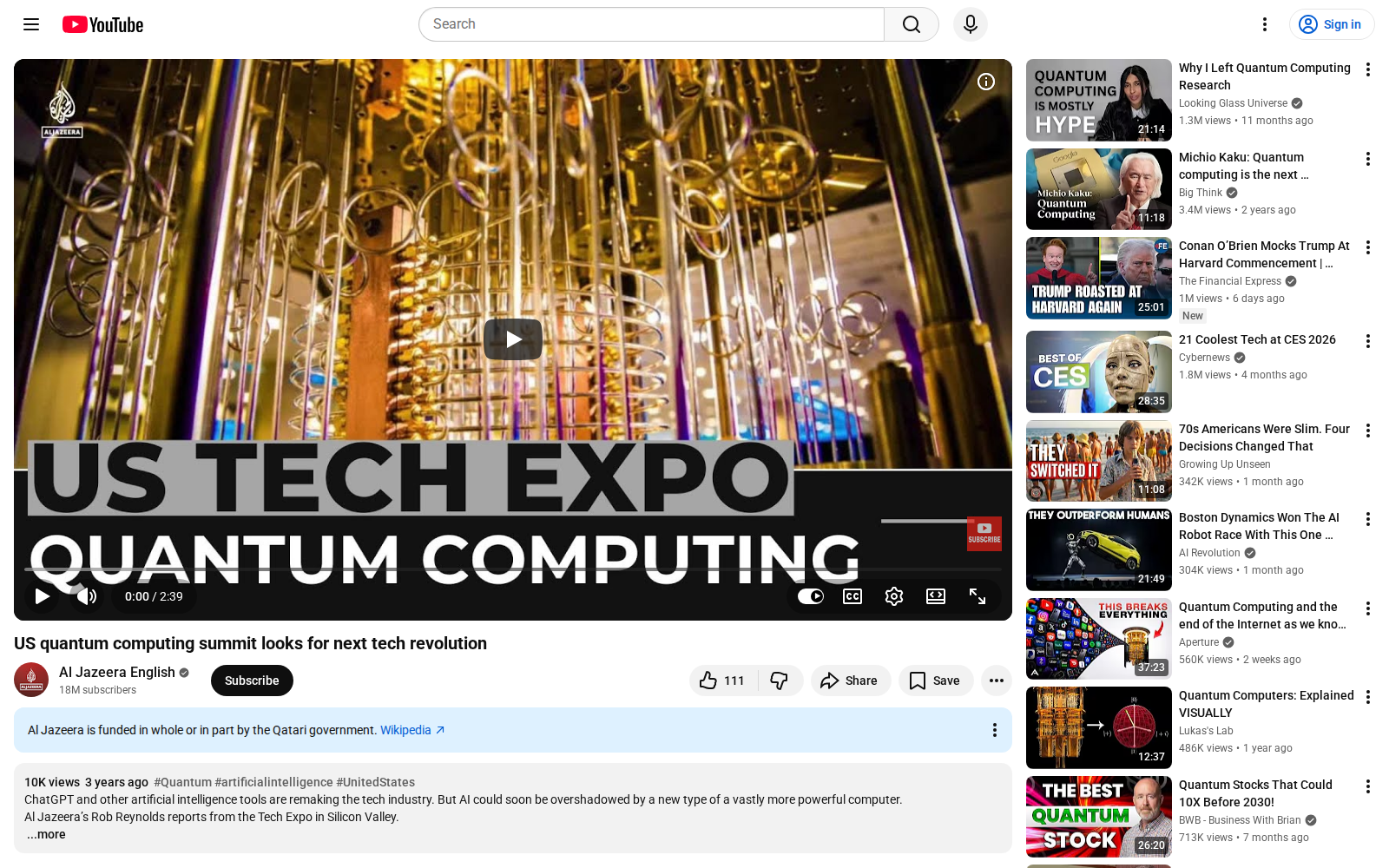
Al Jazeera English's segment 'US quantum computing summit looks for next tech revolution', May 2023.
Benefits, risks, and why quantum is its own problem
The first of Kop's three themes—the societal benefits and risks of quantum computing—is easy to state and hard to govern. The benefits are genuine and large: quantum simulation could accelerate the design of medicines, catalysts, and materials by modeling molecular behavior that defeats classical machines; quantum sensing promises new precision in medicine, navigation, and earth observation. The risks travel on the same physics. Because a sufficiently large, fault-tolerant quantum computer running Shor's algorithm could factor the large integers that underpin today's public-key cryptography, much of the encryption protecting financial systems, health records, and state secrets has a defined—if uncertain—expiry date absent a timely migration to post-quantum schemes. The asymmetry is the policy problem: the benefits accrue gradually and unevenly, while a cryptographic break would arrive as a step change.
That a single technology carries both promises is not a rhetorical flourish; it is a feature of how quantum information behaves. A quantum bit can occupy a superposition of states rather than a definite zero or one, and entangled qubits exhibit correlations with no classical counterpart—properties that give quantum machines their computational reach and, simultaneously, their disruptive edge over the mathematics that secures our infrastructure. Governance that treats the upside and the downside as separate files will mismanage both, because in quantum technology they are the same capability seen from two directions.
Guardrails for Quantum Artificial Intelligence
Kop's second theme—guardrails for Quantum Artificial Intelligence—addresses the convergence that worried him most. Quantum computing and artificial intelligence are each transformative on their own; combined, quantum-enhanced AI could compress the timelines on which oversight depends, accelerating capability faster than institutions can absorb it. His argument, developed across his Stanford work, is that the moment to install guardrails is now—at the design stage, while the technology is still malleable—rather than after deployment, when the costs of retrofitting safety become prohibitive. This is the same conviction that runs through his broader writing on the dangers of unmanaged convergence, including his 2022 Foreign Policy essay on why quantum computing is even more dangerous than artificial intelligence.
The guardrails Kop has in view are not a single statute but a layered system: technical standards, impact assessment as a design instrument, international coordination, and a governance posture that is pro-innovation and pro-precaution at once. The point of putting the question to a global television audience was precisely that these are not engineering choices to be left to engineers; they are public choices about how a powerful general-purpose technology should be allowed to develop.
The Quantum Event Horizon
Kop's third theme—the Quantum Event Horizon—names the scenario the guardrails are meant to forestall. Borrowing the physics metaphor of a boundary past which return is impossible, the concept describes a point at which a quantum-AI system becomes powerful or fast enough that meaningful human control can no longer be reasserted after the fact. The argument is not a prediction of doom but a design imperative: if such a threshold is even conceivable, then the controls that keep a system within human oversight must be built in before it is approached, not improvised afterward. Kop has since developed the idea in detail—including the proposal of quantum-resistant constitutional AI as a mechanism for keeping advanced systems corrigible—in his later writing on the Quantum Event Horizon and the quantum-AI control problem.
That a working lawyer and policy scholar took these three themes—benefits and risks, guardrails for QAI, and the Quantum Event Horizon—to an international news network in the spring of 2023 is itself part of the story. Responsible quantum technology was, at that moment, a research program in search of a public, and coverage like Al Jazeera English's placed the argument before an international audience beyond the seminar room. For policymakers, the durable takeaway is the one Kop pressed in the interview: because quantum computing's promise and its disruptive edge are the same capability seen from two directions, the legal, ethical, and policy architecture for these machines has to be designed in now—at the inflection point, while the technology is still malleable—not retrofitted once the next revolution has already arrived.
Last updated: June 6, 2026.
Watch / cite / read further
Video. US quantum computing summit looks for next tech revolution, Al Jazeera English, 19 mei 2023. Context: Silicon Valley reportage over quantum computing als volgende technologische revolutie, met Prof. Kop als geïnterviewde expert, https://www.youtube.com/watch?v=bnw4AAvumyY
Verder lezen. Urs Gasser, Eline De Jong & Mauritz Kop, A Call for Responsible Quantum Technology, Nature Physics, doi:10.1038/s41567-024-02462-8.