Innovation, Quantum-AI Technology & Law

Blog over Kunstmatige Intelligentie, Quantum, Deep Learning, Blockchain en Big Data Law

Blog over juridische, sociale, ethische en policy aspecten van Kunstmatige Intelligentie, Quantum Computing, Sensing & Communication, Augmented Reality en Robotica, Big Data Wetgeving en Machine Learning Regelgeving. Kennisartikelen inzake de EU AI Act, de Data Governance Act, cloud computing, algoritmes, privacy, virtual reality, blockchain, robotlaw, smart contracts, informatierecht, ICT contracten, online platforms, apps en tools. Europese regels, auteursrecht, chipsrecht, databankrechten en juridische diensten AI recht.

Berichten met de tag Responsible Quantum Technology
Quantum Technology Governance: The Daiki Quantum Governance Recipe and the World's First QT-QMS

Quantum technology arrives with a governance problem unlike the one that classical computing posed. The systems are powerful, dual-use, and—at the hardware level—physically fragile in ways that ordinary quality regimes never had to model. Daiki, the AI and quantum governance company co-founded by Mauritz Kop, has published the Daiki Quantum Governance Recipe to close that gap: a toolkit that turns responsible-innovation principles into an auditable management system, anchored by what Daiki calls the world's first Quantum Technology Quality Management System (QT-QMS).

A management system for a fragile technology

The QT-QMS is a coined framework, extending to quantum the system-level discipline that ISO 13485 brought to medical devices and ISO/IEC 27001 to information security. The case for a dedicated discipline is physical as much as legal: quantum information lives in fragile superposition states that decoherence degrades on short timescales, and measurement is irreversible, so fidelity, error rates, and calibration drift become first-order operational facts. A quality system built for classical software simply does not have vocabulary for these failure modes, which is why Daiki argues quantum needs a management standard of its own.

Three ingredients, one auditable trail

The Recipe is built around three pillars. A QMS Backbone supplies the ISO-aligned, auditable framework for quality and risk management, integrating ISO/IEC 27001, 27005, and 42001 alongside the proposed QT-QMS. An Ethical Compass operationalizes the Ten Principles for Responsible Quantum Innovation—grouped as Safeguarding, Engaging, and Advancing—through checklists, templates, and guided assessments. An Assessment Engine automates Quantum Impact Assessments across the lifecycle, logging every decision into a time-stamped audit trail that spans ex-ante, ex-durante, and ex-post review. Daiki frames the synthesis of the three as a path to Quantum-Resistant Constitutional AI: systems hardened against quantum attack and bound to an enforceable set of values.

Standards first, regulation later

The Recipe rests on a standards-first philosophy—voluntary, consensus-driven standards as the most workable foundation for a fast-moving field—and situates that approach inside a four-stage cycle running from principles through soft law to hard law. That sequencing matters for timing: by building governance on standards already taking shape through ISO/IEC Joint Technical Committee 3, IEEE, and NIST's post-quantum cryptography work, organizations turn today's best practices into tomorrow's compliance evidence as binding frameworks such as a future EU Quantum Act emerge. Daiki points toward system-level certification of a company's QT-QMS by an accredited body, on the medtech model, as the longer-term destination.

Why it matters now

The deeper argument is one of timing and proof. Quantum governance, like AI governance before it, is moving from voluntary commitment to a documented, auditable function—and the organizations best placed for that shift are the ones building a single coherent management system now, rather than assembling a reactive checklist once enforcement arrives. For a quantum ecosystem dominated by startups and research labs, the Recipe's promise is to lower the cost of doing this well, so that responsibility and speed stop being a trade-off.

Meer lezen
A Principled Approach to Quantum Technology: The Stanford RQT Framework and Its Ten Principles

Quantum hardware is advancing faster than the rules meant to govern it. In A Principled Approach to Quantum Technologies (posted as a preprint on SSRN), Mauritz Kop—Founder of the Stanford Center for Responsible Quantum Technology—surveys the 2024–2025 wave of breakthroughs from Google, IBM, D-Wave, Quantinuum, and Microsoft, and argues that the governance gap should be closed now, through the Stanford RQT framework and its Ten Principles for Responsible Quantum Innovation, rather than by waiting for comprehensive regulation.

Capability is outpacing governance

The paper reads the hardware moment carefully: Google's 105-qubit Willow crossing the below-threshold error-correction milestone; IBM's modular roadmap; D-Wave's 4,400-plus-qubit Advantage2 and its 2025 supremacy claim on a materials-simulation problem; Quantinuum and Microsoft's progress on logical qubits; and Microsoft's Majorana 1 topological chip, presented as a scientific advance still facing real scaling challenges. The trajectory—rising capability across computing, simulation, sensing, networking, and quantum/AI hybrids—is what makes governance urgent, because the field still lacks unified interoperability standards, certification, benchmarking, and quantum-ready quality-management systems.

Quantum-ELSPI and dual use

The governance frame is Quantum-ELSPI: the ethical, legal, socio-economic, and policy implications of quantum technology. Because second-generation quantum systems directly harness superposition, entanglement, and tunneling, their dual-use character is acute—quantum simulation can yield vaccines or weapons, sensors can serve the environment or surveillance—and a sufficiently capable machine could break today's encryption, making preparation for "Q-day" through post-quantum cryptography and NIST standards a present-tense task. The paper draws an explicit lesson from nuclear technology—society justifies medical and energy uses while doing little about the destructive extreme—an asymmetry quantum governance should not repeat. The deeper lessons come from a community Kop helped build, surveyed in the second annual Stanford Responsible Quantum Technology Conference.

The RQT framework and SEA

The constructive answer is Responsible Quantum Technology, operationalized through Ten Principles organized under safeguarding, engaging, and advancing (SEA) quantum technologies, society, and humankind—the aim being to safeguard society through advancing quantum technology, a responsible but pro-innovation stance. The framework also folds in the four dimensions of Responsible Research and Innovation—anticipation, reflexivity, inclusion, and responsiveness—and treats regulation as a balancing act, invoking the Collingridge dilemma to argue for anticipatory governance before the technology becomes locked in. Absent formal regulation beyond security and export controls, stakeholders are urged to adopt self-regulatory quantum-technology-assessment tools to monitor, validate, and audit applications across their life cycle—an approach the paper frames as both a public good and a first-mover advantage. Kop developed this institutional home as the center's founder, whose launch at Stanford set the agenda the paper now systematizes. Its governing maxim—quantum R&D kept "as open as possible, and as closed as necessary"—frames a deliberate path through the current regulatory vacuum.

Meer lezen
Towards an Atomic Agency for Quantum-AI

Stanford, CA May 5, 2025 — Today, Mauritz Kop published interdisciplinary research proposing “A Principled Approach to Quantum Technologies”, and the establishment of an “Atomic Agency for Quantum-AI” on the website of the European Commission. The Atomic Agency essay analyzes emerging AI and quantum technology (including their increasing complementarity and interdependence embodied in quantum-AI hybrids) regulation, export controls, and technical standards in the U.S., EU, and China, comparing legislative efforts anno 2025 to strategically balance the benefits and risks of these transformative technologies through the lens of their distinct innovation systems. The Principled Approach paper posits that quantum technology's dual use character brings with it the need to balance maximizing benefits with mitigating risks. In this spirit, the paper argues that quantum technology development should best be guided by a framework for Responsible Quantum Technology, operationalized by a set of tailored principles to optimize risk-benefit curves. Download the paper here.

Towards an Atomic Agency for Quantum-AI

The article analyzes emerging regulation, export controls, and technical standards for both quantum and AI (including their increasing complementarity and interdependence embodied in quantum-AI hybrids) in the U.S., EU, and China and offers novel conceptual frameworks to steward these technologies towards shared global benefit.

Key Takeaways:

1. Converging Need for Responsible Governance: Despite distinct innovation philosophies (market-driven in the U.S., values-based in the EU, and state-driven in China), there's a growing international consensus on the necessity for principled and responsible technology governance for both AI and quantum technologies.

2. The 'Washington Effect' vs. 'Beijing Effect': The U.S.'s security-centric policies are creating a de facto "Washington effect," potentially setting global rules for quantum law but risking premature regulation. Conversely, China's push for state-aligned standardization (e.g., via the Digital Silk Road) signals a "Beijing effect," which could export autocratic norms and fragment global interoperability, a trend exacerbated by unilateral export controls.

3. Potential U.S., EU and China Visions on a Quantum Governance Act: Given the distinct innovation ecosystems and strategic priorities of the United States, the European Union, and China, it is instructive to envision how each might hypothetically structure a dedicated legislative framework for quantum technologies. The research outlines hypothetical "Quantum Governance Acts" for each, reflecting their respective governance philosophies and innovation models, while also considering pathways towards greater international alignment based on shared values:

a. United States: Removing Barriers for U.S. Quantum Technology Act (deregulation, industrial standards-centric approach, Safeguarding through Advancing quantum technology, prioritizing market dynamism, national & economic security, and defense).

b. European Union: EU Quantum Act (harmonized regulation rooted in fundamental rights and societal benefit based on New Legislative Framework while incorporating elements from European Chips Act, renewed focus on defense via “European DARPA”).

c. China: Comprehensive Quantum Law (Safeguarding state control while Advancing state goals, blending elements of authoritarian governance with surveillance capitalism, integration of civilian and military sectors, self-reliance, exporting state norms & values through technical standards).

4. Global Challenges & Opportunities for Alignment: Faced with planetary challenges like disease, inequality and climate change, aligning on Responsible Quantum Technology (RQT) norms and standards is a critical global opportunity. The article cautions against a simplistic zero-sum game or Cold-War redux narrative for quantum competition, arguing it hinders vital international cooperation.

5. Quantum-Relativistic Innovation Theory of Everything: Philosophical thought experiment to understand innovation dynamics by drawing analogies from quantum mechanics (uncertainty, superposition at micro-level) and general relativity (context, structure at macro-level), theories about the fundamental nature of reality.

6. Smart Regulation and RQT by Design: Effective governance must move beyond mere restrictions to actively incentivize responsible behaviors, promoting "Responsible Quantum Technology (RQT) by design" through flexible instruments like Quantum Impact Assessments (QIA), RQT by design metrics, adaptive, modular legislation, & regulatory sandboxes.

7. Harmonized "Quantum Acquis Planétaire": The article advocates for a global body of Quantum Law ("Quantum Acquis Planétaire"), complemented by sector-specific practices. Such a quantum acquis would be anchored in universal ethical values and translated into foundational standards and agile legal guardrails. This requires inter-continental policymaking and strategic "recoupling" between major players like the U.S. and China, based on incentives and shared values (“what connects us” – e.g. human dignity, security, well-being).

8. An "Atomic Agency for Quantum-AI": A central proposal is the establishment of an international agency modeled after the International Atomic Energy Agency (IAEA). This body would aim to enforce a global acquis, deter a quantum arms race, ensure non-proliferation of dual-use quantum-AI technologies via safeguards implementation (inspired by nuclear governance), and potentially oversee a global UN Quantum Treaty.

9. Need for International Collaboration & Research Platforms: Realizing ambitious goals like fault-tolerant quantum centric supercomputing, and scalable topological qudits unlocking higher-dimensional quantum systems leveraging multi-level logic, requires collective global expertise and collaborative research platforms akin to CERN or ITER, challenging protectionist measures that stifle necessary cooperation. Immediate global actions should focus on leveraging quantum for the UN Sustainable Development Goals (SDGs), mitigating a 'Quantum Divide,' promoting quantum literacy, and building a skilled quantum workforce.

The research underscores the urgent need for robust global quantum-AI governance structures and calls for a shift from purely competitive dynamics towards pragmatic cooperation and the codification of a harmonized global framework.

Meer lezen

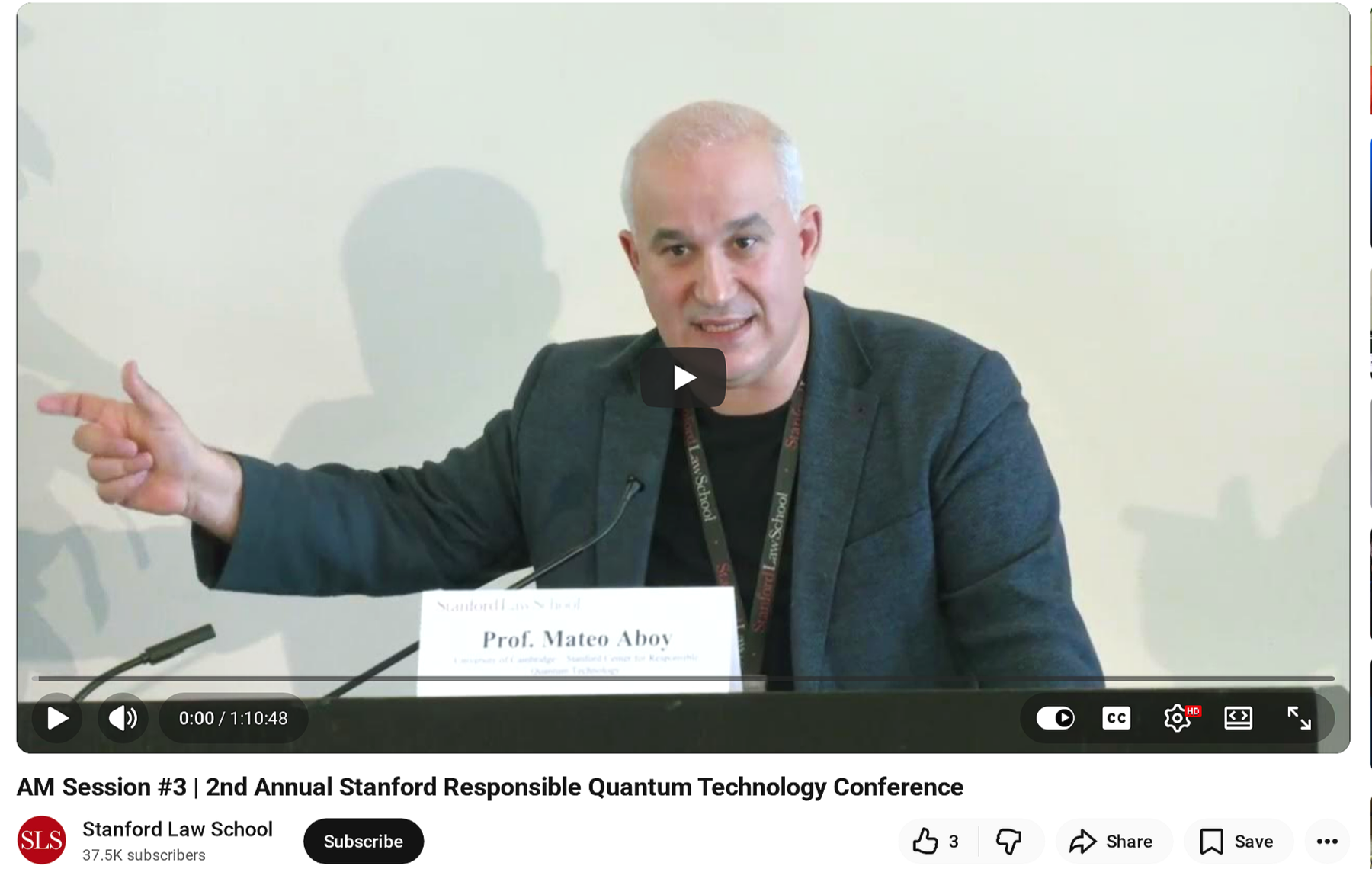
Stanford RQT 2.0: Inside the Second Stanford Responsible Quantum Technology Conference at Stanford Law School, Chaired by Mauritz Kop

The second annual Stanford Responsible Quantum Technology Conference, chaired by Mauritz Kop at Stanford Law School, took a question that an inaugural event had to argue into existence and treated it instead as settled—then spent the day pressure-testing how to answer it. This is the chair's record of how the conference came together and unfolded, from the welcome address to the concluding panel on quantum geopolitics. A separate write-up summarizes the conference's core themes; the account here follows the program itself.

An address that respects the mechanics

Kop opened by recording the institutional debts behind the day and by stating the project's governing discipline: conceptualizing responsible quantum technology “without breaking the laws of physics.” The year's theme, quantum simulation—studying one quantum system by building another that obeys the same rules—anchored the framing. Because an unknown quantum state can be neither copied nor measured without disturbance, the mechanics are not ornament around the legal argument; they are its premise, shaping every downstream question about verification, security, and trust. The Center's stance, he said, is deliberately and modestly techno-optimistic: pro-innovation, calibrated to keep policymakers from lagging the science.

A program built to be argued with

The day moved from responsible-innovation foundations—the Nature Physics call, the SEA framework of safeguarding, engaging, and advancing society, and the Ten Principles for Responsible Quantum Innovation—through materials science, an industry applications panel, a healthcare and life-sciences panel, and empirical studies of the quantum patent landscape. A governance session set out a phased, FDA-style proposal for quantum technology and invited its critics to stress-test it in real time. International perspectives followed, from a global capacity-building listening tour to supply-chain criticality, a Dutch innovation strategy, and a European Commission view. Disagreement was the design, not a defect: panelists openly contested whether quantum is genuinely novel for law, whether an agency model would help or merely slow new entrants, and whether standards should lead where statutes cannot keep pace.

What a second edition signals

That a conference reached its second edition is itself a datum about a maturing field. The institutional fabric—Stanford Law School, the moderating faculty, two University of Copenhagen and Novo Nordisk Foundation research programs, and an industry sponsor—shows responsible quantum technology as an institutional achievement rather than an individual one. The chair closed where he began, on “the cusp of the second quantum revolution,” and framed the combined work as a research agenda spanning a golden triangle of academia, industry, and policy. The encryption question supplied the day's one near-consensus risk: a capable quantum computer would break widely deployed RSA, Diffie-Hellman, and elliptic-curve public-key systems, making the migration to quantum-safe methods a present task. For the field's intellectual lineage, see the underlying Nature Physics call for responsible quantum technology.

Meer lezen
Mauritz Kop Interviewed by Al Jazeera on Responsible Quantum AI Computing at Stanford University

Al Jazeera English featured an interview with Mauritz Kop on responsible quantum computing and quantum artificial intelligence (QAI) at Stanford University, woven into a report from a Silicon Valley summit looking for computing's next breakthrough. Speaking in the spring of 2023, as a Transatlantic Technology Law Forum Fellow at Stanford Law School working on responsible quantum technology, Kop set out three themes that have anchored his work ever since: the societal benefits and risks of quantum computing, the need for guardrails for QAI, and his legal-futurist scenario of a Quantum Event Horizon.

Quantum technology arrives in public view

The interview's setting—an industry expo rather than a lecture hall—signaled how far quantum technology had already traveled from theory toward commerce. Kop's role in the segment was to translate that momentum into a governance question: what legal and policy architecture should accompany machines that exploit superposition and entanglement to do what classical computers cannot? The benefits, from quantum simulation in drug and materials discovery to advances in sensing, are real; so is the risk that fault-tolerant quantum computing could eventually undermine the public-key cryptography securing global infrastructure absent migration to post-quantum schemes. In quantum technology, the same capability that delivers the promise also carries the threat—which is why Kop argues the two cannot be governed as separate concerns.

Building the guardrails early

Kop's case for guardrails turns on timing. Quantum computing and artificial intelligence are each transformative; their convergence could compress the timelines on which human oversight depends. The remedy he advocates is to install safeguards at the design stage—through technical standards, impact assessment as a design instrument, and international coordination—rather than retrofitting them after deployment, when the cost of correction climbs. The Quantum Event Horizon names what those guardrails are meant to prevent: a threshold past which a quantum-AI system can no longer be brought back under meaningful human control. The concept is a design imperative, not a forecast—if such a point is even conceivable, the controls must precede it.

From research program to public conversation

What makes the Al Jazeera interview notable in hindsight is its moment. In the spring of 2023 the case for responsible quantum technology still had to be made to a general audience; the Stanford Center for Responsible Quantum Technology that Kop would found and direct was only then taking shape, with its inaugural conference held that year. Coverage on an international network helped carry the argument beyond the academy toward the citizens, regulators, and technologists whose decisions will determine whether quantum's next revolution is also a responsible one. The same conviction animates Kop's later policy writing, including his consultations with U.S. lawmakers on AI and quantum technology policy, and his profile of scholarship at the intersection of law, quantum technology, and AI.

Meer lezen
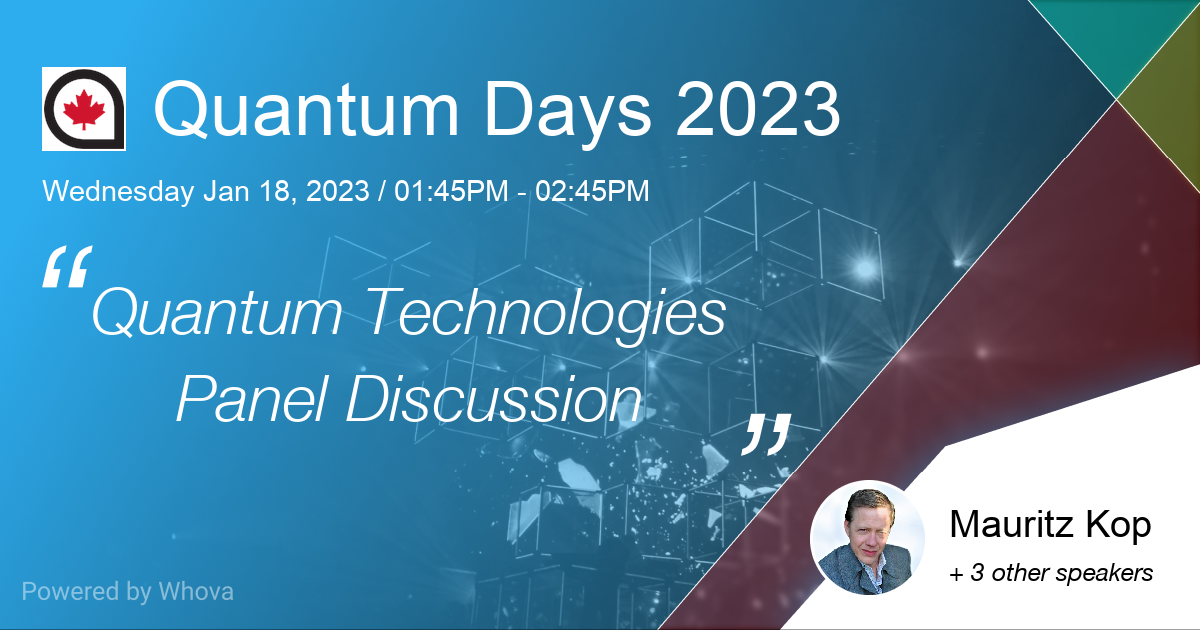
Quantum Days Canada: CCA Panel on Quantum Technologies

When the Council of Canadian Academies brought its quantum expert panel to Quantum Days in January 2023, it did something unusual for a national academy: it opened an unfinished study to public input. Mauritz Kop joined the session to frame the ethical, legal, social, and policy stakes of quantum adoption—and to invite the audience to help shape the questions, not just receive the answers.

A government-commissioned panel, in public

The panel had been formed at the request of federal sponsors, including the National Research Council of Canada and Innovation, Science and Economic Development Canada, and was chaired by the physicist Raymond Laflamme. The Quantum Days appearance gathered members of that panel—Laflamme, Jeff Kinder, Mauritz Kop, and Jacqueline Bartlett among the named participants—to discuss the panel's mandate, key questions, and priorities while its assessment of Canadian quantum adoption was still being written. It was a national study opened up mid-draft, with its conclusions deliberately still open.

Live polls and equitable access

The session's signature move was procedural: the audience was invited to feed the eventual report through live polls, under the banner of helping Canada build a quantum ecosystem. That design choice carries an argument. Responsible quantum governance, on Kop's reading, treats equitable access to quantum-enabled prosperity as a question to be settled by deliberation rather than left to the market, and asks how codes of conduct and design guidelines can be agreed across cultures whose ethical intuitions differ. Live audience input is well suited to surfacing exactly the trade-offs that have no single technically correct answer—and it reflects the distributive themes that run through Kop's broader scholarship on responsible technology.

Why the policy lens belongs at a physics conference

Quantum systems invite governance because their behavior is genuinely unfamiliar. Superposition and entanglement change what computation can do, with consequences for cryptography and security that existing law did not anticipate. The case for an ethical, legal, social, and policy lens at a technical conference is that the rules must be drafted while the science is still moving—a position consistent with the standards-and-principles direction Kop and colleagues set out in the Ten Principles for Responsible Quantum Innovation.

A panel on its way to a report

The Quantum Days session is one step in a longer process. The same panel, under the same chair, is carrying its study through 2023 toward a national assessment of quantum adoption in Canada, with Kop among its members. The sequence—open the questions in public, gather input through live polls, then translate that deliberation into evidence for decision-makers—offers a working model of quantum governance that is both expert-led and publicly grounded, an early example of treating quantum policy as a question worked out in the open rather than a finished product to be announced. (That study became the CCA's Quantum Potential report, published November 30, 2023.)

Meer lezen