
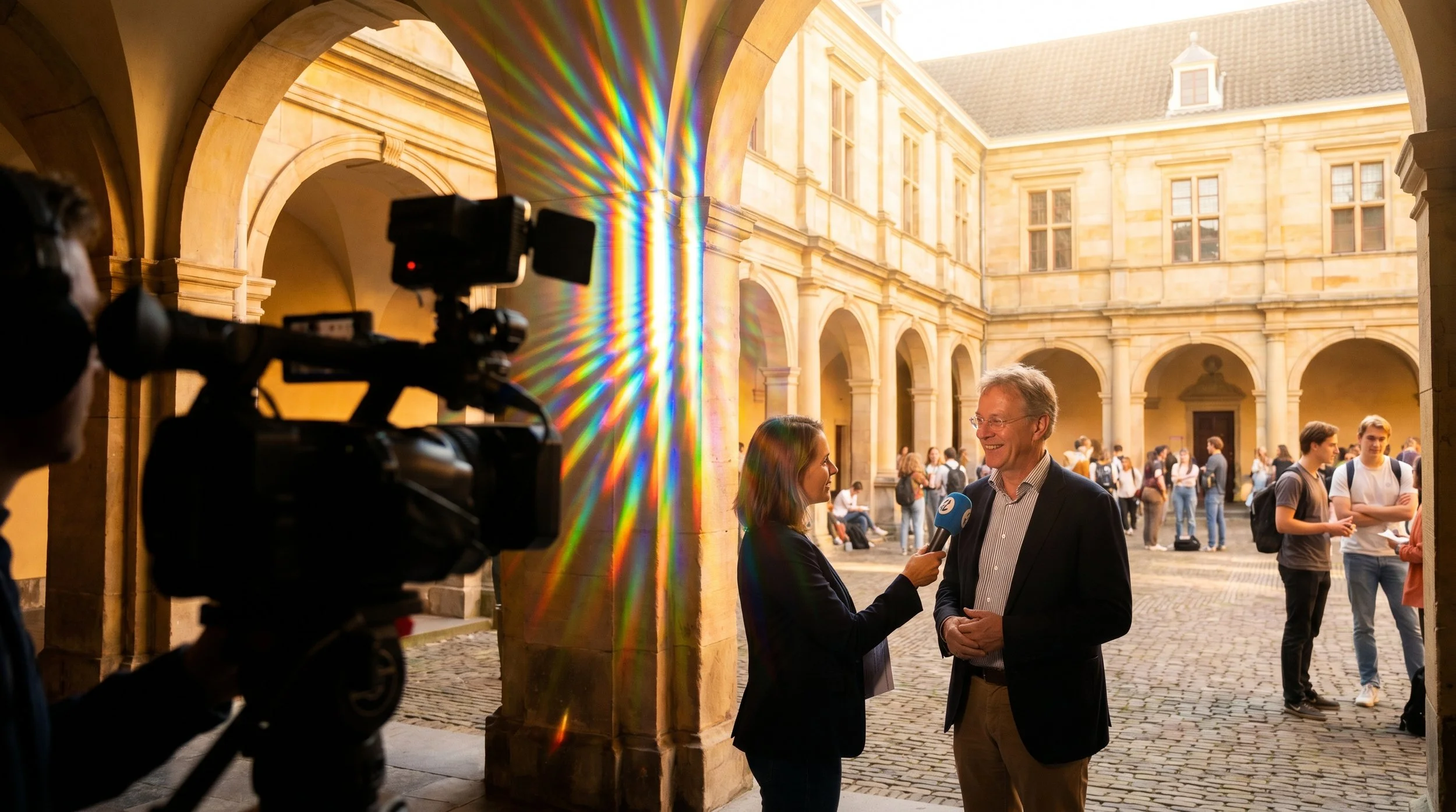
Al Jazeera English featured an interview with Mauritz Kop on responsible quantum computing and quantum artificial intelligence (QAI) at Stanford University, woven into a report from a Silicon Valley summit looking for computing's next breakthrough. Speaking in the spring of 2023, as a Transatlantic Technology Law Forum Fellow at Stanford Law School working on responsible quantum technology, Kop set out three themes that have anchored his work ever since: the societal benefits and risks of quantum computing, the need for guardrails for QAI, and his legal-futurist scenario of a Quantum Event Horizon.
Quantum technology arrives in public view
The interview's setting—an industry expo rather than a lecture hall—signaled how far quantum technology had already traveled from theory toward commerce. Kop's role in the segment was to translate that momentum into a governance question: what legal and policy architecture should accompany machines that exploit superposition and entanglement to do what classical computers cannot? The benefits, from quantum simulation in drug and materials discovery to advances in sensing, are real; so is the risk that fault-tolerant quantum computing could eventually undermine the public-key cryptography securing global infrastructure absent migration to post-quantum schemes. In quantum technology, the same capability that delivers the promise also carries the threat—which is why Kop argues the two cannot be governed as separate concerns.
Building the guardrails early
Kop's case for guardrails turns on timing. Quantum computing and artificial intelligence are each transformative; their convergence could compress the timelines on which human oversight depends. The remedy he advocates is to install safeguards at the design stage—through technical standards, impact assessment as a design instrument, and international coordination—rather than retrofitting them after deployment, when the cost of correction climbs. The Quantum Event Horizon names what those guardrails are meant to prevent: a threshold past which a quantum-AI system can no longer be brought back under meaningful human control. The concept is a design imperative, not a forecast—if such a point is even conceivable, the controls must precede it.
From research program to public conversation
What makes the Al Jazeera interview notable in hindsight is its moment. In the spring of 2023 the case for responsible quantum technology still had to be made to a general audience; the Stanford Center for Responsible Quantum Technology that Kop would found and direct was only then taking shape, with its inaugural conference held that year. Coverage on an international network helped carry the argument beyond the academy toward the citizens, regulators, and technologists whose decisions will determine whether quantum's next revolution is also a responsible one. The same conviction animates Kop's later policy writing, including his consultations with U.S. lawmakers on AI and quantum technology policy, and his profile of scholarship at the intersection of law, quantum technology, and AI.
Meer lezen