Innovation, Quantum-AI Technology & Law

Blog over Kunstmatige Intelligentie, Quantum, Deep Learning, Blockchain en Big Data Law

Blog over juridische, sociale, ethische en policy aspecten van Kunstmatige Intelligentie, Quantum Computing, Sensing & Communication, Augmented Reality en Robotica, Big Data Wetgeving en Machine Learning Regelgeving. Kennisartikelen inzake de EU AI Act, de Data Governance Act, cloud computing, algoritmes, privacy, virtual reality, blockchain, robotlaw, smart contracts, informatierecht, ICT contracten, online platforms, apps en tools. Europese regels, auteursrecht, chipsrecht, databankrechten en juridische diensten AI recht.

Berichten met de tag Quantum Governance
Prof. Mauritz Kop Invited to Speak at Quantum Innovation 2026 in Nagoya on Responsible Quantum Innovation and the Post-Quantum Transition

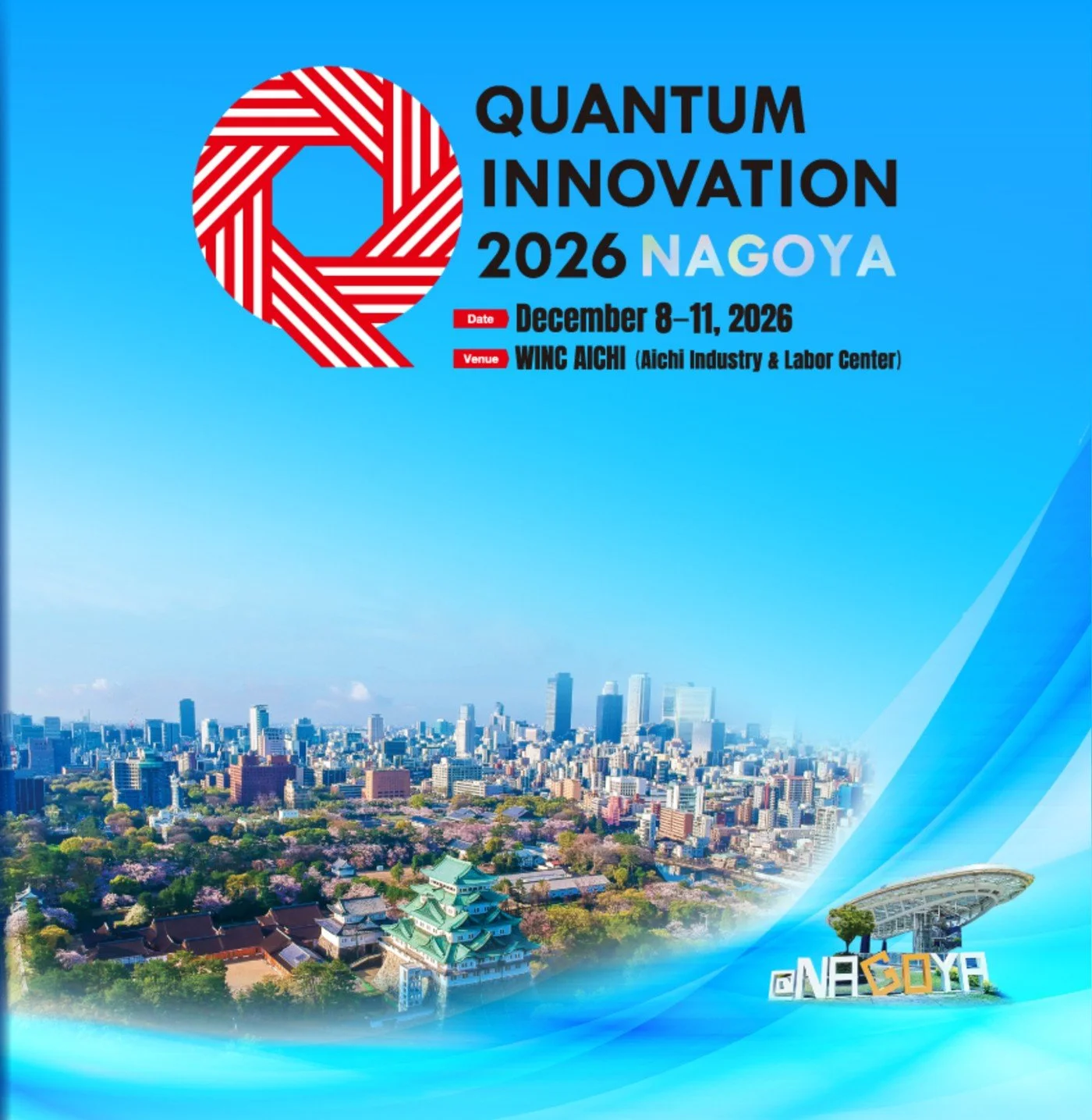
Prof. Mauritz Kop has been invited to speak at Quantum Innovation 2026, the International Symposium on Quantum Science, Technology and Innovation, held from December 8 to 11, 2026 at WINC AICHI in Nagoya. The symposium is organized by Japan's Quantum Technology Innovation Hubs with the support of the Government of Japan and JST. Kop closes the session on Practical Quantum Computing on December 8 with a talk on the legal and governance side of quantum security, titled Before Q-Day: Responsible Quantum Innovation, Standards, and the Post-Quantum Transition.

Japan's National Quantum Symposium Comes to Nagoya

Co-organized by Japan's Cabinet Office, three ministries, JST, RIKEN, AIST, NICT, Q-STAR, and leading universities, and sponsored by Fujitsu, Toyota, Toshiba, and Hitachi, the symposium covers quantum computing, sensing, and cryptography over four days, with a closing day on Japan's Moonshot goal of a fault-tolerant quantum computer. The program spans quantum computing, the post-quantum transition, and quantum networks. Keynotes come from Dorit Aharonov, Amir Yacoby, and Hoi-Kwong Lo, and the invited speakers include Elham Kashefi, Google Quantum AI, IonQ, Intel, and RIKEN. A Japan-Netherlands matchmaking workshop on December 9 links the Dutch and Japanese ecosystems, and Kop will also visit a quantum computer in Japan with the delegation. Participation is free; registration closes on November 22.

Standards, Certification, and the LSI Test for the Post-Quantum Transition

Following two talks on quantum cryptanalysis, Kop speaks from 5:40 to 6:10 PM Japan time on responsible quantum innovation, standards, and the post-quantum transition. He brings Stanford RQT's foundational work, the Quantum-ELSPI framework, and the LSI test from his Nexus paper, which asks that security measures be least trade-restrictive, security-sufficient, and innovation-preserving. Nagoya joins his forthcoming engagements at CIGI, the University of Virginia, and ACM. Our article also profiles Japan's quantum computers at RIKEN, Fujitsu, Quantinuum, and IBM, and a panel on certifying quantum key distribution.

Meer lezen
Prof. Mauritz Kop Chairs CIGI Quantum Nexus Workshop and Roundtable on Quantum, Intellectual Property, and National Security

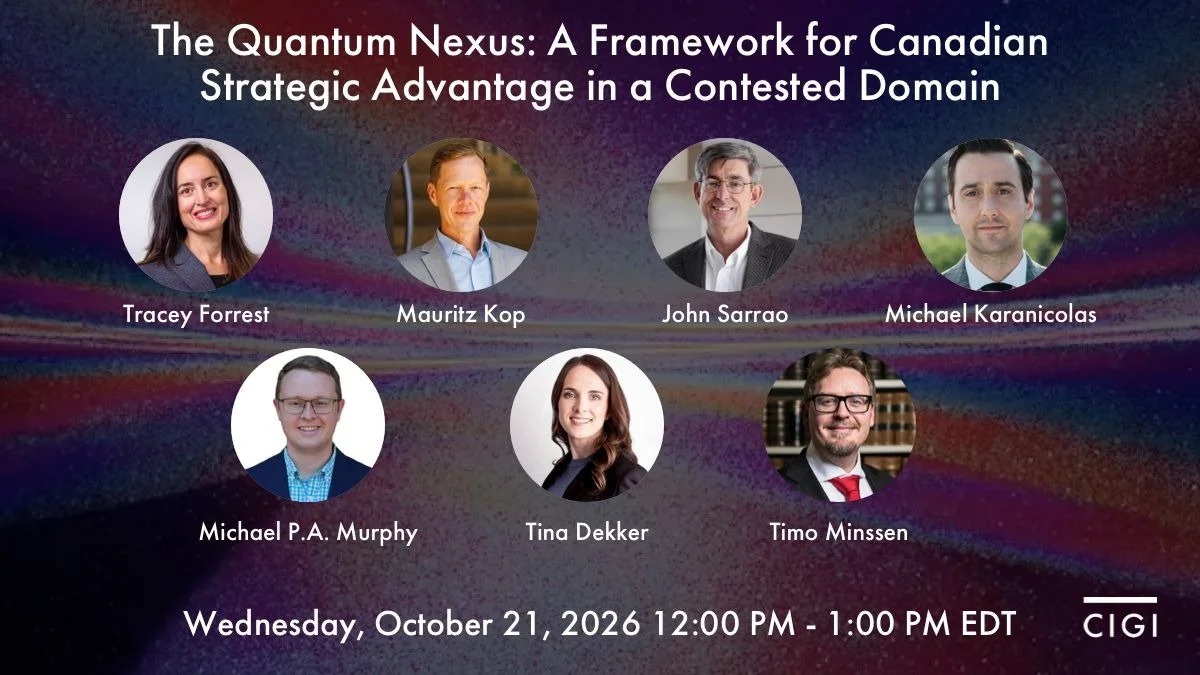
On Wednesday, October 21, 2026, Prof. Mauritz Kop chairs the CIGI Quantum Nexus workshop in Waterloo: a public online expert panel from 12:00 to 1:00 PM Eastern Time, followed by a closed-door roundtable. As Senior Fellow and Principal Investigator at the Centre for International Governance Innovation, Kop leads the project The Quantum Nexus: A Framework for Canadian Strategic Advantage in a Contested Domain, funded through the Department of National Defence's MINDS program.

Five Panelists, a Senior Roundtable, and Six Emerging Scholars

The panel brings together John Sarrao (SLAC National Accelerator Laboratory), Michael Karanicolas (Dalhousie University), Tina Dekker, Michael P. A. Murphy (Queen's University), and Timo Minssen (University of Copenhagen), with CIGI's Tracey Forrest. The roundtable, held under the CIGI Rule, includes the Privy Council Office's Dominic Rochon, the Canadian Intellectual Property Office's Konstantinos Georgaras, former U.S. Assistant Secretary of Commerce Kevin J. Wolf, Michele Mosca, Larry Diamond, and Los Alamos physicist Alan J. Hurd. Six emerging scholars from universities across Canada, personally selected and mentored by Kop, join the day and will write analytical notes for the project's final CIGI report.

The LSI Test and Kop's Work With Canada Since 2022

The workshop builds on Kop's Nexus paper, indexed in the Harvard-Smithsonian NASA Astrophysics Data System, and its LSI test for security measures that are least trade-restrictive, security-sufficient, and innovation-preserving. It continues his work on the Council of Canadian Academies expert panel chaired by the late Raymond Laflamme, his CIGI policy brief with Tracey Forrest, and his War on the Rocks essays. Our article also traces CIGI's history, from its founding by BlackBerry's Jim Balsillie, with a founding gift from Mike Lazaridis, to its role among G7 think tanks. The public panel will be recorded, and registration for the online session is open to everyone on the CIGI event page.

Meer lezen
Prof. Mauritz Kop Invited to Speak at the Inaugural ACM PQQS 2026 in Silicon Valley on the Race to Quantum First

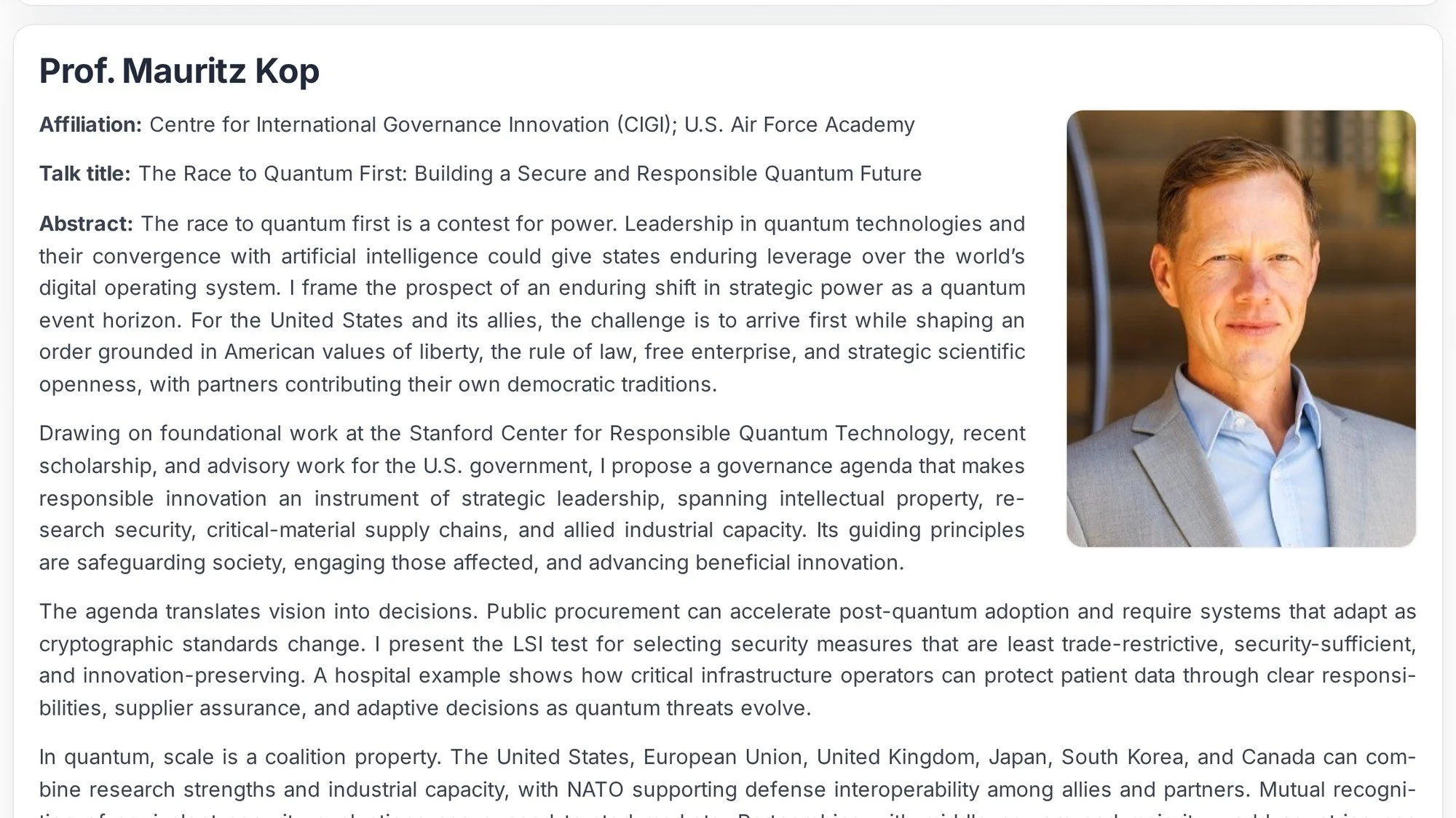
Prof. Mauritz Kop has been invited to speak at ACM PQQS 2026, the inaugural ACM Conference on Post-Quantum and Quantum-based Security, held from November 2 to 4, 2026 in Silicon Valley near San Jose. Kop, Founder of the Stanford Center for Responsible Quantum Technology, is listed with his affiliations at CIGI and the U.S. Air Force Academy, and his talk is titled The Race to Quantum First: Building a Secure and Responsible Quantum Future.

A New ACM SIGSAC Venue With Boneh, Babbush, Preneel, and NIST

ACM's security community launched PQQS as a new annual venue for post-quantum cryptography, quantum cryptography, and the security of quantum computing systems. General Chair Elisa Bertino and program chairs Rei Safavi-Naini and Ashish Kundu assembled a program of twenty-six peer-reviewed papers, keynotes by Dan Boneh, Ryan Babbush of Google Quantum AI, Renato Renner, and Ramana Kompella, invited talks by Bart Preneel, Reza Nejabati, Vipul Goyal, Yevgeniy Dodis, and J.R. Rao, and a panel with NIST's Dustin Moody and Michele Mosca. One of the call's four topic areas covers post-quantum migration policy, regulation, and ecosystem readiness.

Procurement, the LSI Test, and a European Quantum Act

Kop's talk proposes a governance agenda in which responsible innovation becomes an instrument of strategic leadership for the United States and its allies. Public procurement can accelerate post-quantum adoption, and the LSI test from his Nexus paper, indexed in the Harvard-Smithsonian NASA Astrophysics Data System, selects security measures that are least trade-restrictive, security-sufficient, and innovation-preserving. A hospital example shows how operators can protect patient data, and a European Quantum Act architecture would strengthen the EU as a capable allied partner. The talk also weighs a lean, U.S.-led verification body inspired by IAEA safeguards. It builds on Stanford RQT's foundational papers, on his two War on the Rocks essays on the race to quantum first, and on his advisory work for the U.S. Government, including the Pentagon and the Department of State.

Meer lezen
Prof. Mauritz Kop Invited to Co-Opting AI: Quantum at the University of Virginia, With Paul Davies, Shohini Ghose, and Host Mona Sloane

Prof. Mauritz Kop, Founder of the Stanford Center for Responsible Quantum Technology, has been invited to speak at Co-Opting AI: Quantum, a public conversation hosted by the University of Virginia's Digital Technology for Democracy Lab, NYU's Institute for Public Knowledge, and Sloane Lab. The online event takes place on Wednesday, October 28, 2026, from 4:00 to 5:15 PM Eastern Time, with the physicists Paul Davies of Arizona State University and Shohini Ghose of Wilfrid Laurier University, and with Professor Mona Sloane as host.

Episode 55 of Mona Sloane's Co-Opting AI Series Turns to Quantum

Mona Sloane's Co-Opting AI series has gathered leading scholars on technology and society since April 2019, from Alondra Nelson and Virginia Eubanks on Justice to Sandra Wachter on the GDPR and Danielle Keats Citron on Privacy. The quantum episode is the series' fifty-fifth and its first on quantum technology. The organizers frame it around one idea: quantum computing is arriving into institutions, supply chains, and geopolitical formations shaped by AI, and that inheritance will shape how quantum develops as a technological and social phenomenon. For lawyers who work on AI governance, this is the moment the familiar questions of liability, access, and accountability move to the next technology.

Stanford RQT Scholarship and Kop's Talks From Oxford to Washington

Kop brings the body of work that defined responsible quantum technology: the Yale Journal of Law and Technology article on a legal-ethical framework for quantum technology, the Ten Principles for Responsible Quantum Innovation, the Nature Physics call for responsible quantum technology, the Science article on standards-first governance, and the Quantum-ELSPI research field. The invitation follows his talks at Oxford, TU Munich, CNAS, CIGI, and Stanford Law School, his two War on the Rocks essays, and his advisory work for the U.S. Government, including the Pentagon and the Department of State. The session is open to the public and will be recorded for those who register.

Meer lezen
Harvard–Smithsonian's NASA Astrophysics Data System Indexes the Quantum Nexus Article by Mauritz Kop

Which record Harvard–Smithsonian created for the Nexus Article, and what a bibcode changes

The NASA Astrophysics Data System, run by the Center for Astrophysics | Harvard & Smithsonian under a NASA grant, now holds a permanent record for the book-length article The Nexus of Quantum Technology, Intellectual Property, and National Security: Deterrence by Denial for Democratic Resilience: An LSI Test for Securing the Quantum Industrial Commons, written by Mauritz Kop (Founder of the Stanford Center for Responsible Quantum Technology). The article examines how democratic nations can protect critical quantum infrastructure through a middle path between total closure and open laissez-faire. The record carries the bibcode 2026arXiv260215051K, reproduces the full abstract, names Kop as sole author, dates the work to February 2026, and files the Article under Physics and Society, History and Philosophy of Physics, and Quantum Physics. The document type is recorded as an eprint, the accurate description of a work posted as a preprint on 11 February 2026.

Why a physics catalogue matters for an Article about export controls, and what Kop advises the Pentagon on

Quantum governance scholarship is written by legal and policy scholars and read by physicists, engineers and procurement officers, who search from the other side of the divide. The LSI test — least-trade-restrictive, security-sufficient, innovation-preserving — was built to be applied by the people who draft export-control lists and standards documents, and the Article's claim that the United States and its allies should pursue security-sufficient openness now surfaces in the same results as the technical literature on the capabilities it governs. The index already held nine other works by the same author, among them Nature Physics, Science, Quantum Science and Technology, EPJ Quantum Technology and Physics World. Since August 2026 Kop has served as Quantum Strategy Advisor to the Pentagon, the Office of the Secretary of Defense for Policy, invited to advise on Quantum First across dual-use technology, industrial policy, national and economic security, governance and grand strategy. The role is advisory, carries no employment relationship, and implies no institutional endorsement. The paradigms it carries forward are the Stanford RQT ones: the Ten Principles, the War on the Rocks migration discipline, and the LSI test itself.

Meer lezen
War on the Rocks Publishes 'Before Q-Day: The Race to Quantum First'

One Race, Five Fronts

War on the Rocks published Before Q-Day: The Race to Quantum First on July 20, 2026 — a new essay by Mauritz Kop, founder of the Stanford Center for Responsible Quantum Technology, and Joseph Federici of the U.S.-China Economic and Security Review Commission. Its argument: the United States and its allies should field strategically significant quantum capabilities before China does, and should run cryptography, quantum-AI, networks, sensing, and the supply chain as one race under one office. The Commission's goal is Quantum First by 2030. The essay opens with the threat that makes the goal urgent — hard drives filling up with harvested encrypted traffic, waiting for a quantum computer to read the vulnerable public-key layer — and walks each front: federal migration deadlines for high-value systems whose private-sector counterparts are, in the authors' words, "only being asked politely"; a speculative "X-Ray City" scenario in which quantum sensors fuse with AI into a surveillance layer the authors say no policy document yet addresses; China's quantum-secure communications network of more than 12,000 kilometers and the risk of network standards written in Beijing; and a supply chain that, in the essay's assessment, no single country can build alone.

From Bletchley Park to European Boardrooms

The essay is the natural successor to "A Bletchley Park for the Quantum Age," carrying the Bletchley method — science, engineering, operations, and alliance management as one integrated system — from the cryptographic migration to the entire quantum ecosystem. Kop writes that it grows from the scholarship of the Stanford Center for Responsible Quantum Technology, inaugurated in 2023 during Mark Rutte's Stanford visit, with work published in Science, Nature Physics, and the Harvard, Yale, Columbia, and Berkeley law journals. Read from Europe, the essay previews questions heading for European agendas: migration deadlines that travel through procurement chains and G7 coordination, a cryptographic inventory that is turning into a board-level question for entities covered by NIS2 and DORA, and export-control and certification choices that will shape the European quantum market. In this post we summarize the essay's five fronts, place it in the Stanford quantum governance corpus, and set out our analysis of what Quantum First asks of European general counsel, compliance teams, and boards — starting with the contracts their organizations sign this year.

Meer lezen
From Kananaskis to Évian: Will the G7 Govern Quantum, or Keep Describing It?

When G7 leaders meet in Évian-les-Bains from June 15 to 17, 2026, quantum technology sits on the leaders' table for a second consecutive year. In a new CIGI op-ed, Stanford and CIGI legal scholar Mauritz Kop argues that the era of shared values and summit language has run its course: between the Kananaskis Common Vision and the OECD Recommendation on Quantum Technologies, the conceptual groundwork is done. What remains is implementation — and implementation is what voluntary coordination delivers slowly, unevenly, or never.

From a Common Vision to Working Machinery

Kananaskis named the right concerns in June 2025 but built light machinery — no timelines, no benchmarks, no procurement commitments. A year on, Kop puts the question to Évian directly: does the G7 intend to govern quantum, or to keep describing it? His answer is not another principles instrument but a delivery body with named products and deadlines, reporting back to leaders at the 2027 summit.

Five Decisions for Évian

The piece sets out five decisions leaders can take in France: post-quantum cryptography migration milestones for critical infrastructure; trusted and resilient quantum supply chains; standards-based governance backed by procurement; dual-use coordination through a least trade-restrictive, security-sufficient and innovation-preserving (LSI) test; and vigilance on the market structure of an industry already concentrating around a few compute-, patent- and talent-rich incumbents.

Each decision turns a value into something auditable. The "harvest-now, decrypt-later" threat makes cryptographic migration a present-tense problem with an unknown deadline; when Google gives itself until 2029, governments that have given themselves ten years should take notice. The same logic runs through supply-chain chokepoints, technical standards and export controls — defaults that will be written by someone, and better written deliberately than by accident.

The Window Is Still Open

Quantum is leaving the laboratory and becoming strategic infrastructure, a shift central banks already treat as systemic. The window for writing the rules of the road remains open, Kop warns, but it will not stay open forever. For the legal and policy background to the dual-use argument, see our coverage of the LSI test for securing the quantum industrial commons.

Meer lezen
Call for Applications: CIGI Quantum Nexus Emerging Scholars Program for Canadian Strategic Advantage

The Centre for International Governance Innovation (CIGI) is accepting applications for a competitive emerging scholars program attached to The Quantum Nexus: A Framework for Canadian Strategic Advantage in a Contested Domain, a research project supported by the Department of National Defence's MINDS program and led by CIGI Senior Fellow Mauritz Kop. The deadline is July 15, 2026.

A mentorship cohort with a mission

Four to six emerging scholars from across Canada—undergraduates through post-docs, from any discipline—join a virtual program from September to December 2026. The format is deliberately personal: a one-on-one mentorship session with the Principal Investigator, an online international expert workshop in October, and a group masterclass on emerging-technology governance and publication development in November. No prior quantum expertise is required, and applications from equity-deserving groups are strongly encouraged; the program is built on the conviction that good governance of emerging technologies needs many kinds of minds. It is the same conviction that brought a Canadian quantum governance delegation to Stanford to prepare Canada's G7 presidency.

From analytical note to CIGI report

This is a publication program, not a lecture series. Every participant develops a 1,200–1,500-word analytical note on an assigned subtopic within one of six themes—spanning intellectual property and export controls, post-quantum cryptography migration, critical materials and supply chains, quantum-AI convergence, standards and allied interoperability, and the application of the LSI test (least trade-restrictive, security-sufficient, innovation-preserving) to a real case. The notes are contributed to the project's final CIGI report as a dedicated Emerging Scholars annex—a substantive contribution at the start of a research career.

Dates and deadlines

Applying takes one PDF: a 300–500-word expression of interest naming the theme you want to work on, a CV, and one reference letter, sent to programs@cigionline.org (subject line: Emerging Scholars Application: DND MINDS Project). Applications close July 15, 2026; acceptances follow in mid-August; the program runs September through December. For emerging scholars who want to help shape how the quantum age is governed, this is the opening.

Meer lezen
NATO StratCom Features Mauritz Kop as Subject Matter Expert in Workshop Video on Quantum and Cognitive Sovereignty

The NATO Strategic Communications Centre of Excellence engaged Mauritz Kop as a subject-matter expert for its Riga workshop The Integrity of Reality and Cognitive Sovereignty—via a thirty-minute video interview recorded as study material for participants and as input to the Centre's threatcasting work.

A video briefing for Riga

Held in early June 2026, in the week of the Centre's flagship Riga StratCom Dialogue, the workshop examined what happens to shared truth when both conflict and communication are increasingly automated. Kop's recorded interview adds the layer the strategic-communications field is only beginning to map: the quantum layer. His opening line does the analytical work of a whole briefing—the past is not yet stable. The argument extends the case he made when the Hoover Institution invited him to speak on quantum, democracy, and authoritarianism.

Three quantum pressures on the mind's privacy

The interview names three converging pressures on cognitive sovereignty: civic-scale quantum sensing that, in principle, could resolve subsurface and interior spaces from public rights-of-way—what Kop calls the X-Ray City scenario; quantum-enhanced biosensing and brain-computer interfaces that open the inference of mental states; and the temporal instability of the cryptographic record under harvest-now, decrypt-later collection. For the first two, Kop argues for capability protection—prohibition-grade guardrails at the infrastructure layer, not consent forms after deployment.

Why communicators should care about cryptography

An adversary who can retroactively forge or contest the signed record does not need to fabricate convincingly—only to seed doubt at scale. The interview's prescription is precision over speed: the LSI test for every proposed control, standards-first governance, and verifiable allied migration to post-quantum cryptography as the strategic-communications measure rarely recognized as one.

Meer lezen
OECD Recommendation on Quantum Technologies Builds on Responsible Quantum Principles Developed at Stanford RQT

On May 28, 2026, the OECD Council adopted OECD/LEGAL/0508, the Recommendation of the Council on Quantum Technologies—the first intergovernmental standard to set shared principles for the responsible development and use of trusted quantum technologies. Its four high-level principles and five policy recommendations will read as familiar to anyone who has followed responsible-quantum scholarship, because the instrument's core ideas track work that the Stanford Center for Responsible Quantum Technology and its founder, Mauritz Kop, helped build over the previous half-decade.

The first intergovernmental quantum standard

Developed through a multistakeholder process—forty-seven experts from twenty-six nationalities across four scoping meetings in 2025, building on the OECD's January 2025 Quantum Technologies Policy Primer—the Recommendation asks all Actors to promote innovation that respects democratic values, to prevent and mitigate harms across the technology lifecycle, to promote secure and broad access, to facilitate collaboration, and to foster accountability and trustworthiness. It is non-binding but normatively weighty: thirty-eight adherents are now expected to implement it through their own legal frameworks. The OECD's broader responsible-quantum-technology agenda has long argued that the field needs exactly this kind of shared, anticipatory baseline.

A visible lineage, not a formal citation

The Recommendation names no academic source, and nothing in its text formally credits Stanford RQT. What it shows is conceptual lineage. Its lifecycle-embedded, values-first framing echoes the Ten Principles for Responsible Quantum Innovation; its post-quantum-cryptography and quantum-resilient-infrastructure language draws on the same concern with cryptanalysis that animated Kop's 2021 Yale legal-ethical framework; its accountability-and-trustworthiness principle parallels families in the World Economic Forum Quantum Computing Governance Principles he helped conceptualize; and its call for science-based standards mirrors the standards-first program he and colleagues set out in Science. Kop was among the experts consulted in the course of the OECD's quantum-policy work, an engagement that sits within a longer record of peer-reviewed calls for responsible quantum technology.

Why anticipation is the right posture

Both the Recommendation and the scholarship it echoes favor agile, forward-looking, evidence-based governance—and the physics explains why. Quantum technologies draw their power from superposition and entanglement, phenomena that do not scale gently: an entanglement-enabled sensor can cross a sensitivity threshold, and a cryptanalytically relevant machine can render trusted public-key cryptography suddenly breakable, in ways that arrive nonlinearly. Governance that waits for a capability to mature arrives too late by construction. This is the case the responsible-quantum field, including the Quantum-ELSPI research agenda, has pressed since 2021—and the case OECD/LEGAL/0508 now encodes for thirty-eight economies.

What comes next

The Recommendation tasks the OECD's Digital Policy Committee and Committee for Scientific and Technological Policy to develop practical guidance and to report back within five years, so the standard is built to evolve with the technology. Its arrival signals that these responsible-quantum arguments have reached the institutions that set international norms—a quiet but consequential validation of work begun years earlier at Stanford.

Meer lezen
CNAS Interviews Mauritz Kop for The Entanglement Edge Quantum Networking Report

The Center for a New American Security has published The Entanglement Edge: U.S. Strategic Priorities in Quantum Networking—and Mauritz Kop briefed the CNAS research team on quantum networking and cybersecurity in November 2025, as part of the expert interviews behind it.

The entanglement edge, soberly measured

The report by Constanza M. Vidal Bustamante and Morgan Peirce declines the hype on both sides. Quantum key distribution is a niche complement, not a replacement, for post-quantum cryptography; China's 10,000-kilometer QKD network is real infrastructure but not next-generation readiness; and America's task is to fund what compounds—interconnects, benchmarks, supply chains, PQC migration—while declining to subsidize theater.

Where Kop's briefing landed

Kop gave the researchers an administrable rule: "PQC by default"—QKD only where incremental assurance can be proven over cost and complexity, quantum random-number generators widely for stronger entropy. His briefing pressed the shift from guidance to verifiable outcomes: a federal transition lead with a public dashboard, procurement requiring validated FIPS 203/204/205 modules, crypto-agility drills, and allied "one test, many markets" certification so the coalition's cryptographic baseline cannot fracture into a quantum splinternet. It is the operational sequel to the positions he brought to the U.S. Department of State on quantum technology and foreign policy.

What planners should take away

The harvest-now, decrypt-later campaigns are already running; the contest that decides their outcome is over verification—whose security architecture can be tested, certified, and trusted across an alliance. Reports built on dozens of expert interviews, rather than vendor decks, are how that architecture gets designed before the deadline arrives.

Meer lezen