
The Innovator Features Mauritz Kop in Interview on Responsible Quantum Governance
By Editor
Paris, France, November 24, 2024—The Innovator, the Paris-based digital media outlet, has named Mauritz Kop its Interview of the Week, in a wide-ranging conversation on the future of quantum technology and how to govern it responsibly. Conducted by founding editor Jennifer L. Schenker after the XPANSE conference in Abu Dhabi, the interview ranges across the science, the security stakes, and the policy choices that will decide who benefits from the coming generation of quantum machines. Kop—Founder and Executive Director of the Stanford Center for Responsible Quantum Technology (Stanford RQT) and a Stanford Law School Transatlantic Technology Law Forum (TTLF) Fellow—frames the moment plainly: the technology is arriving faster than its governance.

The Innovator's Interview of the Week on responsible quantum governance (illustrative editorial image).
An interview at the inflection point
The Innovator describes its mission as helping corporates "understand the technologies transforming their businesses" through "independently reported stories that they will not find elsewhere," and the Kop interview fits that brief. The conversation followed his appearance at XPANSE, the deep-tech gathering in Abu Dhabi, and it treats quantum not as a single product on a single timeline but as a family of capabilities—computing, sensing, networking, and cryptography—each maturing at its own pace. Kop, who at the time also held a fellowship in the Novo Nordisk Foundation's Copenhagen-Cambridge-Harvard Inter-CeBIL Program and served as General Counsel at the AI governance company Daiki, works at the seam between physics and law, and the interview's value lies in how concretely it maps that seam for a business audience.
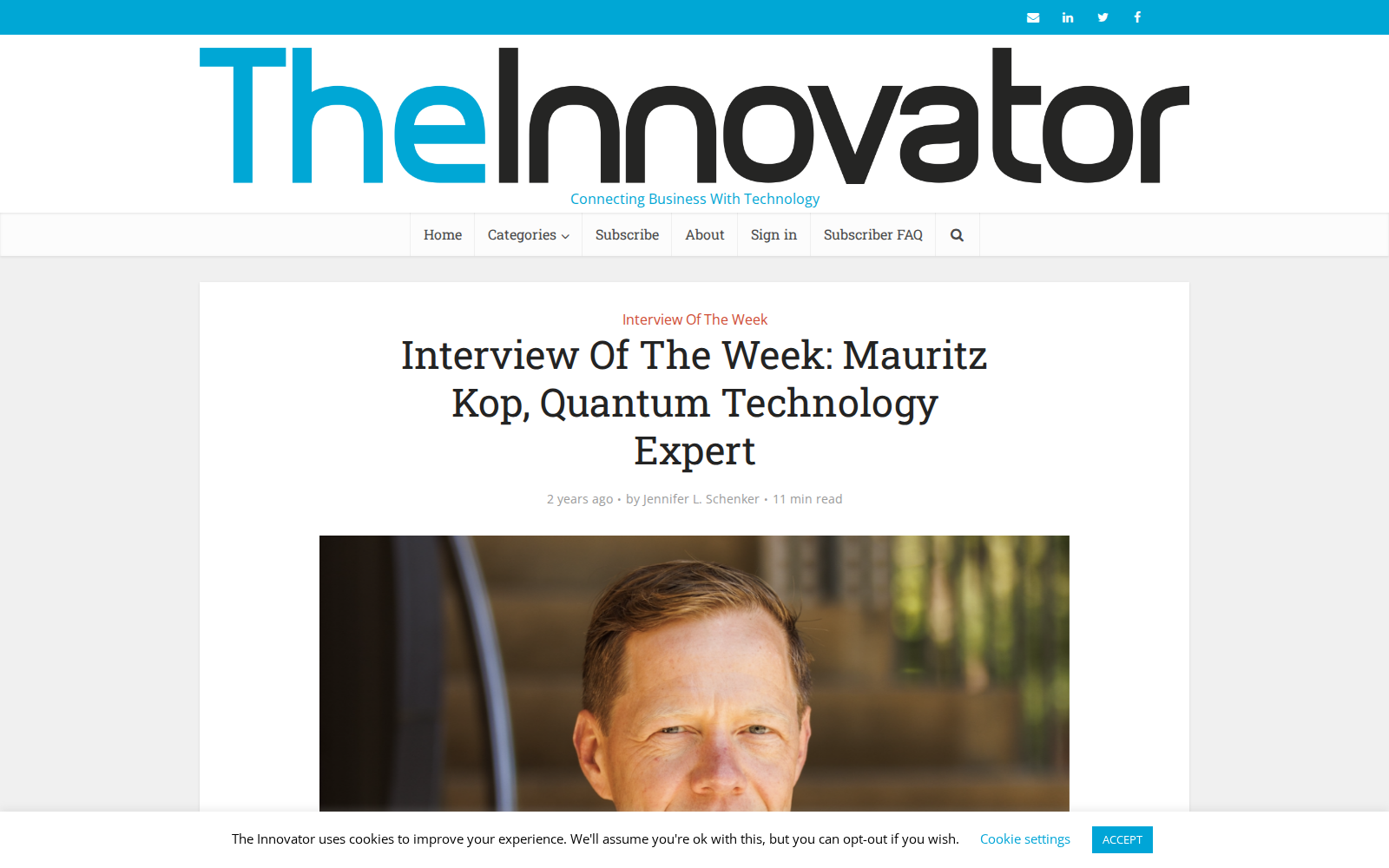
The Innovator's Interview of the Week with Mauritz Kop, November 2024.
A branch-by-branch timeline
Asked when the technology actually lands, Kop offers an unusually specific forecast—his own assessment, more bullish than the field's consensus. "Useful, scalable quantum computing is very close. I think we are less than three years away; quantum networking is about 10 years away; quantum-AI hybrids are being developed right now." The same sentence appears on Stanford Law School's media-coverage page for the interview. The distinction matters because each branch carries a different governance clock. A fault-tolerant quantum computer threatens widely deployed public-key cryptography; quantum networking promises channels whose security rests, in principle, on physics rather than on a hard math problem—because measuring a quantum system in superposition forces it to collapse, and an arbitrary unknown quantum state cannot be copied (the no-cloning theorem), so eavesdropping leaves detectable traces; and quantum-AI hybrids fold today's most powerful artificial intelligence systems into machines whose behavior is harder still to predict.
The cryptographic stakes are not abstract. The threat to public-key cryptography comes from a fault-tolerant quantum computer running Shor's algorithm, which exploits superposition and quantum interference to factor large integers efficiently—the very problem whose hardness underpins RSA. Such a machine would put the RSA encryption that secures much of the internet within reach. That is why the standards-first response is already under way: the U.S. National Institute of Standards and Technology (NIST) has finalized its first post-quantum cryptography (PQC) standards, and migrating to quantum-resistant algorithms is the concrete near-term task. The same risk is why Kop has long argued, in venues from Foreign Policy to academic journals, that quantum computing carries distinct and underappreciated risks alongside its promise.
Planetary problems, planetary thinking
Kop is equally clear that the upside is real and large. "Quantum uses less energy and the hope is if we can get nuclear fusion done and combine that with AI + quantum we will be able to tackle some of the world's biggest problems including climate change mitigation, in a very sustainable way." The framing connects quantum capability to the United Nations Sustainable Development Goals—materials discovery, drug design, energy systems, logistics—rather than to narrow commercial advantage alone. But potential is not access, and here the interview sounds a warning. "The hardware in particular is difficult and expensive to develop so we risk a quantum divide that exacerbates existing inequalities." A technology that concentrates in a few states and firms could widen the gaps it might otherwise help to close—which is why Kop ties the opportunity to a duty of equitable governance.
The remedy, on his account, is not to slow the science but to steer it. "What we need is planetary thinking with sensible quantum governance and smart, pro-innovation regulation tied to values laden standards." That sentence distills a program he has developed across years of scholarship: governance that is anticipatory rather than reactive, standards that encode shared values, and regulation calibrated to advance innovation rather than smother it. It is the same logic behind the Ten Principles for Responsible Quantum Innovation and the call for responsible quantum technology he co-authored, the framework that organizes the work of the Stanford center he founded.
Advice to corporates: move early, move responsibly
For the business readership The Innovator serves, Kop's counsel is direct. Announcing the interview, he advised firms to engage now rather than wait: "I advise corporates to invest heavily both in #quantum and #quantumAI today to get ahead of the curve and to start learning about its responsible use to remain compliant." The pairing of investment and responsible use is deliberate. Quantum literacy, in his telling, is a competitive position rather than a defensive crouch. "Become quantum literate and you will be a first mover and enjoy the first mover advantages of being an early investor in the family of quantum technologies." The implicit thesis is that firms which build governance capability alongside technical capability will be better placed when the rules arrive—because the discipline that responsible adoption requires is the same discipline that compliance is likely to require as regulatory expectations develop.
That argument rhymes with the standards-first direction of Kop's broader work: international standards, developed early and tied to explicit values, give organizations something concrete to build toward before binding law is settled. For corporates weighing how to enter the field, the interview's message is that the responsible path and the strategic path are converging—and that the window to take both at once is open.
Why this interview matters
The XPANSE setting is fitting: a summit convened to map the deep technologies reshaping the global economy is exactly where the governance conversation belongs—while a market forms, not after it matures. The Innovator's decision to feature a legal scholar rather than only a physicist or a founder reflects a recognition now spreading through industry: the hard problems of quantum are no longer only engineering problems. They are problems of who holds the capability, on what terms, under what guardrails, and to whose benefit. By translating those questions for a corporate audience, the interview gives decision-makers a branch-by-branch timeline in Kop's own terms, a candid account of the risks, and a usable theory of responsible early action.
Last updated: June 6, 2026.