Innovation, Quantum-AI Technology & Law

Blog over Kunstmatige Intelligentie, Quantum, Deep Learning, Blockchain en Big Data Law

Blog over juridische, sociale, ethische en policy aspecten van Kunstmatige Intelligentie, Quantum Computing, Sensing & Communication, Augmented Reality en Robotica, Big Data Wetgeving en Machine Learning Regelgeving. Kennisartikelen inzake de EU AI Act, de Data Governance Act, cloud computing, algoritmes, privacy, virtual reality, blockchain, robotlaw, smart contracts, informatierecht, ICT contracten, online platforms, apps en tools. Europese regels, auteursrecht, chipsrecht, databankrechten en juridische diensten AI recht.

Berichten met de tag Conference
Stanford University Library Creates Permanent RQT Scholarship Repository Of Selected Works

Stanford, CA, July 10, 2025 – Stanford University Library, in a significant move to advance the field of responsible quantum innovation, has established a dedicated digital scholarship repository for the Stanford Center for Responsible Quantum Technology (RQT), that had its Law School tenure from December 2023 to January 2025. This new collection, accessible via the persistent URL https://purl.stanford.edu/hp536nb5631, will preserve and showcase the influential research and scholarly output of the Center, ensuring its global accessibility for researchers, policymakers, and industry leaders.

The Stanford Center for RQT, founded by Mauritz Kop and part of the Stanford Program in Law, Science & Technology led by Mark Lemley, stands at the forefront of shaping a future where quantum advancements contribute to equitable and beneficial social goals. With a mission to foster interdisciplinary research, education, and collaboration, the Center addresses the profound societal impacts of quantum technologies, promoting competition, transparency, inclusivity, intergenerational equity, and sustainable innovation, all while safeguarding human rights and democratic values. A highlight of the Center's public engagement is its annual Stanford Responsible Quantum Technology Conference, which brings together global leaders to discuss the field's most pressing issues. The creation of this repository marks a milestone in the Center's efforts to disseminate its foundational works, and ensures their longevity.

The Stanford Library Permanent RQT Repository

The initial collection features a selection of the Center's influential publications that underscore its commitment to a holistic and forward-thinking governance approach. The showcased works include:

10 Principles for Responsible Quantum Innovation: Published in IOP Quantum Science and Technology, this seminal paper by Mauritz Kop and his team outlines a guiding framework for the ethical development of quantum technologies, emphasizing principles from safeguarding and accountability to advancing societal well-being.

Towards Responsible Quantum Technology: This foundational paper from the Harvard Berkman Klein Center for Internet & Society Research Publication Series, authored by Mauritz Kop, Mateo Aboy, Eline De Jong, Urs Gasser, Timo Minssen, I. Glenn Cohen, Mark Brongersma, Teresa Quintel, Luciano Floridi & Ray Laflamme, lays out a comprehensive vision for the responsible development and stewardship of the quantum ecosystem.

A Project-Based Approach to Responsible Quantum Innovation

In addition to its publications, the Center's work is driven by a project-based approach that tackles critical challenges at the intersection of quantum technology and society. Key projects include:

Regulating Quantum Technology: This foundational project performs a detailed study of how to sensibly regulate second-generation (2G) quantum technology. It aims to design sui generis governance frameworks that offer strategic blueprints for decision-makers, integrating risk management, resource optimization, and safety standards to ensure that the benefits of quantum are distributed equitably.

Quantum Leap: Decoding Quantum Computing Innovation: In collaboration with the University of Cambridge, this empirical project by Mateo Aboy conducts a comprehensive analysis of the patent landscape in quantum computing. By examining patenting trends, the project provides valuable, evidence-based insights to inform policy decisions related to intellectual property, innovation, and regulation in this rapidly evolving field.

Key Stanford Center for RQT Focus Areas

The Center's research and policy advocacy are concentrated on several key areas critical to the future of quantum technology:

Global Governance and Standards: Studying how technical standards, certification, and other governance mechanisms can foster the trust needed for technology uptake and responsible deployment. This includes exploring governance tipping points, geopolitics, smart regulation, dual-use, supply chains, and export controls, all within a framework that advances first-to-market innovation, reinforces human rights and safeguards democratic values.

Quantum Diplomacy and Government Advocacy: Informing policymakers, diplomats, and the judiciary about the principles of responsible quantum technology, and fostering international dialogue and strategic alliances to shape effective global governance strategies.

The establishment of this repository by the Stanford University Library not only provides a permanent home for the Center's vital scholarship but also reinforces Stanford's leadership in the global dialogue on technology governance. It serves as an essential resource for anyone seeking to understand and contribute to the responsible development of the quantum future.

Thanks to Professor Mark Lemley and to Beth Williams, Associate Dean, Robert Crown Law Library & Senior Lecturer in Law, for curating the RQT Repository.

To explore the full collection, please visit https://purl.stanford.edu/hp536nb5631.

Meer lezen
Mauritz Kop Delivers Keynote on Global Quantum Governance Frameworks at the World Quantum Summit in Washington DC

At the World Quantum Summit in Washington, DC, held during DC Climate Week on May 2, 2025, Mauritz Kop, Founder of the Stanford Center for Responsible Quantum Technology, delivered a keynote on Global Quantum Governance Frameworks. The address landed in a symbolic year—the centennial of quantum mechanics and the International Year of Quantum Science and Technology—and made a single, sustained argument: that quantum's distinctive physics demands tailored governance, and that the world should cooperate to unlock quantum for societal progress rather than fracture into rival blocs.

A fragmented compliance web—and a standards-first answer

Kop's diagnosis is that developers of quantum and hybrid systems already face a fragmented web of regional and global requirements, from export controls to sector-specific rules supported by standards, certifications, and quality-management systems. His remedy is unified quantum interoperability standards to avert a "quantum splinternet," paired with the Responsible Quantum Technology (RQT) framework and its benchmarks. This standards-first posture—building technical consensus before locking in less adaptable legislation—runs through his scholarship on responsible quantum innovation, including the Ten Principles for Responsible Quantum Innovation published in IOP Quantum Science and Technology.

Benefits, risks, and Quantum-ELSPI

The keynote mapped quantum's promise and peril by domain. On the benefit side, Kop aligned responsible quantum innovation with the UN Sustainable Development Goals—drug discovery, weather forecasting, battery chemistry, carbon capture. On the risk side, he flagged "Q-day," when current RSA and AES encryption fails, alongside dual-use ambiguity in quantum simulation and sensing. These interrelated ethical, legal, socio-economic, and policy implications form what he calls Quantum-ELSPI, the lens through which he argues quantum should be governed in line with civil liberties, human rights, and the rule of law.

An Atomic Agency for the quantum age

The address built toward an institutional proposal: a globally harmonized "Quantum Acquis Planétaire," a UN Quantum Treaty modeled on the 2024 UN AI Resolution and the 1968 Nuclear Non-Proliferation Treaty, and an "Atomic Agency for Quantum/AI" inspired by the IAEA's safeguards model, complemented by CERN-style international resource pooling. The keynote is distinct from Kop's role as a speaker for the International Year of Quantum Science and Technology 2025: that recognition concerns the year's designation, whereas this address sets out the specific governance architecture he believes the quantum age now requires. His central claim is that the architecture must be designed today—before second-generation, agentic quantum and AI systems outpace the law—and that it should be standards-first, rights-respecting, and global by construction, so that quantum technology serves a collective future of widespread, equitably distributed prosperity.

Meer lezen
The Innovator Features Mauritz Kop in Interview on Responsible Quantum Governance

In its weekly long-form feature, the Paris-based digital media outlet The Innovator sat down with Mauritz Kop—Founder and Executive Director of the Stanford Center for Responsible Quantum Technology and a Stanford Law School TTLF Fellow—to ask a deceptively simple question: how close is quantum technology, and who will it actually serve? The interview, conducted by founding editor Jennifer L. Schenker after Kop's appearance at the XPANSE conference in Abu Dhabi, is notable for refusing the two easy answers. It neither dismisses quantum as decades-distant nor inflates it into magic. Instead it offers a branch-by-branch reading—in Kop's own terms—of a technology arriving faster than the rules meant to govern it.

A family of technologies, not a single arrival

Kop's central move is to treat quantum as a family—computing, sensing, networking, cryptography—rather than a monolith. Useful, scalable quantum computing, on his estimate, is the nearest of the branches; secure quantum networking sits roughly a decade out; and quantum-AI hybrids are already under active development. Each branch keeps its own governance clock, and conflating them is precisely how policy goes wrong. The interview's discipline in separating the timelines is what makes it useful to the corporate readers The Innovator serves.

The divide, and the duty to close it

The conversation does not stop at capability. Kop is candid that quantum hardware is "difficult and expensive to develop," raising the prospect of a quantum divide that deepens existing inequalities rather than easing them. Set against that risk is a large, genuinely planetary upside: combined with AI and advances in energy, quantum tools could help address climate-scale problems in materials and chemistry. The gap between those two futures, in Kop's telling, is governance—which is why he calls for "planetary thinking" tied to values-laden standards, the same anticipatory posture that animates his broader scholarship on the ethical, legal, social, and policy implications of quantum technology.

Advice for the early movers

For business leaders, the interview delivers a clear thesis: invest early, but build governance capability in step with technical capability. Quantum literacy, Kop argues, is a first-mover advantage, and the discipline responsible adoption requires today is the same discipline compliance is likely to require as regulatory expectations develop. That conviction runs through the body of work documented on Kop's scholar profile, where standards developed early give organizations something concrete to build toward before binding law settles. Featured in the aftermath of a deep-tech summit, the interview captures a field at its inflection point—and a scholar insisting that the responsible path and the strategic path are, increasingly, the same road.

Meer lezen
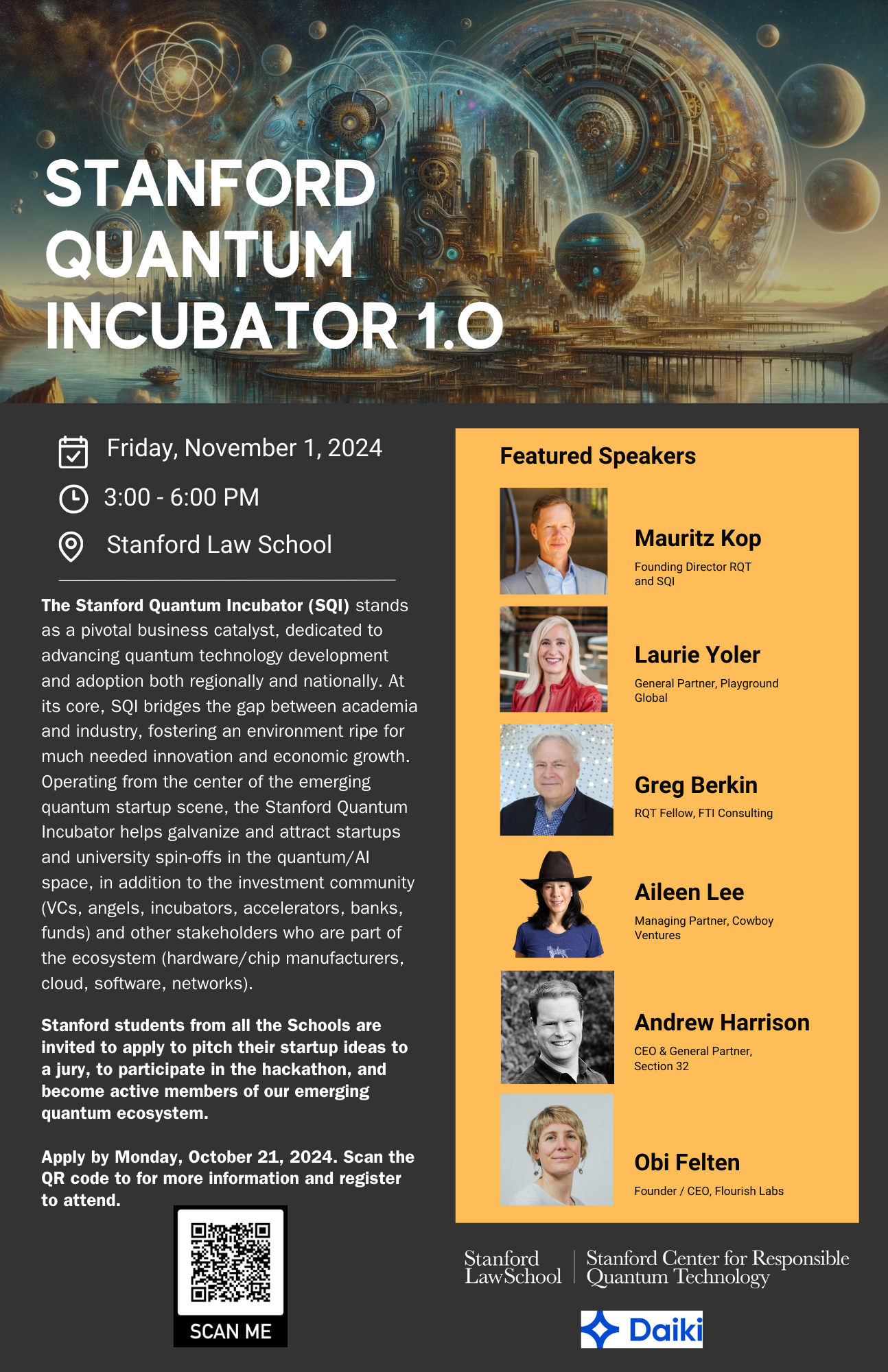
Stanford Quantum Incubator Workshop 1.0, November 1, 2024, at Stanford Law School

On November 1, 2024, the Stanford Quantum Incubator (SQI) convened its pilot workshop at Stanford Law School: a half-day of startup pitches, a hackathon, and venture-community networking, built to test whether a responsible quantum and AI startup ecosystem could be assembled deliberately from the ground up. Founded by Mauritz Kop and sponsored by the Stanford Center for Responsible Quantum Technology and the governance company Daiki, the incubator sits at an unusual address—inside a law school—where commercialization and responsible-innovation questions are treated as a single design problem.

An incubator inside a law school

Most technology incubators live in engineering quadrangles or business schools. SQI's decision to anchor itself in Stanford Law School signals a thesis about second-generation quantum technology: that its legal, ethical, social, and policy implications should be engaged before products ship, not litigated after. The center had already built that conviction into its research and convening program; the incubator carried it into entrepreneurship, framing responsible innovation as a competitive feature rather than a compliance cost.

Pitch, hackathon, and a values-laden ecosystem

Workshop 1.0 was participatory by design. Students from across Stanford—physics, computer science, medicine, business—were invited to apply by October 21, 2024, to pitch ventures to a jury of investment professionals, join a hackathon, and become members of the emerging ecosystem. Organized by SQI Fellows Greg Berkin and Bradley Horowitz, the workshop drew an investment-community jury that Kop thanked—Mark Lemley, David Hornik, Laurie Yoler, Obi Felten, Aileen Lee, Andrew Harrison, and Ching-Yu Hu among them—with speakers Alex Waldherr, Katie Liu, and Victor Wei addressing topics from novel quantum-computing chip architectures to responsible quantum technology in pharma and healthcare. The explicit goal was to build a local, values-laden ecosystem of quantum competency—competence and conscience grown together rather than sequenced.

Why early-stage governance matters for quantum

The incubator launched at a moment when second-generation quantum technologies—computing, cryptography, sensing, simulation, networking, and communication—were beginning to cross from the laboratory into markets spanning healthcare, finance, manufacturing, logistics, defense, and space. Because these technologies depend on engineered control over fragile quantum states that decohere easily, the questions of how to commercialize, secure, and govern them arrive at the same time as the first products. Convening founders, investors, and researchers at the earliest stage is one way to ensure those questions are asked while the answers can still shape the technology, a logic that also runs through the center's work on quantum and AI in healthcare and the life sciences.

A proof of concept

As an inaugural event, Workshop 1.0 functioned as a proof of concept for a deliberate, interdisciplinary model of quantum entrepreneurship—one that pairs commercial ambition in the emerging quantum market with values designed in rather than bolted on. The pilot offered an early template for SQI's stated aim of bridging Stanford's research strength and the venture ecosystem forming around it.

Meer lezen
Stanford Center for Law and the Biosciences: BioLawLaPaLooZa 2023-2024

For those deeply engaged in the intricate intersections of law, life sciences, and ethics, Professor Hank Greely’s annual BioLawLaPaLooza at Stanford Law School stands as an intellectual cornerstone. It is a vibrant, informal, yet deeply substantive gathering that brings together leading scholars to test new ideas, debate emerging challenges, and build the collaborative bridges essential for navigating our complex technological future. As a speaker and the photographer for the 2023 and 2024 editions, Stanford Center for Responsible Quantum Technologie Founder Mauritz Kop had the distinct pleasure of documenting and participating in these vital conversations. This post offers a reflection on and tribute to these remarkable events, which serve as a testament to the foresight and community-building spirit of Stanford’s Center for Law and the Biosciences.

The Center for Law and the Biosciences (CLB): A Foundation for Interdisciplinary Dialogue

Before delving into the events themselves, it is essential to understand the institution that makes them possible. The Stanford Center for Law and the Biosciences (CLB), under the direction of Hank Greely, has long been a preeminent academic hub for exploring the legal and ethical quandaries posed by advances in the life sciences. Alongside the Petrie-Flom Center for Health Law Policy, Biotechnology, and Bioethics at Harvard University, directed by Professor I. Glenn Cohen, the CLB stands as one of the world's leading institutions in this domain. The Center's mission is to foster interdisciplinary research, educate the next generation of leaders in law and science, and inform public policy on topics ranging from genetics and neuroscience to reproductive technologies and AI in healthcare.

The CLB's history is marked by influential scholarship, a distinguished roster of fellows and faculty, and a commitment to public engagement. Its fellowship program has proven to be a successful launchpad, with former fellows frequently securing positions as professors and becoming influential scholars in their own right. Its publications consistently shape academic discourse and provide critical guidance to policymakers. BioLawLaPaLooza is the embodiment of the Center’s mission, creating an environment where complex ideas can be presented and scrutinized in a collegial, fast-paced format. The event’s structure—short, sharp presentations followed by engaged discussion—ensures a breadth and depth of intellectual exchange that is both rare and invaluable.

The Journal of Law and the Biosciences: A Premier Scholarly Venue

Further extending the intellectual ecosystem of which the CLB is a part is the Journal of Law and the Biosciences (JLB). As the first peer-reviewed academic journal focused on the intersection of law and the life sciences, JLB serves as the premier venue for scholarship in this field. It is a co-publication of Duke University, Harvard University Law School, and Stanford University, published by Oxford University Press. The journal's leadership reflects the collaborative and interdisciplinary spirit of the field, with Editors-in-Chief Professor Nita Farahany (Duke), Professor I. Glenn Cohen (Harvard), and Professor Hank Greely (Stanford). Many of the scholars who present their nascent ideas at BioLawLaPaLooza are also contributors to and readers of the journal, highlighting the symbiotic relationship between the conference and the formal academic literature. https://academic.oup.com/jlb

Meer lezen
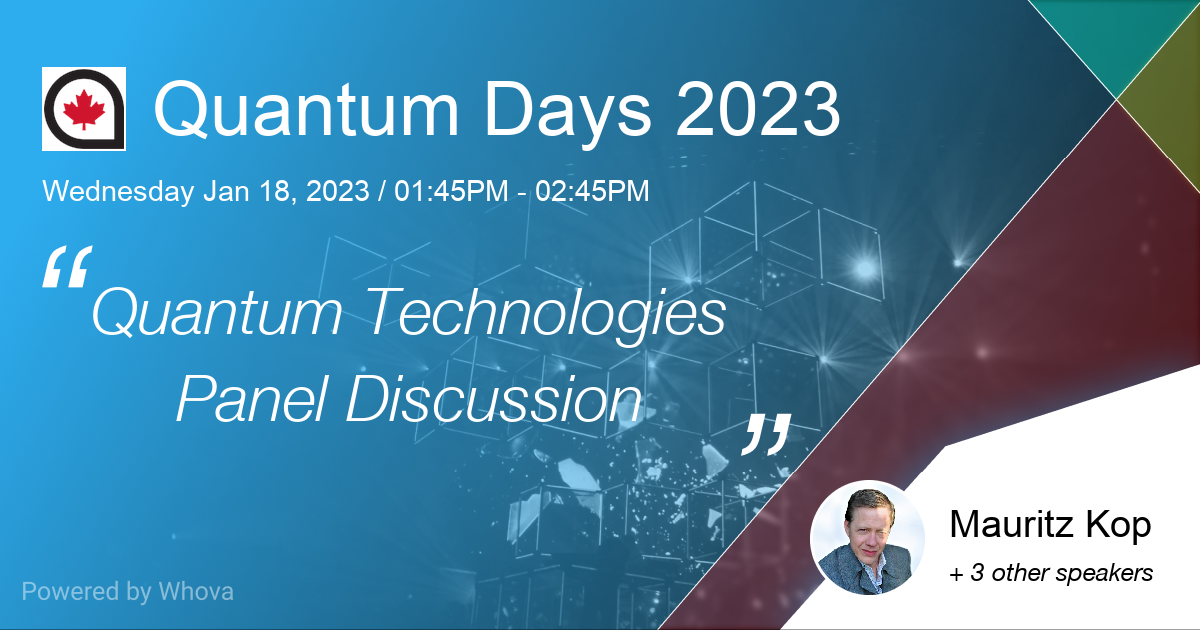
Quantum Days Canada: CCA Panel on Quantum Technologies

When the Council of Canadian Academies brought its quantum expert panel to Quantum Days in January 2023, it did something unusual for a national academy: it opened an unfinished study to public input. Mauritz Kop joined the session to frame the ethical, legal, social, and policy stakes of quantum adoption—and to invite the audience to help shape the questions, not just receive the answers.

A government-commissioned panel, in public

The panel had been formed at the request of federal sponsors, including the National Research Council of Canada and Innovation, Science and Economic Development Canada, and was chaired by the physicist Raymond Laflamme. The Quantum Days appearance gathered members of that panel—Laflamme, Jeff Kinder, Mauritz Kop, and Jacqueline Bartlett among the named participants—to discuss the panel's mandate, key questions, and priorities while its assessment of Canadian quantum adoption was still being written. It was a national study opened up mid-draft, with its conclusions deliberately still open.

Live polls and equitable access

The session's signature move was procedural: the audience was invited to feed the eventual report through live polls, under the banner of helping Canada build a quantum ecosystem. That design choice carries an argument. Responsible quantum governance, on Kop's reading, treats equitable access to quantum-enabled prosperity as a question to be settled by deliberation rather than left to the market, and asks how codes of conduct and design guidelines can be agreed across cultures whose ethical intuitions differ. Live audience input is well suited to surfacing exactly the trade-offs that have no single technically correct answer—and it reflects the distributive themes that run through Kop's broader scholarship on responsible technology.

Why the policy lens belongs at a physics conference

Quantum systems invite governance because their behavior is genuinely unfamiliar. Superposition and entanglement change what computation can do, with consequences for cryptography and security that existing law did not anticipate. The case for an ethical, legal, social, and policy lens at a technical conference is that the rules must be drafted while the science is still moving—a position consistent with the standards-and-principles direction Kop and colleagues set out in the Ten Principles for Responsible Quantum Innovation.

A panel on its way to a report

The Quantum Days session is one step in a longer process. The same panel, under the same chair, is carrying its study through 2023 toward a national assessment of quantum adoption in Canada, with Kop among its members. The sequence—open the questions in public, gather input through live polls, then translate that deliberation into evidence for decision-makers—offers a working model of quantum governance that is both expert-led and publicly grounded, an early example of treating quantum policy as a question worked out in the open rather than a finished product to be announced. (That study became the CCA's Quantum Potential report, published November 30, 2023.)

Meer lezen
Mauritz Kop and Mateo Aboy Present QT and Law Research at Lund Quantum Conference

When Lund University convened The Quantum Law Conference in late April 2022, the legal scholarship on quantum computing was still in its infancy. Organized by Valentin Jeutner under the WASP-HS-funded Quantum Law Project, the gathering—formally titled The Legal Dimensions of Quantum Computing—gave an early home to a question that has only grown more urgent: whether intellectual property law is fit for the quantum age. Mauritz Kop, then a TTLF Fellow at Stanford Law School, and Mateo Aboy, Principal Research Scholar at the University of Cambridge, brought a distinctive answer—one built on data rather than intuition.

Theory meets the patent record

Kop's theoretical contribution warned of IP overprotection: a "rainbow" of overlapping rights that could entrench first movers and concentrate market power in a young field. Rather than rest on the argument, the team tested it. Aboy led a patent-landscape study of the quantum computing subfield, asking whether feared "thicket" and "anticommons" effects were actually appearing. The pairing of a normative framework with empirical patent analysis is what made the Lund presentation unusual—and useful to policymakers who need evidence, not assertion.

A counter-intuitive result

The data pointed the other way. The patent system in quantum computing was not, at that stage, generating innovation-choking overprotection; instead, a growing share of quantum patent information was entering the publicly available disclosure record through lapsed and non-granted filings, forming an expanding information commons. The important caveat was secrecy: trade secrets and state secrets ordinarily do not appear in patent datasets, so quantitative mapping must always be read alongside qualitative analysis. The conclusion was measured—IP law works best in concert with competition law, steering between under- and overprotection.

From a conference room toward the journals

The work is not staying in Lund. The theoretical and market-power strand is forthcoming as a peer-reviewed article in the Journal of Intellectual Property Law & Practice (Oxford University Press), and the companion patent-landscape study is forthcoming in IIC – International Review of Intellectual Property and Competition Law (Springer), with a transatlantic author team spanning Stanford, Cambridge, and CeBIL at the University of Copenhagen. Together they promise one of the earliest evidence-based treatments of quantum-IP policy. It is a quieter companion to Kop's better-known warning that quantum computing carries risks that rival those of artificial intelligence: here the concern is not catastrophe but market structure—who gets to build on quantum technology, and on what terms. The answer the Lund research offers is calibration, not maximalism: predictability enough to attract investment, openness enough to keep the field competitive.

Meer lezen
Suzan Slijpen Conference Speaker at the National University of Ireland

Legal Aspects of AI in Healthcare

On 16 August 2019, Suzan Slijpen LL.M. had the honour to speak about the legal aspects of the development and use of artificial intelligence (a disruptive technology) in healthcare, at the AI in Medicine Conference organized by the Irish Association of Physicists in Medicine (IAPM). The conference took place in Galway, at the National University of Ireland (School of Physics, NUI Galway/ OÉ Gaillimh). Suzan is a senior legal consultant at AIRecht.nl, and specializes in eHealth & medical devices, pharmaceutical law, European food law and contract law, from an AI helicopterview. She is also founder and lawyer at boutique law office Slijpen Legal.

Key topics of the Artificial Intelligence in Medicine lecture

Key legal topics that Suzan addressed in her Artificial Intelligence in Medicine lecture:

1. AI & Robotics: Disruptive Technologies: Synergetic effects of 4th Industrial Revolution technologies like robotics, big data, quantum computing, Blockchain, Virtual Reality (VR) and Internet of Things (IoT).

2. eHealth and medical devices: legal classification.

3. Fundamental Rights: Safeguarding of Fundamental Rights in AI applications, Rights of Patients.

4. Ethics and responsible AI: 1791 French Revolution Values, HLEG Concept of Trustworthy AI.

5. Intellectual Property on AI and Health Apps: Licensing your IP.

6. Liability for damages caused by smart robots: who is liable for misdiagnosis by an AI algorithm?

7. Legislation and Jurisprudence.

8. AI Impact Assessment: remove roadblocks for AI.

Legislation and regulations regarding AI in Healthcare

Do you want to know more about legislation and regulations regarding AI in Healthcare, or Legal aspects of disruptive tech in Medicine? Or do you want to organize a workshop or conference yourself and invite us as a speaker or teacher? Then please contact us about the possibilities!

Meer lezen