Stanford RQT Meets VR Lab Meets Classical Music Meets Fractal Art: Jin-Hee Lee, Katie Liu and Mauritz Kop at Stanford's VR Lab (Spring 2024)
By our Editor
What does quantum mechanics sound like? In the spring of 2024, an exploratory project at Stanford's virtual-reality lab, titled Stanford RQT Meets VR Lab Meets Classical Music Meets Fractal Art, brought together quantum technology, artificial intelligence, classical music, and fractal art. It featured Jin-Hee Lee, Katie Liu, and Mauritz Kop, three collaborators from the Stanford responsible-quantum circle who had earlier visited Caltech's quantum research center together.
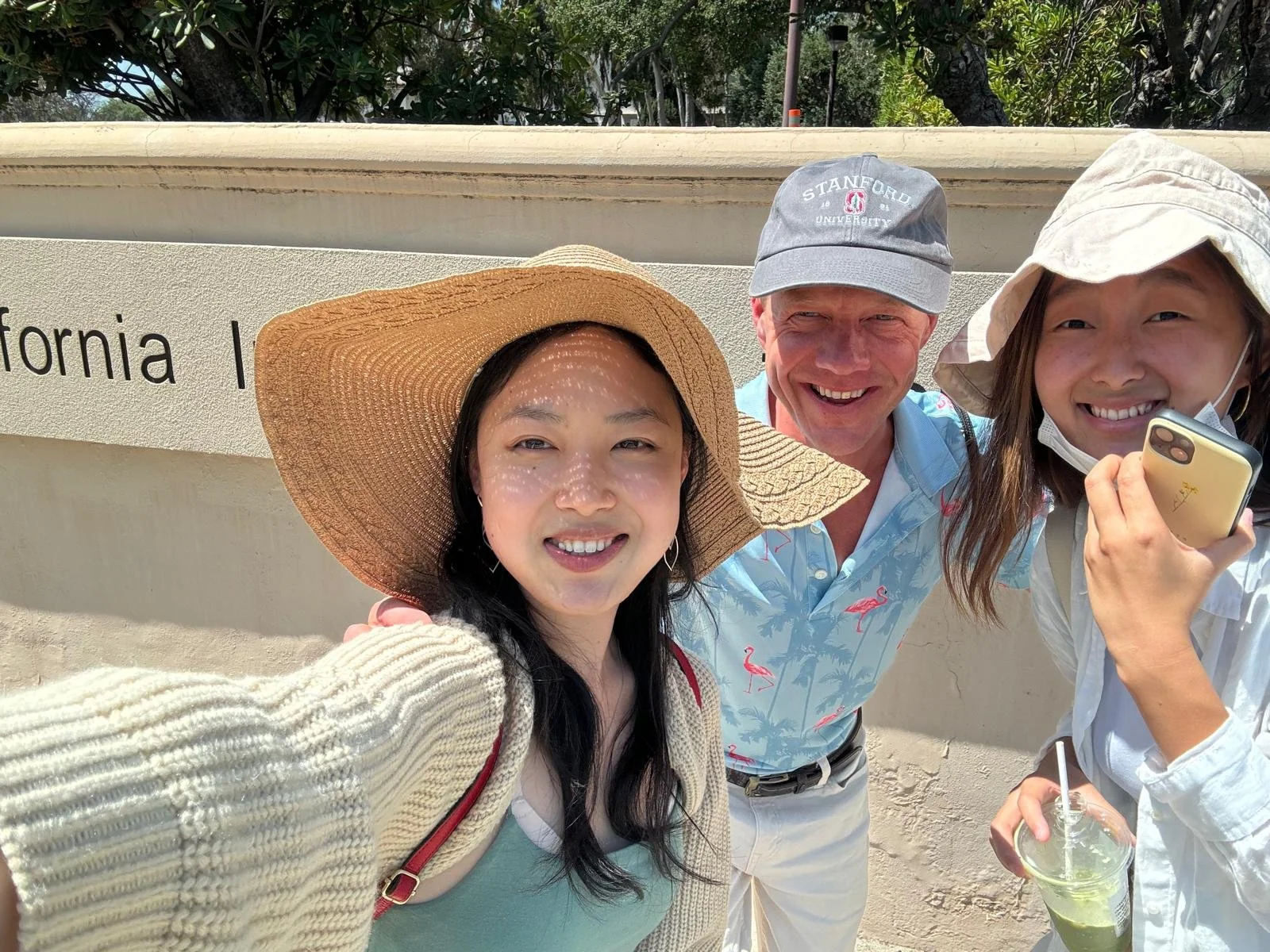
Jin-Hee Lee, Katie Liu and Mauritz Kop during their 2024 visit to Caltech's quantum research center.
What the project imagines for learners, performers, and conferences in virtual reality
The project's ambitions were sketched in remarks delivered at the event by Katie Liu, who studies computer science and music at Stanford. Imagine quantum-VR applications that let a learner watch a conductor's gestures from the vantage point of any instrument in the orchestra; sheet music you can touch and reshape in real time, adjusting tempo and dynamics to taste; a future classroom where a student plays along with a professional ensemble and feels musical expression from the inside; academic conferences attended remotely through immersive 3D visualization instead of a flat video grid. The through-line is presence: using virtual reality to put people inside phenomena that lectures can only describe.

Stanford RQT Meets VR Lab Meets Classical Music Meets Fractal Art Jin-Hee Lee, Katie Liu and Mauritz Kop at Stanford's VR Lab (Spring 2024)
Why a law-and-governance team ends up in a VR lab
Immersive and artistic formats do something policy papers cannot. They make quantum phenomena experiential. Superposition, entanglement, and measurement resist intuition, and sonification and virtual visualization can help students, policymakers, and the public approach the technology they are being asked to govern, provided the mapping to the underlying physics is explicit and its limits are explained. The inquiry at the event ran further than music, toward quantum computing and simulation for molecular modeling in the life sciences, and speculative hypotheses about quantum effects in cognition, which remain unestablished and contested. On this view, science communication is governance infrastructure.

C:\Users\QAdmin\OneDrive - MusicaJuridica\Documenten\MusicaJuridica\Stanford Law School\Stanford Center for RQT\Photos
The musician in the jurist: why quantum-AI music raises copyright questions
For Kop, the project joins two biographies: the jurist and legal scholar who founded Stanford's responsible-quantum center, and the classically trained musician and electronic-music producer. That combination has surfaced before on this blog, from Music Law and Artificial Intelligence to music-law teaching at conservatoires. AI-generated and quantum-inspired music also raises live legal questions: who owns output shaped by probabilistic machines, and how do we credit human creative direction within it? The puzzles the AI-and-copyright debate has spent a decade on return here with a quantum twist.
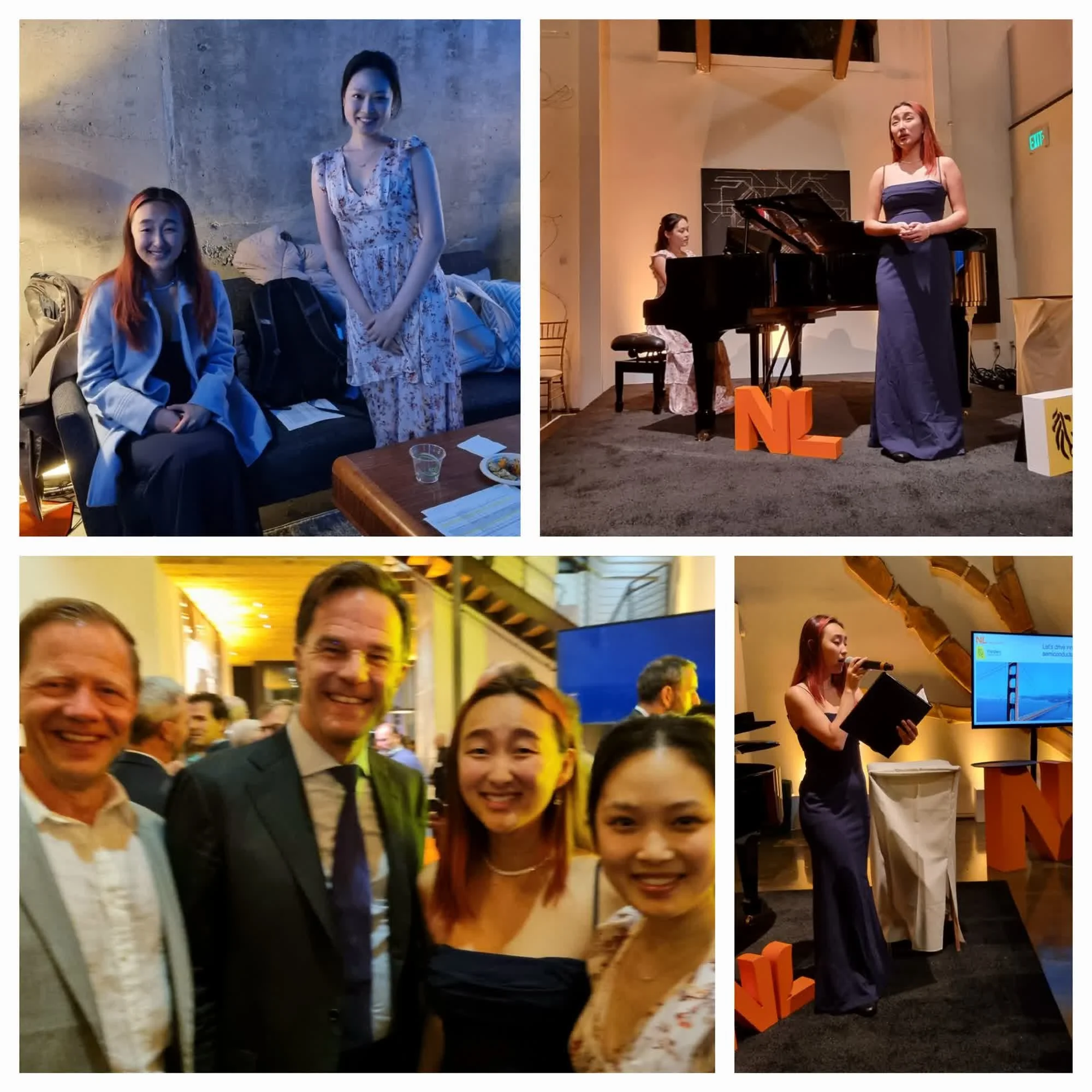
The Stanford RQT musicians Jin-Hee Lee, Katie Liu and Mauritz Kop with former Dutch Prime Minister Mark Rutte at Stanford.
Art as a research instrument for representing probabilistic processes
The VR-lab collaboration treats art as an instrument of inquiry: a way to study how audiences interpret artistic representations of probabilistic processes, and a bridge between the concert hall, the laboratory, and the seminar room. The scholarly backbone remains archived in the Stanford RQT collection at the Stanford Digital Repository.
For educators and research funders, the practical lesson is that a public with a real voice in quantum governance first needs a real feel for the technology, and immersive art may be the shortest path from equation to intuition.

Art as a research instrument for representing probabilistic processes
Last updated: September 3, 2026