Innovation, Quantum-AI Technology & Law

Blog over Kunstmatige Intelligentie, Quantum, Deep Learning, Blockchain en Big Data Law

Blog over juridische, sociale, ethische en policy aspecten van Kunstmatige Intelligentie, Quantum Computing, Sensing & Communication, Augmented Reality en Robotica, Big Data Wetgeving en Machine Learning Regelgeving. Kennisartikelen inzake de EU AI Act, de Data Governance Act, cloud computing, algoritmes, privacy, virtual reality, blockchain, robotlaw, smart contracts, informatierecht, ICT contracten, online platforms, apps en tools. Europese regels, auteursrecht, chipsrecht, databankrechten en juridische diensten AI recht.

Berichten in Stanford
Stanford Scholar Mauritz Kop Teaches Quantum Computing & Law at Fordham Law School

New York, NY, January 21, 2025 – Stanford University scholar Mauritz Kop, a leading voice in the intricate nexus of quantum technology, AI, and law, today addressed the legal community at the Fordham Law School Library. His presentation, titled "Here Comes Quantum Computing — What the Legal Community Needs to Know," was a featured event in the Maloney Library's esteemed "Tech Lunch 'n' Learn" series, a program designed to keep legal professionals at the forefront of technological innovation.

Stanford Scholar Mauritz Kop the Quantum Future for the Legal Community at Fordham Law

Kop, the Founding Director of the Stanford Center for Responsible Quantum Technology, offered a comprehensive overview of the transformative potential and inherent risks of quantum technologies at Fordham Law. He emphasized that the leitmotif of our time is that "Quantum’s benefits outweigh its risks, if implemented responsibly".

Responsible Quantum Technology (RQT) is a framework designed to ensure that the innovation and implementation of quantum technologies align with societal demands and enhance global welfare. It provides a principled approach to guide quantum technology development.

Responsible Quantum Technology

The core components and objectives of RQT entail:

Compliance and Safety: Developers, vendors, and users of quantum systems must adhere to a range of emerging regional and global requirements. This includes technology-specific rules and industry-specific regulations in sectors like finance and healthcare, supported by standards and certifications to guarantee safe deployment.

Addressing Implications (Quantum-ELSPI): RQT involves engaging with quantum technologies in a way that is consistent with Quantum-ELSPI—the ethical, legal, socio-economic, and policy implications of the technology. This requires a tailored approach that considers the unique and counter-intuitive principles of quantum mechanics, such as superposition and entanglement.

Alignment with RRI: The RQT framework responds to the key dimensions of Responsible Research and Innovation (RRI): anticipation, reflexivity, inclusion, and responsiveness.

Ethical Foundation: RQT must align with quantum ethics, which involves identifying the dilemmas inherent in making these technologies ethical through interdisciplinary, context-specific methods.

Legal Frameworks: The framework requires adherence to legal norms like the rule of law and proportionality. It advocates for future legislation that mitigates risks and maximizes benefits, providing legal certainty to incentivize Responsible Quantum Innovation (RQI).

Socio-Economic Considerations: RQT dictates that quantum technology should prioritize society's most pressing goals, such as cybersecurity, economic stability, and managing climate change. It also mandates that the benefits and burdens of the technology should be equitably distributed.

Policy Guidance: RQT serves as a tool for policymakers, helping them learn from the governance of other disruptive technologies like AI, nuclear energy, and the internet. An important policy goal is to foster values-based quantum ecosystems globally.

Operational Principles: The RQT paradigm is put into practice through "10 Principles for Responsible Quantum Innovation". These principles are structured to safeguard, engage, and advance (SEA) quantum technologies, society, and humankind, with the ultimate goal of protecting society by responsibly advancing the technology.

Practical Tools: The framework can be used by policymakers to design regulations and can be complemented by self-regulatory tools like technology impact assessments to monitor, validate, and audit quantum applications throughout their lifecycle using appropriate RQT benchmarks and metrics.

Hardwiring Values: A core tenet of RQT is embedding shared values and standards into the design, deployment, and infrastructure of quantum systems. This includes current work on how to embed values and standards into the architecture and infrastructure of quantum AI systems, products, and services. The goal is to guide these technologies toward collective social and environmental benefit.

Quantum Computing — What the Legal Community Needs to Know

The ‘Quantum Computing — What the Legal Community Needs to Know’ lecture provided an in-depth exploration of second-generation (2G) quantum technologies, which harness the unique principles of quantum physics, such as superposition and entanglement, to solve problems beyond the grasp of classical computers. Kop highlighted recent breakthroughs, including Google's "Willow" quantum computing chip, which completed a complex calculation in under five minutes—a task that would take the fastest supercomputers an estimated 10 septillion years. This, he explained, demonstrates the potential for quantum computers to revolutionize sectors like healthcare, finance, energy, and defense.

Navigating the Ethical and Legal Maze

A significant portion of the talk was dedicated to the ethical, legal, socio-economic, and policy implications (Quantum ELSPI) of this emerging field. Kop stressed the dual-use nature of quantum technology, which, much like nuclear energy, can be applied to both civilian and military purposes. This duality necessitates a robust governance framework to prevent misuse by adversaries and to avoid a new arms race.

Kop advocated for a "Responsible Quantum Technology (RQT)" framework to ensure that innovation aligns with societal values and legal standards. This approach calls for a recalibration of legal frameworks to mitigate risks while fostering responsible innovation. He pointed to the "Collingridge dilemma," cautioning that regulating quantum too early could stifle innovation, while regulating too late could result in irreversible negative consequences.

A Call for Global Cooperation and Responsible Innovation

The lecture underscored the necessity of global cooperation in developing unified quantum interoperability standards to avoid a "quantum splinternet" fragmented along geopolitical lines. Kop argued for a research and development agenda that is "as open as possible, and as closed as necessary" to address national security concerns while fostering international partnerships.

To operationalize the RQT paradigm, Kop and his research group have proposed "10 Principles for Responsible Quantum Innovation," organized to safeguard, engage, and advance (SEA) quantum technologies for the benefit of humanity.

Fordham's Commitment to Legal Tech Education

The "Tech Lunch 'n' Learn" series at Fordham's Maloney Library provides a crucial platform for such discussions, inviting experts to shed light on the evolving landscape of law and technology. These sessions empower students and practitioners to grapple with complex subjects like AI, data privacy, and now, quantum computing.

Kop's lecture at Fordham served as a vital call to action for the legal community to proactively engage with the development of quantum technologies. As he concluded, "As society shapes technology, technology shapes society". The legal profession has a critical role to play in ensuring that the quantum era unfolds in a manner that is secure, equitable, and beneficial for all.

Meer lezen

Law, Ethics and Policy of Quantum & AI in Healthcare and Life Sciences published at Harvard, Stanford and European Commission

A collaborative research initiative by scholars from Stanford, Harvard, and MIT, published by the Petrie-Flom Center at Harvard Law School, the Stanford Center for Responsible Quantum Technology, and the European Commission, delves into the complex regulatory and ethical landscape of integrating quantum technologies and artificial intelligence (AI) into the healthcare and life sciences sectors. This series of policy guides and analyses, authored by an interdisciplinary team including Mauritz Kop, Suzan Slijpen, Katie Liu, Jin-Hee Lee, Constanze Albrecht, and I. Glenn Cohen, offers a comprehensive examination of the transformative potential and inherent challenges of this technological convergence.

Regulating Quantum & AI in Healthcare and Medicine: A Brief Policy Guide

This body of research, examining the entangled legal, ethical, and policy dimensions of integrating quantum technologies and AI into healthcare, is articulated across a series of publications in leading academic and policy forums. These works collaboratively build a comprehensive framework for understanding and navigating the future of medicine. A related policy guide was also published on the European Commission's Futurium platform, further disseminating these findings to a key international policymaking audience. The specific publications include:

1. A Brief Quantum Medicine Policy Guidehttps://blog.petrieflom.law.harvard.edu/2024/12/06/a-brief-quantum-medicine-policy-guide/

2. How Quantum Technologies May Be Integrated Into Healthcare, What Regulators Should Considerhttps://law.stanford.edu/publications/how-quantum-technologies-may-be-integrated-into-healthcare-what-regulators-should-consider/

3. EU and US Regulatory Challenges Facing AI Health Care Innovator Firmshttps://blog.petrieflom.law.harvard.edu/2024/04/04/eu-and-us-regulatory-challenges-facing-ai-health-care-innovator-firms/

4. Regulating Quantum & AI in Healthcare: A Brief Policy Guidehttps://futurium.ec.europa.eu/en/european-ai-alliance/document/regulating-quantum-ai-healthcare-brief-policy-guide

by Mauritz Kop, Suzan Slijpen, Katie Liu, Jin-Hee Lee, Constanze Albrecht & I. Glenn Cohen

Forging the Future of Medicine: A Scholarly Perspective on the Law, Ethics, and Policy of Quantum and AI in Healthcare

The research posits that the fusion of AI with second-generation quantum technologies (2G QT)—which harness quantum-mechanical phenomena like superposition and entanglement—is poised to revolutionize precision medicine. This synergy of quantum computing, sensing and simulation with artificial intelligence promises hyper-personalized healthcare solutions, capable of tackling intricate medical problems that lie beyond the grasp of classical computing. The potential applications are vast, spanning from accelerated drug discovery and development workflows and enhanced diagnostic imaging to rapid genome sequencing and real-time health monitoring. For instance, quantum simulations could model molecular interactions to create more effective pharmaceuticals, while quantum dots may offer novel platforms for targeted cancer therapies and treatments for neurodegenerative conditions by overcoming the blood-brain barrier.

However, the authors caution that these groundbreaking advancements are accompanied by significant ethical, legal, socio-economic, and policy (ELSPI) implications. The emergence of Quantum Artificial Intelligence (QAI), Quantum Machine Learning (QML), and Quantum Large Language Models (QLLM) is expected to amplify these ELSPI concerns. The dual-use nature of these technologies, such as their potential application in gain-of-function research, necessitates a principled and human-centric governance approach.

Meer lezen
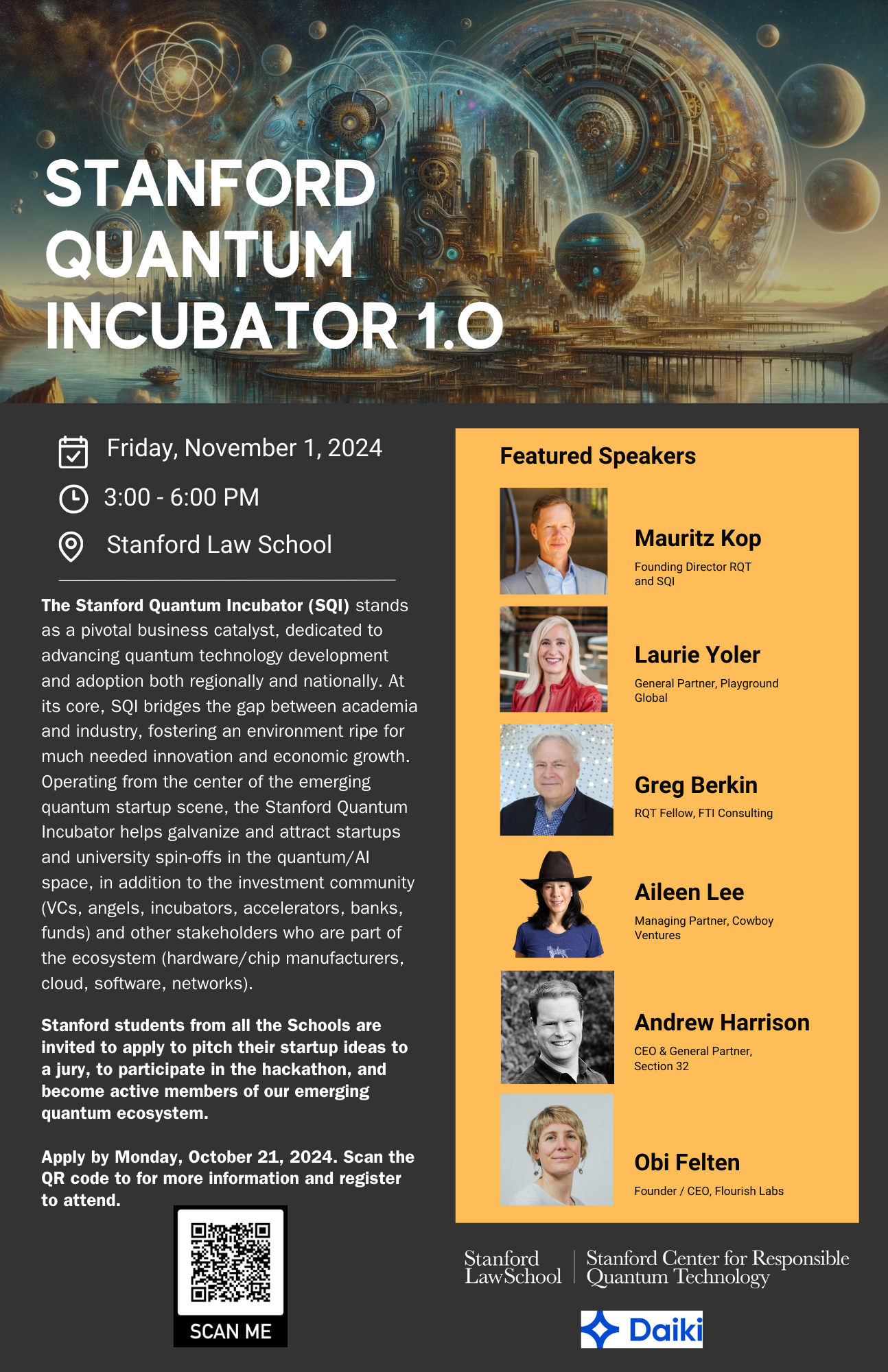
Stanford Quantum Incubator Workshop 1.0, November 1, 2024, at Stanford Law School

On November 1, 2024, the Stanford Quantum Incubator (SQI) convened its pilot workshop at Stanford Law School: a half-day of startup pitches, a hackathon, and venture-community networking, built to test whether a responsible quantum and AI startup ecosystem could be assembled deliberately from the ground up. Founded by Mauritz Kop and sponsored by the Stanford Center for Responsible Quantum Technology and the governance company Daiki, the incubator sits at an unusual address—inside a law school—where commercialization and responsible-innovation questions are treated as a single design problem.

An incubator inside a law school

Most technology incubators live in engineering quadrangles or business schools. SQI's decision to anchor itself in Stanford Law School signals a thesis about second-generation quantum technology: that its legal, ethical, social, and policy implications should be engaged before products ship, not litigated after. The center had already built that conviction into its research and convening program; the incubator carried it into entrepreneurship, framing responsible innovation as a competitive feature rather than a compliance cost.

Pitch, hackathon, and a values-laden ecosystem

Workshop 1.0 was participatory by design. Students from across Stanford—physics, computer science, medicine, business—were invited to apply by October 21, 2024, to pitch ventures to a jury of investment professionals, join a hackathon, and become members of the emerging ecosystem. Organized by SQI Fellows Greg Berkin and Bradley Horowitz, the workshop drew an investment-community jury that Kop thanked—Mark Lemley, David Hornik, Laurie Yoler, Obi Felten, Aileen Lee, Andrew Harrison, and Ching-Yu Hu among them—with speakers Alex Waldherr, Katie Liu, and Victor Wei addressing topics from novel quantum-computing chip architectures to responsible quantum technology in pharma and healthcare. The explicit goal was to build a local, values-laden ecosystem of quantum competency—competence and conscience grown together rather than sequenced.

Why early-stage governance matters for quantum

The incubator launched at a moment when second-generation quantum technologies—computing, cryptography, sensing, simulation, networking, and communication—were beginning to cross from the laboratory into markets spanning healthcare, finance, manufacturing, logistics, defense, and space. Because these technologies depend on engineered control over fragile quantum states that decohere easily, the questions of how to commercialize, secure, and govern them arrive at the same time as the first products. Convening founders, investors, and researchers at the earliest stage is one way to ensure those questions are asked while the answers can still shape the technology, a logic that also runs through the center's work on quantum and AI in healthcare and the life sciences.

A proof of concept

As an inaugural event, Workshop 1.0 functioned as a proof of concept for a deliberate, interdisciplinary model of quantum entrepreneurship—one that pairs commercial ambition in the emerging quantum market with values designed in rather than bolted on. The pilot offered an early template for SQI's stated aim of bridging Stanford's research strength and the venture ecosystem forming around it.

Meer lezen
2nd Annual Stanford Responsible Quantum Technology Conference: Summary of Core Themes and Selected Highlights

The 2nd annual Stanford Responsible Quantum Technology Conference convened by the Stanford Center for Responsible Quantum Technology and expertly orchestrated by its Executive Director Mauritz Kop, provided a broad overview of the latest developments in quantum technology, with a focus on quantum simulation. It brought together a diverse and interdisciplinary group of experts from the US and Europe – united in their interest in responsible development and use of second-generation quantum technologies – to discuss innovations, challenges, and future directions in this emerging space. The conference included both in-depth presentations and far-ranging panel discussions, with artistic and musical performances interspersed as alternative spaces of approximation and exploration.

The following write-up by Constanze Albrecht does not aim to offer a comprehensive overview of the wealth of perspectives and insights shared at the conference. Instead, it introduces some of the conference’s core themes by summarizing some of the anchor presentations and is intended as an invitation to readers to dive deeper into the conference materials and videos posted online.

Technological Advancements and Market Dynamics

One of the standout presentations was “Project Quantum Leap: Quantum Computing Innovation—Patenting Trends Innovation & Policy Implications” by Mateo Aboy. This presentation offered an in-depth empirical study of the intellectual property landscape in quantum computing. He emphasized the necessity of evidence-based IP studies to inform policy and innovation governance in this rapidly evolving field. Aboy revealed significant growth in quantum computing patents over the past two decades, particularly noting an uptick since 2014, with patents mainly focuses on physical realizations, quantum circuits, error correction, and quantum algorithms. This surge reflects the increased involvement of diverse entities, including universities, startups, and established corporations.

The presentation further highlighted the critical role of international harmonization in patent laws and the importance of public disclosures in advancing technology. Mateo Aboy also explored the state-of-the-art applications of quantum computing in healthcare, emphasizing its potential to revolutionize both fundamental and clinical research despite being in its early stages. He concluded with a call for a balanced regulatory approach that promotes technological advancement while safeguarding against potential risks, underscoring the need for proactive policy measures.

Quantum Use Cases in Healthcare and Life Sciences

In this context, a fascinating panel discussion moderated by Hank Greely offered a deep dive into the applications and use cases of quantum technology in the health and life sciences. Mateo Aboy, Glenn Cohen, Timo Minssen and Victoria Ward examined the transformative potential of quantum computing, sensing, and simulation in enhancing diagnostic tools, personalizing treatment plans, and accelerating drug discovery processes. The discussions also addressed market dynamics, highlighting the competitive landscape and the strategic positioning of key players in the quantum technology market. The panelists underscored the importance of fostering a robust innovation ecosystem that supports the growth of startups and encourages collaboration between academia, industry, and government bodies.

Providing insight into the technical aspects of quantum technology innovation, Mark Brongersma, Professor in the Department of Materials Science and Engineering at Stanford University, presented cutting-edge research at the intersection of materials science and quantum technology. His presentation focused on developing and analyzing nanostructured materials for nanoscale electronic and photonic devices. Key research topics included nanophotonics, which enhances light manipulation at the subwavelength scale, and microcavity resonators, which confine light to boost light-matter interactions. This pioneering work paves the way for future innovations that could revolutionize current sensing and simulation technologies.

Meer lezen
Mauritz Kop Teaches Stanford Quantum Computing Association Students at Stanford Electrical Engineering

STANFORD, CA, April 16, 2024 – Today, Mauritz Kop, Founding Director of the newly established Stanford Center for Responsible Quantum Technology (RQT), delivered a lecture to the Stanford Quantum Computing Association (SQCA) at Stanford Electrical Engineering, titled "A Call for Responsible Quantum Technology." The interdisciplinary lecture was a featured event in the SQCA's distinguished "Industry Nights" speaker series and concluded with an engaging question-and-answer session with Stanford's outstanding physics, computer science, and electrical engineering students.

The Stanford Quantum Computing Association (SQCA)

The Stanford Quantum Computing Association (SQCA) serves as a vital hub for the university's burgeoning quantum community, connecting students across disciplines with the forefront of quantum innovation. SQCA’s mission is to establish and support a quantum computing community at Stanford by building bridges between students, researchers, and faculty from various departments interested in the field. Its "Industry Nights" series consistently hosts influential voices from leading companies and research institutions such as Google Quantum AI, D-Wave Quantum, and Quantinuum, providing quantum computing students with direct access to the field's pioneers. The SQCA also acts as a liaison between the Stanford quantum community and academic and industry groups outside the university. Its activities include hosting talks, holding workshops, and organizing projects.

Ethics, Law, Societal Impact, Economics, and Policy

During his talk, Professor Kop outlined a comprehensive vision for navigating the dawn of the quantum age. He introduced the concepts of the Quantum-ELSPI metaparadigm—which addresses the ethical, legal, socio-economic, and policy implications of the technology—and the Responsible Quantum Technology (RQT) framework developed by a transatlantic team of interdisciplinary scholars. The RQT framework, Kop explained, integrates these ELSPI perspectives into the entire lifecycle of quantum research and development, from the lab to the market.

To make this framework actionable, Kop presented the "10 Principles for Responsible Quantum Innovation," a guide designed to operationalize RQT. These principles are organized into three functional categories: Safeguarding, Engaging, and Advancing (SEA). A crucial insight shared was that safeguarding society and humanity can often be best achieved by responsibly advancing quantum technology. This vision was recently detailed in a paper co-authored by Kop and his team, "A Call for Responsible Quantum Technology," which was notably published in the prestigious journal Nature Physics on April 9, 2024, lending significant credibility to the mission of embedding responsible governance within the scientific community.

Stanford Center for RQT and Stanford Quantum Incubator (SQI) Launch

The lecture was also marked by two significant announcements for the Stanford quantum community. Kop officially introduced the Stanford Center for RQT, a new multidisciplinary center under his leadership that aims to influence the emerging quantum technology governance cycle and foster a competitive, values-based quantum ecosystem. He also unveiled the recent launch of the Stanford Quantum Incubator (SQI), a Silicon Valley business catalyst designed to bridge the gap between academia, government, investors, and industry to accelerate quantum development and adoption.

The presentation underscored the massive global implications of quantum technology, which is poised to transform everything from healthcare and energy to defense and materials science. By engaging directly with the next generation of quantum scientists and engineers at the SQCA, Kop emphasized the shared responsibility of the entire community to steer these powerful technologies toward beneficial societal and planetary outcomes while the field is still malleable.

Meer lezen
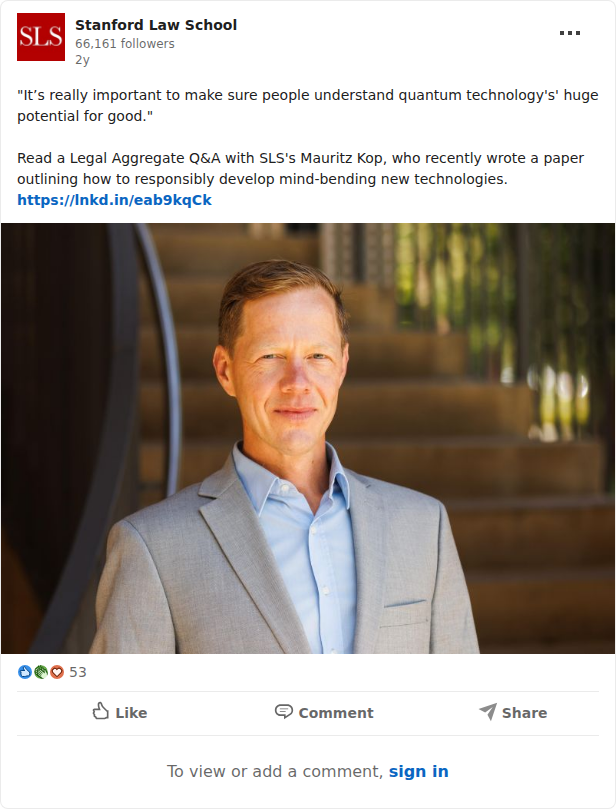
Stanford Law School Legal Aggregate Q&A with SLS's Mauritz Kop on Quantum Technologies

Stanford Law School's Legal Aggregate blog has run a Q&A with Mauritz Kop—SLS's Mauritz Kop Discusses Quantum Technology and the Need for Legal and Policy Guardrails—published a day after his Nature Physics comment A Call for Responsible Quantum Technology, co-authored with Urs Gasser and Eline De Jong. The conversation translates a scholarly argument for responsible quantum technology into terms a general readership can act on.

Guardrails as a design choice

The interview's frame is constructive rather than alarmist: the case for legal and policy guardrails is the case for capturing quantum technology's benefits responsibly, while the field's commercial and strategic shape is still being set. Because qubits can hold superpositions of states and become entangled, quantum systems unsettle long-standing assumptions—about what can be measured, copied, or kept secret—that current law and infrastructure quietly rely on. Addressing that upstream, the argument runs, is cheaper and more credible than reacting to harms after deployment. The piece is equally careful about timing: much of the field's most consequential promise depends on advances in error correction and the management of decoherence, and it is exactly that gap between current machines and eventual capability that makes early, revisable governance the prudent course.

Scholarship built to be cited

A distinctive thread is Kop's publication strategy: placing work in both scientific and legal journals so that policymakers can cite it and build durable policy on top of it—across national security, export controls, supply chains, intellectual property, and standardization. The Nature Physics comment makes the foundational move, calling on the research community to take shared responsibility for defining the principles and practices of responsible quantum technology rather than leaving that to after-the-fact regulation.

Institution-building at Stanford

The Q&A situates the argument inside the work then underway at Stanford Law School—a newly launched center for responsible quantum technology, a quantum incubator, and an annual conference, the second edition of which was covered in the 2nd Annual Stanford Responsible Quantum Technology Conference summary. The fuller portrait of the scholar behind the program is set out in the Mauritz Kop profile. The result is a single message in two registers: responsible governance of quantum technology is an upstream design choice, best made while the technology, the market, and the law are all still forming. It is a message that echoes a recurring theme in the parallel governance of artificial intelligence: that durable rules tend to rest on a credible evidentiary record assembled before the technology matures. The Legal Aggregate Q&A reads, in that light, as an attempt to apply that insight to quantum technology one cycle earlier.

Meer lezen
Stanford University Launches Stanford Center for Responsible Quantum Technology

Stanford, CA – December 6, 2023 – Stanford University today announced the launch of the Stanford Center for Responsible Quantum Technology (RQT), a pioneering initiative dedicated to addressing the profound ethical, legal, social, and policy implications of the rapidly advancing field of quantum technologies, including quantum artificial intelligence (QAI). The Center, part of the Stanford Program in Law, Science & Technology (LST) at Stanford Law School (SLS), is believed to be the first academic center of its kind.

Dutch Network for Academics in the USA Semicon, Geopolitics and Shared Values Event

The announcement was made during a distinguished Dutch Network for Academics in the USA event focused on semicon, geopolitics and shared democratic values, presented by the Stanford Institute for Economic Policy Research (SIEPR). The occasion was graced by the presence of outgoing Netherlands Prime Minister Mark Rutte, Nobel Prize winner and Stanford School of Business Professor Guido Imbens, Stephen Harris Professor of Materials Science and Engineering Mark Brongersma, and William H. Neukom Professor of Law Mark Lemley, who is also the Director of the LST program and serves as the faculty leader of the new Quantum Institute.

Mauritz Kop Founding Director of the Stanford Center for Responsible Quantum Technology

Mauritz Kop, who founded and directs the Center and began his tenure as a Transatlantic Technology Law Forum Fellow at Stanford Law School in 2019, highlighted the critical juncture at which the Center is being established. "Quantum technologies—especially in the areas of encryption, computing, and sensors—were rapidly evolving from hypothetical ideas to commercial realities," Kop observed. "Here, I determined, was where the most interesting–and pressing–questions of law and policy lay. Put simply, quantum technology involves the smallest particles in the universe but has the potential to create some of the world’s biggest technological quandaries and opportunities."

Stanford University Library RQT Scholarship Repository of Selected Works: https://purl.stanford.edu/hp536nb5631

Meer lezen
Mauritz Kop Judge at 6th Annual Junior Faculty Forum for Law and STEM at Stanford

On October 27, 2023, Stanford Law School hosted the 6th Annual Junior Faculty Forum for Law and STEM, a premier event organized and hosted by Professor Mark Lemley that convenes the next generation of leading legal scholars to present and refine their cutting-edge research. The forum, which rotates between Stanford, the University of Pennsylvania, and Northwestern University, provides a vital platform for interdisciplinary dialogue on the complex legal challenges posed by rapid scientific and technological advancement. Mauritz Kop, a recognized expert in technology law and governance, had the honor of serving as a judge and commentator, contributing to the rigorous intellectual exchange that defines the event.

The forum's mission is to foster the development of early-career academics by providing a supportive yet critical environment for them to receive feedback from senior scholars in their fields. Over two days, junior faculty presented works-in-progress on a diverse array of topics, from the metaverse and quantum computing to medical device regulation and genome governance, showcasing the breadth and depth of contemporary law and STEM scholarship.

The Call for Papers: Fostering Interdisciplinary Law & Technology Scholarship

The selection of presenters for the forum is a rigorous process, initiated by a formal Call for Papers issued by the organizing universities: Northwestern, the University of Pennsylvania, and Stanford Law School. The call invites junior faculty from any discipline to submit papers on any topic related to the intersection of law and STEM. The goal is to promote interdisciplinary research that explores how developments in STEM are affecting law and vice versa, with a preference for papers that strongly integrate these two fields.

A Rich Tapestry of Emerging Legal Questions

The agenda for the 2023 forum was a testament to the pressing legal and ethical questions emerging from the frontiers of science and technology. The papers presented offered a glimpse into the future of legal scholarship and the complex societal issues that lawmakers, judges, and regulators will face in the coming years.

Among the thought-provoking works discussed were:

  1. "Taxing the Metaverse" by Christine Kim (Cardozo School of Law): This paper tackles the novel challenge of how to apply principles of taxation to the burgeoning virtual economy. Kim argues that economic activity within the metaverse satisfies traditional definitions of income and that failing to tax it would create a new kind of tax haven. The paper explores how the metaverse could serve as a laboratory for modernizing the tax system, potentially overcoming the traditional realization requirement.

  2. "Regulating Medical Device Innovation" by George Horvath (University of Akron School of Law): Horvath reframes the debate around medical device safety, moving beyond the narrow concept of "predicate creep" in the 510(k) clearance process to a broader analysis of "device creep." He makes the counterintuitive argument that properly structured safety regulations can stimulate, rather than stifle, innovation by building a more robust clinical knowledge base.

  3. "Who Owns Children's DNA?" by Nila Bala (UC Davis School of Law): This article addresses the critical and underexplored issue of parental control over children's genetic information. Bala argues that parental consent is an insufficient safeguard against the collection and use of a child's DNA by law enforcement, particularly in the context of direct-to-consumer genetic testing. She proposes moving from a framework of parents-as-owners to parents-as-fiduciaries, drawing on property law principles to protect the child's long-term interests.

  4. "Gene Stewards: Rethinking Genome Governance" by Shelly Simana (Stanford Law School): Simana confronts the exploitative practices of entities that collect and use human genetic material. She proposes a new statutory category of "Gene Stewards," which would impose quasi-fiduciary duties of loyalty and care on these powerful public and private entities, ensuring they act as responsible stewards of this sensitive information.

Reviewing "Privacy in the Quantum Age"

As part of his role, Mauritz Kop, alongside Professor Christopher Yoo of the University of Pennsylvania, served as a commentator for the paper "Privacy in the Quantum Age" by Anat Lior (Yale Law School). Lior's paper addresses the profound privacy implications of quantum computing, particularly its potential to break current encryption standards.

In his review, Kop commended Lior for her courage in tackling such a complex and deeply interdisciplinary subject. He emphasized the need for legal scholars entering this domain to achieve a high level of "quantum literacy" to engage credibly with both the technology's promise and its perils. He offered several pieces of constructive feedback aimed at strengthening the paper's impact and scholarly contribution.

Meer lezen
Stanford Responsible Quantum Technology Conference 2023

Stanford, CA – May 22, 2023 – The 21st century is undeniably the Quantum Age, and on May 22, 2023, Stanford University hosted the inaugural Stanford Responsible Quantum Technology Conference at the iconic Paul Brest Hall, Stanford Law School. This landmark annual event, themed "Quantum-ELSPI" for its first iteration, brought together the global quantum community to explore the multifaceted ethical, legal, socio-economic, and policy implications (ELSPI) of this transformative field.

The conference was designed as a unique confluence of quantum physics, law, and art, aiming to discuss informed suggestions on how to balance maximizing the benefits and mitigating the risks of applied quantum technology. It covered state-of-the-art quantum computing, sensing, simulation, communication, materials, and quantum-classical hybrids, all within diverse multidisciplinary settings and taking a pro-innovation stance.

A Day of Interdisciplinary Exploration and Artistic Inspiration

The day was marked by deeply interdisciplinary presentations and an elegant intellectual atmosphere, uniquely punctuated by live musical interludes featuring works by Mozart, Schönberg, and Chopin, and opera arias by Handel, Liszt, and Gounod. Attendees also witnessed interactive quantum physics experiments, including demonstrations of quantum sensing and interferometry, designed to make the counter-intuitive quantum world more accessible.

The program began with Opening Remarks by Mauritz Kop of Stanford University, AIRecht.nl, and Daiki. This set the stage for a day of profound discussions.

What Responsible Quantum Technology & Innovation Entails

As attendees experienced, the conference provided an illuminating platform for discussing the state-of-the-art in quantum science, governance tipping points, risk-benefit analyses, intellectual property, societal impact assessments, and the myriad exciting novel use cases being developed. The discussions on what Responsible Quantum Technology & Innovation truly entails in diverse, multidisciplinary, and intergenerational settings were a highlight for all participants.

Mauritz Kop offered closing remarks, and the day concluded with a reception, further fostering the sense of community and shared purpose.

Deep gratitude was extended to all the speakers, moderators, musicians (Ireh Kim, Jin-Hee Catherine Lee, Zoe Logan Schramm, Katie Liu, Daniel Changxiao Sun, and Mauritz Kop), and physicists (Franz Inthisone Pfanner, Daniel Changxiao Sun) who contributed to the success of this inaugural event. Special thanks were also conveyed to Professor Mark Lemley and the team at Stanford Law School for making this memorable conference a reality.

The Stanford Responsible Quantum Technology Conference has set a high bar for future discussions, and the quantum community eagerly anticipates Stanford RQT 2.0.

Meer lezen
Scarcity, Regulation, and the Abundance Society Roundtable at Stanford Law

In 2022, Mauritz Kop had the honor of contributing a chapter to the book project "Scarcity, Regulation, and the Abundance Society," a special volume of Frontiers in Research edited by two leading minds in technology law, Professor Mark Lemley of Stanford Law School and Professor Deven Desai of Georgia Institute of Technology. The project culminates years of research and dialogue, including a memorable and insightful roundtable held at Stanford Law School.

The central inquiry of the project is to explore how our legal and economic institutions, which are fundamentally built on scarcity, should respond as "technologies of abundance" make scarcity a thing of the past in many industries. As new technologies like AI, 3D printing, and synthetic biology democratize and disrupt production, the book examines whether we will try to legally replicate scarcity or reorder our society to focus on things other than scarcity.

The "Abundance and Equality" Chapter Edited by Mark Lemley

His chapter, titled "Abundance and Equality," was edited by Mark Lemley and connects the concepts of good governance and the end of scarcity by unifying equality with technology-driven abundance. The piece introduces the Equal Relative Abundance (ERA) principle—a post-Rawlsian framework for distributive justice designed for an age of abundance.

The ERA principle builds on John Rawls's "difference principle" but integrates desert-based critique, arguing that unequal rewards for contributions (due to hard work, talent, or entrepreneurial spirit) are justified only to the extent that they also improve the position of the least advantaged members of society. The chapter examines how ten key exponential technologies of the Fourth Industrial Revolution—including AI, quantum technology, and biotechnology—are the primary drivers of this shift from scarcity to abundance. It critically analyzes our existing scarcity-based institutions, particularly property and intellectual property law, and posits that we must begin experimenting with hybrid systems that mix the best of forward-thinking socialist and ethical post-capitalist paradigms, built on a foundation of participatory democracy.

Mauritz Kop Presents Book Chapter at 2022 Stanford Law’s Abundance Roundtable

On April 22, 2022, the project's contributors gathered for a roundtable workshop at Stanford Law School. The event provided a forum for a deeply interdisciplinary group of scholars to present their work and engage in a robust dialogue about the future of our society. The format consisted of short 8-10 minute presentations followed by 20 minutes of discussion, fostering a rich exchange of ideas.

A Convergence of Post-Scarcity Presentations and Discussions

During his session, Kop presented the core arguments from his "Abundance and Equality" chapter, outlining the tension between technology-driven abundance and the persistent reality of inequality for many across the globe. He introduced the ERA principle as a moral and political guide for distributing the benefits and burdens of our increasingly abundant future.

The roundtable featured a breadth of perspectives. Vivek Wadhwa discussed solving humanity's grand challenges, while Funmi Arewa explored the scarcity of opportunity within the digital economy. Zahr Said and Joshua Fairfield tackled the creation of artificial scarcity through intellectual property and the legal status of virtual property in the age of NFTs, respectively. Shane Greenstein of Harvard Business School offered insights on supply chains and the platformization of clothing personalization. This convergence of ideas underscored the complexity of the transition ahead and the need for holistic solutions.

Musical Interlude: A Spontaneous Translation of Ideas

The roundtable was a stimulating intellectual affair, filled with rigorous debate. During lunch break, celebrating the occasion, Mauritz Kop sat down at the piano in the Stanford Faculty Lounge and performed a brief impromptu musical interlude. It was a personal endeavour to translate the abstract and often-dense themes of our discussion—the post-scarcity economy, abundance, equality, and the human condition—into the universal language of music. It was an opportunity for him to share that moment with his colleagues, connecting the analytical with the artistic.

The "Scarcity, Regulation, and the Abundance Society" project is a vital and timely undertaking. The discussions at the Stanford roundtable and the resulting publications provide a critical foundation for reimagining our legal, economic, and social institutions for a new era. These forward-looking conversations are essential for ensuring that the future of technological abundance is one that fosters not new forms of inequality, but greater justice and human flourishing for all.

Meer lezen
Quantum ELSPI: Ethical, Legal, Social and Policy Implications of Quantum Technology

Call for Papers Quantum ELSPI

Delighted to announce that the Quantum ELSPI call for papers is now open! AIRecht Director & Stanford Law School TTLF Fellow Mauritz Kop has the honor to guest-edit a Topical Collection for Digital Society, a new journal edited by Luciano Floridi (Oxford Internet Institute). This project is a Stanford/Oxford collaboration that aims to explore uncharted territories of Ethical, Legal, Social and Policy Implications of Quantum Technology. Articles should be submitted before 15 February 2022 and will be double blind peer reviewed. Accepted articles will be published by Springer Nature.

You can find the Quantum ELSPI collection page here: https://link.springer.com/collections/eiebhdhagd.

Download the Springer Nature Quantum-ELSPI Call for Papers here: TC_Quantum ELSPI_Call for papers

ELSPI stratagems for quantum technology

Anticipating spectacular advancements in real-world quantum driven products and services, the time is ripe for governments, academia and the market to prepare regulatory and business strategies that balance their societal impact. This topical collection seeks to provide informed suggestions on how to maximize benefits and mitigate risks of applied quantum technology. It intends to deliver insights and actionable recommendations on how and when to address identified opportunities and challenges, which can then be refined into plausible, evidence-based policy decisions by stakeholders across the world.

Special edition of Digital Society

In this special edition of Digital Society, we aim for scholars to reflect on the multifaceted questions associated with Quantum ELSPI. In addition to learning from history and connecting quantum to other big picture trends, quantum should be treated as something completely unique and unprecedented. We especially welcome cross-disciplinary contributions that look beyond research silos and integrate law, economic theory, ethics, sociology, philosophy of science, quantum information science, and sustainable innovation policy, and that consider how to improve ELSPI stratagems for quantum technology. We encourage authors to be pioneers in this complex, and at times counterintuitive field.

Multifaceted questions associated with Quantum ELSPI

Questions and topics that could be addressed by contributions in the topical collection are not restricted to, but could include the following:

-Potential strategies for industries facing disruption such as the cybersecurity industry and financial institutions. What role could antitrust law, intellectual property, prizes, fines, funding, taxes, lifelong learning and labor mobility play while incentivizing innovation?

-How should dual use applications be managed? How do we balance freedom with control? What role could a Quantum Treaty play to make our world a safer place?

-The creation of a list of quantum-specific themes, goals, benefits and risks that need to be addressed by universal, overarching principles of responsible quantum design and application, including a definition of hi-risk quantum-systems.

-How can policy makers learn from history and adjacent fields - such as AI, biotechnology, nanotechnology, semiconductors and nuclear - when regulating exponential innovation and ensuring equal access to quantum computing, sensing and the quantum internet? How can winner take all effects and a quantum divide be prevented? To what extent does governing digitization driven by classical computing paradigms (binary digits) differ from governing quantum computing (qubits)?

-It is not inconceivable that the development and uptake of transnational quantum principles will run along the lines of democratic and authoritarian tech governance models. Against that background, how can we embed cultural norms, liberal values, democratic principles, human rights and fundamental freedoms in globally accepted interoperability standards?

-How can we implement ethically aligned design into our quantum systems architecture and infrastructure? How can quantum technology impact assessments help achieve these goals?

Guest-Editor Quantum ELSPI: Mauritz Kop (Stanford Law School, Stanford University)

Editor-in-Chief Digital Society: Luciano Floridi (Oxford Internet Institute, Oxford University)

Meer lezen
EU Artificial Intelligence Act: The European Approach to AI

Stanford - Vienna Transatlantic Technology Law Forum, Transatlantic Antitrust and IPR Developments, Stanford University, Issue No. 2/2021

New Stanford tech policy research: “EU Artificial Intelligence Act: The European Approach to AI”.

Download the article here: Kop_EU AI Act: The European Approach to AI

EU regulatory framework for AI

On 21 April 2021, the European Commission presented the Artificial Intelligence Act. This Stanford Law School contribution lists the main points of the proposed regulatory framework for AI.

The Act seeks to codify the high standards of the EU trustworthy AI paradigm, which requires AI to be legally, ethically and technically robust, while respecting democratic values, human rights and the rule of law. The draft regulation sets out core horizontal rules for the development, commodification and use of AI-driven products, services and systems within the territory of the EU, that apply to all industries.

Legal sandboxes fostering innovation

The EC aims to prevent the rules from stifling innovation and hindering the creation of a flourishing AI ecosystem in Europe. This is ensured by introducing various flexibilities, including the application of legal sandboxes that afford breathing room to AI developers.

Sophisticated ‘product safety regime’

The EU AI Act introduces a sophisticated ‘product safety framework’ constructed around a set of 4 risk categories. It imposes requirements for market entrance and certification of High-Risk AI Systems through a mandatory CE-marking procedure. To ensure equitable outcomes, this pre-market conformity regime also applies to machine learning training, testing and validation datasets.

Pyramid of criticality

The AI Act draft combines a risk-based approach based on the pyramid of criticality, with a modern, layered enforcement mechanism. This means, among other things, that a lighter legal regime applies to AI applications with a negligible risk, and that applications with an unacceptable risk are banned. Stricter regulations apply as risk increases.

Enforcement at both Union and Member State level

The draft regulation provides for the installation of a new enforcement body at Union level: the European Artificial Intelligence Board (EAIB). At Member State level, the EAIB will be flanked by national supervisors, similar to the GDPR’s oversight mechanism. Fines for violation of the rules can be up to 6% of global turnover, or 30 million euros for private entities.

CE-marking for High-Risk AI Systems

In line with my recommendations, Article 49 of the Act requires high-risk AI and data-driven systems, products and services to comply with EU benchmarks, including safety and compliance assessments. This is crucial because it requires AI infused products and services to meet the high technical, legal and ethical standards that reflect the core values of trustworthy AI. Only then will they receive a CE marking that allows them to enter the European markets. This pre-market conformity mechanism works in the same manner as the existing CE marking: as safety certification for products traded in the European Economic Area (EEA).

Trustworthy AI by Design: ex ante and life-cycle auditing

Responsible, trustworthy AI by design requires awareness from all parties involved, from the first line of code. Indispensable tools to facilitate this awareness process are AI impact and conformity assessments, best practices, technology roadmaps and codes of conduct. These tools are executed by inclusive, multidisciplinary teams, that use them to monitor, validate and benchmark AI systems. It will all come down to ex ante and life-cycle auditing.

The new European rules will forever change the way AI is formed. Pursuing trustworthy AI by design seems like a sensible strategy, wherever you are in the world.

Meer lezen