
Mauritz Kop Consults Amgen on Quantum-Biomedical Discovery
By Editor
Stanford, CA, March 3, 2026—At the invitation of Howard Chang—the physician-scientist who led a renowned genomics laboratory at Stanford and now serves as Senior Vice President, Global Research, and Chief Scientific Officer at Amgen—Mauritz Kop, Founder of the Stanford Center for Responsible Quantum Technology (Stanford RQT), consulted with Amgen's research leadership on quantum-biomedical discovery. The engagement was a structured exchange of ideas and viewpoints: where quantum technology can realistically strengthen biomedical R&D, how to evaluate it without hype, and how to do both responsibly—in the hope that the exchange ultimately leads to better medicine.

Quantum-biomedical discovery: hybrid quantum-classical methods meet the discovery pipeline.
A Hippocratic Quantum conversation
The consultation built on the approach Kop calls Hippocratic Quantum, published at Harvard and discussed in our post on the Harvard piece: use quantum and quantum-classical methods to accelerate biomedical discovery, but do so with the guardrails that medicine itself would prescribe—rigorous validation, privacy, security, and patient trust built in from the first experiment. Quantum is hypercomplex; translating it into real-world clinical value takes the best people, careful judgment, and a great deal of creativity. The conversation with Amgen—a company with the translational seriousness to evaluate where these methods may genuinely help—was, in that sense, a meeting of complementary disciplines: deep biology on one side, quantum strategy and governance on the other. The Amgen team in the exchange included Scott Skellenger, Senior Vice President and Chief Information Officer; Alan Russell, Vice President of Research, Large Molecule Discovery, and Head of R&D Technology & Innovation; Ryan Potts, Vice President and Head of the Induced Proximity Platform; and Marti Head, Executive Director of Computational and Data Sciences, whose lab applies mechanistic, machine-learning, and AI methods to disease biology and the design of new therapeutics. The invitation itself had a fittingly Stanford origin: Kop and Chang first met through the university's faculty tennis community.
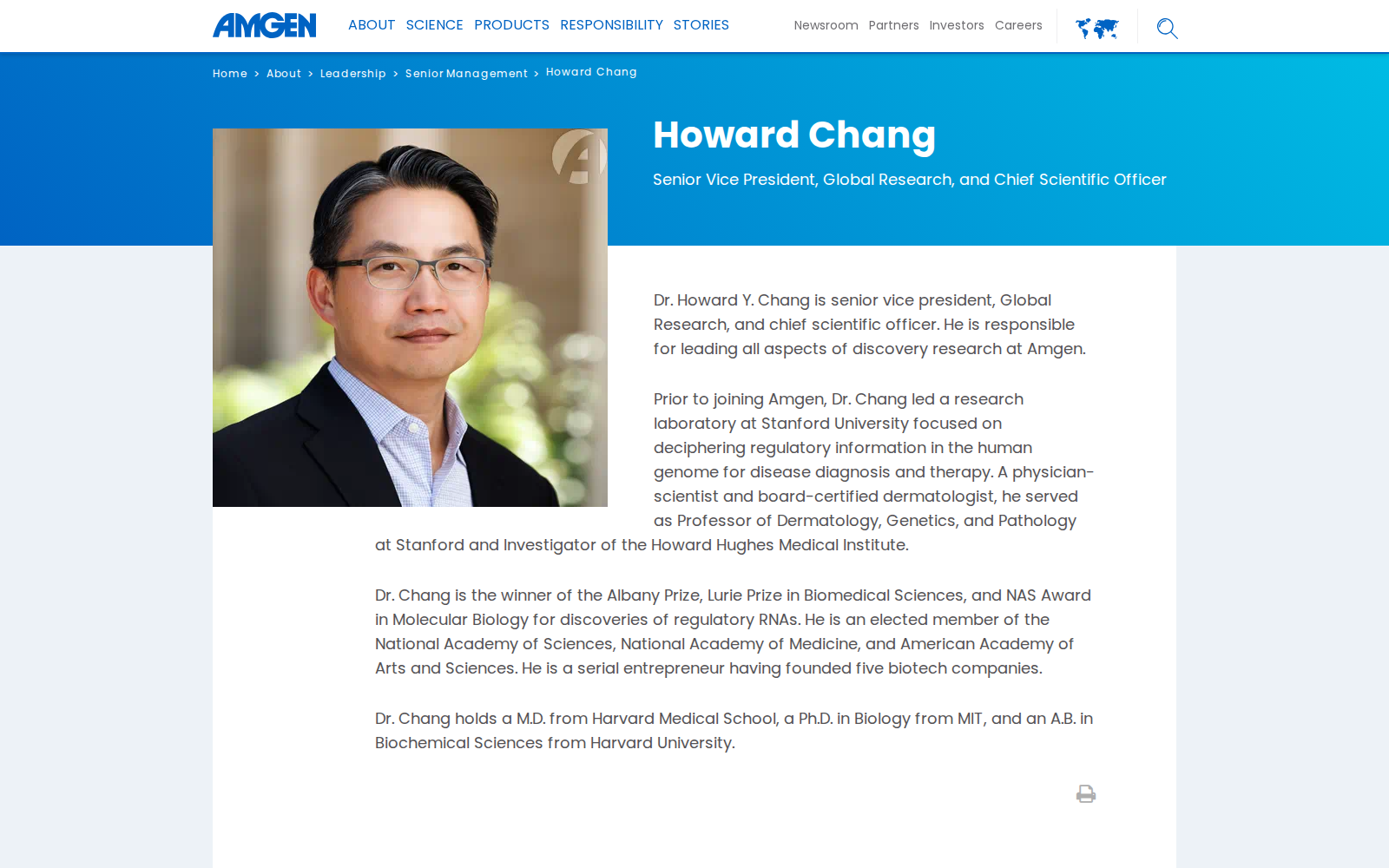
Howard Chang — Senior Vice President, Global Research, and Chief Scientific Officer — on Amgen's leadership page.
Where quantum can earn a place in the pipeline
Kop's framing was deliberately practical: quantum will not replace a pharmaceutical company's computational stack; it is a catalyst that can strengthen selected parts of the discovery and development workflow, especially in combination with artificial intelligence (AI) and strong classical baselines. The discussion ranged across six candidate use cases. The most credible entry point is computational chemistry for de novo discovery and lead optimization—whether hybrid quantum-classical workflows can improve candidate ranking, conformational exploration, binding hypotheses, and the triage of compounds before expensive wet-lab cycles. A second lane is protein structure, binding, and selected omics analytics, kept narrow and hypothesis-driven. A third is molecular interaction, metabolism, and toxicity simulation, where killing weaker candidates earlier already creates value. A fourth, staged approach targets blood-brain-barrier and neurodegenerative R&D: better computational permeability and delivery hypotheses, validated in smarter, more human-relevant experimental systems such as organoids and lab-on-a-chip environments. The fifth—perhaps underrated—is optimization across R&D operations, from experimental design to screening strategies. The sixth sits on the watchlist: quantum neural networks and quantum machine learning for molecule generation and receptor modeling where data are sparse and physical correlations resist classical capture.
One discipline runs through all six: benchmark first. Every pilot should be tied to a concrete scientific or business question, with success metrics and strong classical baselines defined from day one—the same evaluation culture Kop builds with startups at the Stanford Quantum Incubator.
Post-quantum security by design
A biomedical quantum strategy is incomplete without its security half. Long-lived patient, clinical-trial, and research data are precisely the assets exposed to harvest-now, decrypt-later collection, which makes a post-quantum cryptography roadmap and enterprise crypto-agility an early priority rather than an afterthought. Governance completes the picture: vendor diligence and diversification across qubit modalities, protection of trade secrets and IP-sensitive data, standards alignment, and regulatory pathway planning—themes Kop and co-authors mapped for the sector in Law, Ethics and Policy of Quantum & AI in Healthcare and Life Sciences.
Better medicine as the measure
What makes quantum computing interesting for a company like Amgen is not the physics; it is decision quality—earlier, cheaper, better-informed choices about which molecules, targets, and experiments deserve the next dollar. The honest position is that this value must be demonstrated, use case by use case, against the best classical tools. That is exactly the kind of disciplined, evidence-first exploration this consultation was designed to support: an open exchange between a quantum governance scholar and one of the world's largest biotechnology companies, measured not in announcements but in whether discovery pipelines come to run smarter, data is better protected, and medicines reach patients sooner. The framing and use cases described here are Kop's own analysis, not Amgen positions.
Last updated: June 5, 2026.