
Innovation, Quantum-AI Technology & Law

Blog over Kunstmatige Intelligentie, Quantum, Deep Learning, Blockchain en Big Data Law

Blog over juridische, sociale, ethische en policy aspecten van Kunstmatige Intelligentie, Quantum Computing, Sensing & Communication, Augmented Reality en Robotica, Big Data Wetgeving en Machine Learning Regelgeving. Kennisartikelen inzake de EU AI Act, de Data Governance Act, cloud computing, algoritmes, privacy, virtual reality, blockchain, robotlaw, smart contracts, informatierecht, ICT contracten, online platforms, apps en tools. Europese regels, auteursrecht, chipsrecht, databankrechten en juridische diensten AI recht.

Berichten met de tag Healthcare
BioLawLaPaLooZa: Mauritz Kop on Hippocratic Quantum and the End of Stable Records at Stanford Law School

At BioLawLaPaLooZa, the annual law-and-biosciences conference convened at Stanford Law School by Henry T. "Hank" Greely and co-hosted with the Journal of Law and the Biosciences, Mauritz Kop delivered a talk that fused two strands of his recent work: the biomedical-ethics argument of his Harvard-published Hippocratic Quantum project and the security lens of his NATO Strategic Communications advisory work. It was his third appearance at the gathering, which builds on his earlier BioLawLaPaLooZa remarks.

The past is not yet stable

Kop's organizing line was that "the past is not yet stable." Rather than treating the quantum threat as a future event, he argued that today's authenticated, confidential records are contingent on a cryptographic transition still under way: adversaries can harvest encrypted data now and decrypt it once a Shor-capable machine factors the large integers beneath RSA. Confidentiality, in this reading, must be defended retroactively as well as prospectively—making the migration to post-quantum cryptography, for hospitals and biobanks, a clinical duty rather than an IT preference. The point reframes a familiar threat model: the danger is not only what a future machine will decrypt, but what is being copied and stored today against that day.

Four classical principles, recomputed

The talk recast the four principles of biomedical ethics—autonomy, beneficence, non-maleficence, and justice—for a quantum register. Quantum does not replace them, Kop said; it changes what applying them requires. Autonomy comes to demand data sovereignty and a credible right not to know as quantum-AI systems build finer probabilistic patient models. Dual-use simulators that design therapeutics can also lower the barrier to designing pathogens, which is where his LSI test—least trade-restrictive, security-sufficient, innovation-preserving—supports tiered disclosure over blanket secrecy. And the justice problem is a widening one: the quantum divide, he warned, may prove steeper than the digital divide.

The X-Ray City and a constitution for medicine

Widening the lens, Kop described civic-scale quantum gravimetric and magnetic sensors moving from the laboratory toward infrastructure pilots—able, from public rights-of-way, to resolve subsurface and interior spaces, and so to reach into the privacy of the home. He calls this prospect the X-Ray City, and said he had told NATO it needs a Hippocratic Quantum posture of its own. He closed with a "quantum constitution for medicine" in four standards of care: quantum-safe encryption, sovereignty over patient digital twins, human oversight in the loop, and tiered disclosure under the LSI test. The premise the room had not heard before, he suggested, was simply that the past itself is not yet settled.

Meer lezen


Mauritz Kop Consults Amgen on Quantum-Biomedical Discovery

Invited by Howard Chang—the physician-scientist who led a renowned genomics laboratory at Stanford and now serves as Senior Vice President, Global Research, and Chief Scientific Officer at Amgen—Mauritz Kop consulted with Amgen's research organization on quantum-biomedical discovery: a disciplined exchange of ideas about where quantum methods can genuinely improve the way medicines are found.

An invitation from Amgen's chief scientist

The conversation paired deep biology with quantum strategy and governance. Its anchor was the Hippocratic Quantum approach Kop published at Harvard: accelerate discovery with quantum and quantum-classical methods, but under guardrails medicine itself would prescribe—validation, privacy, security, and patient trust from the first experiment. The same translational seriousness ran through the responsible-quantum lecture and workshop Kop gave at SandboxAQ.

Six use cases, one discipline

From computational chemistry for de novo discovery and lead optimization, through protein structure and selected omics analytics, metabolism and toxicity simulation, blood-brain-barrier hypotheses validated in organoid and lab-on-a-chip systems, operational optimization, and a watchlist for quantum neural networks—every candidate use case answers to the same rule: benchmark hard against strong classical baselines from day one, and let the evidence decide which pilots earn the next dollar.

Guardrails before hype

The strategy's quiet half is security and governance: a post-quantum cryptography roadmap for long-lived patient and research data, vendor diversification across qubit modalities, trade-secret and IP protection, and standards alignment. What the exchange was about, in the end, is decision quality—smarter discovery pipelines, better-protected data, and medicines that reach patients sooner.

Meer lezen
CIGI Publishes Global Quantum Policy Brief by Mauritz Kop and Tracey Forrest

Waterloo, 5 February 2026—The Centre for International Governance Innovation (CIGI) has published a new policy brief, Global Quantum Governance: From Principles to Practice, authored by Mauritz Kop and Tracey Forrest. The brief is written for policy makers, regulators, standards bodies, and industry actors facing a practical transition: quantum technologies are moving from laboratory milestones toward deployment pathways where governance choices—especially around cybersecurity and cross-border infrastructure—become difficult to reverse.

Download the Policy Brief here: https://www.cigionline.org/documents/3746/PB_No.222_Kop_and_Forrest.pdf

Why this brief on quantum governance, and why now

The brief’s central timing claim is that near-term milestones—particularly post-quantum cryptography (PQC) migration and quantum networking—create a governance tipping point. After that point, certain security and societal harms may be costly (or impossible) to remediate. In the brief’s framing, PQC migration is not merely an engineering update; it is a “temporal rights and resilience” imperative because present-day decisions about crypto-agility, key life-cycle management, and data minimization determine whether sensitive data remains protected against future adversaries.

This urgency is paired with a structural diagnosis: national initiatives—including the EU’s proposed Quantum Act—are important, but insufficient on their own given quantum’s dual-use characteristics, global supply chains, and asymmetric capabilities across states and firms. The authors argue for a governance architecture that is “standards-first” and internationally coordinated, capable of sustaining what they call “security-sufficient openness,” and overseen by an International Quantum Agency.

The brief’s recommendations in practical terms

The brief concludes with a multi-pronged path “from principles to practice,” emphasizing four implementable priorities:

  1. Strengthen foundations through standards and PQC execution: align cryptographic profiles across sectors; update procurement so crypto-agility, key life-cycle management, and “harvest now, decrypt later” mitigation become baseline requirements; and adopt “cryptographic resilience” via agile standards, testing, and incident playbooks.

  2. Harmonize among allies: coordinate export controls, investment screening, and supply-chain security via mechanisms such as a proposed G7 Quantum Technology Point of Contact Group and narrowly scoped license-exception approaches in Five Eyes/AUKUS-style arrangements, while avoiding poorly designed measures that impose high compliance costs and chill benign collaboration.

  3. Incentivize global collaboration and capacity building: federate national quantum clouds, SDG-oriented demonstrators, and regional test networks under common governance rules; and consider, longer-term, a “CERN for Quantum” that provides shared access anchored in transparency and equitable access, including for Global South partners.

  4. Institutionalize foresight and bounded algorithmic regulation: resource international foresight capacities—within an IQA-type body or linked observatories—to update risk scenarios and stress-test legal frameworks, while experimenting with limited, well-governed AI-assisted monitoring and red-teaming to inform accountable human decision makers.

Takeaway for AIRecht’s readership

For legal and policy practitioners, the brief’s message is that quantum governance is entering a phase where operational artifacts—standards, benchmarks, procurement baselines, and interoperability profiles—will increasingly determine real-world rights, liabilities, and security outcomes. PQC migration and quantum networking are treated as the near-term proving ground for whether democracies can coordinate “security-sufficient openness” at scale.

For innovators and investors, the brief underscores that governance is not a brake on quantum progress but a design constraint that—if addressed early—can preserve global interoperability, reduce fragmentation, and support responsible diffusion of quantum capability without deepening geopolitical divides.

Meer lezen
The US ISO 42001 Standards-Centric Approach to AI Governance: Compliance, Trust, and Innovation (Daiki Repost)

AIRecht reposts, in full and with permission, a Daiki essay by Mauritz Kop, Co-Founder, on why the United States is converging on a standards-centric model of artificial intelligence governance—and why ISO/IEC 42001 has become its anchor. The repost is presented as published on May 13, 2025, with its original spellings, figures, and references intact.

A standards-first answer to a fragmented regime

The American approach to AI is, by design, light on binding federal statute and heavy on voluntary, risk-based guidance: the NIST AI Risk Management Framework, sector-specific direction from the FTC, EEOC, and FDA, and a patchwork of state laws. Into that fragmentation steps ISO/IEC 42001, the world's first international standard for AI Management Systems, published in December 2023. The essay's argument is that a single, certifiable management system can do what a stack of statute-shaped checklists cannot—give an organization one coherent governance posture that travels across jurisdictions.

The transatlantic bridge

The stakes are clearest for U.S. companies selling into Europe. ISO 42001 certification is not the same as EU AI Act compliance, but the two overlap heavily on risk management, data governance, transparency, documentation, and human oversight—precisely the obligations the Act imposes on high-risk systems. The repost frames the standard as a "common language" that lets a U.S. firm demonstrate diligence to European regulators and partners without building a separate compliance machine for each market. It is the same standards-first logic Kop and colleagues have argued for in quantum governance, where international standards substitute for legislation that has not yet caught up to the technology.

From paperwork to governance asset

The closing move is strategic rather than procedural. Under an anticipated period of U.S. federal deregulation, the essay contends, a globally recognized standard offers stability that domestic political cycles cannot: a baseline of good governance that holds regardless of which executive orders survive. The Daiki method then operationalizes that posture through six integrated components—an AI system registry, an EU AI Act toolkit, an ISO 42001 implementation framework, ISO 27001 data-security integration, MDR/ISO 13485 support for medical AI, and a responsible generative-AI framework—so overlapping requirements are managed once, not many times. The throughline connects to Daiki's wider body of work on operationalizing regulation, including its EU AI Act compliance solution and its quantum-governance recipe.

Why repost it here

For boards, general counsel, and AI program leads, the practical message is that the era of principles is giving way to an era of evidence: organizations will increasingly be asked to prove their governance, not merely assert it. Reposting the essay in full preserves Kop's argument verbatim while placing it alongside AIRecht's running coverage of Mauritz Kop's work at the intersection of AI, standards, and responsible technology governance.

Meer lezen
A Brief Quantum Medicine Policy Guide: What Regulators Should Consider for Quantum and AI in Precision Medicine

As quantum technology and artificial intelligence move toward precision medicine, regulators face a problem they have not yet built tools for. A Brief Quantum Medicine Policy Guide—published on the Harvard Petrie-Flom Center's Bill of Health blog by Mauritz Kop, Suzan Slijpen, Katie Liu, Jin-Hee Lee, Constanze Albrecht, and I. Glenn Cohen, and cross-posted with the Stanford Center for Responsible Quantum Technology and the European Commission's European AI Alliance—is a concise map of the use cases, the overlapping legal regimes, and what agencies such as the FDA and EMA should consider. It is a companion to the team's longer treatment of how quantum technologies may be integrated into healthcare, and continues the collaboration later reflected in Kop's work consulting Amgen on quantum biomedical discovery.

Quantum use cases in healthcare

The guide sorts second-generation quantum medicine by domain. Quantum computing and simulation could accelerate de novo drug discovery by modeling molecular interactions, speed genome sequencing, and assist protein-folding prediction; quantum sensing could deliver continuous high-precision vital-sign monitoring, precision laser therapy, and earlier retinal diagnostics; post-quantum cryptography and quantum key distribution could secure patient data in line with HIPAA and GDPR. A recurring thread is the semiconducting quantum dot, whose ability to cross the blood-brain barrier opens possibilities in oncology imaging, targeted drug delivery, and neurodegenerative-disease research. Throughout, the authors keep the claims proportionate, marking many applications as early-stage or theoretical.

A fragmented regulatory map

There is no quantum-specific medical-device law in either the EU or the US. European devices fall mainly under the Medical Devices Regulation, with the EU AI Act and data laws in supporting roles, while CE marking is slowed by a shortage of Notified Bodies versed in AI or quantum. US devices may sit within the existing FDA framework—potentially including the Software-as-a-Medical-Device pathway—alongside HIPAA, the FTC, and standards such as ISO 13485. The guide's first practical counsel is for manufacturers to engage agencies early.

What regulators should build next

The guide names four changes: evaluation protocols attuned to quantum behaviors; risk-management frameworks that protect human subjects from quantum unpredictability; clinical-trial guidelines tailored to quantum devices; and interoperability standards. It then proposes a three-part architecture—ex-ante regulatory sandboxes for quantum-AI devices, ex-durante expert subcommittees, and an ex-post registration database—framed by ten guiding principles, from promoting quantum literacy to fostering institutional plasticity in bodies like the FDA and EMA. The throughline is a standards-first, anticipatory posture: prepare the institutions before the technology arrives, and balance innovation against patient safety rather than choosing between them.

Meer lezen
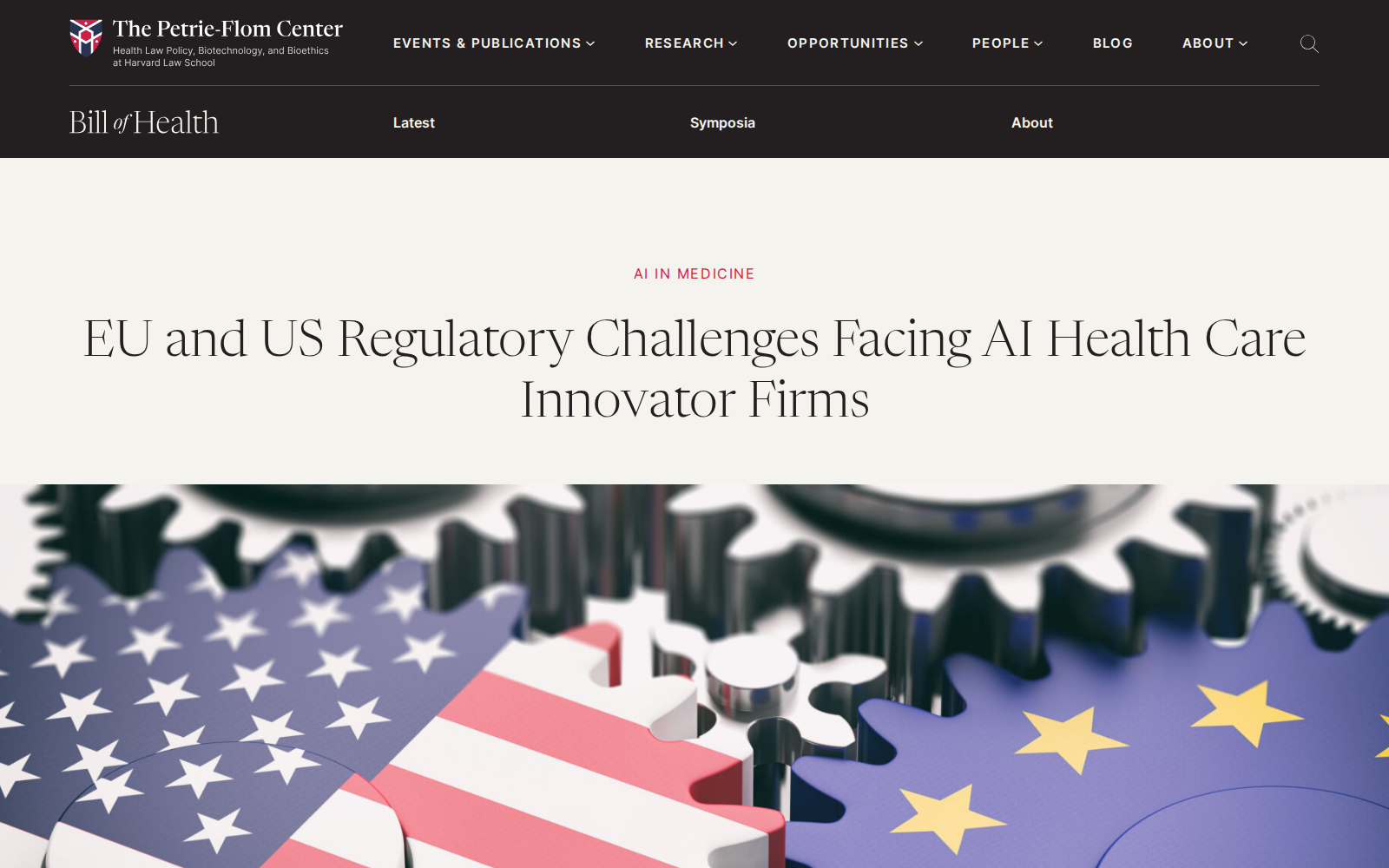
Harvard Petrie-Flom publishes EU and US Regulatory Challenges Facing AI Health Care Innovator Firms

Harvard Law School's Petrie-Flom Center has published EU and US Regulatory Challenges Facing AI Health Care Innovator Firms on its Bill of Health blog—an op-ed co-written by lead author Suzan Slijpen, Mauritz Kop (Founder of the Stanford Center for Responsible Quantum Technology), and senior author I. Glenn Cohen, who directs the Center. It examines why firms building artificial intelligence for medicine face such a tangled compliance map, and what a better one might look like.

Two regulatory philosophies, one transatlantic market

The piece sets Europe's cross-sectoral instinct against America's sectoral one. An AI medical product entering the EU must answer to the Medical Device Regulation, the GDPR, and a sweeping digital rulebook that now includes the EU AI Act and the coming European Health Data Space. In the United States, by contrast, coverage is patchy by design: HIPAA reaches only certain entities and data, and the FDA regulates medical AI only where it fits an existing category. Each model has genuine merits and genuine blind spots, and a firm selling on both shores must satisfy both at once.

Where the law strains hardest

The authors are clearest on the cases that resist tidy rules. Adaptive algorithms that keep learning after deployment make it hard to say when a model has changed enough to need fresh review—an area where the FDA's 2023 predetermined-change-control guidance points a constructive way forward. Generative AI overtook the EU AI Act mid-negotiation, unsettling how foundation models are treated under a rulebook drafted before they arrived. And at the material frontier sit quantum- and AI-driven devices, with their export controls, fragile supply chains, dual-use questions, and intellectual-property and security concerns—the bridge from this op-ed to Kop's broader work on the quantum technology governance frontier. The lesson the authors draw is procedural as much as substantive: regulators must understand the tempo of the technology they govern, or risk writing rules that are obsolete before they bind.

Toward a workable middle ground

Rather than crowning a winner, the authors propose a mixed horizontal-vertical approach: keep the precautionary care for patient safety, keep the permissionless capacity to innovate, and tailor the result to the economic realities of health care—from clinical-trial costs to market licenses. Regulation that is sensible, practical, and sector-specific, they argue, serves innovators and patients alike; anything less is rendered ineffective fast. Readers tracking Kop's longer arc on responsible technology can also follow his AIRecht scholar profile, where the through-line from AI in medicine to the law and ethics of the quantum age is laid out across a decade of work.

Meer lezen
Quantum Trials: An FDA for Quantum Technology

What if the United States regulated emerging quantum technology the way it regulates new medicines? That is the provocation at the center of Quantum Trials: An FDA for Quantum Technology, a Stanford Law School working paper by Alexandra Waldherr, I. Glenn Cohen, and Mauritz Kop, posted as a preprint and first presented at the 2023 Stanford Responsible Quantum Technology Conference. The paper proposes a phased, documentation-driven pipeline for second-generation quantum technology, modeled on the FDA's clinical-trials regime.

A phased pipeline for quantum

The framework maps the FDA's four stages onto quantum research and development. Phase I captures a theoretical idea or laboratory proof-of-concept in a concise technical one-pager; Phase II adds a proof-of-principle validation with an ethical checklist; Phase III is a confirmatory stage whose findings are condensed into a Summary of Quantum Characteristics for regulatory assessment; and Phase IV follows the authorized technology through its public lifecycle, with failure reports and audits. Throughout, "efficacy" is reread as technical innovation and "safety" as the absence of unresolved ethical and legal concerns. A binding registry ties the phases together, serving regulators, engineers, educators, and the public from one shared record.

SEA TURTLE and the registry-first first step

Over the phases sits the SEA TURTLE checklist—a six-point barometer distilling the Ten Principles for Responsible Quantum Innovation and the broader Responsible Quantum Technology paradigm into a quick test of whether a technology is both innovative and responsibly developed. Its "SEA" element names a commitment to Safeguarding, Engaging, and Advancing quantum technology, society, and humankind. The authors are realistic about the political capital a full "FDA for Quantum" would demand, so they single out one immediate, low-cost step: making the registration of quantum developments mandatory by law, in the spirit of the legislation that produced clinicaltrials.gov. A standardized registry, they argue, gives regulators the evidence they need to balance underregulation against overregulation.

Why the analogy matters for governance

The deeper argument is structural. A young, dual-use, exponentially developing field is better served by an evidence-generating, phased pipeline than by either premature prohibition or laissez-faire. The same logic animates the authors' work on law, ethics, and policy of quantum and AI in healthcare and the ethics of biomedical discovery in Hippocratic Quantum. The paper does not claim the drug-approval analogy is settled; it invites the physics community to test its feasibility and the legislative branch to adopt, evaluate, and refine it. As an opening move in the design of quantum-specific regulatory institutions, it is less a verdict than a carefully argued invitation.

Meer lezen
Mauritz Kop Fellow at Inter-CeBIL Harvard Cambridge Copenhagen

Harvard-Cambridge-Copenhagen, Sept 15, 2023 — Mauritz Kop has accepted a position as an Inter-CeBIL Fellow at the prestigious Novo Nordisk Foundation Copenhagen-Cambridge-Harvard Inter-CeBIL Programme for International Collaborative Bioscience Innovation & Law. In this role, Kop will focus his research on Advanced Medical Computing, Artificial Intelligence (AI) and Quantum Technologies within the life sciences ecosystem.

About the Inter-CeBIL Programme

The Inter-CeBIL Programme is a world-leading research hub dedicated to identifying and tackling the most significant legal and regulatory barriers to health and life science innovation. The initiative fosters robust knowledge networks to provide tailored legal and regulatory support to patients, researchers, businesses, and incubators, with the ultimate goal of ensuring that health and life science innovations can safely and effectively reach patients and markets.

This international collaboration brings together top-tier academic institutions to drive progress in healthcare and biotechnology. The program is a joint effort between the Centre for Advanced Studies in Bioscience Innovation Law (CeBIL) at the University of Copenhagen, the Petrie-Flom Center for Health Law Policy, Biotechnology, and Bioethics at Harvard Law School, and the University of Cambridge, among other key partners. The program is led by a distinguished team, including Professor Timo Minssen as the Founding Director of CeBIL at the University of Copenhagen, Professor I. Glenn Cohen who leads Harvard Law School’s contribution, and Professor Mateo Aboy who leads the Cambridge part.

Key Research Areas

The Inter-CeBIL Programme centers its research on three key "grand challenges":

1. Advanced Medical Computing: Focusing on Artificial Intelligence (AI) and Quantum Technologies (QT).

2. Pandemic Preparedness & Anti-Microbial Resistance (AMR).

3. Sustainable Innovation & Biosolutions: Encompassing eco-systems, drug R&D, drug regulation, and data infrastructures.

Focus on Key Area 1: Advanced Medical Computing, AI & Quantum Technology

This key research area addresses the increasingly critical role of advanced computing in the life sciences and medical sectors. Algorithms are becoming fundamental building blocks in a wide range of medical devices, digital health technologies (DHTs), and drug discovery tools (DDTs). The use of advanced computing, including AI/ML and quantum computing (QC), holds immense potential benefits for the life sciences, drug discovery, and medical sectors. These advancements also raise significant legal, ethical, governance, and regulatory issues that the program aims to address.

In his capacity as an Inter-CeBIL Fellow, Mauritz Kop will contribute his deep expertise in quantum-AI, its governance, and its legal-ethical implications to this key research area, helping to navigate the complex challenges and opportunities presented by these cutting-edge technologies.

Meer lezen
Safeguards for accelerated market authorization of vaccines in Europe

by Suzan Slijpen & Mauritz Kop

This article has been published by the Stanford Law School ‘Center for Law and the Biosciences’, Stanford University, 15 March 2021. link to the full text: https://law.stanford.edu/2021/03/15/safeguards-for-accelerated-market-authorization-of-vaccines-in-europe/

Download the article here: Slijpen_Kop_Manufacturing Licenses and Market Authorization Vaccines EU-Stanford Law

The first COVID-19 vaccines have been approved

People around the globe are concerned about safety issues encircling the accelerated introduction of corona vaccines. In this article, we discuss the regulatory safeguards for fast-track market authorization of vaccines in Europe. In addition, we explain how the transmission of European Union law into national Member State legislation works. We then clarify what happens before a drug can be introduced into the European market. We conclude that governments should build bridges of mutual understanding between communities and increase trust in the safety of authorized vaccines across all population groups, using the right messengers.

Drug development normally takes several years

Drug development normally takes several years. The fact that it has been a few months now seems ridiculously short. How is the quality and integrity of the vaccine ensured? That people - on both sides of the Atlantic - are concerned about this is entirely understandable. How does one prevent citizens from being harmed by vaccines and medicines that do not work for everyone, because the admission procedures have been simplified too much?

The purpose of this article is to shed a little light upon the accelerated market authorization procedures on the European continent, with a focus on the situation in the Netherlands.

How a vaccine is introduced into the market

In June 2020, the Dutch government, in close cooperation with Germany, France and Italy, formed a Joint Negotiation Team which, under the watchful eye of the European Commission, has been negotiating with vaccine developers. Its objective: to conclude agreements with drug manufacturers at an early stage about the availability of vaccines for European countries. In case these manufacturers are to succeed in developing a successful vaccine for which the so-called Market Authorization (MA) is granted by EMA or CBG, this could lead to the availability of about 50 million vaccines (for the Netherlands alone).

Who is allowed to produce these vaccines?

Who is allowed to produce these vaccines? The Dutch Medicines Act is very clear about this. Only "market authorization holders" are allowed to manufacture medicines, including vaccines. These are parties that have gone through an extensive application procedure, who demonstrably have a solid pharmaceutical quality management system in place and have obtained a pharmaceutical manufacturing license (the MIA, short for Manufacturing and Importation Authorisation). This license is granted after assessment by the Health and Youth Care Inspectorate of the Ministry of Health, Welfare & Sport (IGJ) – by Farmatec. Farmatec is part of the CIBG, an implementing body of the Ministry of Health, Welfare and Sport (VWS). The M-license is mandatory for parties who prepare, or import medicines.

Read more at the Stanford Center for Law and the Biosciences!

Read more on manufacturing licenses, fast track procedures and market authorization by the European Medicines Agency (EMA) and the EC, harmonisation and unification of EU law, CE-markings, antigenic testing kits, mutations, reinfection, multivalent vaccines, mucosal immunity, Good Manufacturing Practices (GMP), pharmacovigilance, the HERA Incubator, clinical trials, compulsory vaccination regimes and continuous quality control at Stanford!

Meer lezen
Suzan Slijpen Conference Speaker at the National University of Ireland

Legal Aspects of AI in Healthcare

On 16 August 2019, Suzan Slijpen LL.M. had the honour to speak about the legal aspects of the development and use of artificial intelligence (a disruptive technology) in healthcare, at the AI in Medicine Conference organized by the Irish Association of Physicists in Medicine (IAPM). The conference took place in Galway, at the National University of Ireland (School of Physics, NUI Galway/ OÉ Gaillimh). Suzan is a senior legal consultant at AIRecht.nl, and specializes in eHealth & medical devices, pharmaceutical law, European food law and contract law, from an AI helicopterview. She is also founder and lawyer at boutique law office Slijpen Legal.

Key topics of the Artificial Intelligence in Medicine lecture

Key legal topics that Suzan addressed in her Artificial Intelligence in Medicine lecture:

1. AI & Robotics: Disruptive Technologies: Synergetic effects of 4th Industrial Revolution technologies like robotics, big data, quantum computing, Blockchain, Virtual Reality (VR) and Internet of Things (IoT).

2. eHealth and medical devices: legal classification.

3. Fundamental Rights: Safeguarding of Fundamental Rights in AI applications, Rights of Patients.

4. Ethics and responsible AI: 1791 French Revolution Values, HLEG Concept of Trustworthy AI.

5. Intellectual Property on AI and Health Apps: Licensing your IP.

6. Liability for damages caused by smart robots: who is liable for misdiagnosis by an AI algorithm?

7. Legislation and Jurisprudence.

8. AI Impact Assessment: remove roadblocks for AI.

Legislation and regulations regarding AI in Healthcare

Do you want to know more about legislation and regulations regarding AI in Healthcare, or Legal aspects of disruptive tech in Medicine? Or do you want to organize a workshop or conference yourself and invite us as a speaker or teacher? Then please contact us about the possibilities!

Meer lezen