
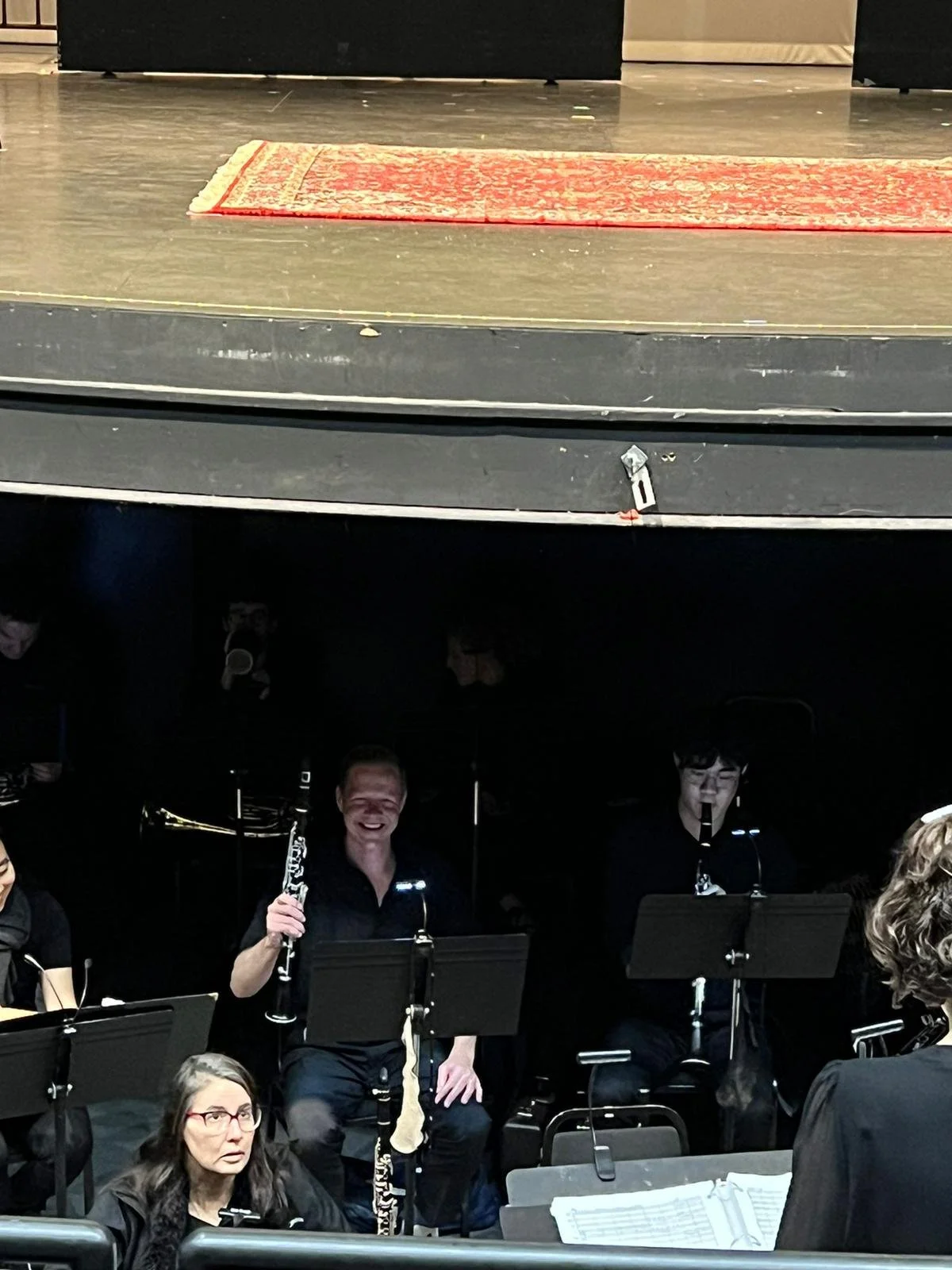
In February 2023, Stanford law scholar Mauritz Kop stepped off the page and into the orchestra pit, joining the Stanford Light Opera Company (SLOCo) for its winter production of Johann Strauss II's Die Fledermaus. He played clarinet—A and B-flat—substage with the company's orchestra across four performances at Dinkelspiel Auditorium. For a researcher whose work increasingly concerns the rights of performers and composers in the age of artificial intelligence, the view from below the stage was more than a hobby; it was a vantage point.
A student company's feminist Strauss
SLOCo's staging, directed by Nicolle Hendzel '23 in an English translation by Marcie Stapp, reimagined a ballroom farce as a deliberately feminist work, placing the characters who orchestrate the plot's great prank—and who hold power within it—in the hands of its women. The company is a student-run organization with roots in the Stanford Savoyards, a Gilbert and Sullivan society founded in 1973 and rebranded as SLOCo in 2016. The operetta itself dates to 1874, when it premiered at the Theater an der Wien in Vienna; nearly a century and a half later, a student orchestra gave it a contemporary edge.
Where music meets the law of AI
Kop is a Stanford Law School fellow and a practicing classical musician on piano and clarinet, and the two roles inform one another. His scholarship on copyright, authorship, and the public domain carries the weight of someone who has sat among the performers the law is meant to protect. That sensibility runs through his analysis of cloned voices and machine-generated compositions, where familiar copyright questions—who is the author, who is paid, and what enters the public domain—have been made newly pressing by generative systems. A scholar who has taught music law at the Royal Conservatoire in The Hague has good reason to keep one foot in live performance.
Why the arts belong in technology-law writing
Technology law has a tendency to treat the arts as something to be regulated rather than understood. An evening in a student orchestra reverses that order. The discipline of a rehearsed part delivered in real time, the collective labor of an ensemble, and the precarious economics of a production staged for love rather than profit are precisely what the law of music exists to serve. As AI begins to imitate the performer's craft at scale, the argument for a creator-aware approach to authorship and remuneration only sharpens—an argument that runs throughout Kop's scholarship on responsible technology across law, music, and policy. The clarinet, on this telling, is not a distraction from the research—it is a reminder of whom the research is for.
Meer lezen