
Mauritz Kop Advises Yale Law School's Lowenstein Human Rights Project on Quantum Technology and Human Rights
By Editor
New Haven, CT, November 9, 2022—Mauritz Kop, Visiting “Quantum & Law” Scholar at Stanford University, was approached by the Lowenstein Project at Yale Law School for his expertise on quantum technology and human rights. The student-led human rights group reached out as it worked on a background policy memorandum exploring the relationship between new technology and human rights—part of a broader effort, in association with the Seoul National University Artificial Intelligence Policy Initiative and the Korean Mission to the United Nations in Geneva, to support a proposal for a new thematic Special Rapporteurship under the U.N. Human Rights Council focused on the applicability of human rights to the development of new technologies. The question put to Kop was deliberately practical: how does a layperson "get smart" on quantum?

A solemn human-rights setting evoking a Geneva assembly chamber and Yale-Gothic stonework, overlaid with a faint qubit superposition lattice.
Why human rights lawyers came to a quantum scholar
The Lowenstein International Human Rights Project is an extracurricular human rights group at Yale Law School, founded in 1981 and named for Allard K. Lowenstein, the U.S. congressman and human rights activist. It operates under the Orville H. Schell, Jr. Center for International Human Rights, and its students work in small teams alongside outside partner organizations—usually addressing those partners' research needs. The project's reach is wide; a Yale Law School account of the same academic year describes teams "around the world" working on issues from reparations for civilian victims of the war in Yemen to a draft crimes-against-humanity treaty at the U.N. General Assembly's Sixth Committee.
One of those teams was studying "the evolving relationship between human rights and technology." That framing explains why a human rights advocacy group would write to a legal scholar of quantum technology. Building a credible case for a new Special Rapporteurship on new technologies and human rights requires the drafters first to understand the technologies themselves—well enough to identify where, concretely, rights might be engaged. Quantum sits at the hard end of that problem: harder to make legible than AI or social media, and easy to discuss in metaphors that quietly mislead.
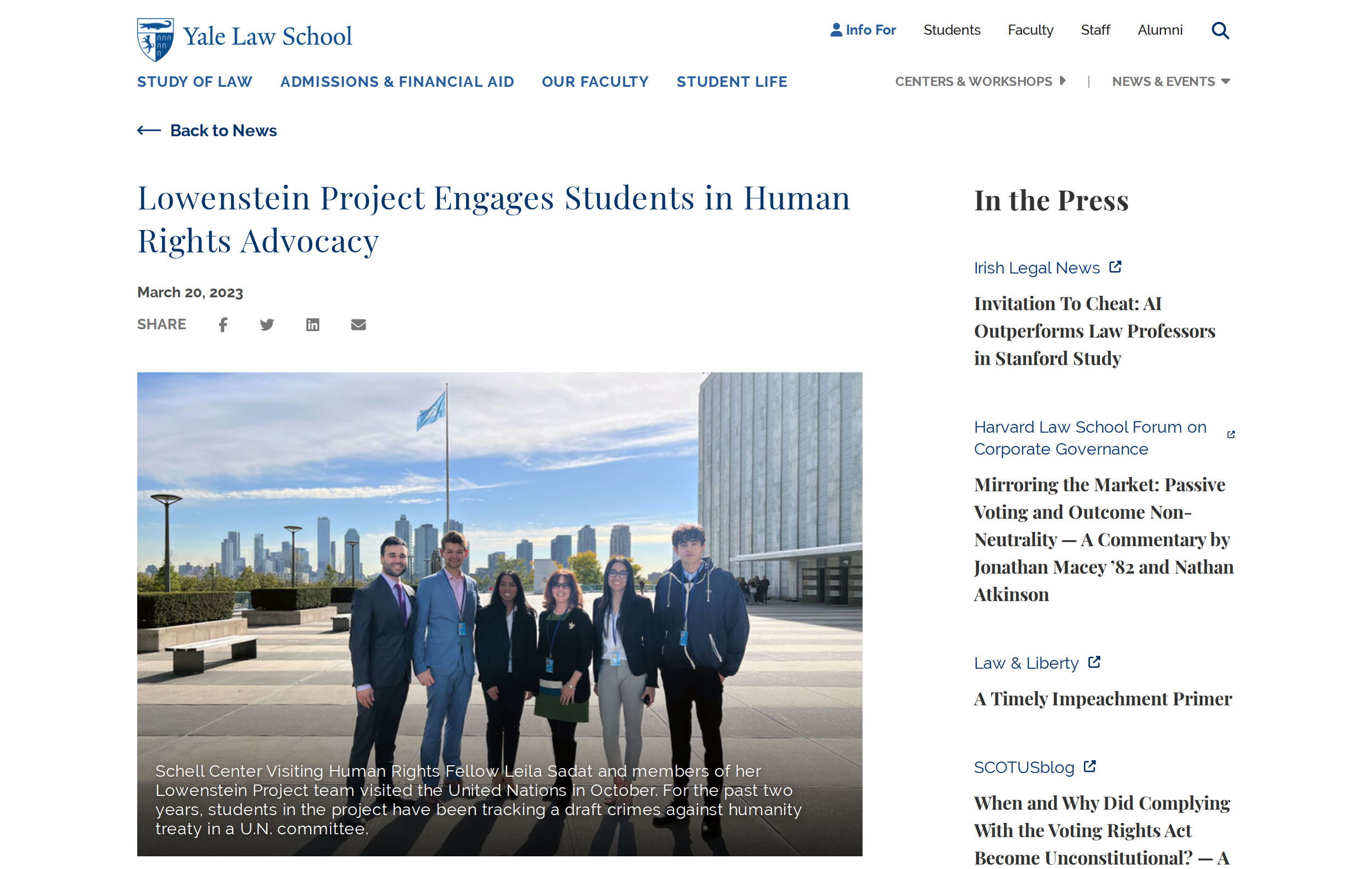
Yale Law School, March 20, 2023.
The actual question: how a layperson "gets smart" on quantum
The Lowenstein team's outreach was, by its own description, "primarily focused on the research process, especially from a lay perspective." The questions were about method rather than conclusions: where to look first when researching quantum computing; what learning approaches work; how a non-specialist should sequence the material; which kinds of technical understanding—the physics, the mathematics, the code—human rights applications actually need; and which other experts to consult. Kop shared his insights into that process. He did not draft the memorandum, and the engagement is best described for what it was: a working scholar helping advocates make a difficult field legible before they wrote about it.
That modesty is the point. The value Kop added was not a verdict on which rights quantum threatens, but a route in—an account of how a careful generalist can reach the threshold of understanding from which rights questions can be posed precisely rather than rhetorically.
What must actually be understood before the rights talk gets concrete
Getting "smart" on quantum technology means, at minimum, grasping three features of the physics that have no classical analogue. A quantum bit can occupy a superposition of its two basis states, so a register of n qubits is described by amplitudes over 2n basis states, not 2n outcomes available at once; entanglement correlates qubits so that the joint state cannot be described as the separate states of its parts, a resource behind quantum communication and many speed-ups; and measurement is irreversible and probabilistic—reading a qubit collapses its superposition to a single classical outcome, so information is not simply "looked at" without disturbance. Until those three ideas are in hand, rights talk about quantum stays metaphorical. With them, claims become testable: a privacy worry tied to a cryptographically relevant quantum computer breaking today's public-key encryption is a different, more disciplined claim than a generalized anxiety about "quantum" doing something powerful and unspecified. Kop's own framework work develops the legal and ethical implications that follow once the physics is taken seriously, including his peer-reviewed framework establishing a legal-ethical framework for quantum technology—the strand of his work on quantum technology and human rights in the Yale Journal of Law & Technology that drew the Lowenstein team to him.
Quantum literacy as a precondition for rights-protective governance
The episode is small in itself, but it illustrates a structural fact about emerging-technology governance: rights protection now depends on technical literacy reaching the people who draft norms. The U.N. human rights system can only fashion meaningful safeguards for a technology its drafters understand; an instrument written from metaphor risks protecting the wrong things, or nothing. This is why Kop and colleagues have argued, in venues from the Quantum-ELSPI research agenda on the ethical, legal, social, and policy implications of quantum technology to standards-first proposals, that responsible quantum governance must be built interdisciplinary from the start, with lawyers, ethicists, and physicists in the same room. The Lowenstein outreach is that argument running in reverse: advocates recognizing that they had to "get smart" first.
That recognition has only grown more relevant. Kop has since carried quantum governance into multilateral fora directly, including as a speaker at the United Nations during the International Year of Quantum Science and Technology in 2025. The through-line from a 2022 student request to "get smart" on quantum to a U.N. platform is not coincidence; it is the same conviction that quantum literacy is a precondition for rights-protective governance, not an optional supplement to it.
What the engagement does and does not claim
To be precise about the record: Kop answered the Lowenstein Project's research-process questions and shared his insights on how a layperson can learn quantum technology. He was not an author of the memorandum, and the request he received concerned method rather than substance. As for the broader effort, a Yale Law School account reports that a Lowenstein Project team "provided research for a policy memorandum that was presented to the U.N. Human Rights Council" and that "called for the creation of a thematic U.N. Special Rapporteurship focusing on New Technologies and Human Rights." Whether such a Rapporteurship is ultimately established is a matter for the Human Rights Council; the point here is narrower and durable—that the people building the case sought out a quantum scholar to make the field legible first.
For human rights practitioners and policymakers, the lesson travels well beyond one memorandum: quantum literacy is not a specialist's luxury but the entry ticket to rights-protective governance—and the time to acquire it is while the technology's norms are still being written. That rights-protective ambition has since reached intergovernmental instruments, as the OECD Recommendation on Quantum Technologies shows.
Last updated: June 5, 2026.