
Innovation, Quantum-AI Technology & Law

Blog over Kunstmatige Intelligentie, Quantum, Deep Learning, Blockchain en Big Data Law

Blog over juridische, sociale, ethische en policy aspecten van Kunstmatige Intelligentie, Quantum Computing, Sensing & Communication, Augmented Reality en Robotica, Big Data Wetgeving en Machine Learning Regelgeving. Kennisartikelen inzake de EU AI Act, de Data Governance Act, cloud computing, algoritmes, privacy, virtual reality, blockchain, robotlaw, smart contracts, informatierecht, ICT contracten, online platforms, apps en tools. Europese regels, auteursrecht, chipsrecht, databankrechten en juridische diensten AI recht.

Berichten met de tag Quantum Literacy
Mauritz Kop Reviews Der Derian’s Project Q: War, Peace and Quantum Mechanics

Stanford University, April 1, 2024—In an era defined by rapid technological acceleration, the quantum revolution looms as perhaps the most profound and least understood transformation on the horizon. It is a domain where the esoteric principles of physics—superposition, entanglement, and uncertainty—are migrating from theoretical blackboards to the geopolitical chessboard. It is this critical, and often unsettling, intersection of science, society, and security that James Der Derian’s consequential new documentary, Project Q: War, Peace and Quantum Mechanics, masterfully explores. Having been graciously invited by the film’s producers at Bullfrog Films to review this important work as the Founding Director of the Stanford Center for Responsible Quantum Technology, Mauritz Kop found it to be an essential primer for what may well be the defining technological challenge of the 21st century.

The film serves as a crucial vehicle for fostering what Mauritz Kop calls ‘quantum literacy’—a foundational understanding of not just the science, but the societal, ethical, and political ramifications of quantum technologies, and their inherent dual-use nature. Der Derian, a distinguished scholar of international relations and director of the Centre for International Security Studies at the University of Sydney, is uniquely positioned to guide this inquiry. He eschews a purely technical exposition, instead weaving a narrative that brings together a diverse chorus of voices: leading physicists, philosophers, national security experts, artists, and historians. This multidisciplinary approach is the film’s greatest strength, transforming a subject that could easily be arcane and inaccessible into a deeply human and urgent conversation.

A Summary of the Film: The Quantum Conundrum

Project Q dives headfirst into the rapidly advancing world of quantum science, highlighting the massive investments by governments, corporations, and universities while probing the unanswered questions about humankind's quantum future. The documentary skillfully unpacks the foundational elements of quantum mechanics for a lay audience. It introduces concepts like complementarity, Niels Bohr’s principle that objects can exhibit contradictory properties, such as being both a wave and a particle, but not simultaneously. It visualizes superposition through the famous Schrödinger's cat analogy, where a particle—or a cat in a box—can exist in multiple states at once until the moment it is observed.

Project Q in Sydney: A Conclave for the Quantum Age

The documentary is inextricably linked to the real-world initiative from which it takes its name. Project Q, based at the University of Sydney, is an ambitious undertaking to bridge the gap between the scientists building the quantum future and the humanists, policymakers, and public who will inhabit it. A ‘quantum risk lab’'. The project’s home is the Q Station in Sydney, a former quarantine station with a history of isolating and managing existential threats. This setting serves as a poignant backdrop, a physical manifestation of the need to grapple with the potentially world-altering implications of quantum technology before they arrive unchecked.

A Must-Watch Call for Quantum Literacy

Project Q is a documentary of profound importance and timeliness. It is a wake-up call, an invitation to a global conversation that has been largely confined to laboratories and classified government briefings. Der Derian has crafted a film that is both intellectually rigorous and deeply accessible, challenging its audience to think critically about the path we are on. By exploring both the risks and benefits of quantum innovation, the film offers a vital multidisciplinary perspective on how this emerging suite of technologies might reshape global peace, security, and politics.

Meer lezen
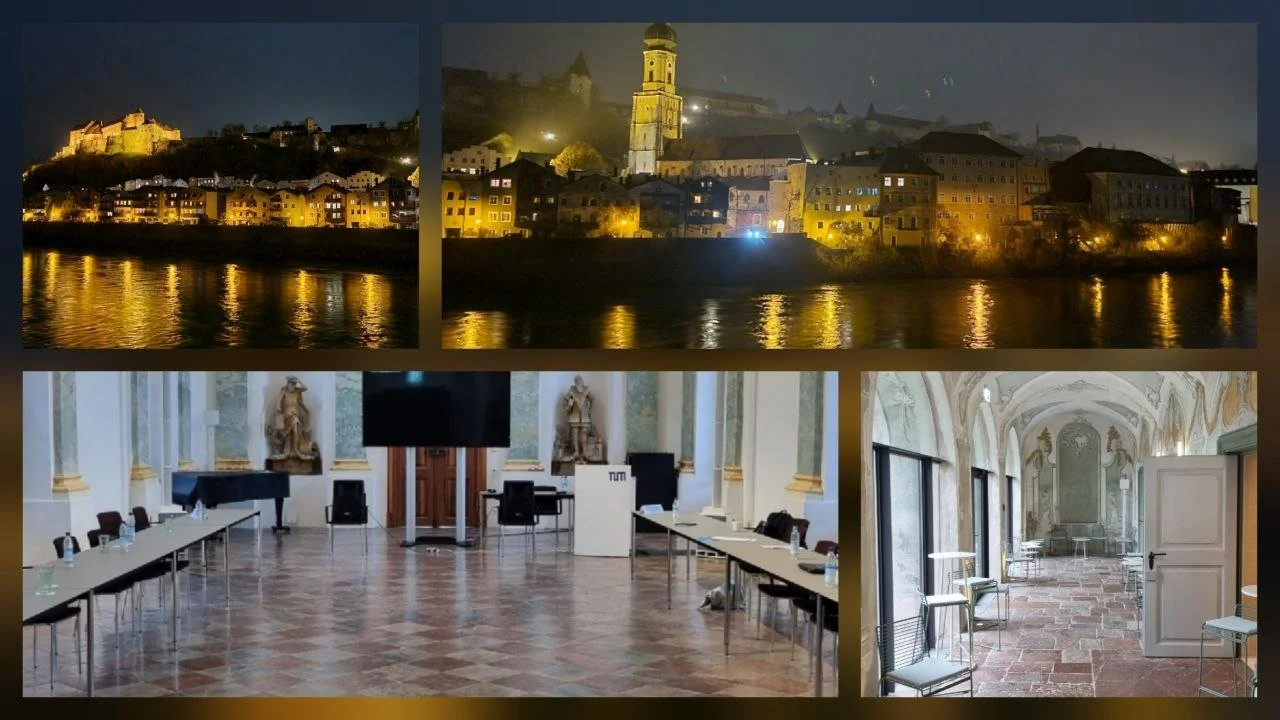
Mauritz Kop and Urs Gasser at the TUM Festival of Ideas: A Live Quantum-Art Demonstration (November 2023)

In November 2023, the inaugural Festival of Ideas gathered scholars, technologists, and policymakers at the Technical University of Munich and its historic Science & Study Center at Raitenhaslach Monastery to ask how society should design a new "operating system" for an age of artificial intelligence and quantum computing. I took part as a Stanford Center for Responsible Quantum Technology participant, alongside Professor Urs Gasser of TUM.

Quantum governance on the agenda

Quantum technology ran through the program rather than sitting at its edge. A closing use-case session on responsible technology—focused on quantum, AI, and immersive tools—was moderated by Urs Gasser, Rector of TUM's Hochschule für Politik. It was the same collaboration that soon produced the Nature Physics call for responsible quantum technology that Gasser, Eline de Jong, and I co-authored, making the Festival an early working session for that line of scholarship.

A live demonstration of quantum intuition

My contribution went beyond a conventional talk. I gave a live demonstration using my own photo, video, and music as input to a real-time, beat-synced audiovisual system inspired by fractal geometry, with a generative-AI element in the loop. Fractal patterns recur in nature—and have been observed in quantum materials—so inviting the audience to become the input data made an abstract idea tangible: that art can foster the quantum intuition an interdisciplinary, double-educated quantum workforce will need.

From Abu Dhabi to a Munich grand piano

The Munich demonstration was one public instance of a format I have also performed in Abu Dhabi, on exponential-technology stages of the kind I later addressed as a speaker at XPANSE 2024. As a working musician, I added an unscripted piano interlude on the venue's grand piano—of a piece with the Festival's argument that creativity is a method, and that the most durable guardrails for fast-moving technology are designed where law, ethics, science, and art are allowed to meet.

Meer lezen
Mauritz Kop Advises Yale Law School's Lowenstein Human Rights Project on Quantum Technology and Human Rights

In November 2022, the Lowenstein Project at Yale Law School—the student-led human rights group founded in 1981 under the Schell Center for International Human Rights—reached out to Mauritz Kop for his expertise on quantum technology and human rights. The team was working on a background policy memorandum, in association with the Seoul National University Artificial Intelligence Policy Initiative and the Korean Mission to the United Nations in Geneva, to support a proposed new U.N. Special Rapporteurship on human rights in the development of new technologies. Their question was practical and revealing: how does a layperson "get smart" on quantum?

Lawyers seeking to make a hard field legible

The outreach was, in the project's own words, "primarily focused on the research process, especially from a lay perspective." The questions concerned method, not conclusions—where to begin, how to sequence the material, which kinds of technical understanding human rights applications actually require, and whom else to consult. Kop shared his insights into that process. He did not draft the memorandum and the engagement should not be overstated: it was a scholar helping advocates reach the threshold of understanding from which rights questions can be posed precisely rather than rhetorically.

Why the physics has to come first

Quantum is harder to make legible than artificial intelligence or social media, and easy to discuss in metaphors that mislead. Getting smart on it means grasping superposition, entanglement, and measurement—features with no classical analogue—well enough that rights claims become testable rather than atmospheric. A concrete worry about a future quantum computer breaking today's public-key encryption is a disciplined claim; generalized anxiety about "quantum" doing something powerful and unspecified is not. The difference is exactly what a layperson must cross to draft credible norms.

Quantum literacy as a precondition for rights protection

The episode is small but structural. The U.N. human rights system can only fashion meaningful safeguards for a technology its drafters understand; an instrument written from metaphor risks protecting the wrong things, or nothing. That is why responsible quantum governance has to be interdisciplinary from the start, with lawyers, ethicists, and physicists working together—a case Kop and colleagues have made across the responsible-quantum-technology literature, including the Ten Principles for Responsible Quantum Innovation. The Lowenstein outreach is that argument running in reverse: advocates recognizing that they had to learn the technology before they could protect against it.

A small request, a durable lesson

To be precise about the record: Kop answered the project's research-process questions; he was not an author of the memorandum, and whether a new Special Rapporteurship is ultimately established is a matter for the Human Rights Council. The durable point is narrower and more interesting—that human rights advocates building a case at the United Nations turned to a quantum scholar to make the field legible first. Quantum literacy is becoming a precondition for rights-protective governance, not an optional supplement to it.

Meer lezen