
CQ Researcher Interviews Mauritz Kop on Regulating Artificial Intelligence and Quantum Computing
By Editor
Washington, D.C., November 25, 2022—CQ Researcher, the long-form policy publication in the lineage of Congressional Quarterly, published The Future of Artificial Intelligence — Can it be successfully regulated? by journalist Sarah Glazer (CQ Press). In preparing the report, Glazer interviewed Mauritz Kop—Founder of the Stanford Center for Responsible Quantum Technology (Stanford RQT) and, at the time, a Stanford Law School TTLF Fellow and Visiting Scholar—for his assessment of where artificial intelligence and quantum computing regulation stood, and where it was headed. What follows draws on Kop's own written responses to Glazer's questions, not on the paywalled report itself.
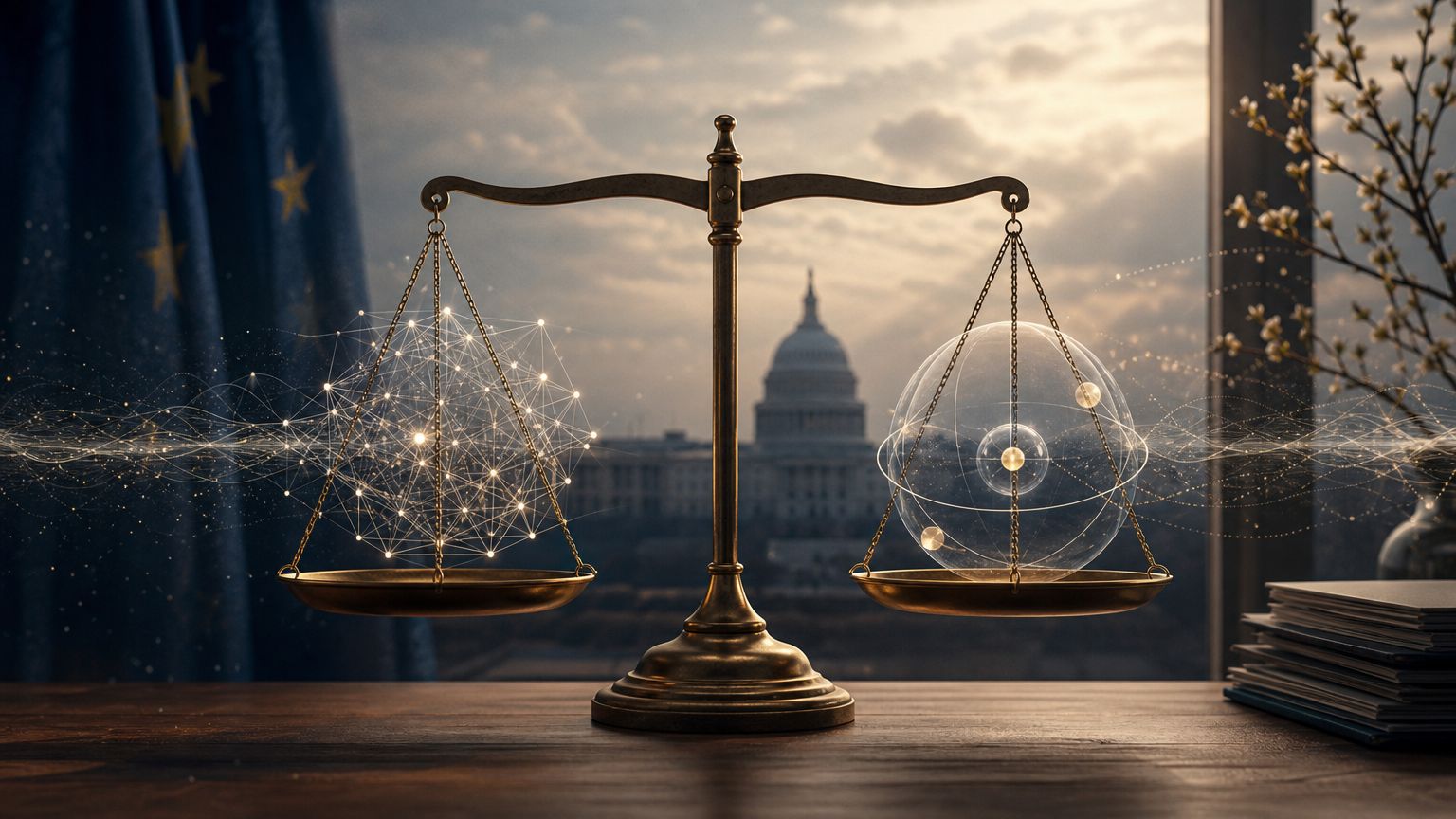
An algorithmic neural-net circuit lattice meets a quantum qubit lattice above the U.S. Capitol — regulating AI and quantum computing.
The questions: gaps, the EU AI Act, quantum, China, and sentience
Glazer's brief was ambitious. Her questions, sent ahead of the interview in line with Kop's media policy, mapped the live debates of late 2022: the major regulatory gaps for AI in the United States and Europe; whether the forthcoming EU Artificial Intelligence Act would close them—especially on algorithmic bias—and how far its influence would reach beyond the EU; how quantum computing should be regulated, and whether the perennial "twenty years away" skepticism justified complacency; how worried the West should be about China and other powers pulling ahead; and, finally, whether AI or quantum computing could ever produce a sentient being.
"AI regulation is virtually nonexistent"
On the first question—the gaps—Kop's answer was blunt. "On both sides of the Atlantic, AI regulation is virtually nonexistent at the moment," he told Glazer in 2022. The observation was diagnostic, not defeatist: it set up the EU Artificial Intelligence Act as the first serious attempt to convert principles into binding law. Kop explained that the Act's reach would extend well beyond Europe through the Brussels effect—the tendency of EU market rules to become de facto global standards because multinationals find it cheaper to comply everywhere than to maintain two product lines.
He was precise about why the instrument mattered legally. Because the AI Act is a Regulation rather than a Directive, it would bind all Member States directly, unifying the rules instead of leaving each country to transpose them. Kop described its architecture: a risk-tiered scheme placing ascending requirements on AI systems by their potential harm; a prohibition on real-time remote biometric identification by law enforcement in public spaces, subject to narrow exceptions; and a pre-market conformity regime for high-risk AI systems—data-governance duties for their training data, with CE marking applied to the system itself—plus transparency and human-oversight duties for algorithms posing a high risk of discrimination, such as in medical devices or employment. That standards-and-certification logic anticipates the European approach to AI Kop had already analyzed in depth in a peer-reviewed study.
Glazer also pressed on the Act's critics: that it is vague about which systems fall into which risk category, and that mandatory human oversight may not actually fix flawed algorithms—citing University of Michigan researcher Ben Green's 2022 argument in the Computer Law & Security Review that human-in-the-loop requirements can become a fig leaf. The honest reading of Kop's position is that conformity assessment, dataset documentation, and certification are necessary scaffolding for accountability—but that oversight is only as good as the institutional capacity behind it, and that bias mitigation must be engineered into the system and its training data, not bolted on at the end.
CQ Researcher / CQ Press, November 25, 2022.
Quantum: why "twenty years away" misreads the physics
The interview's most distinctive thread was quantum. To the skeptics' line—that quantum computing had been "on the horizon for twenty years" and might never arrive in our lifetimes—Kop's response, consistent with his published work, was that the framing confuses engineering timelines with physical reality. The threat does not wait for a fault-tolerant machine: an adversary can intercept and store encrypted traffic today and decrypt it later once a capable quantum computer exists—the harvest-now, decrypt-later problem—so the regulatory clock for post-quantum migration is already running.
The physics is what makes the stakes concrete. A quantum computer encodes information not in bits but in qubits, which exploit superposition and entanglement: placing n qubits in superposition holds an amplitude for each of the 2n basis states at once, and Shor's algorithm uses entanglement and interference between those amplitudes to extract a function's period—the step that collapses the hardness of factoring large integers, and with it the RSA assumptions underpinning much of today's encryption. That is why Kop, in the Foreign Policy op-ed with Vivek Wadhwa that prompted Glazer's invitation, described quantum computing as "an even more powerful emerging technology with the potential to wreak havoc, especially if it is combined with AI," and urged action "before it is too late." Regulation, on this view, should be standards-first and anticipatory rather than reactive.
China, defense, and the geostrategic dimension
On Glazer's national-security question—anchored to the Special Competitive Studies Project's warnings about China—Kop located both AI and quantum in their geostrategic context. The Foreign Policy analysis he co-authored noted that two of the world's most powerful quantum computers had been built in China, a signal of possible advantage over the West, even as the U.S., Russia, India, and several European countries pursued their own programs. The point for policymakers is not alarmism but sequencing: export controls, standards, and alliance coordination must be in place before capability matures. Kop's later engagements—including consulting Senator Mark Warner on AI and quantum technology policy—carry the same through-line.
Machine sentience and the rights question
Glazer closed with the question that recurs in every AI debate: could AI or quantum computing ever create a sentient being, and should it hold human rights, such as the right not to be enslaved? The disciplined answer separates capability from consciousness. Today's systems—however fluent—optimize objective functions; they do not possess subjective experience, and nothing in quantum mechanics supplies it on demand. Quantum effects make certain computations tractable that classical machines cannot run efficiently; they do not, by themselves, manufacture an inner life. The serious governance task is therefore not to litigate the rights of hypothetical machine minds but to govern the real systems we already deploy—an agenda Kop has developed since his early AI Impact Assessment work—while keeping the deeper philosophical questions honestly open.
Why the interview still matters
Read in 2026, the 2022 conversation is a map drawn just before the territory changed. The EU AI Act has since been adopted; NIST finalized its first three post-quantum cryptography standards in 2024; and the China-and-defense framing has moved from think-tank papers into statute and procurement. Kop's contribution to Glazer's CQ Researcher report was to insist that AI and quantum technology be governed together, with the underlying physics taken seriously rather than deferred—an argument that has anticipated several later policy developments. The same conviction surfaces in the parallel 2022 conversations in which two technology outlets interviewed Kop on quantum ethics and the EU AI Act.
Last updated: June 5, 2026.