
Morning Brew and Dark Reading Interview Mauritz Kop on Quantum Ethics and the EU AI Act
By Editor
New York, NY / Berlin, Germany, June 21, 2022—Two technology outlets interviewed Mauritz Kop within the same fortnight on the governance frontiers that define his work: the ethics of quantum computing and the European Union's proposed AI Act. Emerging Tech Brew, Morning Brew's technology vertical, featured him on June 21, 2022 in "As quantum computing advances, who's thinking about ethics?"; eleven days earlier, Dark Reading published "EU Debates AI Act to Protect Human Rights, Define High-Risk Uses." In both, Kop is identified as a Transatlantic Technology Law Forum fellow at Stanford University and a strategic intellectual property lawyer at AIRecht.

A diptych joining a quantum-computing superposition motif and an EU human-centric scales-of-rights motif — quantum ethics meets the EU AI Act.
Morning Brew: codify the ethics before the technology locks in
Reporter Hayden Field framed the quantum question as a familiar balancing act—responsible development without stifling innovation—and put it to three sources, including Kop. His central argument was one of timing: the window to shape a technology closes as it matures, and AI had already shown what it costs to arrive late.
"We were obviously too late for AI, and now, [for quantum computing], we still have the chance to be in time before the technology gets locked in," Kop told Emerging Tech Brew. "So it's always a Collingridge dilemma from when to interfere in the innovation process and steering things into the right direction by regulation, or controls, or embedding the values into the tech. All this did not happen for AI, and we can see the results around us. So we really need to respond to this call to action by creating the governance structures, and the regulatory frameworks, and the lists of principles and best practices to guide this tech."
The Collingridge dilemma is the crux: early on a technology is malleable but its risks are hard to see; later the risks are obvious but the technology is too entrenched to redirect—the case for acting on quantum technology now.
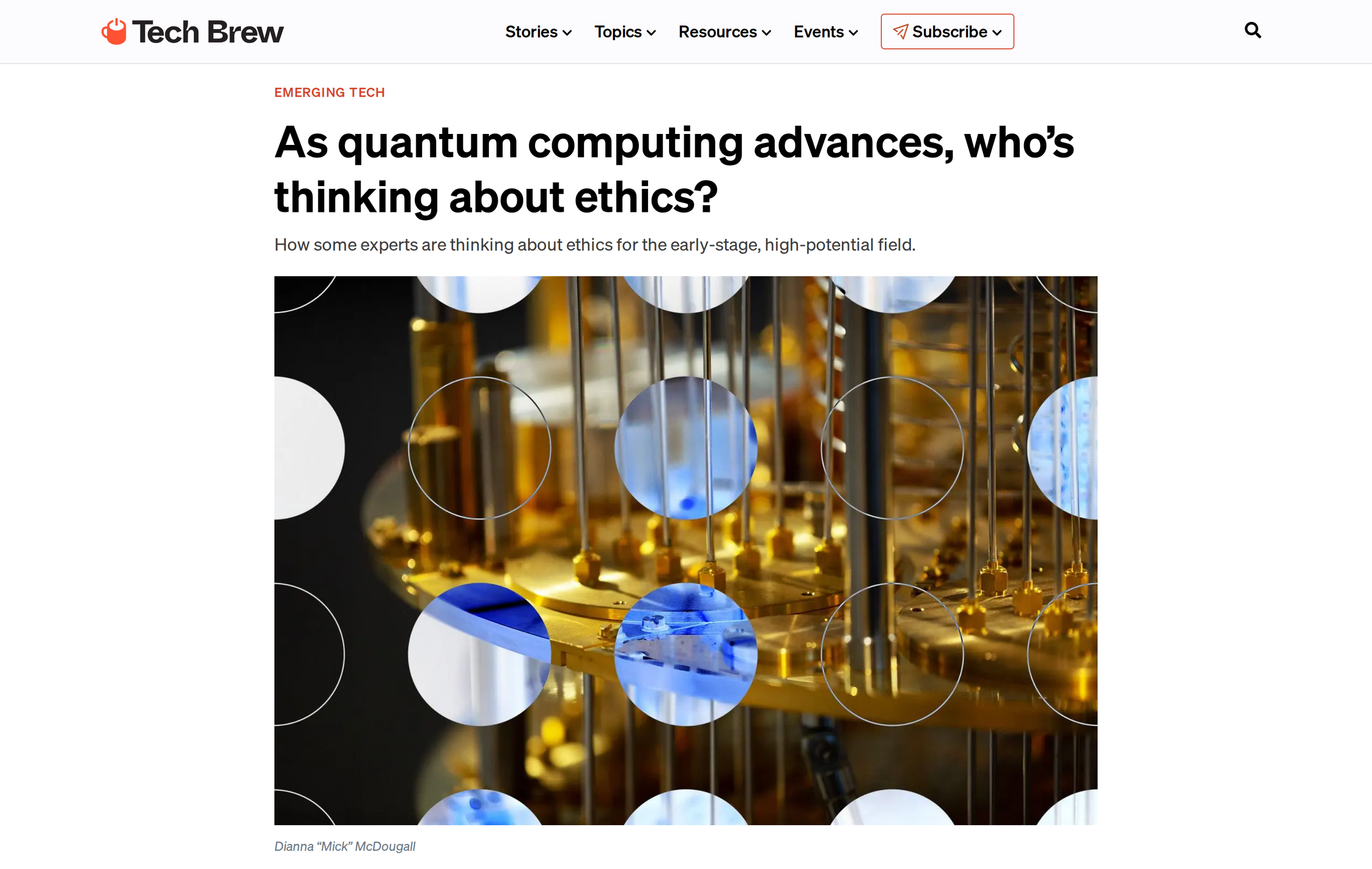
Morning Brew / Emerging Tech Brew, June 21, 2022.
Why quantum capabilities are categorically different
Part of what makes quantum ethics urgent is that the underlying physics is not merely a faster classical machine. A quantum bit can exist in a superposition of states at once, and two or more qubits can be entangled so that measuring one fixes the correlated outcomes of the others—correlations with no classical analogue that carry no signal—so the computational state space grows exponentially with qubit count. By exploiting interference among these superposed states—the mechanism behind period-finding—a sufficiently large, fault-tolerant quantum computer can run Shor's algorithm and break the RSA and elliptic-curve public-key cryptography that secures today's communications. The World Economic Forum's Quantum Computing Governance Principles, cited in the same article, register that risk by naming "non-maleficence" a core value.
Kop also stressed transparency about present capability, paired with humility about the unknown: it is vital, he said, to be honest with the public about what quantum computing currently can and cannot do, while still addressing the "Pandora's Box of unknown risks." He reached for a medical analogy from an earlier opinion piece: "The Hippocratic Oath taken by doctors exemplifies the moral responsibility of medical professionals towards their patients, and similarly, quantum technology has its own specific ethical challenges and dilemmas—and in this case, our society is the patient," Kop said. "Ethics is really important there. So it's all about human conduct and moral standards being converted into practical rules, principles, and responsibilities." In a paper in the Yale Journal of Law & Technology, the article notes, Kop has called for impact assessments in quantum computing.
Dark Reading: the EU AI Act as a product-safety regime for AI
For Dark Reading's June 10, 2022 feature, Nathan Eddy assembled a panel of experts to examine the European Commission's draft AI Act. Kop's framing was that the legislation is, at its core, a product-safety regime for artificial intelligence. AI is now mostly unregulated except for a few sector-specific rules, he noted, and the act aims to close those gaps by treating AI the way Europe already treats other potentially dangerous products on its market.
He was direct about why voluntary measures will not do: "The risks are too high for nonbinding self-regulation by companies alone," Kop said—and equally direct about the purpose the regime serves. "The EU AI Act aims to be a human centric legal-ethical framework that intends to safeguard and protect human rights and fundamental freedoms from violations of these rights and freedoms by algorithms and smart machines," he told Dark Reading—adding that the right to know whether you are dealing with a human or a machine, increasingly hard to discern as AI grows more sophisticated, is part of that vision.
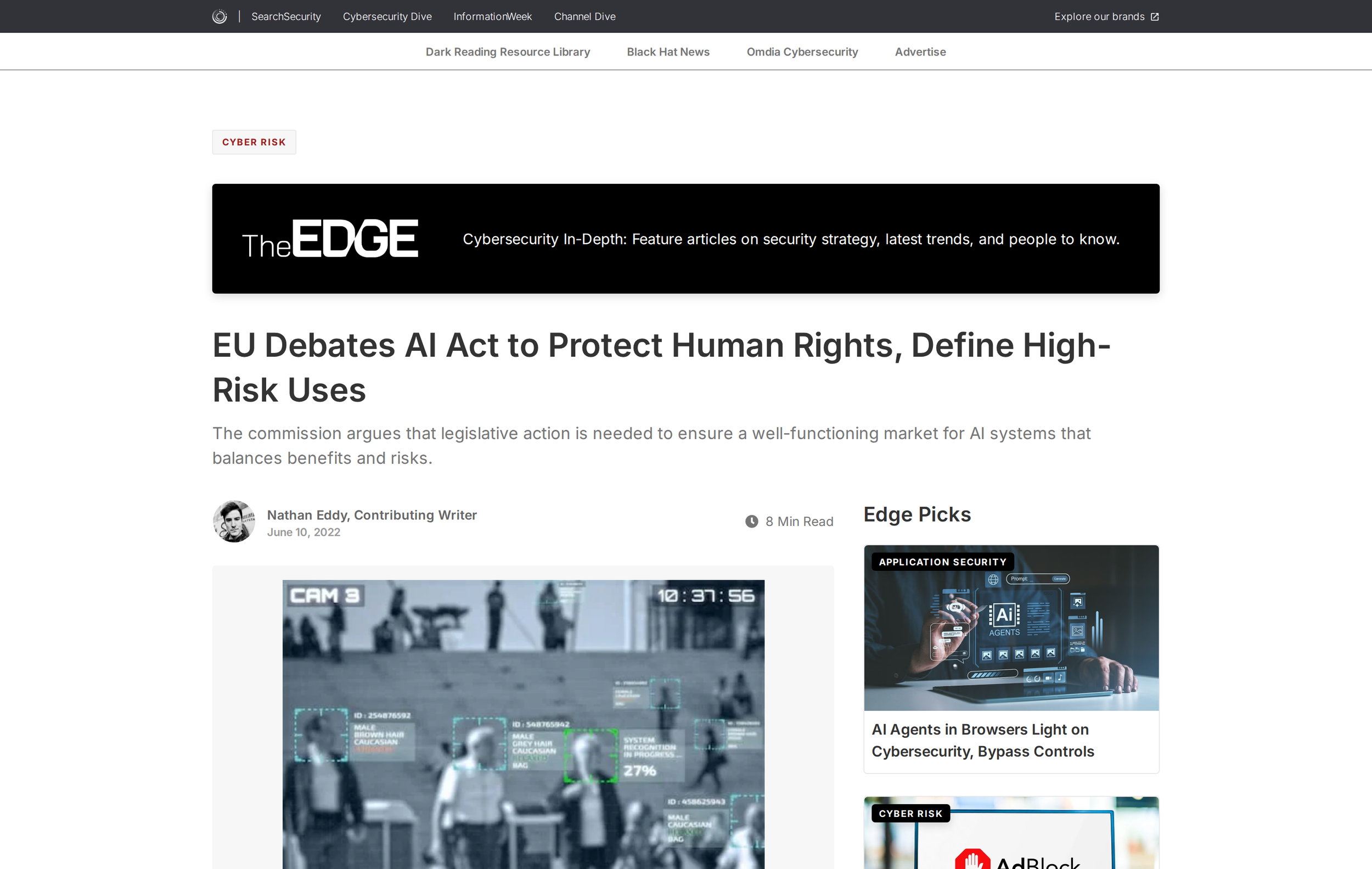
Dark Reading, June 10, 2022.
Defining "high risk"—and the cost of compliance
On classification, Kop described a framework that scales obligations to danger. "It will be a dynamic list that contains various types of AI applications used in certain high-risk industries, which means the rules get stricter for riskier AI in healthcare and defense than they are for AI apps in tourism," he told Dark Reading. "For instance, medical AI is [classified as] high risk to prevent direct harm to patients due to AI errors." In his fuller written answers he placed this within a "pyramid of criticality"—unacceptable-risk practices prohibited outright, high-risk systems subject to certification and audits, with facial recognition classified as high-risk dual-use technology rather than banned across the board.
He did not minimize the burden. Regulatory conformity and legal compliance will weigh on early AI startups developing high-risk systems, Kop acknowledged, pointing to empirical research suggesting the GDPR had a negative effect on innovation even as it preserved privacy. "The legal uncertainty surrounding [regulation] and the lack of budget to hire specialized lawyers or multidisciplinary teams still are significant barriers for a flourishing AI startup and scale-up ecosystem," Kop said. "The question remains whether the AI Act will improve or worsen the startup climate in the EU." In his written responses he argued the answer lies in building compliance in from the first line of code—"Trustworthy AI by Design"—and in the legal sandboxes the draft provides.
One thread across both interviews
Read together, the two interviews trace a single conviction: governance works best when embedded early, by design, and grounded in human rights rather than bolted on after harm. For AI, Europe was among the earliest to advance that conviction toward binding law—then still a proposal; for quantum technology, the field still has the rarer chance to act before it locks in. Both threads run through his earlier work—on the European approach to the AI Act, on ethics in the quantum age, and in the lecture on quantum ethics for which IBM invited Mauritz Kop that year. The quantum-ethics half of this story belongs to a larger Stanford- and Harvard-facing responsible-quantum-technology arc, set out in the Berkman Klein paper Towards Responsible Quantum Technology and traced further in the parallel coverage of when CQ Researcher interviewed Kop on regulating AI and quantum computing.
Last updated: June 5, 2026.