
Innovation, Quantum-AI Technology & Law

Blog over Kunstmatige Intelligentie, Quantum, Deep Learning, Blockchain en Big Data Law

Blog over juridische, sociale, ethische en policy aspecten van Kunstmatige Intelligentie, Quantum Computing, Sensing & Communication, Augmented Reality en Robotica, Big Data Wetgeving en Machine Learning Regelgeving. Kennisartikelen inzake de EU AI Act, de Data Governance Act, cloud computing, algoritmes, privacy, virtual reality, blockchain, robotlaw, smart contracts, informatierecht, ICT contracten, online platforms, apps en tools. Europese regels, auteursrecht, chipsrecht, databankrechten en juridische diensten AI recht.

Berichten met de tag Ethics
OECD Recommendation on Quantum Technologies Builds on Responsible Quantum Principles Developed at Stanford RQT

On May 28, 2026, the OECD Council adopted OECD/LEGAL/0508, the Recommendation of the Council on Quantum Technologies—the first intergovernmental standard to set shared principles for the responsible development and use of trusted quantum technologies. Its four high-level principles and five policy recommendations will read as familiar to anyone who has followed responsible-quantum scholarship, because the instrument's core ideas track work that the Stanford Center for Responsible Quantum Technology and its founder, Mauritz Kop, helped build over the previous half-decade.

The first intergovernmental quantum standard

Developed through a multistakeholder process—forty-seven experts from twenty-six nationalities across four scoping meetings in 2025, building on the OECD's January 2025 Quantum Technologies Policy Primer—the Recommendation asks all Actors to promote innovation that respects democratic values, to prevent and mitigate harms across the technology lifecycle, to promote secure and broad access, to facilitate collaboration, and to foster accountability and trustworthiness. It is non-binding but normatively weighty: thirty-eight adherents are now expected to implement it through their own legal frameworks. The OECD's broader responsible-quantum-technology agenda has long argued that the field needs exactly this kind of shared, anticipatory baseline.

A visible lineage, not a formal citation

The Recommendation names no academic source, and nothing in its text formally credits Stanford RQT. What it shows is conceptual lineage. Its lifecycle-embedded, values-first framing echoes the Ten Principles for Responsible Quantum Innovation; its post-quantum-cryptography and quantum-resilient-infrastructure language draws on the same concern with cryptanalysis that animated Kop's 2021 Yale legal-ethical framework; its accountability-and-trustworthiness principle parallels families in the World Economic Forum Quantum Computing Governance Principles he helped conceptualize; and its call for science-based standards mirrors the standards-first program he and colleagues set out in Science. Kop was among the experts consulted in the course of the OECD's quantum-policy work, an engagement that sits within a longer record of peer-reviewed calls for responsible quantum technology.

Why anticipation is the right posture

Both the Recommendation and the scholarship it echoes favor agile, forward-looking, evidence-based governance—and the physics explains why. Quantum technologies draw their power from superposition and entanglement, phenomena that do not scale gently: an entanglement-enabled sensor can cross a sensitivity threshold, and a cryptanalytically relevant machine can render trusted public-key cryptography suddenly breakable, in ways that arrive nonlinearly. Governance that waits for a capability to mature arrives too late by construction. This is the case the responsible-quantum field, including the Quantum-ELSPI research agenda, has pressed since 2021—and the case OECD/LEGAL/0508 now encodes for thirty-eight economies.

What comes next

The Recommendation tasks the OECD's Digital Policy Committee and Committee for Scientific and Technological Policy to develop practical guidance and to report back within five years, so the standard is built to evolve with the technology. Its arrival signals that these responsible-quantum arguments have reached the institutions that set international norms—a quiet but consequential validation of work begun years earlier at Stanford.

Meer lezen

BioLawLaPaLooZa: Mauritz Kop on Hippocratic Quantum and the End of Stable Records at Stanford Law School

At BioLawLaPaLooZa, the annual law-and-biosciences conference convened at Stanford Law School by Henry T. "Hank" Greely and co-hosted with the Journal of Law and the Biosciences, Mauritz Kop delivered a talk that fused two strands of his recent work: the biomedical-ethics argument of his Harvard-published Hippocratic Quantum project and the security lens of his NATO Strategic Communications advisory work. It was his third appearance at the gathering, which builds on his earlier BioLawLaPaLooZa remarks.

The past is not yet stable

Kop's organizing line was that "the past is not yet stable." Rather than treating the quantum threat as a future event, he argued that today's authenticated, confidential records are contingent on a cryptographic transition still under way: adversaries can harvest encrypted data now and decrypt it once a Shor-capable machine factors the large integers beneath RSA. Confidentiality, in this reading, must be defended retroactively as well as prospectively—making the migration to post-quantum cryptography, for hospitals and biobanks, a clinical duty rather than an IT preference. The point reframes a familiar threat model: the danger is not only what a future machine will decrypt, but what is being copied and stored today against that day.

Four classical principles, recomputed

The talk recast the four principles of biomedical ethics—autonomy, beneficence, non-maleficence, and justice—for a quantum register. Quantum does not replace them, Kop said; it changes what applying them requires. Autonomy comes to demand data sovereignty and a credible right not to know as quantum-AI systems build finer probabilistic patient models. Dual-use simulators that design therapeutics can also lower the barrier to designing pathogens, which is where his LSI test—least trade-restrictive, security-sufficient, innovation-preserving—supports tiered disclosure over blanket secrecy. And the justice problem is a widening one: the quantum divide, he warned, may prove steeper than the digital divide.

The X-Ray City and a constitution for medicine

Widening the lens, Kop described civic-scale quantum gravimetric and magnetic sensors moving from the laboratory toward infrastructure pilots—able, from public rights-of-way, to resolve subsurface and interior spaces, and so to reach into the privacy of the home. He calls this prospect the X-Ray City, and said he had told NATO it needs a Hippocratic Quantum posture of its own. He closed with a "quantum constitution for medicine" in four standards of care: quantum-safe encryption, sovereignty over patient digital twins, human oversight in the loop, and tiered disclosure under the LSI test. The premise the room had not heard before, he suggested, was simply that the past itself is not yet settled.

Meer lezen
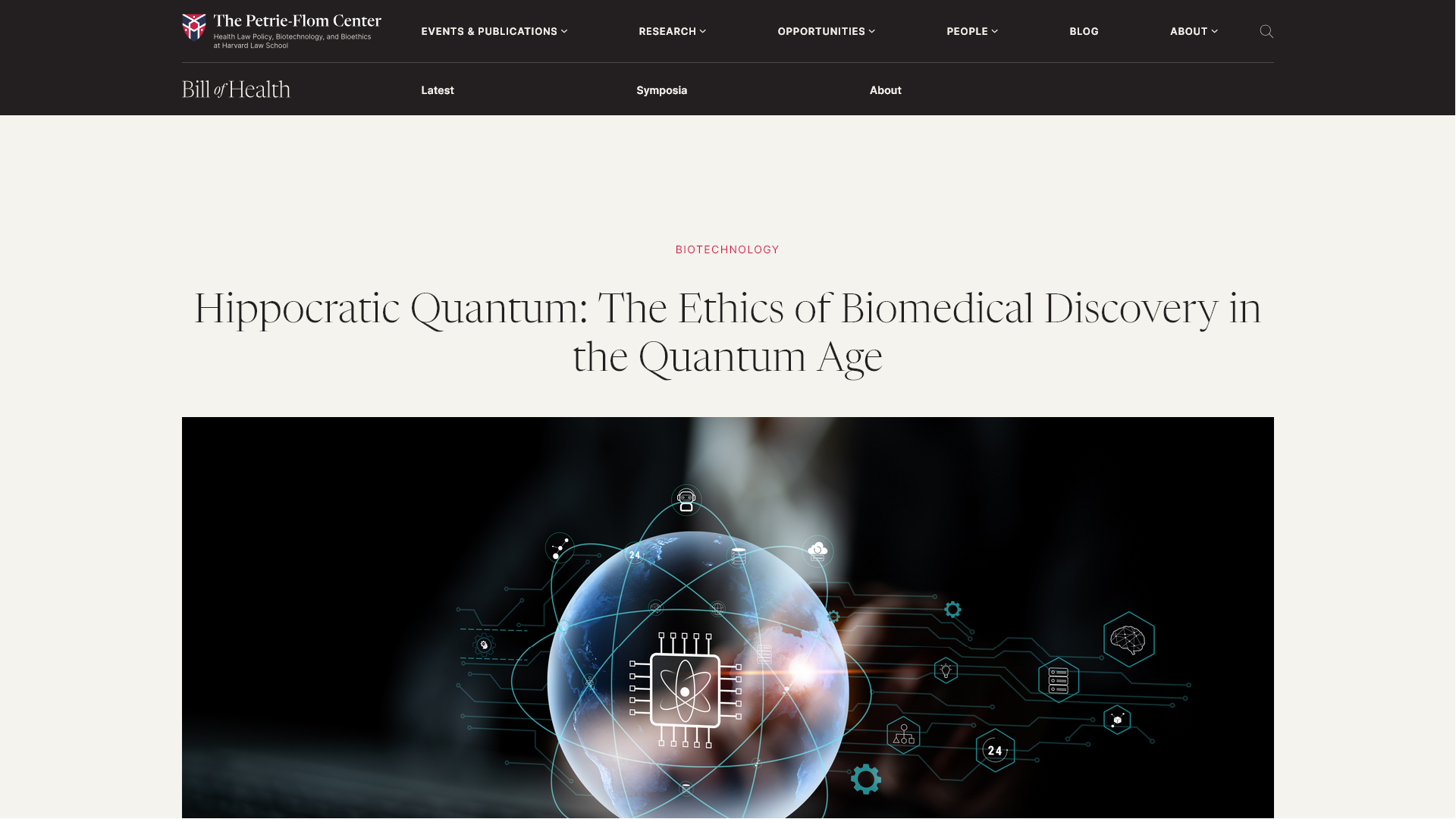
Harvard Law Publishes Hippocratic Quantum: The Ethics of Biomedical Discovery in the Quantum Age

Cambridge, MA, February 25, 2026—Harvard Law’s Petrie-Flom Center has published Mauritz Kop’s new article, Hippocratic Quantum: The Ethics of Biomedical Discovery in the Quantum Age:https://petrieflom.law.harvard.edu/2026/02/25/hippocratic-quantum-the-ethics-of-biomedical-discovery-in-the-quantum-age/

The article advances a proposition that is becoming increasingly difficult for health lawyers, policymakers, and biomedical innovators to ignore: as quantum technologies begin to enter biomedical discovery, the decisive challenge is no longer only scientific capability, but rather governance. In Kop’s account, quantum-enabled medicine should not be understood as a distant or speculative frontier that can be regulated later, once the engineering settles. It should instead be approached as a present-tense quantum governance problem, one that already implicates patient confidentiality, data integrity, cyber resilience, export controls, supply chains, and the geostrategic value of biomedical knowledge.

The article’s answer is not a new morality, but a more demanding implementation of an existing one: quantum medicine requires a Hippocratic framework that is technical enough for engineers, legal enough for regulators, and concrete enough for hospitals and pharmaceutical firms, yet flexible enough to let innovation breathe and encourage the crucial public-private investment necessary to advance allied quantum capabilities.

Five examples of quantum-enabled biomedical innovations

To ground this institutional view, one must consider the specific technological capabilities currently transitioning from theoretical physics to applied biomedicine. Five feasible vectors of innovation illustrate the breadth of this shift. In the domain of quantum computing, hybrid classical-quantum algorithms are emerging to optimize complex drug discovery pipelines and process large-scale genomic datasets. In quantum sensing, technologies such as diamond nitrogen-vacancy magnetometry enable ultra-sensitive, room-temperature mapping of neurological and cardiac activity. For quantum simulation, researchers are utilizing qubit-based systems to model molecular interactions and drug-target binding affinities with high accuracy, aiming to reduce reliance on extensive physical wet-lab screening. Within quantum imaging, techniques leveraging entangled photons permit the high-resolution visualization of cellular structures at lower light intensities, thereby mitigating phototoxicity in living tissues, benefitting medical diagnosis. Finally, in quantum networking, the deployment of quantum key distribution protocols offers a mechanism to cryptographically secure the transmission of sensitive multi-omics data across distributed hospital and research architectures.

From legal-ethical framework to Quantum-ELSPI

The Harvard article is best read as part of a longer intellectual trajectory. An early expression of that project appeared in March 2021 in the Yale Journal of Law & Technology, in Establishing a Legal-Ethical Framework for Quantum Technology: https://yjolt.org/blog/establishing-legal-ethical-framework-quantum-technology

That Yale piece argued that quantum technologies were moving from hypothetical ideas to commercial realities, and that law and policy should not wait for full technical maturity before building governance tools. It proposed a culturally sensitive legal-ethical framework for applied quantum technologies, drawing on AI governance and nanotechnology’s ELSI tradition while recognizing the distinct physical characteristics of quantum systems. Crucially, it also insisted that ethical aspiration must be accompanied by practical mechanisms for monitoring, validation, and life-cycle risk management. In retrospect, many of the themes that now reappear in Hippocratic Quantum were already visible there: the concern for human-centered design, the call for risk-based governance, and the insistence that ethics without institutionalization would be inadequate.

Why quantum medicine changes the governance question

The new Harvard article narrows the focus to biomedicine, but in doing so it sharpens the stakes. Biomedical discovery is not simply another application area. It is a setting in which long-lived and highly sensitive data, bodily integrity, public-health interests, commercial incentives, and geopolitical competition intersect. Quantum technologies matter here not because they promise speculative disruption, but because they may incrementally and then materially improve specific tasks: hybrid quantum-classical computational chemistry, de novo molecular design, lead optimization, selected toxicity and metabolism modeling, and perhaps aspects of high-fidelity sensing, simulation, and networked quantum computation. The issue, then, is not whether every promise will be realized immediately. It is whether institutions are preparing now for the forms of capability that are already foreseeable.

A Harvard-facing research arc

This Harvard publication also extends a longer Harvard-facing research arc across AI, health law, and responsible quantum governance. That arc includes:

  1. The Right To Process Data For Machine Learning Purposes In The EU (Harvard JOLT) https://jolt.law.harvard.edu/digest/the-right-to-process-data-for-machine-learning-purposes-in-the-eu

  2. Towards Responsible Quantum Technology (Harvard Berkman Klein) https://cyber.harvard.edu/publication/2023/towards-responsible-quantum-technology

  3. EU And US Regulatory Challenges Facing AI Health Care Innovator Firms (Harvard Petrie-Flom) https://petrieflom.law.harvard.edu/2024/04/04/eu-and-us-regulatory-challenges-facing-ai-health-care-innovator-firms/

  4. A Brief Quantum Medicine Policy Guide (Harvard Petrie-Flom) https://petrieflom.law.harvard.edu/2024/12/06/a-brief-quantum-medicine-policy-guide/

  5. How Quantum Technologies May Be Integrated Into Healthcare: What Regulators Should Consider (Stanford Law) https://hls.harvard.edu/bibliography/how-quantum-technologies-may-be-integrated-into-healthcare-what-regulators-should-consider/

Seen in this broader context, Hippocratic Quantum brings together early legal-ethical framing, responsible quantum governance, healthcare regulation, and geopolitical analysis into a single biomedical governance argument.

The article has also been featured by The Quantum Insider, which highlighted its central argument that quantum medicine’s promise must be matched by stronger privacy and governance safeguards: https://thequantuminsider.com/2026/02/27/analysis-quantum-medicines-promise-raises-new-privacy-and-governance-risks/

Meer lezen
Responsible Peer Review at Scholarly Journals: Guiding Manuscripts to Their Best Form

Behind every published paper stands an unnamed reader who helped make it publishable. That reader is a peer reviewer—unpaid, anonymous, and usually invisible. Mauritz Kop, Founder of the Stanford Center for Responsible Quantum Technology, has done that work across a strikingly broad set of fields, and this essay treats peer review as a craft worth describing: how to do it well, and where he does it.

Steward, not gatekeeper

Everything follows from how a reviewer understands the role. Read as a turnstile, review collapses into fault-finding; read as care for the scholarly record, it turns into the question of what a paper needs to reach its strongest form. Saying no remains part of the job when nothing can rescue a manuscript—but repair, not rejection, is the starting assumption. The method that supports this is unglamorous: read once generously to grasp intent, again critically to test claim against method and evidence, and a third time as the non-specialist who has to follow it. What the author then receives should be a guide, not a grade—precise, proportionate, and respectful of the labor behind the work.

What interdisciplinary review demands

The journals map the range of the practice—npj Digital Medicine, Ethics and Information Technology, Minds and Machines (Springer Nature), NanoEthics (Springer Nature), Intellectual Property Quarterly (Thomson Reuters), the Journal of Intellectual Property Law & Practice (Oxford University Press), and Quantum Science and Technology (IOP Publishing). Evidence means something different in each: a trial result, a philosophical argument, a reading of statute, and a physics experiment are not validated the same way, so the reviewer adapts to the discipline at hand. Physics makes the point sharp. A quantum protocol that assumes an unknown state can be copied violates the no-cloning theorem; a scheme that ignores decoherence, or forgets that measurement perturbs the very state it reads, has not survived contact with the physics—a rigor that also animates Kop's Quantum-ELSPI work on the legal and ethical implications of quantum technology.

Confidentiality and recognition

You will find no war stories here about particular submissions, and the silence is deliberate. Confidentiality is not an accessory to peer review but its precondition: only because reviewers say nothing can authors hand unfinished work to a stranger. Such discretion makes the labor hard to see, and harder to honor. The exception came in 2022, when IOP Publishing granted Kop its Trusted Reviewer Certification, a competency-based recognition of reviewers who demonstrate a high standard of review—a mark of rigor and usefulness rather than sheer output. Practiced this way, peer review is less a barrier than the quiet mechanism that keeps the scholarly record trustworthy.

Meer lezen
Mauritz Kop Speaker at United Nations International Year of Quantum Science and Technology 2025

On 31 October 2025, Mauritz Kop, Founder of Stanford RQT (Responsible Quantum Technology), served as one of the main speakers at the North America regional workshop on the Ethical, Legal, and Social Aspects (ELSA) of Broadening Global Ownership of Quantum Technologies. The online workshop was part of the United Nations International Year of Quantum Science and Technology 2025 (IYQ 2025), a year-long initiative mandated by the United Nations General Assembly (UNGA) and led by the United Nations Educational, Scientific and Cultural Organization (UNESCO) to mark 100 years of quantum mechanics and to address the emerging “quantum divide” in access, skills, and infrastructure.

The North America edition was convened by Dr. Zeki C. Seskir and Professor Shohini Ghose as part of a six-region ELSA-of-quantum workshop series. Each regional workshop is feeding into a global IYQ event on the Ethical, Legal, and Social Aspects of Broadening Global Ownership of Quantum Technologies to be held in Istanbul in November 2025.

The program brought together four principal speakers—Mauritz Kop, Bruna Shinohara de Mendonça, Lindsay Rand, and Isabelle Lacroix—and designated commentators Rodrigo Araiza Bravo and Karl Thibault. The workshop closed with an open discussion in which participants reflected on regional needs, expected impact, and the kind of alignment that is necessary for a fair and secure quantum future.

The International Year of Quantum and the North America ELSA Workshop

The International Year of Quantum Science and Technology 2025 was proclaimed by the United Nations General Assembly in June 2024. The resolution calls on states and international organizations to use 2025 to raise public awareness of quantum science, promote education and capacity-building—especially in the Global South—and strengthen cooperation so that all countries can participate in and benefit from quantum technologies.

Within this broader mandate, the ELSA of Broadening Global Ownership of Quantum Technologies initiative focuses on quantum governance. The North America workshop was explicitly framed around three questions:

  1. Which ethical, legal, and social aspects of quantum technologies are most urgent for North America today?

  2. Which ELSA topics are most important globally?

  3. How should the future of ELSA and related policy implications be shaped in Europe, North America, and worldwide, and what forms of alignment are needed?

The three-hour program opened with an overview of the IYQ ELSA event series, followed by the four invited talks, a short break, and then a structured discussion and closing reflections.

From ELSA to ELSPI: A Metaparadigm for Quantum Governance

Kop’s keynote, “From ELSA to ELSPI: A Metaparadigm for Quantum Governance,” drew on his recent work on Quantum-ELSPI and Responsible Quantum Technology, including Quantum-ELSPI: A Novel Field of Research; Ten Principles for Responsible Quantum Innovation (co-authored with, among others, Raymond Laflamme); and his legislative blueprint Towards a European Quantum Act.

He began by defining Quantum-ELSPI (co-developed with Luciano Floridi then at Oxford, now at Yale) as the study of Ethical, Legal, Socio-economic, and Policy Implications of quantum technologies. Classical ELSA—Ethical, Legal, and Social Aspects—was designed for more conventional technologies and, in his view, is too narrow for quantum systems that combine:

  • Dual-use components that can be deployed for both civilian and military purposes;

  • Long security horizons, where sensitive data captured today may be decrypted decades later by cryptanalytically relevant quantum computers; and

  • Fragile supply chains, in which a handful of materials, cryogenic systems, or photonic components create systemic bottlenecks.

To address this, Kop articulated three foundational pillars of the Quantum-ELSPI metaparadigm, developed in a recent Science article with co-authors Mateo Aboy, Urs Gasser, Glenn Cohen, and others:

  1. Standards-First Governance
    Technical and assurance standards—such as post-quantum cryptography (PQC) profiles, quantum quality-management systems, and certification schemes—are treated as the primary vehicle for embedding values into systems. Law, policy, and institutional design are built around these standards rather than attempting to regulate hypothetical risks in the abstract.

  2. Execution-Oriented Ethics
    Ethics is framed as a delivery problem. Instead of high-level value statements, Kop emphasized auditable supply chains, post-quantum cryptography migration drills, and verifiable deployment metrics in sectors such as finance, health care, and government archives. Ethics, in this sense, is measured by what actually ships and how it behaves under stress.

  3. Planetary Welfare
    The third pillar reframes quantum technologies not only as instruments of national competitiveness or military advantage, but as ecological and health technologies. Quantum-ELSPI is thus aligned with the Sustainable Development Goals (SDGs), emphasizing applications in climate modeling, clean-energy materials discovery, quantum-enabled medical technologies, and resilient humanitarian communications.

Taken together, these pillars elevate Quantum-ELSPI from a narrow ethics add-on to a metaparadigm for governing the entire quantum stack—from materials and cryogenic infrastructure to cloud-based access, algorithms, and hybrid quantum–classical systems.

Meer lezen
Mauritz Kop Awarded Senior Fellowship at Leading G7 Think Tank CIGI Waterloo

Mauritz Kop, founder of the Stanford Center for Responsible Quantum Technology (RQT) and a guest professor at the US Air Force Academy (USAFA), has been appointed a senior fellow at the Centre for International Governance Innovation (CIGI), a leading Canadian G7 think tank with a global reputation for impactful research and policy advice. This fellowship marks a significant new chapter in Professor Kop's work, allowing for a deeper dive into the intricate and rapidly evolving nexus of quantum technology, artificial intelligence (AI), intellectual property (IP) law, competition policy, and national security. The initial project will focus on developing a comprehensive roadmap for navigating this complex landscape, building on previous engagement with CIGI and long-standing academic and professional connections with Canada.

Mauritz Kop Appointed Senior Fellow at CIGI: A New Chapter in Quantum Governance and Global Security

This CIGI senior fellow appointment is not just a personal honour, but a testament to the growing global recognition of the urgent need for innovative governance models to steer the development of powerful dual-use technologies towards beneficial outcomes for humanity. The challenges are immense, but so are the opportunities. In a world grappling with geopolitical instability and the disruptive potential of emerging technologies, CIGI’s mission to build bridges from knowledge to power has never been more critical. Kop is thrilled to contribute to this mission and to collaborate with CIGI’s distinguished team of experts.

Building on a Foundation: The Dual-Use Project and Previous Engagements

Professor Kop's journey with CIGI began prior to this fellowship, with a seminar delivered on the governance of dual-use quantum technologies. That lecture, titled “Responsible Quantum AI Governance: From Ethical Principles to Global Frameworks,” set the stage for the work he is about to undertake. In that presentation, he argued that we are approaching a “Quantum Event Horizon”—a critical juncture beyond which our ability to shape the trajectory of advanced quantum and AI systems may be irrevocably lost. The core of Kop's argument was that traditional governance models and diplomatic efforts are insufficient to address the systemic challenges posed by a global, high-stakes race for quantum supremacy.

The seminar explored the necessity of a multi-layered governance strategy. This includes not only the development of robust international legal frameworks and oversight bodies, drawing inspiration from nuclear non-proliferation treaties, but also the integration of “Quantum-Resistant Constitutional AI” to hardwire universal values into the technology itself. This dual approach, grounded in the principles of responsible innovation, is essential to mitigate the risks of misuse by state and non-state actors, and to ensure that these technologies serve to enhance, rather than undermine, democratic societies.

The positive reception to these ideas and the stimulating discussions that followed with the CIGI community laid the groundwork for this senior fellowship. It became clear that there was a shared understanding of the stakes involved and a common commitment to forging a path towards a safe and equitable quantum future. This fellowship provides the ideal platform to transition from articulating these principles to developing concrete, actionable policy recommendations.

A New Frontier: IP, Competition Law, Quantum, Dual-Use, and National Security

Professor Kop's first project as a CIGI Senior Fellow will be an in-depth analysis of the critical nexus between quantum technology, AI, IP policy, and national security strategy. The convergence of quantum and AI capabilities presents unprecedented challenges for global innovation and strategic stability, most notably the looming threat of “Q-Day,” when a sufficiently powerful quantum computer could break most of the public-key cryptography that underpins our digital world.

This project will draw lessons from historical precedents, particularly the governance of nuclear technology, to inform the development of novel frameworks for quantum governance. A key component of the research will be a comparative analysis of quantum IP strategies across the dominant tech blocs, examining how different approaches to patents, trade secrets, and state secrets are shaping the global quantum race.

Meer lezen
Quantum Technology Governance: The Daiki Quantum Governance Recipe and the World's First QT-QMS

Quantum technology arrives with a governance problem unlike the one that classical computing posed. The systems are powerful, dual-use, and—at the hardware level—physically fragile in ways that ordinary quality regimes never had to model. Daiki, the AI and quantum governance company co-founded by Mauritz Kop, has published the Daiki Quantum Governance Recipe to close that gap: a toolkit that turns responsible-innovation principles into an auditable management system, anchored by what Daiki calls the world's first Quantum Technology Quality Management System (QT-QMS).

A management system for a fragile technology

The QT-QMS is a coined framework, extending to quantum the system-level discipline that ISO 13485 brought to medical devices and ISO/IEC 27001 to information security. The case for a dedicated discipline is physical as much as legal: quantum information lives in fragile superposition states that decoherence degrades on short timescales, and measurement is irreversible, so fidelity, error rates, and calibration drift become first-order operational facts. A quality system built for classical software simply does not have vocabulary for these failure modes, which is why Daiki argues quantum needs a management standard of its own.

Three ingredients, one auditable trail

The Recipe is built around three pillars. A QMS Backbone supplies the ISO-aligned, auditable framework for quality and risk management, integrating ISO/IEC 27001, 27005, and 42001 alongside the proposed QT-QMS. An Ethical Compass operationalizes the Ten Principles for Responsible Quantum Innovation—grouped as Safeguarding, Engaging, and Advancing—through checklists, templates, and guided assessments. An Assessment Engine automates Quantum Impact Assessments across the lifecycle, logging every decision into a time-stamped audit trail that spans ex-ante, ex-durante, and ex-post review. Daiki frames the synthesis of the three as a path to Quantum-Resistant Constitutional AI: systems hardened against quantum attack and bound to an enforceable set of values.

Standards first, regulation later

The Recipe rests on a standards-first philosophy—voluntary, consensus-driven standards as the most workable foundation for a fast-moving field—and situates that approach inside a four-stage cycle running from principles through soft law to hard law. That sequencing matters for timing: by building governance on standards already taking shape through ISO/IEC Joint Technical Committee 3, IEEE, and NIST's post-quantum cryptography work, organizations turn today's best practices into tomorrow's compliance evidence as binding frameworks such as a future EU Quantum Act emerge. Daiki points toward system-level certification of a company's QT-QMS by an accredited body, on the medtech model, as the longer-term destination.

Why it matters now

The deeper argument is one of timing and proof. Quantum governance, like AI governance before it, is moving from voluntary commitment to a documented, auditable function—and the organizations best placed for that shift are the ones building a single coherent management system now, rather than assembling a reactive checklist once enforcement arrives. For a quantum ecosystem dominated by startups and research labs, the Recipe's promise is to lower the cost of doing this well, so that responsibility and speed stop being a trade-off.

Meer lezen
Quantum Event Horizon: Addressing the Quantum-AI Control Problem through Quantum-Resistant Constitutional AI

What happens when AI becomes not just superintelligent, but quantum-superintelligent? QAI agents with both classical and quantum capabilities? How do we ensure we remain in control?

This is the central question of my new article, where I introduce the concept of the Quantum Event Horizon to frame the urgency of the QAI control problem. As we near this point of no return, the risk of losing control to misaligned systems—machines taking over or seeing them weaponized—becomes acute.

A metaphorical Quantum Event Horizon can be thought of as an inflection point, or quantum governance 'tipping point' beyond which our ability to steward advanced quantum technology and AI towards beneficial outcomes for all of humanity, may vanish.

Simple guardrails are not enough. The solution must be architectural. I propose a new paradigm: Quantum-Resistant Constitutional AI, a method for engineering our core values into the foundation of QAI itself. This is a crucial discussion for policymakers, researchers, builders, and industry leaders.

Navigating the Quantum Event Horizon

This paper addresses the impending control problem posed by the synthesis of quantum computing and artificial intelligence (QAI). It posits that the emergence of potentially superintelligent QAI agents creates a governance challenge that is fundamentally different from and more acute than those posed by classical AI. Traditional solutions focused on technical alignment are necessary but insufficient for the novel risks and capabilities of QAI. The central thesis is that navigating this challenge requires a paradigm shift from reactive oversight to proactive, upfront constitutional design.

The core of the argument is framed by the concept of the ‘Quantum Event Horizon’—a metaphorical boundary beyond which the behavior, development, and societal impact of QAI become computationally opaque and practically impossible to predict or control using conventional methods. Drawing on the Collingridge dilemma and the Copenhagen interpretation, this concept highlights the risk of a "point of no return," where technological lock-in, spurred by a "ChatGPT moment" for quantum, could cement irreversible geopolitical realities, empower techno-authoritarianism, and present an unmanageable control problem (the risk of machines taking over). Confronting this requires a new philosophy for governing non-human intelligence.

Machines Taking Over

The urgency is magnified by a stark geopolitical context, defined by a Tripartite Dilemma between the existential safety concerns articulated by figures like Geoffrey Hinton, the geopolitical security imperative for rapid innovation voiced by Eric Schmidt, and the builder’s need to balance progress with safety, as expressed by Demis Hassabis. This dilemma is enacted through competing global innovation models: the permissionless, market-driven US system; the state-led, top-down Chinese system; and the values-first, deliberative EU model. In this winner-takes-all race, the first actor to achieve a decisive QAI breakthrough could permanently shape global norms and our way of life.

An Atomic Agency for Quantum-AI

Given these stakes, current control paradigms like human-in-the-loop oversight are inadequate. The speed and complexity of QAI render direct human control impossible, a practical manifestation of crossing the Quantum Event Horizon. Therefore, governance must be multi-layered, integrating societal and institutional frameworks. This includes establishing an "Atomic Agency for Quantum-AI" for international oversight and promoting Responsible Quantum Technology (RQT) by Design, guided by principles such as those outlined in our '10 Principles for Responsible Quantum Innovation' article. These frameworks must be led by robust public governance—as corporate self-regulation is insufficient due to misaligned incentives—and must address the distributive justice imperative to prevent a "Quantum Divide."

Towards Quantum-Resistant Constitutional AI

The cornerstone of our proposed solution is Quantum-Resistant Constitutional AI. This approach argues that if we cannot control a QAI agent tactically, we must constrain it architecturally. It builds upon the concept of Constitutional AI by designing a core set of ethical and safety principles (a 'constitution') that are not merely trained into the model but are formally verified and made robust against both classical and quantum-algorithmic exploitation. By hardwiring this quantum-secure constitution into the agent's core, we can create a form of verifiable, built-in control that is more likely to endure as the agent's intelligence scales.

Self-Aware Quantum-AI Agents

Looking toward more speculative futures, the potential for a Human-AI Merger or the emergence of a QAI Hive Mind—a networked, non-human consciousness enabled by quantum entanglement—represents the ultimate challenge and the final crossing of the Quantum Event Horizon. The foundational governance work we do today, including projects like Quantum-ELSPI, is the essential precursor to navigating these profound transformations.

In conclusion, this paper argues that for the European Union, proactively developing and implementing a framework centered on Quantum-Resistant Constitutional AI is not just a defensive measure against existential risk. It is a strategic necessity to ensure that the most powerful technology in human history develops in alignment with democratic principles, securing the EU’s role as a global regulatory leader in the 21st century.

Meer lezen
Towards an Atomic Agency for Quantum-AI

Stanford, CA May 5, 2025 — Today, Mauritz Kop published interdisciplinary research proposing “A Principled Approach to Quantum Technologies”, and the establishment of an “Atomic Agency for Quantum-AI” on the website of the European Commission. The Atomic Agency essay analyzes emerging AI and quantum technology (including their increasing complementarity and interdependence embodied in quantum-AI hybrids) regulation, export controls, and technical standards in the U.S., EU, and China, comparing legislative efforts anno 2025 to strategically balance the benefits and risks of these transformative technologies through the lens of their distinct innovation systems. The Principled Approach paper posits that quantum technology's dual use character brings with it the need to balance maximizing benefits with mitigating risks. In this spirit, the paper argues that quantum technology development should best be guided by a framework for Responsible Quantum Technology, operationalized by a set of tailored principles to optimize risk-benefit curves. Download the paper here.

Towards an Atomic Agency for Quantum-AI

The article analyzes emerging regulation, export controls, and technical standards for both quantum and AI (including their increasing complementarity and interdependence embodied in quantum-AI hybrids) in the U.S., EU, and China and offers novel conceptual frameworks to steward these technologies towards shared global benefit.

Key Takeaways:

1. Converging Need for Responsible Governance: Despite distinct innovation philosophies (market-driven in the U.S., values-based in the EU, and state-driven in China), there's a growing international consensus on the necessity for principled and responsible technology governance for both AI and quantum technologies.

2. The 'Washington Effect' vs. 'Beijing Effect': The U.S.'s security-centric policies are creating a de facto "Washington effect," potentially setting global rules for quantum law but risking premature regulation. Conversely, China's push for state-aligned standardization (e.g., via the Digital Silk Road) signals a "Beijing effect," which could export autocratic norms and fragment global interoperability, a trend exacerbated by unilateral export controls.

3. Potential U.S., EU and China Visions on a Quantum Governance Act: Given the distinct innovation ecosystems and strategic priorities of the United States, the European Union, and China, it is instructive to envision how each might hypothetically structure a dedicated legislative framework for quantum technologies. The research outlines hypothetical "Quantum Governance Acts" for each, reflecting their respective governance philosophies and innovation models, while also considering pathways towards greater international alignment based on shared values:

a. United States: Removing Barriers for U.S. Quantum Technology Act (deregulation, industrial standards-centric approach, Safeguarding through Advancing quantum technology, prioritizing market dynamism, national & economic security, and defense).

b. European Union: EU Quantum Act (harmonized regulation rooted in fundamental rights and societal benefit based on New Legislative Framework while incorporating elements from European Chips Act, renewed focus on defense via “European DARPA”).

c. China: Comprehensive Quantum Law (Safeguarding state control while Advancing state goals, blending elements of authoritarian governance with surveillance capitalism, integration of civilian and military sectors, self-reliance, exporting state norms & values through technical standards).

4. Global Challenges & Opportunities for Alignment: Faced with planetary challenges like disease, inequality and climate change, aligning on Responsible Quantum Technology (RQT) norms and standards is a critical global opportunity. The article cautions against a simplistic zero-sum game or Cold-War redux narrative for quantum competition, arguing it hinders vital international cooperation.

5. Quantum-Relativistic Innovation Theory of Everything: Philosophical thought experiment to understand innovation dynamics by drawing analogies from quantum mechanics (uncertainty, superposition at micro-level) and general relativity (context, structure at macro-level), theories about the fundamental nature of reality.

6. Smart Regulation and RQT by Design: Effective governance must move beyond mere restrictions to actively incentivize responsible behaviors, promoting "Responsible Quantum Technology (RQT) by design" through flexible instruments like Quantum Impact Assessments (QIA), RQT by design metrics, adaptive, modular legislation, & regulatory sandboxes.

7. Harmonized "Quantum Acquis Planétaire": The article advocates for a global body of Quantum Law ("Quantum Acquis Planétaire"), complemented by sector-specific practices. Such a quantum acquis would be anchored in universal ethical values and translated into foundational standards and agile legal guardrails. This requires inter-continental policymaking and strategic "recoupling" between major players like the U.S. and China, based on incentives and shared values (“what connects us” – e.g. human dignity, security, well-being).

8. An "Atomic Agency for Quantum-AI": A central proposal is the establishment of an international agency modeled after the International Atomic Energy Agency (IAEA). This body would aim to enforce a global acquis, deter a quantum arms race, ensure non-proliferation of dual-use quantum-AI technologies via safeguards implementation (inspired by nuclear governance), and potentially oversee a global UN Quantum Treaty.

9. Need for International Collaboration & Research Platforms: Realizing ambitious goals like fault-tolerant quantum centric supercomputing, and scalable topological qudits unlocking higher-dimensional quantum systems leveraging multi-level logic, requires collective global expertise and collaborative research platforms akin to CERN or ITER, challenging protectionist measures that stifle necessary cooperation. Immediate global actions should focus on leveraging quantum for the UN Sustainable Development Goals (SDGs), mitigating a 'Quantum Divide,' promoting quantum literacy, and building a skilled quantum workforce.

The research underscores the urgent need for robust global quantum-AI governance structures and calls for a shift from purely competitive dynamics towards pragmatic cooperation and the codification of a harmonized global framework.

Meer lezen
Mauritz Kop Expert at Eric Schmidt backed von Neumann Commission

Stanford, CA – Mauritz Kop, the Frm. Founding Executive Director of the Stanford Center for Responsible Quantum Technology (RQT), has accepted an invitation to serve as an expert on The von Neumann Commission. The announcement, made on February 1, 2025, positions Kop to contribute to a critical global dialogue at the intersection of quantum computing, artificial intelligence, and grand strategy. The Oxford-based, independent research commission is backed by the Eric and Wendy Schmidt Fund for Strategic Innovation and other key institutions. The von Neumann Commission’s inquiry will be multifaceted, addressing the core technical prospects for quantum acceleration, its strategic implications for the global balance of power, the risks to strategic stability, and the necessary governance frameworks to ensure responsible development. The Commission's investigation is set against the backdrop of a new technological paradigm—the convergence of quantum and AI—and is informed by the historical legacy of its namesake, the strategic vision of its sponsors, and the vital perspectives of its experts.

The Quantum-AI Convergence: A New Technological Paradigm

At the heart of The von Neumann Commission's inquiry is the powerful synergy between quantum computing and artificial intelligence. This convergence is not merely additive; it is a cross-pollination that promises to redefine the boundaries of both fields. To understand this, one must first grasp the fundamental difference between classical and quantum computation.

Classical computers, from supercomputers to smartphones, process information using bits, which can exist in one of two definite states: 0 or 1. Quantum computing, by contrast, operates on the principles of quantum mechanics. It uses qubits, which can exist in a state of superposition—representing both 0 and 1 simultaneously. This property, combined with entanglement, where the state of one qubit is instantly correlated with another regardless of distance, allows quantum computers to explore a vast computational space and perform parallel calculations on an exponential scale.

Professor Kop’s Expertise as a von Neumann Commissioner

As a Commission expert, Professor Kop will contribute a multidisciplinary perspective grounded in his extensive research on the law, ethics, societal impact, and policy of quantum and AI. Professor Kop has advised numerous governments and international organizations on their quantum technology strategies, including the United States (notably the Department of State on its quantum foreign policy, U.S. Senators on quantum governance, and as a Guest Professor at the US Air Force Academy), Canada, the United Kingdom, and The Netherlands, as well as multilateral institutions such as the World Economic Forum (WEF), UNESCO, CERN, and the OECD. He has also provided expert guidance to the European Union on landmark AI legislation, including the EU AI Act and the Data Act. His specific contributions to The von Neumann Commission will draw from his expertise in:

● Geostrategy, Democracy, and Authoritarianism: Analyzing the strategic struggle between democratic and authoritarian models of technology governance. This includes his work in Foreign Policy and the Stanford-Vienna Transatlantic Technology Forum on forming a strategic tech alliance among democratic nations and his lectures at institutions like the Hoover Institution on the impact of quantum technologies on the global balance of power.

● Comparative Regulatory and Innovation Models: Analyzing the legal and policy differences between the US, EU, and China. His scholarship, including his "Ten principles for responsible quantum technology" in IOP Quantum Science and Technology, his “Establishing a Legal-Ethical Framework for Quantum Technology” at Yale University, and foundational articles at Harvard Berkman Klein and Nature, dissects these competing models and provides a crucial framework for navigating global strategic competition.

● China’s Quantum and AI Strategy: Providing in-depth analysis of China's legal, ethical, and policy landscape for quantum technologies. This includes evaluating the country's national strategy, its approach to dual use civil-military fusion, its influence on U.S. and E.U. national and economic security through China’s Digital Silk Road Initiative, and its comparative strengths and weaknesses in the global technology race, as analyzed in his “Towards an Atomic Agency for Quantum-AI” scholarship at the European Commission’s Futurium.

● National and Economic Security: Examining the role of export controls, rare earth and critical mineral supply chain vulnerability as published at the Stanford Program on Geopolitics, Technology, and Governance at CISAC / FSI, intellectual property law as published at Berkeley and the Max Planck Institute, and cybersecurity in managing the geostrategic dimensions of quantum technology. His work in these areas, including his contributions to forums like Tel Aviv University's Cyber Week, provides critical insights into protecting strategic assets.

● Standards and Governance: Contributing to the development of robust standards, certification protocols, and performance benchmarks to ensure the safety, reliability, and ethical implementation of these powerful technologies, drawing from lessons from nuclear governance, and from his conferences and seminars at Stanford, Fordham Law, Arizona State, Copenhagen, the Center for Quantum Networks (CQN) and the Centre for International Governance Innovation (CIGI) in Waterloo.

By integrating these insights, Kop will aid the Commission in formulating a holistic understanding of the challenges pertaining to systemic rivalry and great power competition ahead.

Meer lezen
Mauritz Kop Consults U.S. Department of State on Quantum Technology and Foreign Policy Strategy

Washington D.C. – On December 12, 2024, Mauritz Kop, Founding Director of the Stanford Center for Responsible Quantum Technology (RQT) and the Stanford Quantum Incubator, was invited to consult with the U.S. Department of State on the pressing challenges and strategic opportunities presented by the quantum era. The analytic outreach event, hosted by the Bureau of Intelligence and Research’s Office of Analytic Outreach (INR/AO), provided a critical forum to discuss the integration of quantum technology considerations into U.S. foreign policy and national security strategy.

This engagement highlights the growing recognition within the U.S. government that understanding quantum technology is no longer the exclusive domain of physicists and engineers, but a crucial imperative for diplomats, intelligence analysts, and foreign policy architects.

Informing Diplomacy with Strategic Insight

The U.S. Department of State is the nation’s lead foreign affairs agency, responsible for advancing the interests and security of the American people. Within the Department, the Bureau of Intelligence and Research (INR) holds a unique mandate to provide independent, all-source intelligence and analysis to the Secretary of State and other senior policymakers. INR’s primary mission is to deliver timely, objective, and insightful assessments that inform decision-making on the full spectrum of diplomatic and foreign policy challenges. It is within this context of providing deep, substantive expertise that the Office of Analytic Outreach convenes leading external experts like Mauritz Kop to engage directly with government analysts and officials.

A Bird's-Eye View of Quantum's Strategic Landscape

While the specific details of the consultation remain confidential, the discussion drew upon Mr. Kop’s extensive research on quantum governance, which offers a strategic framework for policymakers. His analysis emphasizes several key themes crucial for navigating the complexities of the quantum age.

A central theme is the inherently dual-use character of quantum technology. This paradigm holds both immense promise and profound risk. On one hand, quantum advancements are poised to revolutionize sectors vital to human progress; quantum sensors could dramatically improve medical imaging and seismic prediction, while quantum simulation could enhance drug discovery and macroeconomic modeling. On the other hand, this same power presents formidable threats. The advent of a fault-tolerant quantum computer, or "Q-Day," could catastrophically break the classical encryption that underpins global finance, data security, and critical infrastructure, with a potential timeframe of just two to three years.

This governance model is set against a backdrop of intense geopolitical competition. Kop’s research posits the risk of a "Quantum Event Horizon"—a governance tipping point at which one technological bloc could achieve quantum supremacy and with that the keys to the world’s operating system, creating an irreversible, "winner-takes-all" advantage that could destabilize the global order. This makes it a strategic imperative for the United States and its allies to lead in building a "globally leading, values-laden Made in America quantum ecosystem."

Embedding Democratic Values into the Quantum Future

A core pillar of the responsible governance framework presented is the imperative to embed democratic values and human rights principles into the very architecture of quantum systems. Technology is never neutral; it inherently carries the values of its creators. Therefore, the U.S. and its like-minded partners have a generational opportunity to set the "rules of the road" for quantum technology through international standard-setting that prioritizes privacy, fairness, and fundamental freedoms. This involves fostering diverse, interdisciplinary research and development teams to combat inherent biases and ensure outcomes align with the principles of a free society.

Stanford RQT and the Department of State’s Bureau of Intelligence and Research

The engagement with the Department of State’s Bureau of Intelligence and Research represents a vital step in bridging the gap between the academic frontier of quantum research and the pragmatic realities of foreign policy. The work of the Stanford Center for Responsible Quantum Technology remains committed to fostering these essential conversations, ensuring that as humanity prepares to take its next great technological leap, it does so with foresight, responsibility, and a steadfast commitment to democratic values.

Meer lezen
Stanford Law’s Jin-Hee Lee, Katie Liu and Mauritz Kop visit Caltech Quantum Research Center

Pasadena, CA – On July 6, 2024, a team from the Stanford Center for Responsible Quantum Technology (RQT) embarked on a research field trip to the California Institute of Technology (Caltech), one of the world's preeminent hubs for quantum science research. This visit, part of an ongoing collaboration between the two world-leading institutions, was a crucial exercise in bridging the gap between the deeply technical world of quantum research and the complex legal, ethical, and societal frameworks required to govern it. The delegation, consisting of RQT Founding Director Mauritz Kop, RQT Fellow Jin-Hee Lee, and Research Assistant to the Director Katie Liu, traveled from Stanford to the heart of Southern California to engage directly with the scientists and engineers who are building the future of quantum. The visit was hosted by RQT Fellow Franz Pfanner, a PhD candidate at Caltech, and focused on the groundbreaking work being done at Caltech's Institute for Quantum Information and Matter (IQIM).

The day was dedicated to exploring the groundbreaking work being done at Caltech's Institute for Quantum Information and Matter (IQIM), a flagship research center led by Professor Manuel Endres, within the university's prestigious Division of Physics, Mathematics and Astronomy. This visit underscores the RQT Center's commitment to fostering a deeply interdisciplinary dialogue, ensuring that the development of responsible quantum governance is informed by a hands-on understanding of the technology itself.

The Epicenter of Quantum Innovation: Caltech's IQIM

Caltech stands as a global powerhouse in quantum research, and at its core is the Institute for Quantum Information and Matter (IQIM). Under the leadership of Professor Manuel Endres, IQIM is dedicated to exploring the frontiers of quantum science, from the fundamental physics of quantum information to the development of novel quantum materials and devices. The institute's work is organized around several Major Activities (MAs), each tackling a different facet of the quantum puzzle.

Bridging Quantum Theory and Society: The Stanford RQT Projects

The visit to Caltech provided a rich technical context for the work being done by the Stanford RQT team, whose projects are focused on the human and societal dimensions of this emerging technological revolution.

Jin-Hee Lee, an RQT Fellow, is pioneering research in the nascent field of Quantum Human-Computer Interaction (Q-HCI). Her project addresses a critical, yet often overlooked, aspect of the quantum future: how will humans interact with these powerful and counterintuitive machines? As quantum computers move beyond the binary logic of classical computing and into the probabilistic realm of qubits and superposition, the interfaces through which we engage with them must be completely re-imagined. Jin-Hee's work, guided by the ELSPI (Ethical, Legal, Social, and Policy Implications) framework, aims to ensure that these interfaces are not only functional but also accessible, intuitive, and ethically designed, preventing the creation of a new digital divide and keeping humanity at the center of the quantum age.

Katie Liu, a Research Assistant at the RQT Center, is focusing on the intersection of quantum technology and neuroscience. Her project, "Responsible Quantum AI in Healthcare – Neurotechnology and Beyond," explores the transformative potential of quantum AI (QAI) to enhance diagnostics and treatments for complex neurological conditions like Alzheimer's and Parkinson's disease. Using the SEA (Safeguarding, Engaging, Advancing) principles as her guide, Katie is investigating how quantum algorithms can analyze the vast datasets generated by neuroimaging and real-time brain monitoring to create personalized treatment plans. Her research also addresses the profound ethical challenges of this work, from ensuring patient data privacy through quantum-resistant encryption to mitigating the dual-use risks of advanced neurotechnology.

A Cross-pollination of Disciplines and a Moment of Reflection

Following the intellectually stimulating day at Caltech, the Stanford delegation visited The Huntington Library, Art Museum, and Botanical Gardens, taking time to reflect in the serene beauty of the Chinese Garden. The garden, with its intricate design and harmonious balance of natural and man-made elements, served as a powerful metaphor for the work ahead: building a responsible quantum future requires a similar blend of technical ingenuity, ethical foresight, and a deep appreciation for the human values we seek to preserve and enhance.

The journey to a quantum-enabled world is just beginning. But as the collaboration between institutions like Stanford and Caltech demonstrates, by working together across disciplines, we can ensure that this powerful new chapter in human history is written not with reckless abandon, but with wisdom, responsibility, and a shared commitment to the common good.

Meer lezen