
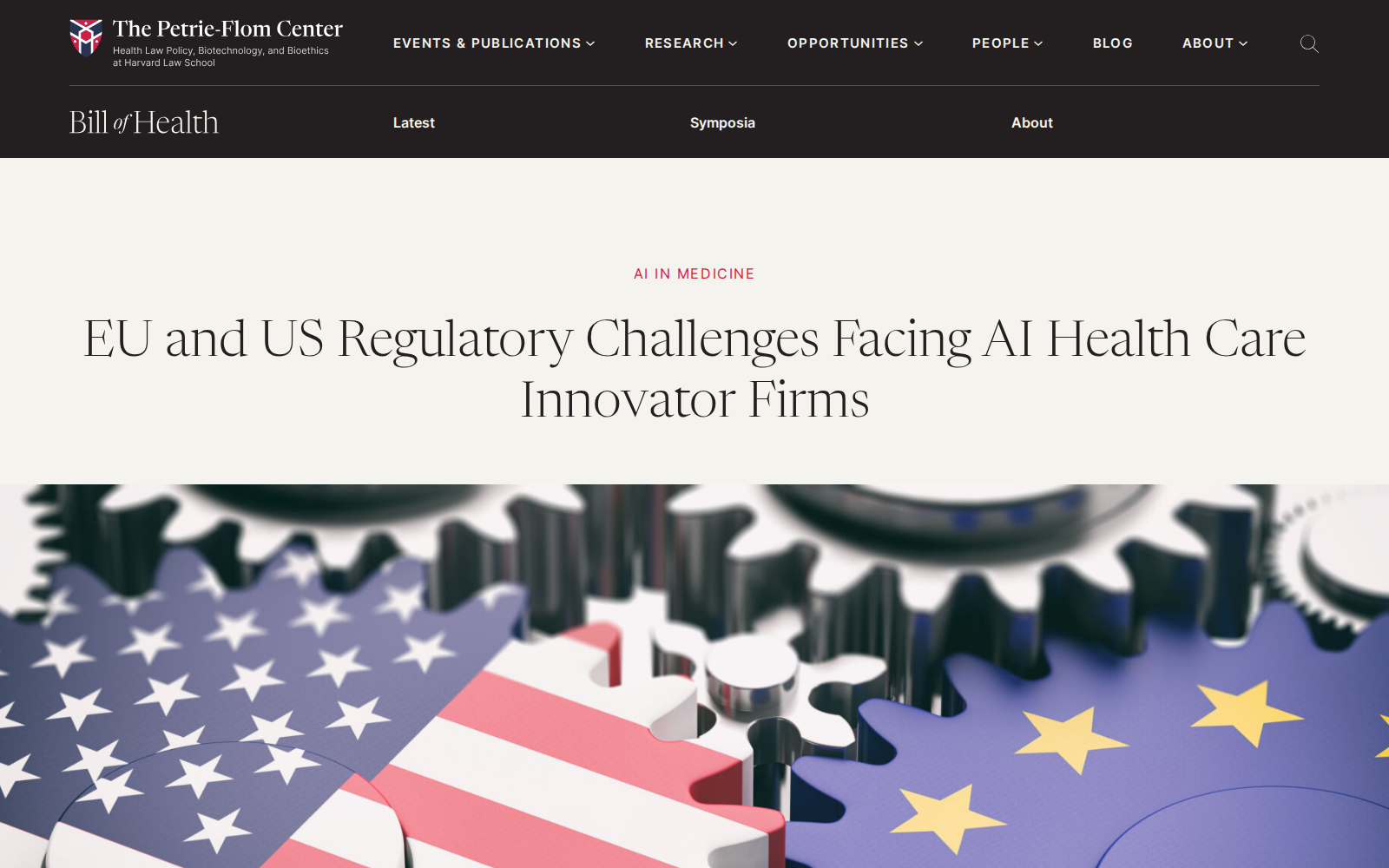
Harvard Law School's Petrie-Flom Center has published EU and US Regulatory Challenges Facing AI Health Care Innovator Firms on its Bill of Health blog—an op-ed co-written by lead author Suzan Slijpen, Mauritz Kop (Founder of the Stanford Center for Responsible Quantum Technology), and senior author I. Glenn Cohen, who directs the Center. It examines why firms building artificial intelligence for medicine face such a tangled compliance map, and what a better one might look like.
Two regulatory philosophies, one transatlantic market
The piece sets Europe's cross-sectoral instinct against America's sectoral one. An AI medical product entering the EU must answer to the Medical Device Regulation, the GDPR, and a sweeping digital rulebook that now includes the EU AI Act and the coming European Health Data Space. In the United States, by contrast, coverage is patchy by design: HIPAA reaches only certain entities and data, and the FDA regulates medical AI only where it fits an existing category. Each model has genuine merits and genuine blind spots, and a firm selling on both shores must satisfy both at once.
Where the law strains hardest
The authors are clearest on the cases that resist tidy rules. Adaptive algorithms that keep learning after deployment make it hard to say when a model has changed enough to need fresh review—an area where the FDA's 2023 predetermined-change-control guidance points a constructive way forward. Generative AI overtook the EU AI Act mid-negotiation, unsettling how foundation models are treated under a rulebook drafted before they arrived. And at the material frontier sit quantum- and AI-driven devices, with their export controls, fragile supply chains, dual-use questions, and intellectual-property and security concerns—the bridge from this op-ed to Kop's broader work on the quantum technology governance frontier. The lesson the authors draw is procedural as much as substantive: regulators must understand the tempo of the technology they govern, or risk writing rules that are obsolete before they bind.
Toward a workable middle ground
Rather than crowning a winner, the authors propose a mixed horizontal-vertical approach: keep the precautionary care for patient safety, keep the permissionless capacity to innovate, and tailor the result to the economic realities of health care—from clinical-trial costs to market licenses. Regulation that is sensible, practical, and sector-specific, they argue, serves innovators and patients alike; anything less is rendered ineffective fast. Readers tracking Kop's longer arc on responsible technology can also follow his AIRecht scholar profile, where the through-line from AI in medicine to the law and ethics of the quantum age is laid out across a decade of work.
Meer lezen