Innovation, Quantum-AI Technology & Law

Blog over Kunstmatige Intelligentie, Quantum, Deep Learning, Blockchain en Big Data Law

Blog over juridische, sociale, ethische en policy aspecten van Kunstmatige Intelligentie, Quantum Computing, Sensing & Communication, Augmented Reality en Robotica, Big Data Wetgeving en Machine Learning Regelgeving. Kennisartikelen inzake de EU AI Act, de Data Governance Act, cloud computing, algoritmes, privacy, virtual reality, blockchain, robotlaw, smart contracts, informatierecht, ICT contracten, online platforms, apps en tools. Europese regels, auteursrecht, chipsrecht, databankrechten en juridische diensten AI recht.

Berichten in Harvard
Harvard Law Publishes Hippocratic Quantum: The Ethics of Biomedical Discovery in the Quantum Age

Cambridge, MA, February 25, 2026—Harvard Law’s Petrie-Flom Center has published Mauritz Kop’s new article, Hippocratic Quantum: The Ethics of Biomedical Discovery in the Quantum Age:https://petrieflom.law.harvard.edu/2026/02/25/hippocratic-quantum-the-ethics-of-biomedical-discovery-in-the-quantum-age/

The article advances a proposition that is becoming increasingly difficult for health lawyers, policymakers, and biomedical innovators to ignore: as quantum technologies begin to enter biomedical discovery, the decisive challenge is no longer only scientific capability, but rather governance. In Kop’s account, quantum-enabled medicine should not be understood as a distant or speculative frontier that can be regulated later, once the engineering settles. It should instead be approached as a present-tense quantum governance problem, one that already implicates patient confidentiality, data integrity, cyber resilience, export controls, supply chains, and the geostrategic value of biomedical knowledge.

The article’s answer is not a new morality, but a more demanding implementation of an existing one: quantum medicine requires a Hippocratic framework that is technical enough for engineers, legal enough for regulators, and concrete enough for hospitals and pharmaceutical firms, yet flexible enough to let innovation breathe and encourage the crucial public-private investment necessary to advance allied quantum capabilities.

Five examples of quantum-enabled biomedical innovations

To ground this institutional view, one must consider the specific technological capabilities currently transitioning from theoretical physics to applied biomedicine. Five feasible vectors of innovation illustrate the breadth of this shift. In the domain of quantum computing, hybrid classical-quantum algorithms are emerging to optimize complex drug discovery pipelines and process large-scale genomic datasets. In quantum sensing, technologies such as diamond nitrogen-vacancy magnetometry enable ultra-sensitive, room-temperature mapping of neurological and cardiac activity. For quantum simulation, researchers are utilizing qubit-based systems to model molecular interactions and drug-target binding affinities with high accuracy, aiming to reduce reliance on extensive physical wet-lab screening. Within quantum imaging, techniques leveraging entangled photons permit the high-resolution visualization of cellular structures at lower light intensities, thereby mitigating phototoxicity in living tissues, benefitting medical diagnosis. Finally, in quantum networking, the deployment of quantum key distribution protocols offers a mechanism to cryptographically secure the transmission of sensitive multi-omics data across distributed hospital and research architectures.

From legal-ethical framework to Quantum-ELSPI

The Harvard article is best read as part of a longer intellectual trajectory. An early expression of that project appeared in March 2021 in the Yale Journal of Law & Technology, in Establishing a Legal-Ethical Framework for Quantum Technology: https://yjolt.org/blog/establishing-legal-ethical-framework-quantum-technology

That Yale piece argued that quantum technologies were moving from hypothetical ideas to commercial realities, and that law and policy should not wait for full technical maturity before building governance tools. It proposed a culturally sensitive legal-ethical framework for applied quantum technologies, drawing on AI governance and nanotechnology’s ELSI tradition while recognizing the distinct physical characteristics of quantum systems. Crucially, it also insisted that ethical aspiration must be accompanied by practical mechanisms for monitoring, validation, and life-cycle risk management. In retrospect, many of the themes that now reappear in Hippocratic Quantum were already visible there: the concern for human-centered design, the call for risk-based governance, and the insistence that ethics without institutionalization would be inadequate.

Why quantum medicine changes the governance question

The new Harvard article narrows the focus to biomedicine, but in doing so it sharpens the stakes. Biomedical discovery is not simply another application area. It is a setting in which long-lived and highly sensitive data, bodily integrity, public-health interests, commercial incentives, and geopolitical competition intersect. Quantum technologies matter here not because they promise speculative disruption, but because they may incrementally and then materially improve specific tasks: hybrid quantum-classical computational chemistry, de novo molecular design, lead optimization, selected toxicity and metabolism modeling, and perhaps aspects of high-fidelity sensing, simulation, and networked quantum computation. The issue, then, is not whether every promise will be realized immediately. It is whether institutions are preparing now for the forms of capability that are already foreseeable.

A Harvard-facing research arc

This Harvard publication also extends a longer Harvard-facing research arc across AI, health law, and responsible quantum governance. That arc includes:

  1. The Right To Process Data For Machine Learning Purposes In The EU (Harvard JOLT) https://jolt.law.harvard.edu/digest/the-right-to-process-data-for-machine-learning-purposes-in-the-eu

  2. Towards Responsible Quantum Technology (Harvard Berkman Klein) https://cyber.harvard.edu/publication/2023/towards-responsible-quantum-technology

  3. EU And US Regulatory Challenges Facing AI Health Care Innovator Firms (Harvard Petrie-Flom) https://petrieflom.law.harvard.edu/2024/04/04/eu-and-us-regulatory-challenges-facing-ai-health-care-innovator-firms/

  4. A Brief Quantum Medicine Policy Guide (Harvard Petrie-Flom) https://petrieflom.law.harvard.edu/2024/12/06/a-brief-quantum-medicine-policy-guide/

  5. How Quantum Technologies May Be Integrated Into Healthcare: What Regulators Should Consider (Stanford Law) https://hls.harvard.edu/bibliography/how-quantum-technologies-may-be-integrated-into-healthcare-what-regulators-should-consider/

Seen in this broader context, Hippocratic Quantum brings together early legal-ethical framing, responsible quantum governance, healthcare regulation, and geopolitical analysis into a single biomedical governance argument.

The article has also been featured by The Quantum Insider, which highlighted its central argument that quantum medicine’s promise must be matched by stronger privacy and governance safeguards: https://thequantuminsider.com/2026/02/27/analysis-quantum-medicines-promise-raises-new-privacy-and-governance-risks/

Meer lezen
Law, Ethics and Policy of Quantum & AI in Healthcare and Life Sciences published at Harvard, Stanford and European Commission

A collaborative research initiative by scholars from Stanford, Harvard, and MIT, published by the Petrie-Flom Center at Harvard Law School, the Stanford Center for Responsible Quantum Technology, and the European Commission, delves into the complex regulatory and ethical landscape of integrating quantum technologies and artificial intelligence (AI) into the healthcare and life sciences sectors. This series of policy guides and analyses, authored by an interdisciplinary team including Mauritz Kop, Suzan Slijpen, Katie Liu, Jin-Hee Lee, Constanze Albrecht, and I. Glenn Cohen, offers a comprehensive examination of the transformative potential and inherent challenges of this technological convergence.

Regulating Quantum & AI in Healthcare and Medicine: A Brief Policy Guide

This body of research, examining the entangled legal, ethical, and policy dimensions of integrating quantum technologies and AI into healthcare, is articulated across a series of publications in leading academic and policy forums. These works collaboratively build a comprehensive framework for understanding and navigating the future of medicine. A related policy guide was also published on the European Commission's Futurium platform, further disseminating these findings to a key international policymaking audience. The specific publications include:

1. A Brief Quantum Medicine Policy Guidehttps://blog.petrieflom.law.harvard.edu/2024/12/06/a-brief-quantum-medicine-policy-guide/

2. How Quantum Technologies May Be Integrated Into Healthcare, What Regulators Should Considerhttps://law.stanford.edu/publications/how-quantum-technologies-may-be-integrated-into-healthcare-what-regulators-should-consider/

3. EU and US Regulatory Challenges Facing AI Health Care Innovator Firmshttps://blog.petrieflom.law.harvard.edu/2024/04/04/eu-and-us-regulatory-challenges-facing-ai-health-care-innovator-firms/

4. Regulating Quantum & AI in Healthcare: A Brief Policy Guidehttps://futurium.ec.europa.eu/en/european-ai-alliance/document/regulating-quantum-ai-healthcare-brief-policy-guide

by Mauritz Kop, Suzan Slijpen, Katie Liu, Jin-Hee Lee, Constanze Albrecht & I. Glenn Cohen

Forging the Future of Medicine: A Scholarly Perspective on the Law, Ethics, and Policy of Quantum and AI in Healthcare

The research posits that the fusion of AI with second-generation quantum technologies (2G QT)—which harness quantum-mechanical phenomena like superposition and entanglement—is poised to revolutionize precision medicine. This synergy of quantum computing, sensing and simulation with artificial intelligence promises hyper-personalized healthcare solutions, capable of tackling intricate medical problems that lie beyond the grasp of classical computing. The potential applications are vast, spanning from accelerated drug discovery and development workflows and enhanced diagnostic imaging to rapid genome sequencing and real-time health monitoring. For instance, quantum simulations could model molecular interactions to create more effective pharmaceuticals, while quantum dots may offer novel platforms for targeted cancer therapies and treatments for neurodegenerative conditions by overcoming the blood-brain barrier.

However, the authors caution that these groundbreaking advancements are accompanied by significant ethical, legal, socio-economic, and policy (ELSPI) implications. The emergence of Quantum Artificial Intelligence (QAI), Quantum Machine Learning (QML), and Quantum Large Language Models (QLLM) is expected to amplify these ELSPI concerns. The dual-use nature of these technologies, such as their potential application in gain-of-function research, necessitates a principled and human-centric governance approach.

Meer lezen
Stanford Law’s Jin-Hee Lee, Katie Liu and Mauritz Kop visit Caltech Quantum Research Center

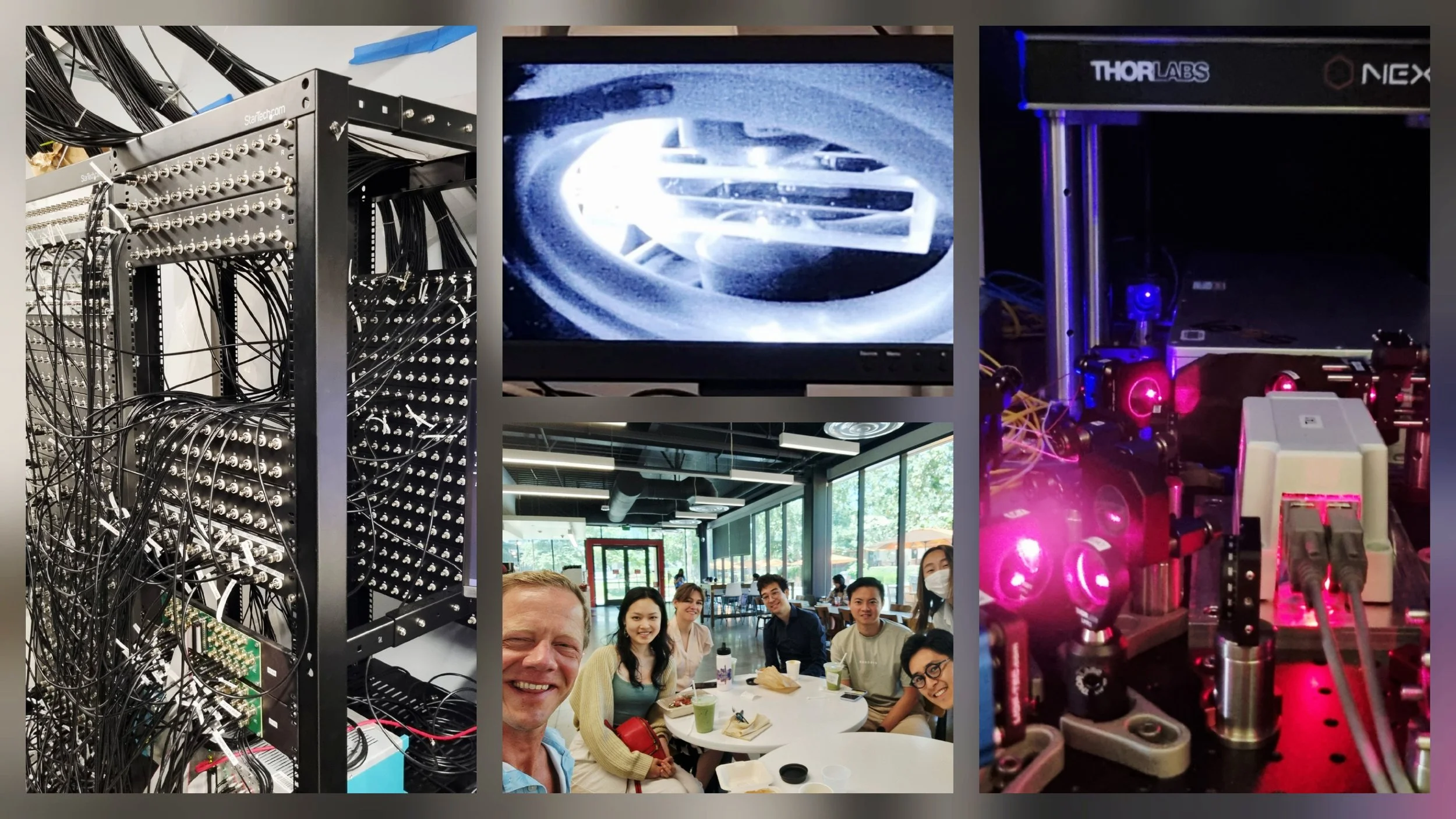
Pasadena, CA – On July 6, 2024, a team from the Stanford Center for Responsible Quantum Technology (RQT) embarked on a research field trip to the California Institute of Technology (Caltech), one of the world's preeminent hubs for quantum science research. This visit, part of an ongoing collaboration between the two world-leading institutions, was a crucial exercise in bridging the gap between the deeply technical world of quantum research and the complex legal, ethical, and societal frameworks required to govern it. The delegation, consisting of RQT Founding Director Mauritz Kop, RQT Fellow Jin-Hee Lee, and Research Assistant to the Director Katie Liu, traveled from Stanford to the heart of Southern California to engage directly with the scientists and engineers who are building the future of quantum. The visit was hosted by RQT Fellow Franz Pfanner, a PhD candidate at Caltech, and focused on the groundbreaking work being done at Caltech's Institute for Quantum Information and Matter (IQIM).

The day was dedicated to exploring the groundbreaking work being done at Caltech's Institute for Quantum Information and Matter (IQIM), a flagship research center led by Professor Manuel Endres, within the university's prestigious Division of Physics, Mathematics and Astronomy. This visit underscores the RQT Center's commitment to fostering a deeply interdisciplinary dialogue, ensuring that the development of responsible quantum governance is informed by a hands-on understanding of the technology itself.

The Epicenter of Quantum Innovation: Caltech's IQIM

Caltech stands as a global powerhouse in quantum research, and at its core is the Institute for Quantum Information and Matter (IQIM). Under the leadership of Professor Manuel Endres, IQIM is dedicated to exploring the frontiers of quantum science, from the fundamental physics of quantum information to the development of novel quantum materials and devices. The institute's work is organized around several Major Activities (MAs), each tackling a different facet of the quantum puzzle.

Bridging Quantum Theory and Society: The Stanford RQT Projects

The visit to Caltech provided a rich technical context for the work being done by the Stanford RQT team, whose projects are focused on the human and societal dimensions of this emerging technological revolution.

Jin-Hee Lee, an RQT Fellow, is pioneering research in the nascent field of Quantum Human-Computer Interaction (Q-HCI). Her project addresses a critical, yet often overlooked, aspect of the quantum future: how will humans interact with these powerful and counterintuitive machines? As quantum computers move beyond the binary logic of classical computing and into the probabilistic realm of qubits and superposition, the interfaces through which we engage with them must be completely re-imagined. Jin-Hee's work, guided by the ELSPI (Ethical, Legal, Social, and Policy Implications) framework, aims to ensure that these interfaces are not only functional but also accessible, intuitive, and ethically designed, preventing the creation of a new digital divide and keeping humanity at the center of the quantum age.

Katie Liu, a Research Assistant at the RQT Center, is focusing on the intersection of quantum technology and neuroscience. Her project, "Responsible Quantum AI in Healthcare – Neurotechnology and Beyond," explores the transformative potential of quantum AI (QAI) to enhance diagnostics and treatments for complex neurological conditions like Alzheimer's and Parkinson's disease. Using the SEA (Safeguarding, Engaging, Advancing) principles as her guide, Katie is investigating how quantum algorithms can analyze the vast datasets generated by neuroimaging and real-time brain monitoring to create personalized treatment plans. Her research also addresses the profound ethical challenges of this work, from ensuring patient data privacy through quantum-resistant encryption to mitigating the dual-use risks of advanced neurotechnology.

A Cross-pollination of Disciplines and a Moment of Reflection

Following the intellectually stimulating day at Caltech, the Stanford delegation visited The Huntington Library, Art Museum, and Botanical Gardens, taking time to reflect in the serene beauty of the Chinese Garden. The garden, with its intricate design and harmonious balance of natural and man-made elements, served as a powerful metaphor for the work ahead: building a responsible quantum future requires a similar blend of technical ingenuity, ethical foresight, and a deep appreciation for the human values we seek to preserve and enhance.

The journey to a quantum-enabled world is just beginning. But as the collaboration between institutions like Stanford and Caltech demonstrates, by working together across disciplines, we can ensure that this powerful new chapter in human history is written not with reckless abandon, but with wisdom, responsibility, and a shared commitment to the common good.

Meer lezen
Stanford Center for Law and the Biosciences: BioLawLaPaLooZa 2023-2024

For those deeply engaged in the intricate intersections of law, life sciences, and ethics, Professor Hank Greely’s annual BioLawLaPaLooza at Stanford Law School stands as an intellectual cornerstone. It is a vibrant, informal, yet deeply substantive gathering that brings together leading scholars to test new ideas, debate emerging challenges, and build the collaborative bridges essential for navigating our complex technological future. As a speaker and the photographer for the 2023 and 2024 editions, Stanford Center for Responsible Quantum Technologie Founder Mauritz Kop had the distinct pleasure of documenting and participating in these vital conversations. This post offers a reflection on and tribute to these remarkable events, which serve as a testament to the foresight and community-building spirit of Stanford’s Center for Law and the Biosciences.

The Center for Law and the Biosciences (CLB): A Foundation for Interdisciplinary Dialogue

Before delving into the events themselves, it is essential to understand the institution that makes them possible. The Stanford Center for Law and the Biosciences (CLB), under the direction of Hank Greely, has long been a preeminent academic hub for exploring the legal and ethical quandaries posed by advances in the life sciences. Alongside the Petrie-Flom Center for Health Law Policy, Biotechnology, and Bioethics at Harvard University, directed by Professor I. Glenn Cohen, the CLB stands as one of the world's leading institutions in this domain. The Center's mission is to foster interdisciplinary research, educate the next generation of leaders in law and science, and inform public policy on topics ranging from genetics and neuroscience to reproductive technologies and AI in healthcare.

The CLB's history is marked by influential scholarship, a distinguished roster of fellows and faculty, and a commitment to public engagement. Its fellowship program has proven to be a successful launchpad, with former fellows frequently securing positions as professors and becoming influential scholars in their own right. Its publications consistently shape academic discourse and provide critical guidance to policymakers. BioLawLaPaLooza is the embodiment of the Center’s mission, creating an environment where complex ideas can be presented and scrutinized in a collegial, fast-paced format. The event’s structure—short, sharp presentations followed by engaged discussion—ensures a breadth and depth of intellectual exchange that is both rare and invaluable.

The Journal of Law and the Biosciences: A Premier Scholarly Venue

Further extending the intellectual ecosystem of which the CLB is a part is the Journal of Law and the Biosciences (JLB). As the first peer-reviewed academic journal focused on the intersection of law and the life sciences, JLB serves as the premier venue for scholarship in this field. It is a co-publication of Duke University, Harvard University Law School, and Stanford University, published by Oxford University Press. The journal's leadership reflects the collaborative and interdisciplinary spirit of the field, with Editors-in-Chief Professor Nita Farahany (Duke), Professor I. Glenn Cohen (Harvard), and Professor Hank Greely (Stanford). Many of the scholars who present their nascent ideas at BioLawLaPaLooza are also contributors to and readers of the journal, highlighting the symbiotic relationship between the conference and the formal academic literature. https://academic.oup.com/jlb

Meer lezen