
Innovation, Quantum-AI Technology & Law

Blog over Kunstmatige Intelligentie, Quantum, Deep Learning, Blockchain en Big Data Law

Blog over juridische, sociale, ethische en policy aspecten van Kunstmatige Intelligentie, Quantum Computing, Sensing & Communication, Augmented Reality en Robotica, Big Data Wetgeving en Machine Learning Regelgeving. Kennisartikelen inzake de EU AI Act, de Data Governance Act, cloud computing, algoritmes, privacy, virtual reality, blockchain, robotlaw, smart contracts, informatierecht, ICT contracten, online platforms, apps en tools. Europese regels, auteursrecht, chipsrecht, databankrechten en juridische diensten AI recht.

Berichten met de tag Petrie-Flom
A Brief Quantum Medicine Policy Guide: What Regulators Should Consider for Quantum and AI in Precision Medicine

As quantum technology and artificial intelligence move toward precision medicine, regulators face a problem they have not yet built tools for. A Brief Quantum Medicine Policy Guide—published on the Harvard Petrie-Flom Center's Bill of Health blog by Mauritz Kop, Suzan Slijpen, Katie Liu, Jin-Hee Lee, Constanze Albrecht, and I. Glenn Cohen, and cross-posted with the Stanford Center for Responsible Quantum Technology and the European Commission's European AI Alliance—is a concise map of the use cases, the overlapping legal regimes, and what agencies such as the FDA and EMA should consider. It is a companion to the team's longer treatment of how quantum technologies may be integrated into healthcare, and continues the collaboration later reflected in Kop's work consulting Amgen on quantum biomedical discovery.

Quantum use cases in healthcare

The guide sorts second-generation quantum medicine by domain. Quantum computing and simulation could accelerate de novo drug discovery by modeling molecular interactions, speed genome sequencing, and assist protein-folding prediction; quantum sensing could deliver continuous high-precision vital-sign monitoring, precision laser therapy, and earlier retinal diagnostics; post-quantum cryptography and quantum key distribution could secure patient data in line with HIPAA and GDPR. A recurring thread is the semiconducting quantum dot, whose ability to cross the blood-brain barrier opens possibilities in oncology imaging, targeted drug delivery, and neurodegenerative-disease research. Throughout, the authors keep the claims proportionate, marking many applications as early-stage or theoretical.

A fragmented regulatory map

There is no quantum-specific medical-device law in either the EU or the US. European devices fall mainly under the Medical Devices Regulation, with the EU AI Act and data laws in supporting roles, while CE marking is slowed by a shortage of Notified Bodies versed in AI or quantum. US devices may sit within the existing FDA framework—potentially including the Software-as-a-Medical-Device pathway—alongside HIPAA, the FTC, and standards such as ISO 13485. The guide's first practical counsel is for manufacturers to engage agencies early.

What regulators should build next

The guide names four changes: evaluation protocols attuned to quantum behaviors; risk-management frameworks that protect human subjects from quantum unpredictability; clinical-trial guidelines tailored to quantum devices; and interoperability standards. It then proposes a three-part architecture—ex-ante regulatory sandboxes for quantum-AI devices, ex-durante expert subcommittees, and an ex-post registration database—framed by ten guiding principles, from promoting quantum literacy to fostering institutional plasticity in bodies like the FDA and EMA. The throughline is a standards-first, anticipatory posture: prepare the institutions before the technology arrives, and balance innovation against patient safety rather than choosing between them.

Meer lezen
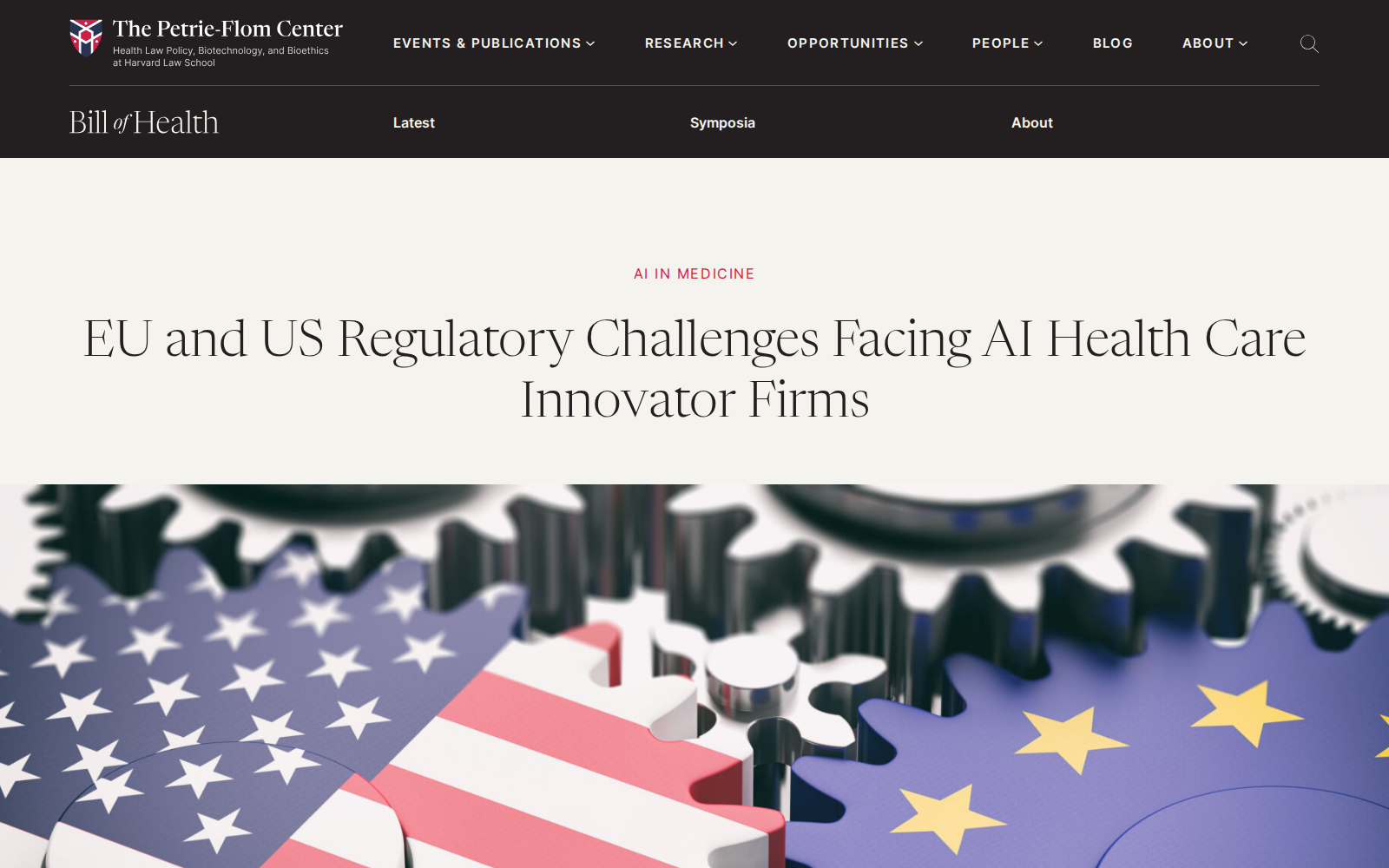
Harvard Petrie-Flom publishes EU and US Regulatory Challenges Facing AI Health Care Innovator Firms

Harvard Law School's Petrie-Flom Center has published EU and US Regulatory Challenges Facing AI Health Care Innovator Firms on its Bill of Health blog—an op-ed co-written by lead author Suzan Slijpen, Mauritz Kop (Founder of the Stanford Center for Responsible Quantum Technology), and senior author I. Glenn Cohen, who directs the Center. It examines why firms building artificial intelligence for medicine face such a tangled compliance map, and what a better one might look like.

Two regulatory philosophies, one transatlantic market

The piece sets Europe's cross-sectoral instinct against America's sectoral one. An AI medical product entering the EU must answer to the Medical Device Regulation, the GDPR, and a sweeping digital rulebook that now includes the EU AI Act and the coming European Health Data Space. In the United States, by contrast, coverage is patchy by design: HIPAA reaches only certain entities and data, and the FDA regulates medical AI only where it fits an existing category. Each model has genuine merits and genuine blind spots, and a firm selling on both shores must satisfy both at once.

Where the law strains hardest

The authors are clearest on the cases that resist tidy rules. Adaptive algorithms that keep learning after deployment make it hard to say when a model has changed enough to need fresh review—an area where the FDA's 2023 predetermined-change-control guidance points a constructive way forward. Generative AI overtook the EU AI Act mid-negotiation, unsettling how foundation models are treated under a rulebook drafted before they arrived. And at the material frontier sit quantum- and AI-driven devices, with their export controls, fragile supply chains, dual-use questions, and intellectual-property and security concerns—the bridge from this op-ed to Kop's broader work on the quantum technology governance frontier. The lesson the authors draw is procedural as much as substantive: regulators must understand the tempo of the technology they govern, or risk writing rules that are obsolete before they bind.

Toward a workable middle ground

Rather than crowning a winner, the authors propose a mixed horizontal-vertical approach: keep the precautionary care for patient safety, keep the permissionless capacity to innovate, and tailor the result to the economic realities of health care—from clinical-trial costs to market licenses. Regulation that is sensible, practical, and sector-specific, they argue, serves innovators and patients alike; anything less is rendered ineffective fast. Readers tracking Kop's longer arc on responsible technology can also follow his AIRecht scholar profile, where the through-line from AI in medicine to the law and ethics of the quantum age is laid out across a decade of work.

Meer lezen