
Innovation, Quantum-AI Technology & Law

Blog over Kunstmatige Intelligentie, Quantum, Deep Learning, Blockchain en Big Data Law

Blog over juridische, sociale, ethische en policy aspecten van Kunstmatige Intelligentie, Quantum Computing, Sensing & Communication, Augmented Reality en Robotica, Big Data Wetgeving en Machine Learning Regelgeving. Kennisartikelen inzake de EU AI Act, de Data Governance Act, cloud computing, algoritmes, privacy, virtual reality, blockchain, robotlaw, smart contracts, informatierecht, ICT contracten, online platforms, apps en tools. Europese regels, auteursrecht, chipsrecht, databankrechten en juridische diensten AI recht.

Berichten in Stanford RQT
Towards Responsible Quantum Technology published by Harvard Berkman Klein Center for Internet & Society

Boston, MA, March 21, 2023—In a landmark contribution to the global dialogue on technology governance, the Harvard Berkman Klein Center for Internet & Society has published the foundational article, "Towards Responsible Quantum Technology." This significant work, the result of a deeply interdisciplinary and transatlantic collaboration, lays out a comprehensive conceptual framework for steering the development of quantum technologies (QT) in a direction that is safe, ethical, and aligned with democratic values.

The manuscript, which was also published in the Hastings Science & Technology Law Journal by the University of California, College of the Law, San Francisco, and in the University of Cambridge repository -with preprints at Stanford Law, ArxiV and the European Commission’s Futurium website- represents a concerted effort to get ahead of the regulatory curve. It argues for a proactive, principled approach to governance while the technology is still malleable, learning from the often-reactive postures taken with previous technological waves like AI and the internet.

A Transatlantic Constellation of Scholars

The paper is authored by a distinguished group of international scholars led by Mauritz Kop, Visiting ‘Quantum & Law’ Scholar at Stanford and the imminent Founding Director of the Stanford Center for Responsible Quantum Technology. The team represents a formidable convergence of expertise from the world's leading academic institutions, including Stanford, Harvard, Oxford, Yale, Cambridge, the University of Waterloo, and the Universities of Munich, Amsterdam, Maastricht, and Copenhagen.

This collaboration brought together leading lights in law, data science, theoretical quantum physics, philosophy and ethics, socioeconomics, materials science and engineering, and innovation policy. The author group includes Mateo Aboy, Eline De Jong, Urs Gasser, I. Glenn Cohen, Timo Minssen, Teresa Quintel, Mark Brongersma, Luciano Floridi, and Raymond Laflamme, whose collective insights provide a holistic and robust foundation for the proposed framework.

The RQT Framework: Integrating Quantum-ELSPI and RRI

At the heart of the paper is the conceptual framework for Responsible Quantum Technology (RQT). This framework is designed to systematically integrate considerations of the Ethical, Legal, Social, and Policy Implications (ELSPI) of quantum technologies directly into the research and development lifecycle.

The RQT framework is built upon the established dimensions of Responsible Research and Innovation (RRI)—anticipation, inclusion, reflection, and responsiveness. By merging these two approaches, Quantum-ELSPI and RRI, the authors have created a powerful tool for ensuring that the development of quantum is not driven solely by technical or commercial imperatives, but by a deep and abiding commitment to societal well-being.

Operationalizing Responsible Quantum Technology: The 10 Principles and Future Regulation

The "Towards Responsible Quantum Technology" paper is the first in a series of studies designed to build a comprehensive governance architecture. It lays the conceptual groundwork that is further operationalized in a subsequent study led by Kop, the "10 Principles for Responsible Quantum Innovation." This second paper translates the high-level SEA framework into concrete, actionable principles for real-world application.

Ultimately, the RQT framework is intended to inform the emergent regulatory landscape for quantum technology. The authors provide an outlook on how regulatory interventions can be designed and contextualized to be effective without stifling innovation. By tailoring governance to the exceptional nature of quantum, the goal is to reduce the risk of unintended, counterproductive policy effects and to foster a thriving, responsible, and values-based quantum ecosystem. The paper concludes with a call to action for the research community and other stakeholders to build upon this foundational work, to further develop the guiding principles, and to translate them into the best practices that will define the quantum future.

Meer lezen
Mauritz Kop Speaks on Quantum Ethics, Intellectual Property and Innovation at NASA SWEEEP Event

On October 3, 2022, a interdisciplinary dialogue on the future of quantum technology and its societal implications took place within a consortium focused on some of the most pressing environmental challenges of our time. Mauritz Kop, a visiting quantum and law scholar at Stanford University, was invited to address a workshop for the SouthWest Engine for Environment and Economic Prosperity (SWEEEP), a major initiative led by a consortium including NASA’s Jet Propulsion Laboratory (JPL), CalTech, and California State University, Northridge. The event, part of the National Science Foundation (NSF) Regional Innovation Engines program, provided a platform to discuss the intricate web of ethical, legal, socio-economic, and policy implications—termed "Quantum-ELSPI"—that must be navigated as quantum technologies are harnessed to address grand challenges like water scarcity and agricultural sustainability.

The Institutional Context: NASA and the SWEEEP Mission

The National Aeronautics and Space Administration (NASA), established in 1958, has a storied history of pushing the boundaries of science and technology for the benefit of humanity. While renowned for space exploration, its mission extends deeply into Earth science, utilizing its unique vantage point from space to understand and protect our home planet. From monitoring climate change and weather patterns to managing natural resources, NASA’s work is foundational to global environmental stewardship.

This commitment to terrestrial challenges is exemplified by its involvement in the SWEEEP initiative. SWEEEP is a direct response to the NSF Regional Innovation Engines program, a nationwide effort to catalyze and accelerate regional-scale, R&D-based innovation ecosystems. The program is designed to fund "Engines" that advance critical technologies, address societal challenges, promote economic growth, and cultivate regional talent, with potential funding of up to $160 million over ten years per Engine.

It was within this context of ambitious technological solution-building that Mauritz Kop was invited to provide a crucial perspective on governance and responsible innovation. The leaders of the initiative, including Edward Chow of NASA JPL and Bingbing Li of California State University Northridge, recognized that developing powerful new technologies carries a responsibility to proactively address their societal impact.

Quantum-ELSPI: A Framework for Responsible Innovation

In his address, Mauritz Kop introduced the comprehensive concept of Quantum-ELSPI, arguing for a multidisciplinary approach that integrates ethical, legal, socio-economic, and policy considerations directly into the R&D lifecycle. He stressed the importance of "building bridges between disciplines," enabling quantum physicists and engineers to communicate effectively with experts in the humanities and social sciences. The goal is not to give premature, all-encompassing answers, but to begin by asking the right questions.

For a project like SWEEEP, this means looking beyond the technical specifications of a quantum sensor to consider the legal frameworks for the data it collects, the ethical implications of its use in agriculture, and the socio-economic impact on farming communities. Kop noted that NSF reviewers would likely value such a forward-thinking awareness of the complex societal dimensions of the proposed technological interventions.

Intellectual Property in the Quantum Age: Fostering or Hindering Innovation?

A significant portion of the discussion was dedicated to the role of intellectual property (IP) in the quantum domain. Quantum computers and related systems are extraordinarily complex, comprising myriad components, each potentially protected by its own IP right. Kop described this as a "rainbow of IP rights," where patents, copyrights, trade secrets, and trademarks can create a dense and overlapping landscape.

While IP is designed to incentivize invention, he cautioned that an over-reliance on exclusive rights could lead to "IP overprotection," potentially stifling the cumulative, follow-on innovation that is essential for a burgeoning field like quantum technology. The challenge is to balance the need to protect inventions with the goal of building an open, thriving global quantum ecosystem.

Meer lezen
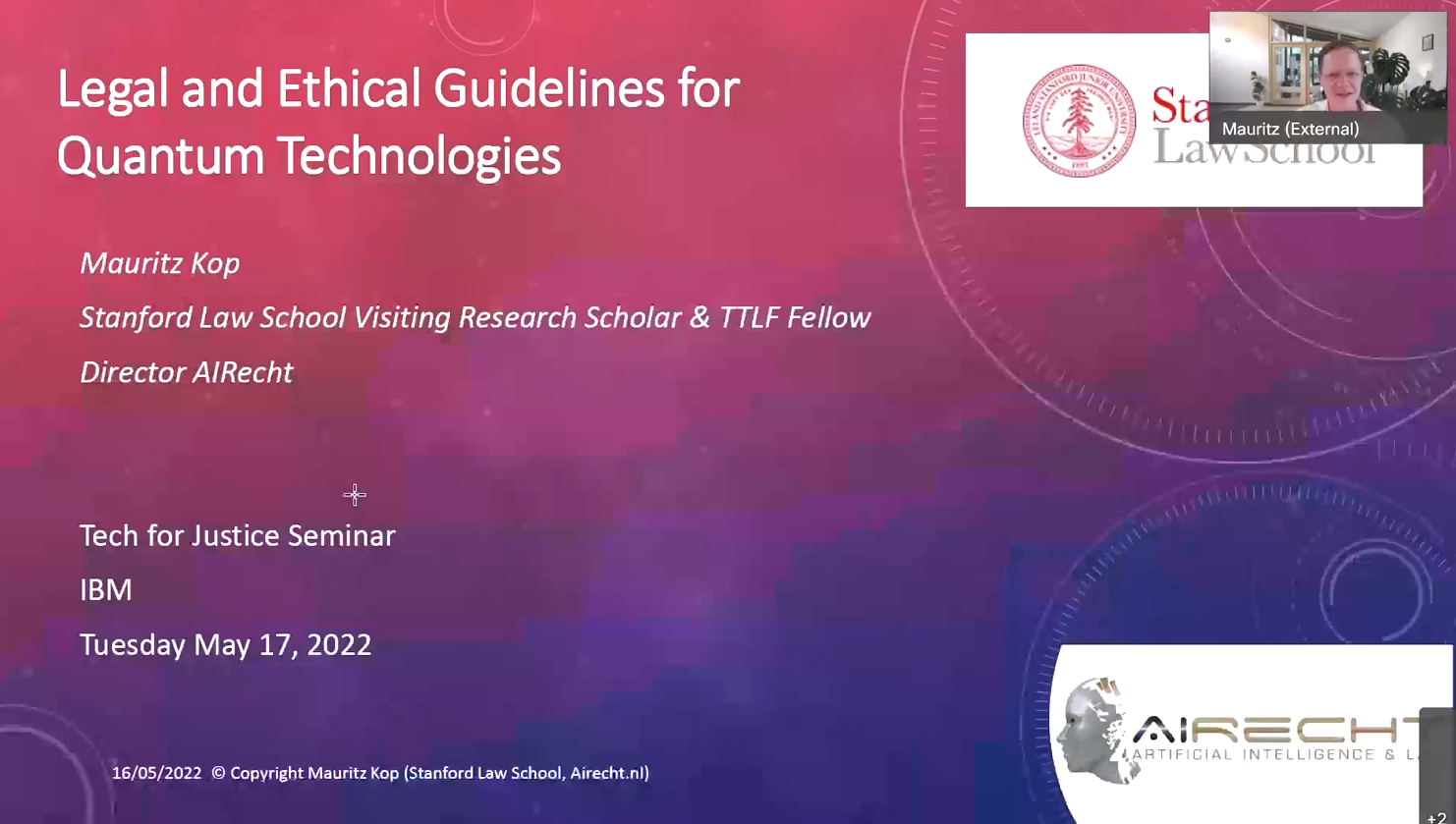
IBM Invites Mauritz Kop for Lecture on Quantum Ethics

New York, May 17, 2022—The development of quantum technology represents a significant advance in computational capability, with the potential to reshape industries, accelerate scientific discovery, and address complex problems. As with other transformative technologies, its power introduces a range of responsibilities. The relevant questions are not only about the technical capabilities of quantum mechanics, but also about the appropriate uses of the technology.

Reflecting this, IBM, a leading company in the quantum field, convened a seminar on May 17, 2022, for its New York and San Francisco teams to focus on the legal and ethical dimensions of this emerging field. The invited speaker for the event was Mauritz Kop, a visiting scholar at Stanford Law School, who presented his work on establishing a governance framework for quantum technologies to an audience of researchers, engineers, and policymakers.

The event was part of IBM's Tech for Justice initiative, a cross-divisional program dedicated to using technology to address systemic biases and advance social equity. Situating the conversation about quantum ethics within this framework indicates an understanding that principles of fairness, accountability, and transparency should be integrated into new technologies from an early stage.

The session was hosted by Dr. Aminat Adebiyi, a Research Staff Member, Experimentalist, and Maker at IBM, and moderated by Dr. Mira Wolf-Bauwens. Kop's collaboration with Wolf-Bauwens includes their shared work on the World Economic Forum's foundational principles for quantum computing, a project that highlights the role of multi-stakeholder cooperation in this area.

The Quantum Vanguard: IBM's Technological Position

To understand the context of the ethical discussion, it is useful to consider the technological landscape. IBM Quantum is one of the leading organizations in quantum computing and has achieved notable milestones in the field. Central to its strategy is the development of universal fault-tolerant quantum computers based on superconducting transmon qubits. This approach, which involves creating and manipulating quantum states in circuits cooled to cryogenic temperatures, has enabled IBM to build increasingly powerful and stable quantum processors.

Charting a Course for Responsible Quantum Development: A Summary of the Lecture

The material presented in the lecture builds upon a body of foundational research by Kop. His work in the Yale Journal of Law & Technology first proposed a comprehensive legal-ethical framework and a set of ten guiding principles for quantum technology. In the Stanford Law School Transatlantic Technology Law Forum, he explored the crucial roles of intellectual property and standardization in fostering sustainable innovation. Furthermore, in Physics World, published by the Institute of Physics, he articulated the necessity of a dedicated field of "quantum ethics," urging the physics community to engage directly with the social and moral implications of their work. Lastly, together with Luciano Floridi at Oxford, Kop conceptualized the Quantum-ELSPI framework as the ethical, legal, social, and policy implications of the suite of quantum technologies. The lecture for IBM synthesized and advanced these core themes.

Kop's lecture, "Legal and Ethical Guidelines for Quantum Technologies," was structured around the thesis that there is a timely opportunity to establish governance for quantum technology. In contrast to the development of the internet or artificial intelligence, where regulation often followed widespread adoption, it is possible to proactively embed democratic values and human rights principles into the architecture of quantum systems.

Interactive Discussion and Call to Action

The lecture was followed by an engaging Q&A session that highlighted the deep commitment of the IBM technical community to responsible innovation. The questions posed by participants explored the practical challenges and nuances of implementing ethical frameworks. Key themes of the discussion included the tangible impact of tech regulation to date, the specific processes needed to assess quantum's potential societal effects, and the distinct yet complementary roles of government and private enterprise in setting and adhering to standards.

Participants were keen to understand how a framework could effectively infuse 'humanism' into every aspect of technology development and how regulation could be used proactively to shape an emerging field for the better. The dialogue also addressed the most significant challenges facing quantum regulation specifically and the strategies required to overcome them.

Meer lezen