
Council of Canadian Academies Publishes Quantum Potential Report
By Editor
Ottawa, Canada, November 30, 2023—The Council of Canadian Academies (CCA) has published Quantum Potential, the report of its Expert Panel on the Responsible Adoption of Quantum Technologies. Chaired by physicist Raymond Laflamme, the thirteen-member panel includes Mauritz Kop, Founder of the Stanford Center for Responsible Quantum Technology (Stanford RQT) and, at the time of the panel's work, a Fellow and Visiting Scholar at Stanford Law School. The report assesses how Canada can capture the economic and scientific promise of quantum technology while addressing its ethical, legal, social, and policy implications—and it places responsible adoption, not mere development, at the center of national strategy.

Quantum Potential: the Council of Canadian Academies' expert-panel report (illustrative editorial image).
What the panel was asked, and who answered
The assessment was commissioned by Innovation, Science and Economic Development Canada (ISED) and the National Research Council of Canada, together with several supporting federal departments, which asked the CCA to examine the opportunities and challenges of adopting quantum technologies across the Canadian economy. The CCA convened an independent, multidisciplinary panel to answer that question. Its thirteen members were Raymond Laflamme (Chair), Jacqueline Bartlett, Sally Daub, Shohini Ghose, Paul Gulyas, Mark W. Johnson, Elham Kashefi, Mauritz Kop, Dominic Martin, Darius Ornston, Barry Sanders, Eric Santor, and Christian Sarra-Bournet. Kop served as one panel member among the thirteen, contributing expertise in the ethical, legal, and policy dimensions of quantum technology—the strand of the assessment that situates the science within governance.
The composition matters. Quantum policy is interdisciplinary by necessity: physicists, computer scientists, economists, and legal scholars on one panel reflect the recognition that the questions raised by quantum technologies do not respect disciplinary boundaries. As the report frames it, "Quantum technologies offer opportunities to harness the properties of quantum mechanics for a breadth of applications, many of them novel." Capturing those opportunities responsibly is, in the panel's reading, as much a matter of law and policy as of engineering.
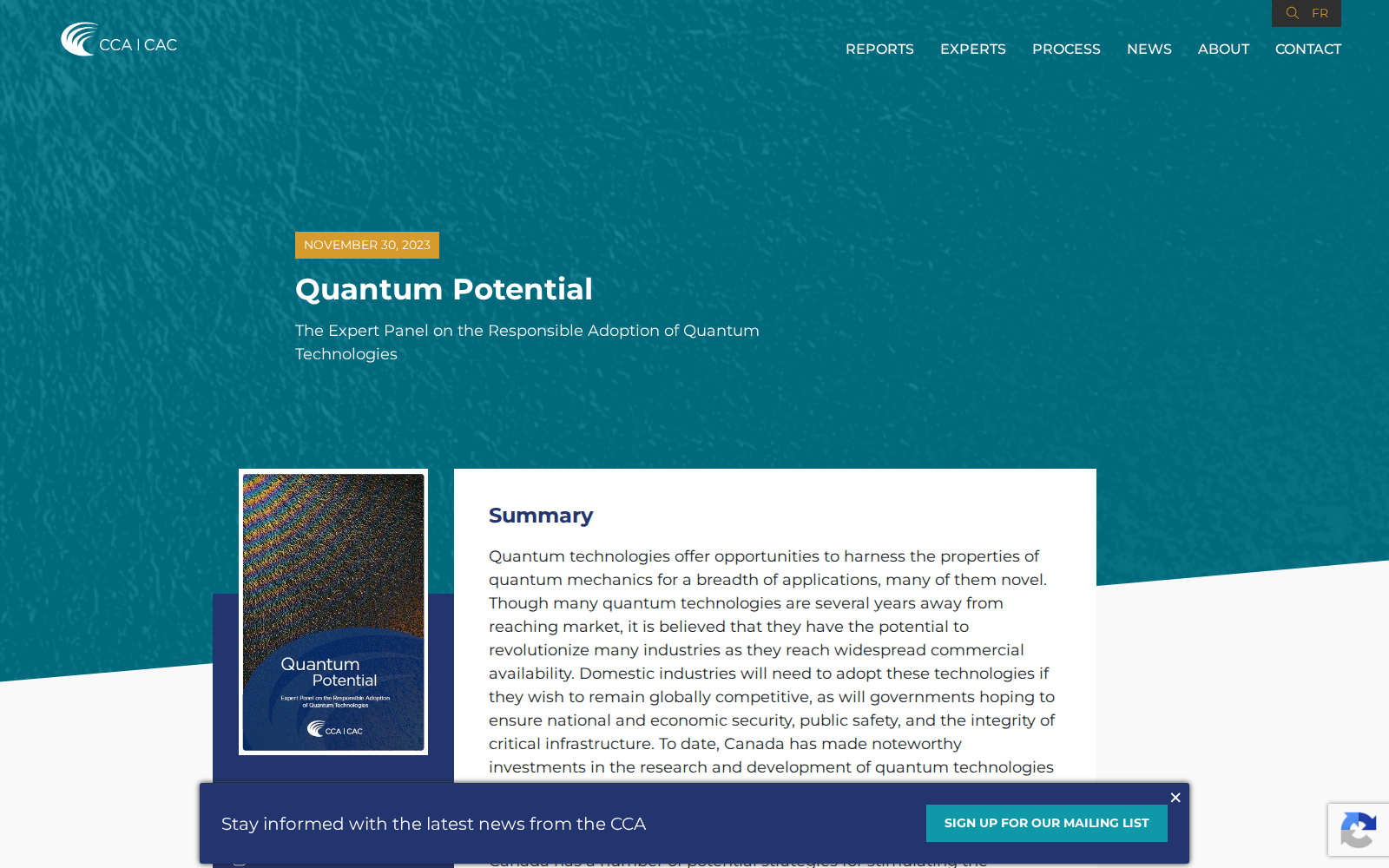
The Quantum Potential report page at the Council of Canadian Academies, November 2023.
The science beneath the strategy
What makes quantum technologies distinctive—and distinctively hard to govern—is the physics. They encode and process information in quantum states that can exist in superposition and become entangled, which is believed to give quantum computers an advantage on certain classes of problems that classical machines are conjectured unable to solve efficiently. The same properties cut two ways for policy. Because an arbitrary unknown quantum state cannot be copied—the no-cloning theorem—quantum key distribution can reveal eavesdropping under suitable protocols, in a manner classical channels cannot; yet, once large-scale, fault-tolerant machines exist, the same computational power that promises advances in chemistry, materials science, and optimization would also threaten the public-key cryptography that secures today's data and infrastructure. The panel's report treats these capabilities not as abstractions but as the source of concrete governance choices: regulatory uncertainty, threats to data security, market-power concentration, and the risk of eroding public trust.
Findings: promise, clustering, and the adoption gap
On the economic side, the report's headline finding is concrete: "Quantum technologies may account for up to 3% of Canada's GDP by 2045, with quantum computing making the most significant contribution." Scientific research, defense, space, chemistry and materials science, finance, and telecommunications are among the sectors most likely to be transformed. Canada, the panel notes, has strong foundations in quantum research, hosts numerous quantum-technology firms, and enjoys high rates of industry and international collaboration.
But the panel also identifies structural weaknesses. Canada's quantum expertise is clustered, which poses challenges to broad access; other countries have begun to surpass Canada's quantum research output; and there are minimal programs to encourage adoption by potential end-users. The gap, in other words, is not only one of invention but of diffusion—turning research strength into adoption across the wider economy. Realizing the benefit, the report stresses, "involves more than encouraging their development and adoption; it also involves anticipating the outcomes of technological change."
Responsible adoption: a two-handed approach to governance
The report's normative core is its account of how to adopt quantum technologies responsibly. The panel's recommendation is deliberately two-handed: "In order to maximize the benefits of quantum technologies while mitigating potential risks, responsible approaches to adoption should use state-sanctioned and self-regulating measures–including quantum impact assessments, soft-law mechanisms, and consultations with stakeholders–to anticipate the effects of technological change." Neither hard regulation alone nor industry self-governance alone is treated as sufficient; the recommended posture pairs state-sanctioned instruments with self-regulating ones, and reaches for anticipatory tools—impact assessment and soft law—rather than waiting for harms to materialize.
This framing will be familiar to readers of Kop's broader work on the ethical, legal, social, and policy implications of quantum technology, which argues for exactly such a graduated, anticipatory toolbox: that responsible quantum governance should combine state-sanctioned and self-regulating measures, deploy soft law where hard law is premature, and treat impact assessment as a forward-looking design instrument rather than after-the-fact paperwork. The panel report does not endorse any one scholar's framework, and should not be read as doing so; but there is a notable thematic overlap between its recommendations and that strand of the responsible-quantum literature, and it is part of why the panel drew on members working at that intersection.
Why the report still matters
National science academies rarely set binding rules; their authority is the authority of independent, expert synthesis offered to governments deciding how to act. Quantum Potential is best read in that light—as evidence and a structured set of options for Canadian policymakers, arriving as Canada weighed its quantum posture ahead of a period of intense international coordination. Its recommendations sit within the broader scholarship on the ethical, legal, social, and policy implications of quantum technology. For a field where the underlying quantum computing capabilities are advancing quickly, an independent panel's verdict—that responsible adoption is a matter of getting both the state-sanctioned and the self-regulating instruments right, and getting them in place early—remains the practical lesson.
Editor's note (later update): the report's themes carried forward into Canada's continued engagement with responsible-quantum governance—including the Canadian quantum-governance delegation that Mauritz Kop and Mark Lemley hosted at Stanford in 2024 to inform Canada's G7 presidency.
Last updated: June 6, 2026.