

Innovation, Quantum-AI Technology & Law

Blog over Kunstmatige Intelligentie, Quantum, Deep Learning, Blockchain en Big Data Law

Blog over juridische, sociale, ethische en policy aspecten van Kunstmatige Intelligentie, Quantum Computing, Sensing & Communication, Augmented Reality en Robotica, Big Data Wetgeving en Machine Learning Regelgeving. Kennisartikelen inzake de EU AI Act, de Data Governance Act, cloud computing, algoritmes, privacy, virtual reality, blockchain, robotlaw, smart contracts, informatierecht, ICT contracten, online platforms, apps en tools. Europese regels, auteursrecht, chipsrecht, databankrechten en juridische diensten AI recht.

Berichten met de tag Council of Canadian Academies
Council of Canadian Academies Publishes Quantum Potential Report

The Council of Canadian Academies has released Quantum Potential, the report of an independent expert panel on the responsible adoption of quantum technologies in Canada. Chaired by physicist Raymond Laflamme, the thirteen-member panel included Mauritz Kop—one panel member among the thirteen, whose listed expertise covered the ethical, legal, and policy dimensions—on a question Canada's federal departments had put to the academies: how to turn quantum research strength into broad, responsible adoption.

A national academy weighs in on quantum

Commissioned by Innovation, Science and Economic Development Canada and the National Research Council of Canada, the assessment treats quantum technology as an economic opportunity inseparable from its governance. The panel's reach across physics, economics, and law reflects a recurring premise of quantum policy: the hard questions—data security, market power, regulatory uncertainty, public trust—sit at the seams between disciplines, and the report frames quantum capabilities as advancing ahead of the institutions meant to steer them.

Promise and the adoption gap

The economics are striking. Quantum technologies, the report finds, may account for up to 3% of Canada's GDP by 2045, with quantum computing making the most significant contribution; the sectors most likely to be transformed range from defense and finance to chemistry and materials science. Yet the panel is candid about structural weakness: Canada's quantum expertise is clustered rather than diffused, rival countries are pulling ahead on research output, and there are few programs to encourage end-user adoption. The challenge, in short, is not only invention but diffusion—and anticipating the outcomes of technological change before they arrive.

Responsible adoption, two-handed

The report's normative center is its prescription for responsible adoption: a deliberately two-handed mix of state-sanctioned and self-regulating measures, reaching for anticipatory instruments—quantum impact assessments, soft-law mechanisms, and stakeholder consultation—rather than waiting for harms to crystallize. That posture echoes a recurring theme in the responsible-quantum literature, where governance is framed as a graduated toolbox calibrated to a technology whose risks are still taking shape. The convergence is not an endorsement of any one framework, but it helps explain why the panel drew on members working at the intersection of quantum science and law and policy.

Why it carries weight

National academies do not legislate; their authority is the authority of independent expert synthesis offered to governments deciding how to act. Quantum Potential functions as exactly that—structured evidence and options for Canadian policymakers as the country set its quantum course. Kop's engagement with Canadian and allied quantum governance is of a piece with his wider advisory work, which later included his 2024 consultations with the U.S. Department of State on quantum technology and foreign-policy strategy. For readers tracing how responsible-quantum thinking moves from scholarship into national policy, the report—and the broader body of work catalogued on the Mauritz Kop profile—is a useful waypoint: a moment when an independent panel told a government, in plain terms, that getting both the state-sanctioned and the self-regulating instruments in place early is the practical work of responsible quantum adoption.

Meer lezen
Quantum Days Canada: CCA Panel on Quantum Technologies

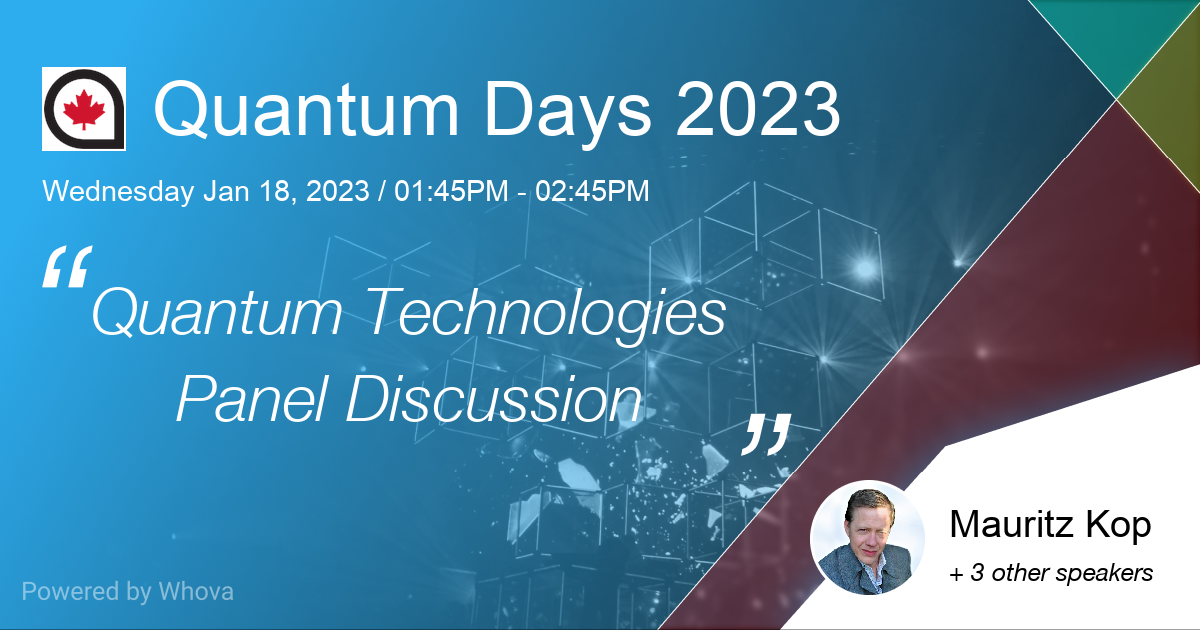
When the Council of Canadian Academies brought its quantum expert panel to Quantum Days in January 2023, it did something unusual for a national academy: it opened an unfinished study to public input. Mauritz Kop joined the session to frame the ethical, legal, social, and policy stakes of quantum adoption—and to invite the audience to help shape the questions, not just receive the answers.

A government-commissioned panel, in public

The panel had been formed at the request of federal sponsors, including the National Research Council of Canada and Innovation, Science and Economic Development Canada, and was chaired by the physicist Raymond Laflamme. The Quantum Days appearance gathered members of that panel—Laflamme, Jeff Kinder, Mauritz Kop, and Jacqueline Bartlett among the named participants—to discuss the panel's mandate, key questions, and priorities while its assessment of Canadian quantum adoption was still being written. It was a national study opened up mid-draft, with its conclusions deliberately still open.

Live polls and equitable access

The session's signature move was procedural: the audience was invited to feed the eventual report through live polls, under the banner of helping Canada build a quantum ecosystem. That design choice carries an argument. Responsible quantum governance, on Kop's reading, treats equitable access to quantum-enabled prosperity as a question to be settled by deliberation rather than left to the market, and asks how codes of conduct and design guidelines can be agreed across cultures whose ethical intuitions differ. Live audience input is well suited to surfacing exactly the trade-offs that have no single technically correct answer—and it reflects the distributive themes that run through Kop's broader scholarship on responsible technology.

Why the policy lens belongs at a physics conference

Quantum systems invite governance because their behavior is genuinely unfamiliar. Superposition and entanglement change what computation can do, with consequences for cryptography and security that existing law did not anticipate. The case for an ethical, legal, social, and policy lens at a technical conference is that the rules must be drafted while the science is still moving—a position consistent with the standards-and-principles direction Kop and colleagues set out in the Ten Principles for Responsible Quantum Innovation.

A panel on its way to a report

The Quantum Days session is one step in a longer process. The same panel, under the same chair, is carrying its study through 2023 toward a national assessment of quantum adoption in Canada, with Kop among its members. The sequence—open the questions in public, gather input through live polls, then translate that deliberation into evidence for decision-makers—offers a working model of quantum governance that is both expert-led and publicly grounded, an early example of treating quantum policy as a question worked out in the open rather than a finished product to be announced. (That study became the CCA's Quantum Potential report, published November 30, 2023.)

Meer lezen