Mauritz Kop and Urs Gasser at the TUM Festival of Ideas: A Live Quantum-Art Demonstration (November 2023)
By Mauritz Kop
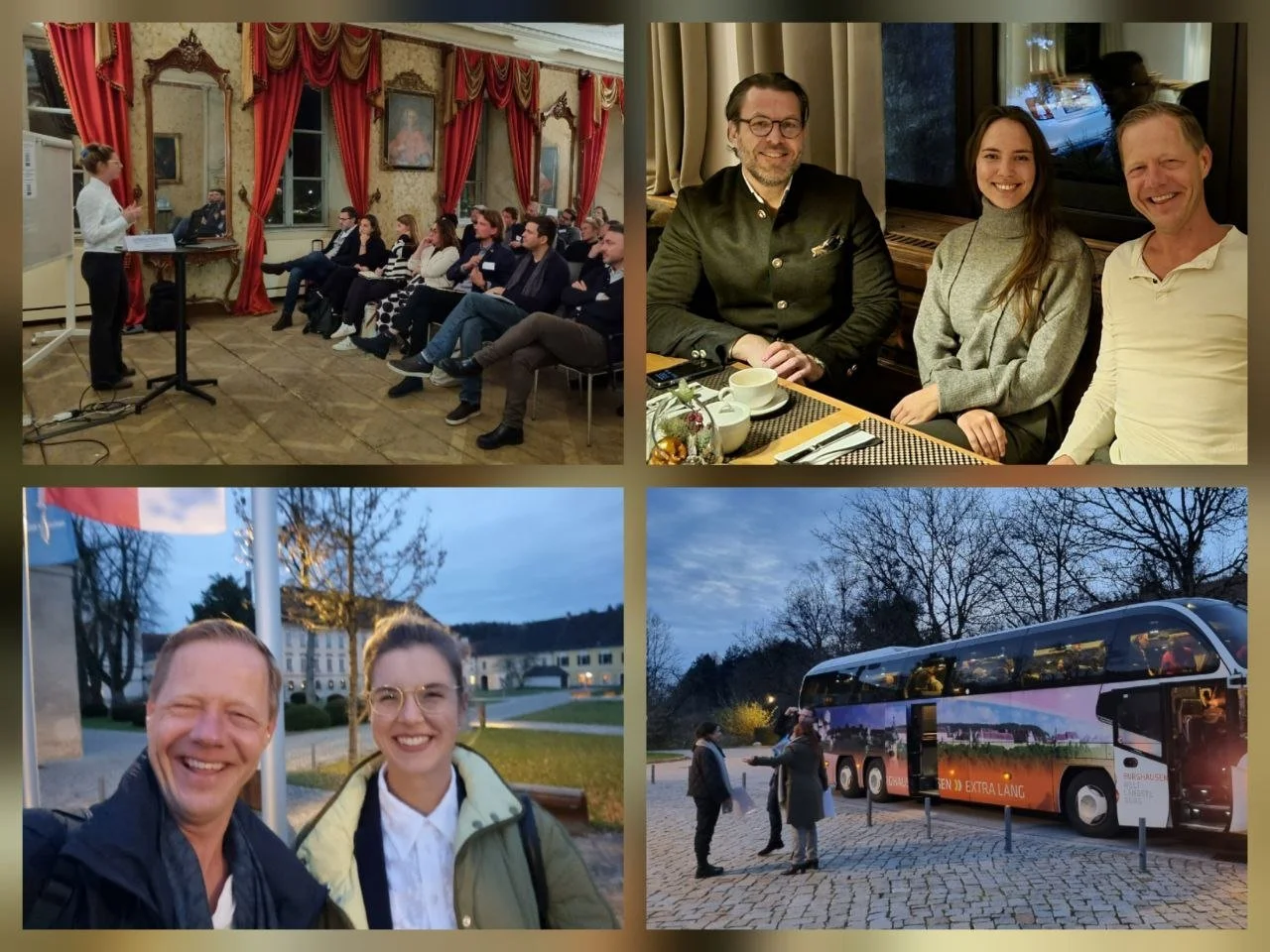
Munich, Germany, November 2023—In late November 2023, the inaugural Festival of Ideas brought a deliberately interdisciplinary group of scholars, technologists, and policymakers to the Technical University of Munich (TUM) and its historic Science & Study Center at Raitenhaslach Monastery. The Festival's organizing question was unusually ambitious: how should society design a new "operating system" for an era reshaped by generative artificial intelligence and quantum computing? I was invited to take part as a Stanford Center for Responsible Quantum Technology (RQT) participant, alongside Professor Urs Gasser—Rector of TUM's Hochschule für Politik and Dean of the TUM School of Social Sciences and Technology—whose own research sits squarely at the intersection of innovative technology, governance, and society. This post records that academic engagement and the live demonstration I gave there.
A festival for ideating society's new operating system
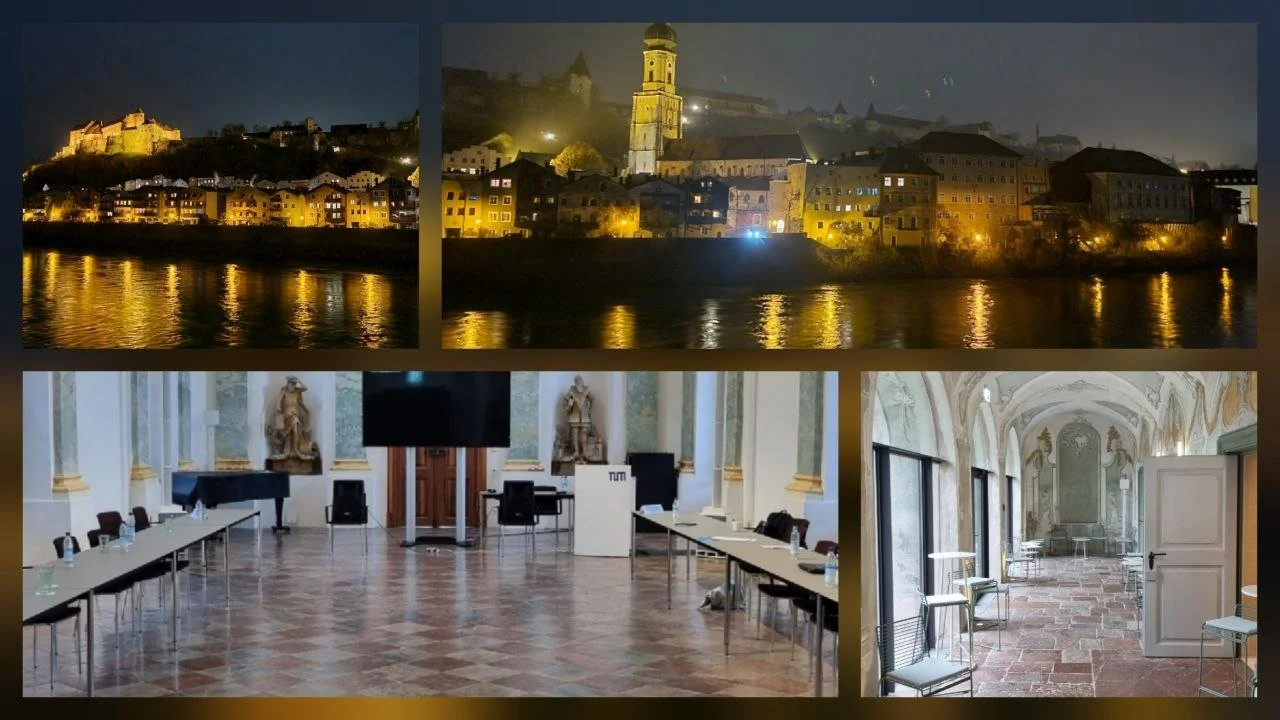
The Festival of Ideas was co-hosted under the Triple Partnership for Socially Responsible AI together with BI Norwegian Business School, and it ran as a multi-day program at Raitenhaslach—a former Cistercian monastery, founded in the twelfth century, that TUM now operates as a residential venue for exactly this kind of concentrated intellectual exchange. The framing throughout was that many of our regulatory, ethical, and governance structures were conceived in a pre-digital era and may need more than an incremental upgrade. The program was staged in movements: envisioning possible futures, then interrogating the algorithms that would carry us there, then assembling the practical tools and skills to translate theory into impact. It was, in the organizers' words, an invitation to co-creation rather than a lecture series. That structure made it a natural home for the kind of responsible quantum technology argument that the Stanford RQT framework advances: that governance, ethics, and innovation should be designed together, from the outset, rather than bolted on afterward.
Quantum on the agenda, with Urs Gasser moderating
Quantum technology was not a footnote at the Festival; it was woven through the program. On the final day, a dedicated use-case session—"Bringing Together Social and Responsible Technology"—convened an open discussion focused on Quantum, AI, and immersive technologies, moderated by Urs Gasser. That session sat alongside earlier conversations on digital-ready legislation, the procurement of responsible technologies, and technology and democracy. The presence of a quantum-and-AI strand, chaired by a scholar whose research centers on the social and regulatory implications of emerging technology, reflected a shared conviction that quantum governance cannot wait for the hardware to mature. Gasser and I have continued that collaboration in the scholarly literature; it is the same intellectual partnership that produced, a few months later, the Nature Physics call for responsible quantum technology co-authored by Urs Gasser, Eline De Jong, and myself. Eline de Jong was also among the Festival's lightning-talk contributors, so the Festival anticipated themes that this collaboration later developed.
A live demonstration: art, fractals, and quantum intuition
My contribution went beyond a conventional input statement. I gave a live demonstration that used my own photo and video material, set to my own music, as input to a real-time, beat-synced audiovisual system inspired by fractal geometry, with a generative-AI element in the loop—DJ-ing and VJ-ing in parallel. The intent was not spectacle for its own sake. Fractal patterns recur throughout nature, from DNA and blood vessels to coastlines, clouds, and the branching of neurons, and they have even been observed experimentally in quantum materials. By inviting the audience to become the input data of what I described as a "creative machine," the demonstration tried to make an abstract idea tangible: that the visual language of fractals can build intuition for the kind of self-similar structure physicists also study in quantum materials. The pedagogical aim was to foster quantum intuition—an art-inspired path to the kind of double-educated, interdisciplinary quantum workforce that responsible innovation will require. It was a concrete illustration of a serious claim: that integrating art into science helps researchers grasp the inter-relatedness of what they study, and that lateral, associative thinking is central, not peripheral, to scientific discovery.
From Abu Dhabi to Munich: a recurring public demonstration
The Munich demonstration was one public instance of a format I have performed in several settings. A prior public outing of the same creative-machine approach took place during my engagements in Abu Dhabi, where exponential-technology gatherings such as the one I later addressed as a speaker at XPANSE 2024 draw an international audience of technologists and decision-makers. Presenting the demonstration across very different venues—a Gulf exponential-tech stage and a Bavarian monastery hosting a European university's Festival of Ideas—was a deliberate test of whether art can carry rigorous scientific ideas to non-specialist audiences. In each setting the goal was the same: to use creative practice as a bridge into quantum literacy, and to model the cross-disciplinary, "chance-encounter" environment that, as the Festival's own program argued, universities should cultivate as a guiding principle for organizational and cultural development.
A piano interlude, and creativity as method
Because I am also a working musician, the Munich engagement included an ad-hoc piano interlude on the venue's grand piano—an unscripted moment that fit the Festival's spirit of serendipity and chance encounter rather than any fixed agenda. The improvisation was not a digression from the intellectual program; it was of a piece with it. The argument I brought to Munich was that creativity is a method, not a mood: that the willingness to improvise, to court failure, and to discover by chance—the way Fleming stumbled onto penicillin while studying something else—belongs inside scientific practice, not outside it. Performing at the keyboard, and then returning to the questions of quantum and AI governance, was simply that argument made audible. For institutions wrestling with how to govern technologies that arrive faster than our rules can adapt, the Festival of Ideas at TUM offered a useful provocation: that the most durable guardrails will be designed in interdisciplinary, creative settings where law, ethics, science, and art are allowed to meet.
This post records an academic engagement and a public live demonstration; it makes no confidential or client claims. The Stanford RQT framework and related scholarship are available on the Mauritz Kop scholar profile.
Last updated: June 8, 2026.