
A Brief Quantum Medicine Policy Guide: What Regulators Should Consider for Quantum and AI in Precision Medicine
By Editor
Cambridge, MA, December 6, 2024—A team led by Mauritz Kop, Founder and Executive Director of the Stanford Center for Responsible Quantum Technology and a Stanford Law School TTLF Fellow, has published A Brief Quantum Medicine Policy Guide on the Harvard Law School Petrie-Flom Center's Bill of Health blog. Written with Suzan Slijpen, Katie Liu, Jin-Hee Lee, Constanze Albrecht, and Harvard's I. Glenn Cohen, the guide asks a practical question that regulators are only beginning to confront: as quantum technology and artificial intelligence converge in precision medicine, what should agencies such as the FDA and the EMA actually do? The guide is a companion to the authors' longer treatment, How Quantum Technologies May Be Integrated Into Healthcare, What Regulators Should Consider, and was cross-posted with the Stanford Center for Responsible Quantum Technology, now archived permanently in the Stanford Center for Responsible Quantum Technology collection at the Stanford Law Library, and on the European Commission's European AI Alliance.

Quantum technology and AI in precision medicine — what regulators should consider (illustrative editorial image).
From first-generation to second-generation quantum medicine
The guide begins by clarifying what "quantum technology" means in a clinical setting. First-generation quantum technologies have already shaped healthcare—magnetic resonance imaging being the obvious example. Second-generation (2G) quantum technologies go further by directly harnessing counter-intuitive quantum-mechanical effects, the authors write, "such as uncertainty, complementarity, superposition, entanglement, tunneling and energy quantization," to achieve both quantitative advantages (more speed and fidelity) and qualitative ones (genuinely new functionality). Crucially, the guide notes that many near-term applications are quantum-classical hybrids—systems that combine quantum resources such as qubits with classical digital bits. The physics here is load-bearing rather than ornamental: because superposition lets a quantum system encode and process information across many configurations at once and entanglement creates correlations with no classical analogue, quantum simulation can model large, strongly correlated molecular systems that are intractable for classical machines—which is precisely why the guide treats drug discovery as a leading use case.
Use cases across computing, simulation, sensing, and cryptography
The guide organizes 2G quantum medicine by domain. In computing, it points to de novo drug discovery through simulation of molecular interactions, quantum-enhanced AI for personalized treatment design, faster genome sequencing, protein-folding simulation for drug design, and optimization of hospital and clinical-trial scheduling. In simulation, it describes modeling complex biological systems—from disease mechanisms to epidemic prediction—and a quantum-sensor-assisted virtual-reality surgery training method. In sensing, the guide highlights continuous, high-precision monitoring of vital signs, precision laser therapy that spares surrounding tissue, "entangled vision" probes for earlier retinal diagnostics, and optical metamaterial single-photon detectors that improve Raman spectroscopy for clinical pathology. In cryptography, it frames post-quantum cryptography and quantum key distribution as privacy-enhancing techniques for quantum-safe patient-data sharing, supporting compliance with regimes such as HIPAA and GDPR. A recurring example threads through several domains: semiconducting quantum dots that can cross the blood-brain barrier, opening possible avenues in oncology imaging, targeted drug delivery, and research into neurodegenerative diseases such as Alzheimer's and Parkinson's. The guide also gestures at quantum-AI hybrids on the horizon—Quantum Artificial Intelligence, geometric Quantum Machine Learning, and quantum large language models—and connects the agenda to broader frameworks such as the United Nations Sustainable Development Goals, positioning quantum medicine as a candidate for societally beneficial application rather than capability for its own sake.
The guide is careful to keep the claims proportionate. It repeatedly marks applications as early-stage, theoretical, or exploratory—stimulating individual neurons at the single-nanocrystal level, for instance, is described as a research direction, not a clinical reality. That restraint matters for a policy document: it lets the authors argue for anticipatory governance without overstating where the science currently stands. The point is not that quantum technology will imminently transform every clinical workflow, but that regulators should be ready before it does for the ones where it plausibly will.
Two regulatory regimes, one fragmented map
The guide is candid that there is no quantum-specific medical-device law in either major jurisdiction. In the European Union, a quantum-infused device would primarily fall under the Medical Devices Regulation (EU 2017/745) and, where relevant, the In Vitro Diagnostic Medical Devices Regulation (EU 2017/746), with the EU AI Act, the then-proposed AI Liability Directive (which the European Commission subsequently withdrew in 2025), and data laws such as the Data Governance Act playing supporting roles. The authors flag a practical bottleneck: securing a Conformité Européenne (CE) mark is slow because few Notified Bodies have expertise in either AI or quantum technologies. In the United States, some quantum-powered devices may fall within the existing FDA framework—including good laboratory and clinical practices, registration and listing, labeling, post-market surveillance, and, in some cases, the FDA's framework for AI/ML-based Software as a Medical Device—while HIPAA, the FTC, the IMDRF risk-categorization framework, and standards such as ISO 13485 and the IEC 60601 series may also apply. The guide's recommendation is concrete: given the novelty, manufacturers should engage the relevant agencies early to clarify expectations.
What regulators should consider
The heart of the guide is its account of why quantum devices strain existing oversight. Quantum devices operate on fundamentally different principles, the authors argue, which complicates safety and efficacy assessment; standardized compliance norms may simply be insufficient for quantum-specific risks. The most consequential of those risks is cryptographic: quantum computing could break widely used encryption, an eventuality the guide calls "Q-Day," requiring ecosystem-level upgrades to data handling and privacy protection. The guide lists four changes regulators in the EU and the US will need to make: developing evaluation protocols attuned to quantum behaviors that existing rules do not anticipate; enhancing risk-management frameworks to protect human subjects from the probabilistic behavior of quantum systems, beginning with near-term applications such as quantum simulation of drug metabolism; establishing clinical-trial guidelines tailored to quantum devices; and setting interoperability standards so quantum devices can exchange information with existing healthcare systems. AI-focused frameworks such as the FDA's SaMD criteria, it cautions, are a useful starting point but may not adequately support market entry for multifunctional quantum devices.
A three-part regulatory architecture and ten guiding principles
Rather than propose a single sweeping statute, the guide sketches a layered architecture across the device life cycle. Ex-ante, it would establish Regulatory Sandboxes for Quantum-AI Devices, linked to innovation hubs such as the Stanford Quantum Incubator, to test technologies under supervision and develop rights-respecting standards tied to certification and benchmarking. Ex-durante, it would have the FDA and the European Commission stand up specialized subcommittees of quantum experts—on the model of the U.S. National Quantum Initiative Advisory Committee—to conduct compliance audits and address ethical, legal, socio-economic, and policy (ELSPI) considerations. Ex-post, it would create a centralized registration database for quantum-AI medical devices to support transparency and market monitoring. Around this architecture, the guide offers ten guiding principles for healthcare policymakers: promote quantum literacy; anticipate societal impact; implement Responsible Quantum Technology (RQT) frameworks tailored to healthcare; operationalize a quantum standards-first approach; adopt ex-ante, principles-based regulation; employ adaptive, modular rules; avoid regulatory fragmentation across jurisdictions; foster institutional plasticity in bodies like the FDA and EMA; encourage cross-sector collaboration; and consider the long term, including future generations. This standards-first, anticipatory posture is the same one Kop and colleagues had earlier set out in the Ten Principles for Responsible Quantum Innovation (April 2024), and which underpins the later biomedical-ethics work in Hippocratic Quantum (2026).
Why the guide matters
The continuity with Kop's earlier work is deliberate. The questions the guide raises—safety, efficacy, privacy, equitable access, and institutional readiness—are the same ones he and collaborators first set out for clinical AI in the main requirements for AI systems in healthcare, now extended to a technology whose risks (a cryptographic "Q-Day," unpredictable quantum effects, dual-use research) are sharper still. The guide is a short, accessible policy brief rather than a peer-reviewed clinical study, and its authors are explicit that quantum medicine remains early-stage and that many applications are still theoretical. Its value is as an orientation document: a map of the use cases, the overlapping regimes, and the four practical changes regulators can begin to make now—balancing innovation against patient safety without waiting for the technology to mature first.
Last updated: June 7, 2026.
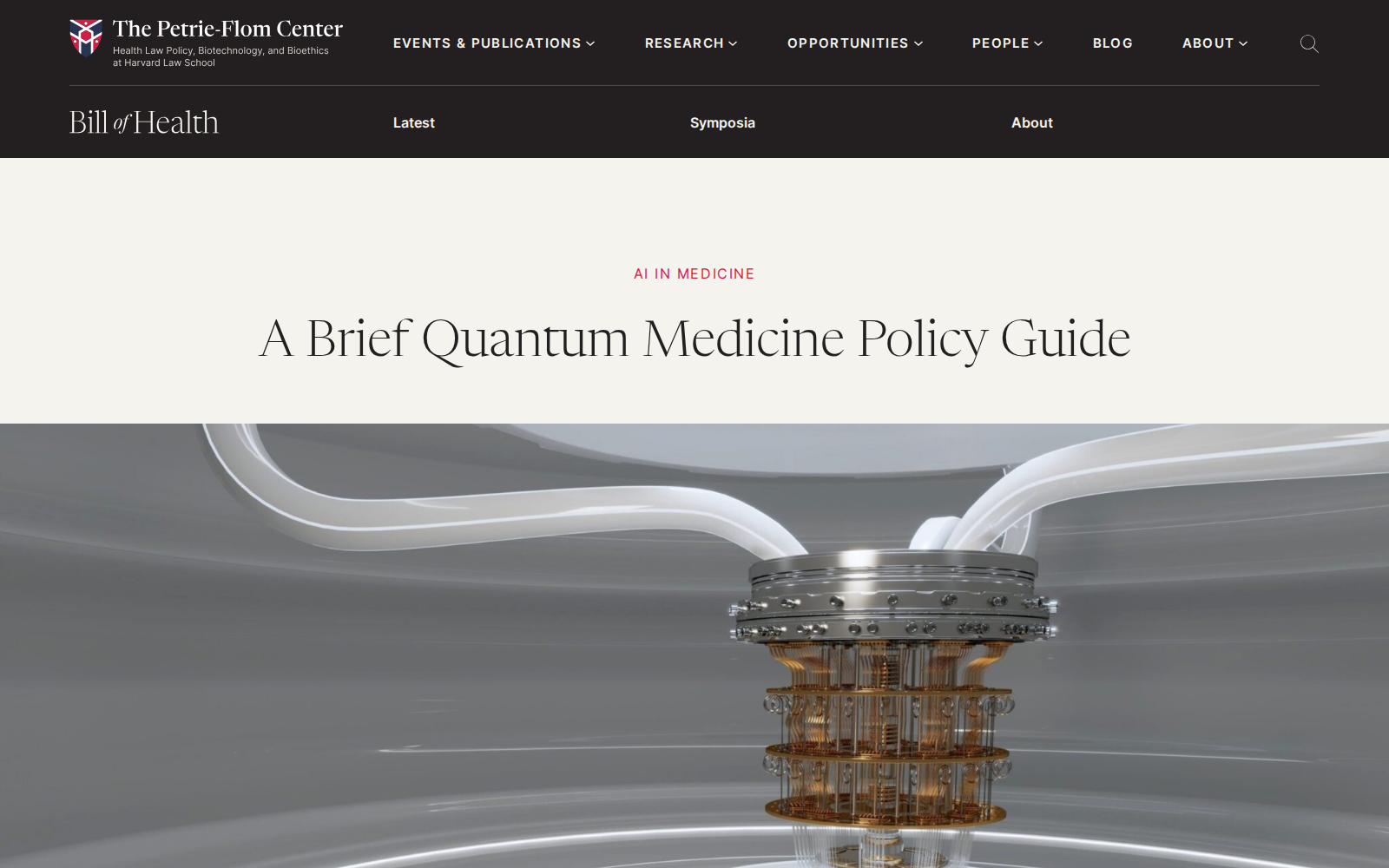
A Brief Quantum Medicine Policy Guide on Harvard's Bill of Health, December 6, 2024.