
Stanford Law School Legal Aggregate Q&A with SLS's Mauritz Kop on Quantum Technologies
By Editor
Stanford, CA, April 10, 2024—Stanford Law School's Legal Aggregate blog has published a question-and-answer feature with Mauritz Kop—SLS's Mauritz Kop Discusses Quantum Technology and the Need for Legal and Policy Guardrails—in which the founder of the Stanford Center for Responsible Quantum Technology (Stanford RQT) sets out why the maturing field of quantum technology needs legal and policy guardrails now, while its commercial and strategic stakes are still being defined. The piece appeared in the same week that Kop, with co-authors Urs Gasser and Eline De Jong, published the comment A Call for Responsible Quantum Technology in Nature Physics, and it translates that scholarly argument into terms a general audience can follow.
(The original Legal Aggregate page is no longer available following a Stanford Law School site redesign; the account below draws on the comment itself and on the public record of how the school presented the Q&A.)

Stanford Law School's Legal Aggregate Q&A on quantum technology guardrails (illustrative editorial image).
A constructive case, not a cautionary one
By the published accounts, the framing of the Q&A is constructive rather than alarmist. As Stanford Law School put it in promoting the conversation, the aim is plain: "It's really important to make sure people understand quantum technology's huge potential for good." That phrasing tracks a recurring throughline in Kop's work—that responsible innovation is a way to realize quantum's benefits, not a brake on them. The emphasis falls less on worst-case scenarios than on how law, standards, and institutional design can keep a powerful new technology aligned with the public interest from the outset.
Quantum technology earns that attention because it does not merely speed up classical computing; it computes in a different way. Information carried by qubits can exist in superpositions of states and become entangled, so that the state of one qubit is correlated with another in a manner with no classical analogue. Those properties promise advances in simulation, sensing, and secure communication—and they also unsettle assumptions, baked into current law and infrastructure, about what can be measured, copied, or kept secret. Guardrails, in this account, are how a society captures the upside while managing the dislocation.
The published account is careful not to overstate the field's maturity. Much of quantum computing's most consequential promise remains years out, contingent on advances in error correction and the management of decoherence, the process by which fragile quantum states lose their coherence through interaction with their environment. That gap between today's machines and the eventual capability is precisely why the moment is right for governance: the legal and policy choices made while the technology is still developing are easier to revise, and harder to capture by entrenched interests, than those imposed after the fact. Acting early is presented less as urgency for its own sake than as a window that does not stay open.
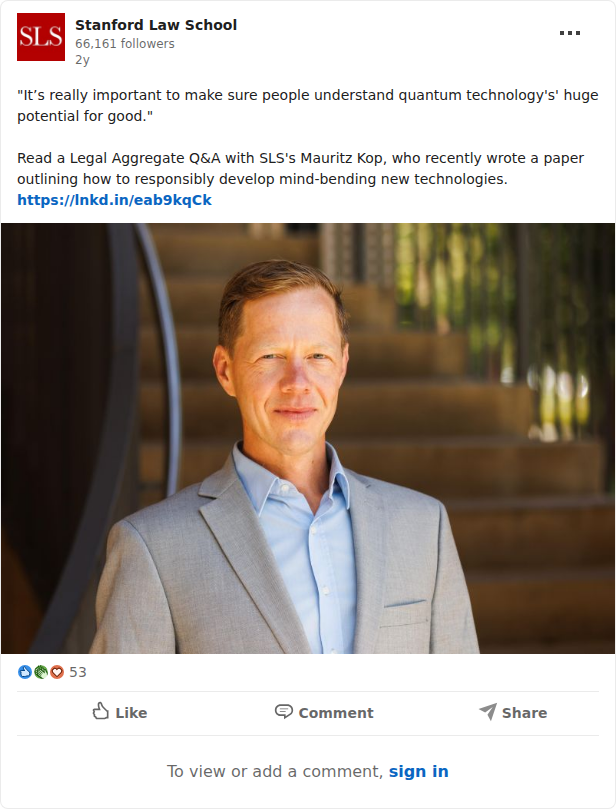
Stanford Law School's LinkedIn post announcing the Legal Aggregate Q&A, April 2024.
The Nature Physics comment behind the interview
The Q&A is anchored in the Nature Physics comment A Call for Responsible Quantum Technology, co-written by Kop with Urs Gasser—dean of TUM's School of Social Sciences and Technology and professor of public policy at the Technical University of Munich—and Eline De Jong, a Dutch scholar working on the philosophical and ethical dimensions of new and emerging technologies. The full announcement of that comment is covered separately on this site in Nature Physics publishes A Call for Responsible Quantum Technology.
The comment argues that the scientific and engineering community should take shared responsibility for defining the principles and practices of responsible quantum technology, rather than leaving that work to be done after the fact by regulators reacting to harms. In the interview, Kop renders that argument accessible: responsible quantum technology is oriented toward jointly safeguarding against risks by addressing them proactively, engaging the full range of stakeholders in the innovation process, and continuing to advance the technology itself—a structure his published work frames as the safeguard-engage-advance approach.
Why publish in both technical and legal venues
One thread the Q&A draws out is a deliberate publication strategy. Kop's practice is to place work in both peer-reviewed scientific and legal journals, so that policymakers can cite that scholarship and build durable policy on top of it. The aim is to give decision-makers a defensible evidentiary base across the questions quantum technology raises—national security, export controls, supply chains, intellectual property, and standardization among them—rather than ad hoc reactions to each new headline. It is a model of scholarship designed to be used, not merely archived.
That orientation connects the interview to a wider body of work on the ethical, legal, social, and policy implications of the field. Readers who want the conceptual scaffolding can turn to the Quantum-ELSPI framework, which organizes those implications into a single research and governance agenda, and to Towards Responsible Quantum Technology, the longer treatment published through Harvard's Berkman Klein Center. The strategy also reflects a view of how policy actually forms: regulators rarely write on a blank page, and they tend to lean on the citable, peer-reviewed record available to them. Putting rigorous interdisciplinary work into that record early is itself a governance act, shaping the menu of options before any statute is drafted.
A center, a conference, and an incubator
The interview also situates Kop's call within the institution-building underway at Stanford Law School. The school had recently launched the Stanford Center for Responsible Quantum Technology—a center focused on the policies, laws, and global practices that promote the responsible development and use of quantum technologies—and the Stanford Quantum Incubator. Kop's broader scholarship situates this work alongside the governance of artificial intelligence, with which quantum technology increasingly converges; the published account keeps the focus on quantum while acknowledging that the two governance agendas are beginning to intersect. The same conversation looked ahead to the Second Annual Stanford Responsible Quantum Technology Conference, then expected in the spring of 2024 at Stanford Law School.
Taken together, the Legal Aggregate Q&A and the Nature Physics comment it accompanies make a single point in two registers: the responsible governance of quantum technology is not a downstream cleanup task but an upstream design choice—one most credibly made while the technology, the market, and the law are all still taking shape.
Last updated: June 6, 2026.