
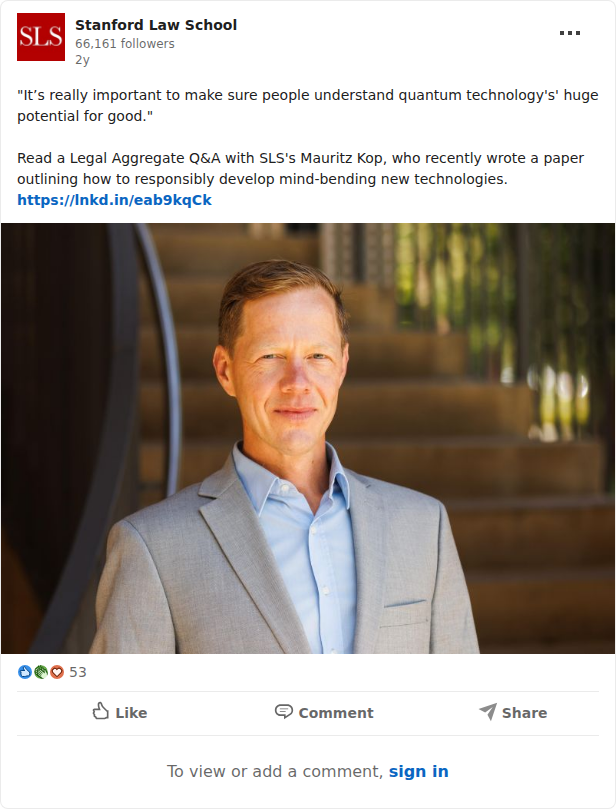
Stanford Law School's Legal Aggregate blog has run a Q&A with Mauritz Kop—SLS's Mauritz Kop Discusses Quantum Technology and the Need for Legal and Policy Guardrails—published a day after his Nature Physics comment A Call for Responsible Quantum Technology, co-authored with Urs Gasser and Eline De Jong. The conversation translates a scholarly argument for responsible quantum technology into terms a general readership can act on.
Guardrails as a design choice
The interview's frame is constructive rather than alarmist: the case for legal and policy guardrails is the case for capturing quantum technology's benefits responsibly, while the field's commercial and strategic shape is still being set. Because qubits can hold superpositions of states and become entangled, quantum systems unsettle long-standing assumptions—about what can be measured, copied, or kept secret—that current law and infrastructure quietly rely on. Addressing that upstream, the argument runs, is cheaper and more credible than reacting to harms after deployment. The piece is equally careful about timing: much of the field's most consequential promise depends on advances in error correction and the management of decoherence, and it is exactly that gap between current machines and eventual capability that makes early, revisable governance the prudent course.
Scholarship built to be cited
A distinctive thread is Kop's publication strategy: placing work in both scientific and legal journals so that policymakers can cite it and build durable policy on top of it—across national security, export controls, supply chains, intellectual property, and standardization. The Nature Physics comment makes the foundational move, calling on the research community to take shared responsibility for defining the principles and practices of responsible quantum technology rather than leaving that to after-the-fact regulation.
Institution-building at Stanford
The Q&A situates the argument inside the work then underway at Stanford Law School—a newly launched center for responsible quantum technology, a quantum incubator, and an annual conference, the second edition of which was covered in the 2nd Annual Stanford Responsible Quantum Technology Conference summary. The fuller portrait of the scholar behind the program is set out in the Mauritz Kop profile. The result is a single message in two registers: responsible governance of quantum technology is an upstream design choice, best made while the technology, the market, and the law are all still forming. It is a message that echoes a recurring theme in the parallel governance of artificial intelligence: that durable rules tend to rest on a credible evidentiary record assembled before the technology matures. The Legal Aggregate Q&A reads, in that light, as an attempt to apply that insight to quantum technology one cycle earlier.
Meer lezen