
CNAS Interviews Mauritz Kop for The Entanglement Edge Quantum Networking Report
By Editor
Washington, D.C., May 26, 2026—The Center for a New American Security (CNAS) has published The Entanglement Edge: U.S. Strategic Priorities in Quantum Networking, a report by Constanza M. Vidal Bustamante and Morgan Peirce assessing where quantum networking genuinely matters for American security and where its promise is narrower than the headlines suggest. As part of the expert interviews underpinning the report, Mauritz Kop, Founder of the Stanford Center for Responsible Quantum Technology (Stanford RQT), briefed the CNAS research team on quantum networking and cybersecurity on November 11, 2025—one voice in a research base that gives the report its notably sober, evidence-first register on quantum technology.

PQC by default, QKD by exception: two architectures meet at the verification beacon.
What the report finds
The report's analytical spine matches what serious cryptographers have argued for years: quantum key distribution (QKD) is at best a potential niche complement to post-quantum cryptography (PQC), not a replacement for it. The National Security Agency and allied cybersecurity agencies have concluded that QKD's practical limitations—implementation vulnerabilities, distance constraints, costly specialized infrastructure, and its inability to provide authentication—make PQC the primary answer to quantum-capable adversaries. Even China, the world's strongest QKD proponent, began developing its own PQC standards in 2025, the report notes. China's first-generation lead is real—over 10,000 kilometers of QKD fiber across 80 cities, plus satellite demonstrations—but that infrastructure does not automatically translate into readiness for the higher-impact, next-generation quantum networks that distributed quantum computing and sensing will demand—capabilities that, unlike artificial intelligence (AI), cannot ride on infrastructure the world has already deployed. The recommendations follow accordingly: standardized benchmarks across quantum networking applications, priority for quantum interconnects within data centers, calibrated R&D portfolios with effective testbeds, secured supply chains for enabling technologies, and accelerated PQC migration at home and abroad.
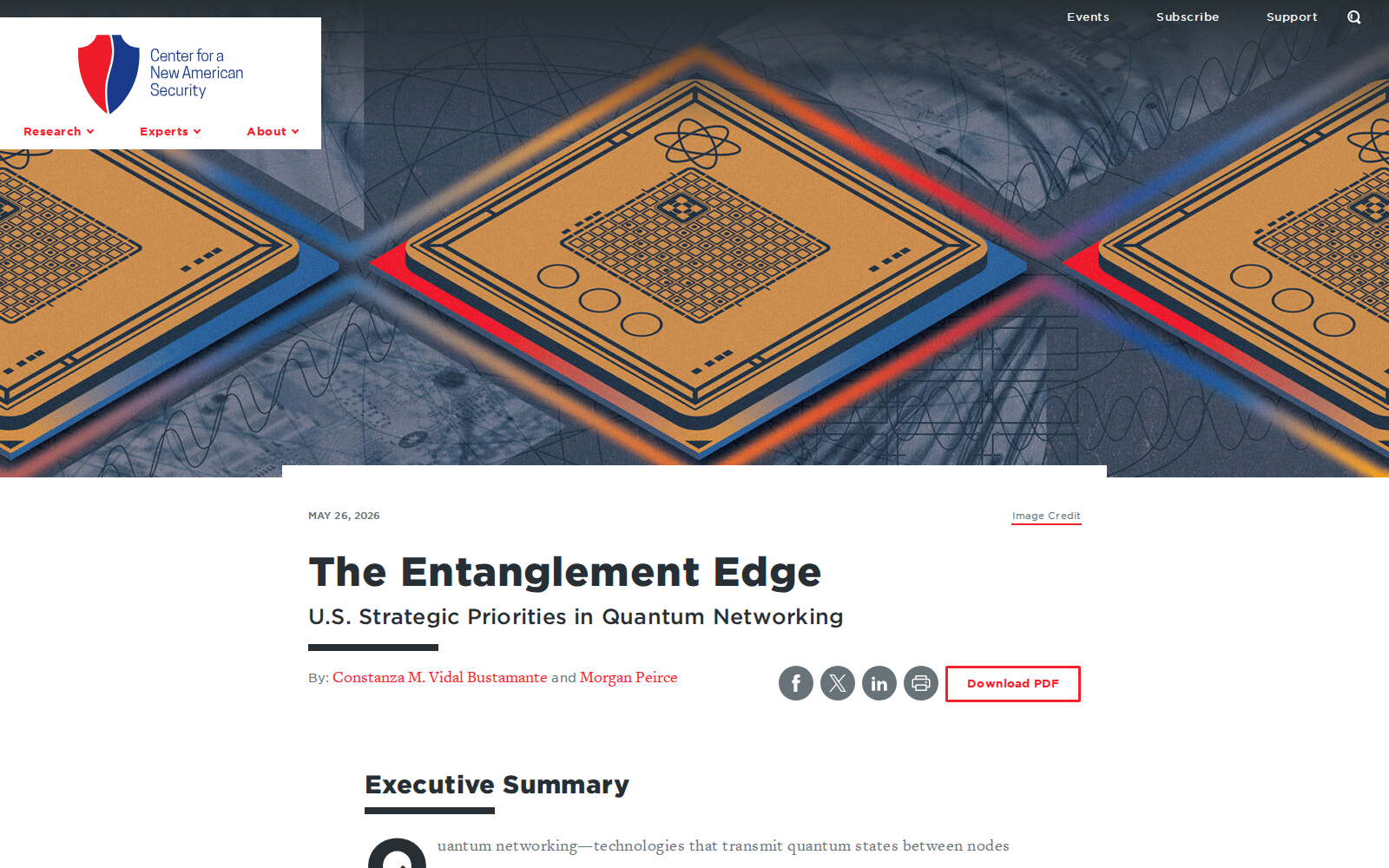
The Entanglement Edge: U.S. Strategic Priorities in Quantum Networking (CNAS, May 26, 2026).
PQC by default, QKD by exception
Kop's briefing to the CNAS research team distilled his position into an administrable rule of thumb: "PQC by default; QKD only where you can prove incremental assurance over cost and complexity; QRNGs widely for stronger entropy." Premature, large-scale QKD deployment risks what he described as a quantum splinternet—a fragmented ecosystem of proprietary, non-interoperable hardware that is difficult to certify and cannot protect data at rest, while quantum random-number generators are broadly useful precisely because high-quality entropy strengthens key generation, secure boot, and hardware security modules without pretending to solve the algorithmic vulnerability that only PQC addresses.
The briefing's second thread moved from guidance to verifiable outcomes: a federal PQC transition lead with a public, quarterly dashboard tied to dated milestones; procurement requiring validated FIPS 140-3 modules implementing FIPS 203, 204, and 205, with machine-readable crypto bills of materials; annual crypto-agility drills; and a federal test-and-evaluation network open to state, local, and critical-infrastructure pilots—a trusted verification function analogous to the Atomic Agency concept for quantum-AI Kop has developed elsewhere. Interoperability with allies, he argued, is an operating model rather than a slogan: mutual recognition of conformance—"one test, many markets"—bridging the U.S./Canada validation program with the EU's certification scheme, as set out in the Bletchley Park framework for the quantum age.
A continuing engagement with CNAS
The briefing extends a relationship with the think tank that goes back to Kop's participation in the CNAS quantum roundtable on research security, technology theft, and intellectual property rights in 2023—debates in which the cost of miscalibrating the balance between openness and protection is counted in both lost science and lost security. The report's acknowledgments thank, without naming individually, "the dozens of experts in government, industry, and academia who participated in quantum technology roundtables at CNAS or who agreed to be interviewed as part of this research project." The Entanglement Edge brings that calibration discipline to quantum networking: invest where the strategic returns are real, decline to subsidize theater, and keep allied certification regimes interoperable enough that the coalition's cryptographic baseline never fractures.
For policymakers and security planners, the report and the briefing behind it converge on one message: the decisive contest is not over who fields the most quantum hardware first, but over whose security architecture can be verified—at home, across the Alliance, and against the quiet collection campaigns already underway.
Last updated: June 5, 2026.
Watch / cite / read further
Download Lecture PDF. CNAS Briefing Quantum Networking & Cybersecurity — Nov 11 2025
Bluebook. Mauritz Kop, CNAS Briefing Quantum Networking & Cybersecurity — Nov 11 2025 (lecture slides / keynote material).
APA. Kop, M. (CNAS). CNAS Briefing Quantum Networking & Cybersecurity — Nov 11 2025 [Lecture slides / keynote material]. AIRecht.
Read further, CIGI Global Quantum Governance policy brief, and USAFA quantum-governance blog.