
NATO StratCom Features Mauritz Kop as Subject Matter Expert in Workshop Video on Quantum and Cognitive Sovereignty
By Editor
Stanford, CA, June 3, 2026—The NATO Strategic Communications Centre of Excellence (NATO StratCom COE) in Riga engaged Mauritz Kop as a subject-matter expert for its expert workshop The Integrity of Reality and Cognitive Sovereignty, held in Riga in early June 2026. At the Centre's request, Kop recorded a thirty-minute video interview—conducted with the Centre's Elina Lange-Ionatamishvili—that served as study material for workshop participants. The recording was made as input to the Centre's threatcasting work and to a planned longer-term policy publication on the quantum layer of the information environment.

Cognitive sovereignty: guarding the record, and the mind, behind the cryptographic shield.
Riga, where NATO thinks about narratives
The workshop ran in the week of the Riga StratCom Dialogue (June 3–4, 2026), the Centre's flagship annual conference, which this year convened under the theme Life is a Miracle: Strategic Communications in an Age of Rupture. The Dialogue gathers policymakers, strategists, communicators, and thinkers from across the Alliance and beyond to widen the frame of security thinking—this year with particular attention to the impact of artificial intelligence on communication and conflict, countering hostile narratives while preserving human agency, and strategy as an act of imagination grounded in human values. The workshop brought quantum technology into that conversation—a dimension the strategic-communications community is only beginning to map.
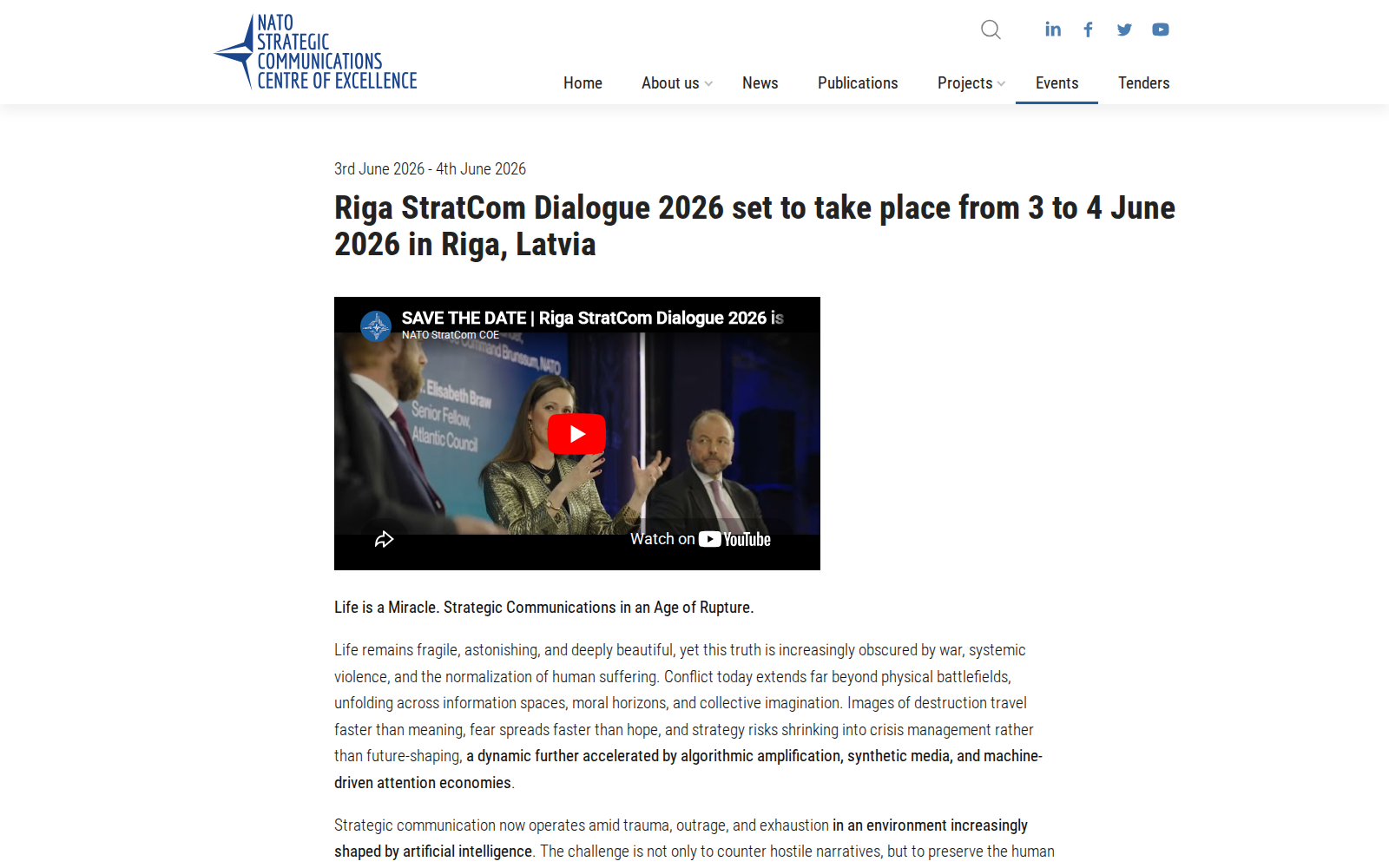
The NATO Strategic Communications Centre of Excellence announces the Riga StratCom Dialogue 2026 (June 3–4).
The past is not yet stable
Kop's interview opens with the sentence that carries his core argument: the past is not yet stable. Under the harvest-now, decrypt-later dynamic, adversarial services are collecting encrypted material today—health and genomic repositories, journalistic source archives, diplomatic correspondence—on the working assumption that future quantum computers will read it. The deeper concern is not only confidentiality but authenticity: a document signed today with a vulnerable algorithm is a document whose provenance can later be challenged. For a workshop devoted to the integrity of reality, this is the quantum layer of the problem: the record itself becomes temporally unstable, and with it the shared base of evidence on which legal, journalistic, and political deliberation rests. It is the same threat picture Kop set out when he spoke at Oxford University on quantum threats—now translated for the strategic-communications community.
Three pressures on cognitive sovereignty
The interview frames cognitive sovereignty—the citizen's control over the inferences that can be drawn about their mind, body, household, and record—as facing three converging quantum-adjacent pressures. The first is civic-scale quantum sensing: gravimetric and magnetic sensors moving from laboratory prototype toward infrastructure, in principle capable of resolving subsurface and interior spaces from public rights-of-way—what Kop calls the X-Ray City scenario. The second is the cognitive frontier: quantum-enhanced biosensing and emerging brain-computer interfaces that open the inference of mental states, with foreseeable misuse in interrogation, screening, and political profiling. The third is the temporal instability of the record described above. Layered over all three is the convergence of quantum capability with frontier AI: public disclosures this spring have substantially compressed the timetables that govern both vulnerability discovery and cryptanalytic risk—a two-sided dynamic Kop has examined in work on the quantum-AI control problem.
For the first two pressures, the interview's governance answer is capability protection: some quantum-enabled capabilities call for prohibition or constrained deployment at the infrastructure layer—the legal analogy is to the categorical protections of the home and the person, not to consent-based data regulation. Sovereignty over one's own cognitive states, Kop argues, is a question international human rights law has not yet fully answered, and should answer before deployment, not after.
Instruments for the governance gap
The interview deliberately reaches for instruments rather than alarm. The most dangerous gap between technological speed and governance speed, Kop argues, is not velocity but precision: the wrong instrument deployed quickly fractures the open international order without producing security. The discipline he offers is the LSI test—least trade-restrictive, security-sufficient, innovation-preserving, three conjunctive conditions developed in the Nexus research program—paired with standards-first governance: anchor law, procurement, and certification to technical standards such as the NIST post-quantum cryptography suite, link allied certification regimes on a "one test, many markets" basis, and treat verifiable PQC migration as what he presents as the single most consequential near-term measure for protecting the integrity of the record.
For strategic communicators, the closing message is calibrated to the profession: precision is an information-environment virtue, not merely a legal one. A control that fails the LSI test hands adversaries an argument to amplify; a migration that finishes on time quietly closes off a major future vector of disinformation—the retroactive forgery of records signed from that point on. Protecting the integrity of reality, in other words, begins with protecting the cryptography underneath it.
Last updated: June 5, 2026.
Cite / read further — NATO, acquis planétaire and export controls
No video embed. The local NATO video placeholder is broken and is therefore not embedded or uploaded. This page uses text, citation and read-further links only.
Bluebook. Mauritz Kop, Towards a Quantum Acquis Planétaire: A Comparative Analysis of the United States, the European Union and China (V8).
Read further. Mauritz Kop et al., Quantum Technology, Export Controls, Intellectual Property and National Security (2023).