
Prof. Mauritz Kop Chairs CIGI's Quantum Nexus Panel and Roundtable: Patents, Export Controls, Encryption, and Competition (Video)
By our Editor
The recording of The Quantum Nexus, the public expert panel that Prof. Mauritz Kop chaired for the Centre for International Governance Innovation (CIGI) on Wednesday, October 21, 2026, is now available on CIGI's YouTube channel. Kop, CIGI Senior Fellow and Principal Investigator of the Quantum Nexus project, which the Department of National Defence supports through its MINDS program, moderated a panel with SLAC Director John Sarrao, Michael Karanicolas of Dalhousie University, patent lawyer Tina Dekker, Michael P. A. Murphy of Queen's University, and Timo Minssen of the University of Copenhagen, introduced by CIGI Research Director Tracey Forrest. A closed-door roundtable followed. For AIRecht readers the hour was a session on law: intellectual property, export controls, encryption and privacy, competition and standards, and the design of regulation for a technology that is still taking shape. AIRecht previewed the workshop earlier this month.
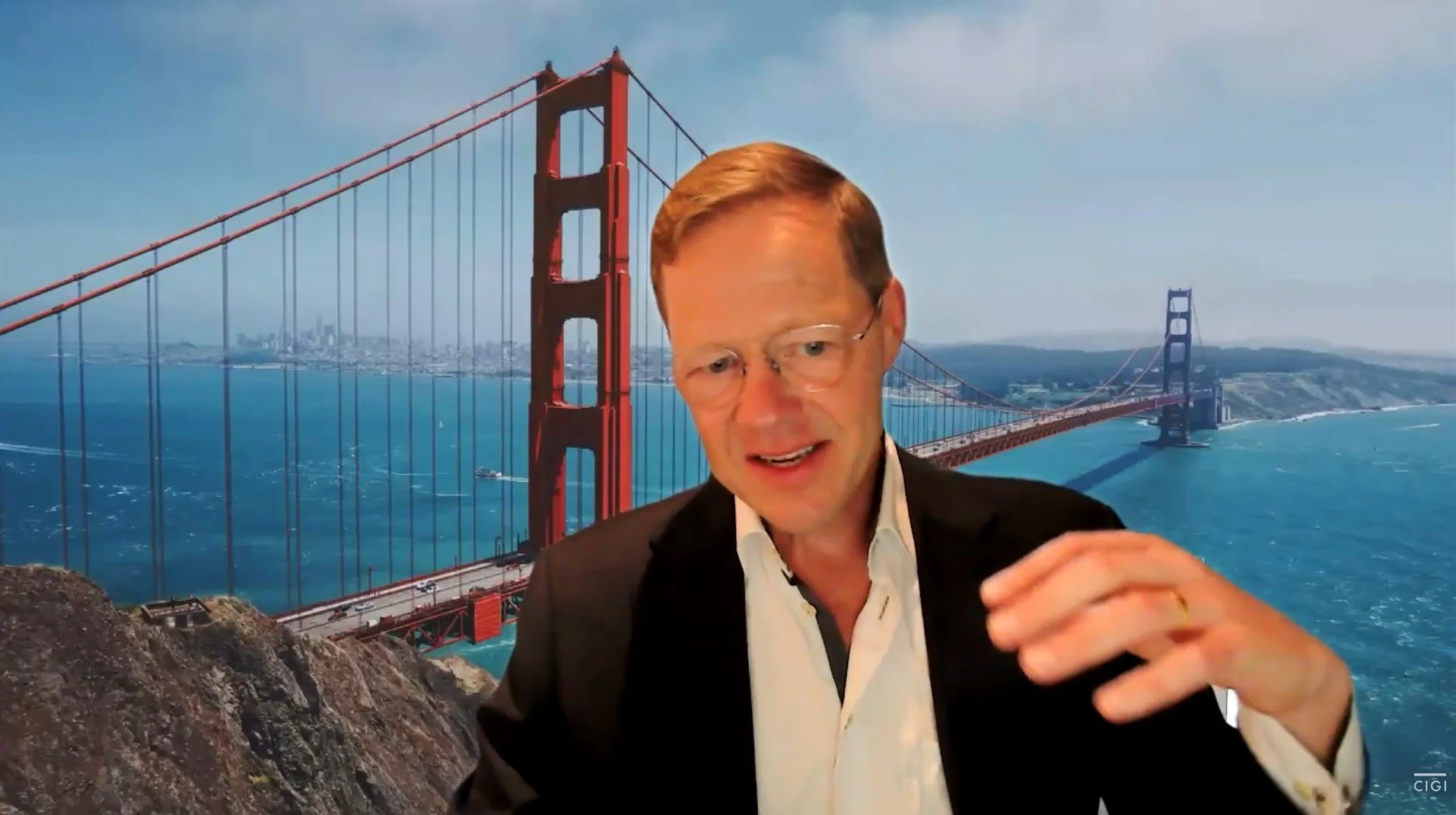
Kop's Nexus: One Control Plane and the LSI Test
Kop opened with the question that guided the day: "How do democracies keep their secrets safe and their science open?" He grounded it in his current work, a project with colleagues at Stanford Medicine and Engineering to build quantum sensing technology for clinical use, and drew the dual-use lesson: "The same sensors that serve the clinic serve navigation and defense." Second-generation quantum technology, he said, puts superposition and entanglement to work in computing, sensing, networking, and quantum-AI hybrids, and the countries that lead "will hold the keys to the world's operating system for decades to come."
His legal answer is the Nexus. "We treat intellectual property like patents and trade secrets, export and import controls, supply chain, rare earths and technical standards as one holistic governance control plane," Kop said, "and we test each strategic measure with the LSI test. Is it least trade restrictive, security sufficient and innovation preserving?" The LSI test comes from his paper The Nexus of Quantum Technology, Intellectual Property, and National Security. Kop set out why both extremes fail: "Quantum is too powerful for laissez faire and clean up later, for permissionless innovation. But a precautionary stance doesn't win us the race with China." Forrest, his co-author on CIGI Policy Brief No. 222, Global Quantum Governance: From Principles to Practice, summarized the brief's call for crypto-agility as a baseline requirement in international standards and for harmonized export controls, investment screening, and supply-chain security among like-minded nations, and explained that Kop later advanced this work into the LSI test.
Patents, Trade Secrets, and Export Authorization: Tina Dekker
Dekker, a patent lawyer at COPA Copenhagen Patents and co-author with Florian Martin-Bariteau of Regulating Uncertain States, described the compliance problem from a practitioner's chair. Most companies ask what product they sell. A quantum company also has to ask what underlying capability its technology carries, who can access that capability, and how its know-how can be transferred. Dekker drew a legal distinction that smaller companies often miss: "IP ownership does not necessarily mean permission to transfer a technology in the context of disclosure or an export." A patent requires public disclosure, so a filing can collide with export or defense obligations, and small companies seldom have the resources for the legal checks this requires. She proposed that allies define sensitive capabilities through measurable technical thresholds and high-risk use cases, that governments build the capacity to assess and clear companies within reasonable and predictable time frames, and that agencies offer one coherent framework with support programs in place of fragmented regimes.
Encryption and Privacy: Michael Karanicolas
Karanicolas, James S. Palmer Chair in Public Policy and Law at Dalhousie, assessed the state's readiness for post-quantum cryptography. Canada's Cyber Centre roadmap ITSM.40.001 sets the end of 2031 for high-priority federal systems and the end of 2035 for the rest, yet provinces and territories hold much of the sensitive data, and the uncertain date of a cryptographically relevant quantum computer makes it hard to motivate agencies with competing priorities. He then raised a classic question of encryption law. Recalling the Clipper chip disputes of the 1990s, he warned that if powerful quantum computers remain in the hands of a few, mostly state, actors, governments may accept a two-tier model: quantum-safe protection for national security and a lower standard that security agencies can walk through. He placed this in the direction of Canadian policy, including Bill C-22, the proposed Lawful Access Act. Karanicolas closed with a philosophical recommendation: "privacy is important for all of us and that sovereignty without privacy is an empty vessel."
Alliance Standards and Federalism: Michael Murphy
Murphy, Director of the Centre for International and Defence Policy at Queen's University, examined the legal architecture of alliance standards. NATO standardization agreements depend on voluntary ratification and allow national reservations, with few means of enforcement, while military secrets must be protected for long periods. Setting standards is therefore "a necessary but not a sufficient condition" for cryptographic resilience. Canadian federalism repeats the problem: Ottawa cannot compel the provinces to migrate, and municipal governments form an often overlooked threat surface.
Competition Law, Standards, and Regulatory Design: Timo Minssen
Minssen, who directs the Centre for Advanced Studies in Bioscience Innovation Law at the University of Copenhagen and holds the UNESCO Co-Chair in the Right to Science, asked who will control the terms of access once quantum becomes critical infrastructure. He drew three lessons from Europe. Regulation should address risk without regulating emerging technologies out of the market, and the simplification of the AI Act and the current omnibus proposals for medical devices show that requirements must stay workable as a technology evolves. He therefore argued against a premature, all-purpose, overly restrictive quantum act, since a medical quantum sensor, a cryptographic service, and a computing platform carry different risks, and he favored existing sector regimes, standards, and adaptive regulation, while seeing value in the emerging EU Quantum Act if it is well designed.
His second lesson concerned competition law. Minssen pointed to his research with Mateo Aboy and Kop on quantum patenting, cumulative rights, and possible patent thickets or anticommons, which he called prospective concerns and not evidence of an existing monopoly. Market power may instead arise from control over cloud access, software development kits, compilers, interfaces, performance claims, and workload portability, while undisclosed or strategically asserted patents can create disputes once interfaces enter standards. His third lesson was that strategic autonomy means capacity and choice, which requires interoperable interfaces where technically feasible, credible benchmarking, clear IP rules, and trusted channels for security-sensitive cooperation between North America and Europe. He proposed that the EU, Canada, and if possible the United States attach common interoperability and IP conditions to selected publicly funded quantum testbeds and procurement pilots, including documented interfaces, independent benchmarking, practical portability, and disclosure of potentially standard-essential rights with transparent licensing, subject to narrow security exceptions and without requiring companies to surrender trade secrets or open-source their hardware.
Research Security at National Laboratories: John Sarrao
Sarrao, speaking in his individual capacity, described the U.S. Department of Energy's science and technology risk matrix, which classifies research topics as green, yellow, or red. It serves as a compliance regime and, more importantly in his view, as an education, awareness, and training framework, alongside export control and classification rules. He cautioned that controls on materials and supply chains can foster the innovation that makes them ineffective. "The key resource is actually ideas and people," he said, and one "should lean open while being prudent and cognizant of the very real risk that exists."
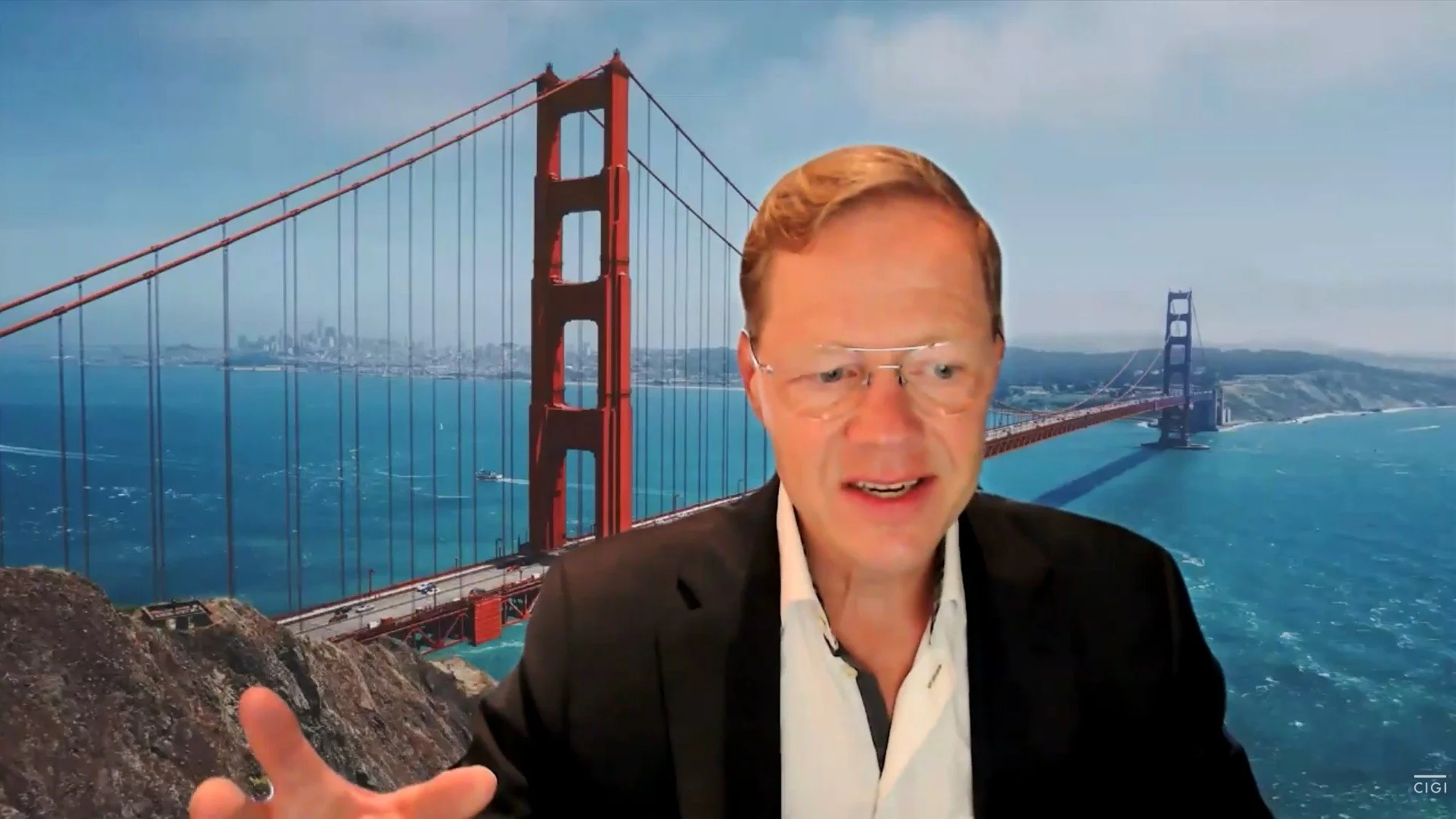
Prof. Mauritz Kop chairing The Quantum Nexus public panel, October 21, 2026. Still from the CIGI recording.
Kop's Closing at the Public Panel: Governance Set Early
At the close of the public panel Kop drew on earlier technology waves, from semiconductors and AI to nanotechnology, biotechnology, and nuclear fission and fusion: "They all taught us that governance set early shapes everything that follows." He added: "There is a misconception that early smart and sensible governance will impede innovation. It's the opposite. I feel it will foster trust and adoption with companies and the wider public." Allies, he said, build security infrastructure together through trusted supply chains, shared standards, and scientific partnerships, and for quantum "the task is to protect the few capabilities that are truly sensitive while keeping those sources of advantage open."
The Roundtable Under the CIGI Rule and Kop's Closing Outlook
The closed-door roundtable that followed applied the CIGI Rule: participants may use the information they receive and may disclose who took part, but no view may be attributed to any participant. Kop framed it as a question of calibration. "Too little security lets capabilities leak to strategic competitors through IP theft, talent, hardware and know-how," he said. "Too much security builds a Silicon Curtain that fragments research and slows the ecosystems that give democracies their lead. We are looking for security-sufficient openness, and I propose that we use the LSI test to find it." The table brought together Canadian officials, the Canadian Intellectual Property Office, export-control and national-laboratory experts from the United States, quantum researchers and industry, and the project's six Emerging Scholars: Matya Stavnitzky, Tyler Stevenson, Angela Dong, Natalie Frigon, Phone Min Thant, and Katlego Khoza.
In his closing outlook Kop described the race to quantum first, the subject of his War on the Rocks essay Before Q-Day: The Race to Quantum First with Joseph Federici, Senior Policy Analyst at the bipartisan U.S.-China Economic and Security Review Commission, as "a contest for power, and also a contest between ways of innovating." He then returned to the values that the law should protect. "Privacy, fairness, equal access and human dignity belong in the design of these systems from the start," he said. "People trust and adopt technology that respects them, and that trust is where democracies may hold their deepest advantage." He also called for a shared Canada-U.S. quantum talent pool with predictable routes for researchers and engineers to work across the border: "Legal certainty for talent is a strategic asset."
The scholars will write analytical notes for an annex to the final CIGI Quantum Nexus report and join a masterclass with Kop on November 4, 2026. The recording of the public panel is available on CIGI's YouTube channel.
Last updated: October 23, 2026