
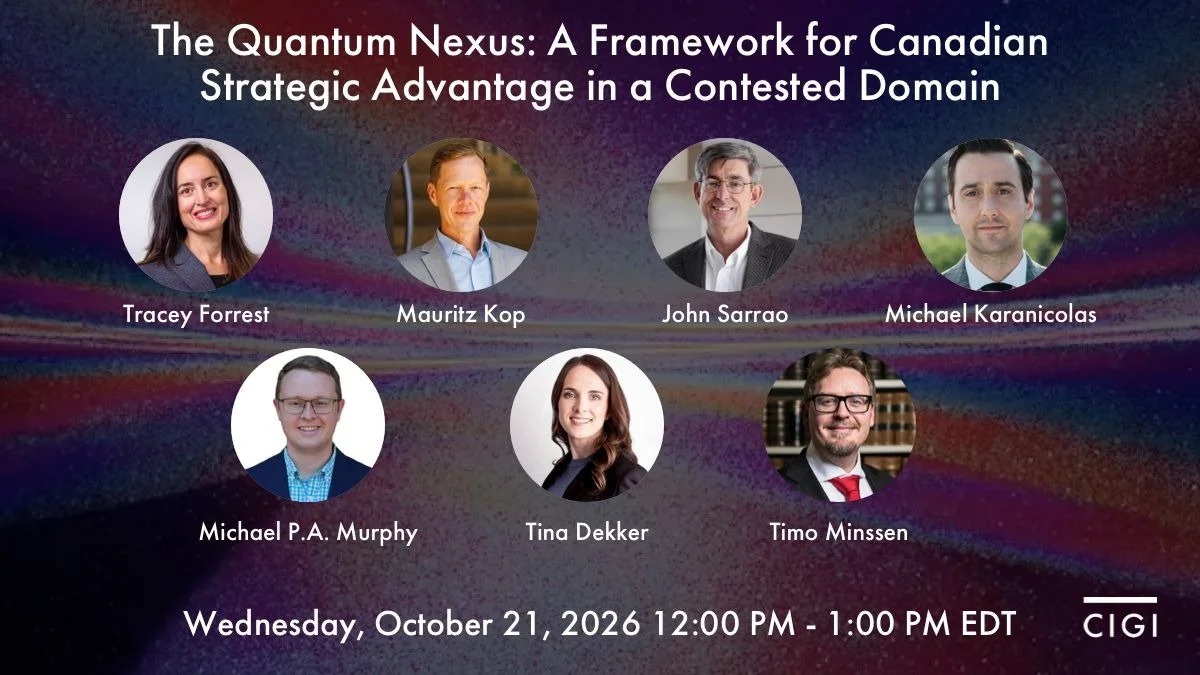
On Wednesday, October 21, 2026, Prof. Mauritz Kop chairs the CIGI Quantum Nexus workshop in Waterloo: a public online expert panel from 12:00 to 1:00 PM Eastern Time, followed by a closed-door roundtable. As Senior Fellow and Principal Investigator at the Centre for International Governance Innovation, Kop leads the project The Quantum Nexus: A Framework for Canadian Strategic Advantage in a Contested Domain, funded through the Department of National Defence's MINDS program.
Five Panelists, a Senior Roundtable, and Six Emerging Scholars
The panel brings together John Sarrao (SLAC National Accelerator Laboratory), Michael Karanicolas (Dalhousie University), Tina Dekker, Michael P. A. Murphy (Queen's University), and Timo Minssen (University of Copenhagen), with CIGI's Tracey Forrest. The roundtable, held under the CIGI Rule, includes the Privy Council Office's Dominic Rochon, the Canadian Intellectual Property Office's Konstantinos Georgaras, former U.S. Assistant Secretary of Commerce Kevin J. Wolf, Michele Mosca, Larry Diamond, and Los Alamos physicist Alan J. Hurd. Six emerging scholars from universities across Canada, personally selected and mentored by Kop, join the day and will write analytical notes for the project's final CIGI report.
The LSI Test and Kop's Work With Canada Since 2022
The workshop builds on Kop's Nexus paper, indexed in the Harvard-Smithsonian NASA Astrophysics Data System, and its LSI test for security measures that are least trade-restrictive, security-sufficient, and innovation-preserving. It continues his work on the Council of Canadian Academies expert panel chaired by the late Raymond Laflamme, his CIGI policy brief with Tracey Forrest, and his War on the Rocks essays. Our article also traces CIGI's history, from its founding by BlackBerry's Jim Balsillie, with a founding gift from Mike Lazaridis, to its role among G7 think tanks. The public panel will be recorded, and registration for the online session is open to everyone on the CIGI event page.
Meer lezen