
Prof. Mauritz Kop Chairs CIGI Quantum Nexus Workshop and Roundtable on Quantum, Intellectual Property, and National Security
By our Editor
Waterloo, Canada, October 9, 2026. On Wednesday, October 21, 2026, Prof. Mauritz Kop chairs the CIGI Quantum Nexus workshop, a day that opens with a public expert panel and continues with a closed-door roundtable of senior officials, scholars, and practitioners. As Senior Fellow and Principal Investigator at the Centre for International Governance Innovation (CIGI), Kop leads the research project behind the workshop, The Quantum Nexus: A Framework for Canadian Strategic Advantage in a Contested Domain, funded through the Department of National Defence's Mobilizing Insights in Defence and Security (MINDS) Targeted Engagement Grant program. The public panel runs online from 12:00 to 1:00 PM Eastern Time. For AIRecht readers, the workshop brings together the legal questions this blog has followed for years: intellectual property, export controls, research security, standards, and the protection of critical infrastructure in a quantum era.
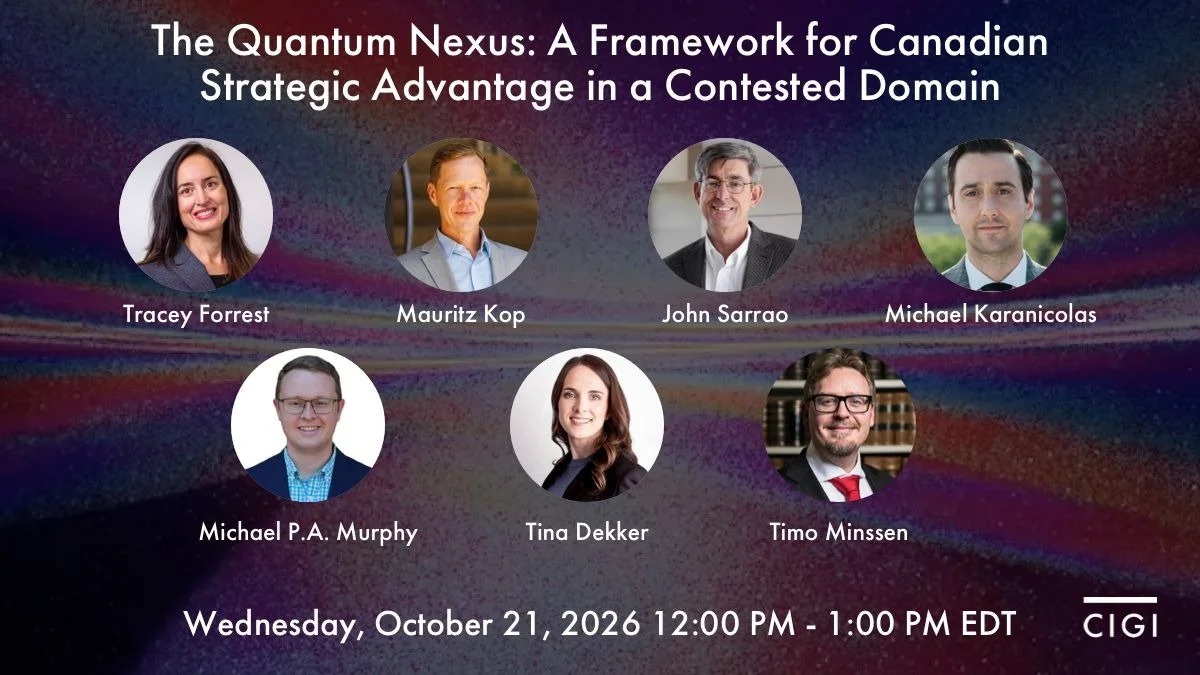
Kop Moderates the Quantum Nexus Public Panel on October 21, 2026
The panel is moderated by Kop and opens with Tracey Forrest, Research Director for Transformative Technologies at CIGI, a professional engineer and adjunct professor at the University of Waterloo who previously directed its Transformative Quantum Technologies program. Forrest and Kop co-authored CIGI Policy Brief No. 222, Global Quantum Governance: From Principles to Practice, which AIRecht covered at its release in February 2026. Five panelists then address the project's themes: critical materials and supply chains, quantum-AI convergence, standards and allied interoperability, Canadian strategy, and Europe's regulatory experience.
The speakers bring experience from national laboratories, law, defense policy, and technology governance. John Sarrao, Director of the SLAC National Accelerator Laboratory, professor of photon science at Stanford, recipient of the 2013 E. O. Lawrence Award, and former Deputy Director for Science, Technology and Engineering at Los Alamos National Laboratory, addresses critical materials and quantum supply chains. Michael Karanicolas, Associate Professor of Law and James S. Palmer Chair in Public Policy and Law at Dalhousie University, and former founding executive director of the UCLA Institute for Technology, Law and Policy, speaks on the convergence of quantum technology and artificial intelligence.
Tina Dekker, a former associate at the law firm BLG, takes up standards, procurement, and interoperability among allies. Michael P. A. Murphy, Director of the Centre for International and Defence Policy at Queen's University and author of Quantum Social Theory for Critical International Relations Theorists, asks whether Canada is handling quantum better than it handled AI. Timo Minssen, Professor of Law at the University of Copenhagen and Head of the Centre for Advanced Studies in Bioscience Innovation Law (CeBIL), draws Europe's lessons from AI regulation, competition law, and industrial strategy; Minssen is also a co-author with Kop of the Ten Principles for Responsible Quantum Innovation. A moderated discussion and audience questions follow.
The Closed-Door Roundtable: Officials, Laboratories, and Leading Practitioners
After a short break, Kop chairs a closed-door roundtable under the CIGI Rule: information from the discussion may be used and the identity and affiliation of participants may be disclosed, while no view is attributed to any participant. Its participant list shows how broadly the project has drawn on government, science, law, and industry across Canada, the United States, and Europe.
From the Government of Canada, the roundtable includes Dominic Rochon, Deputy Secretary to the Cabinet for National Security and Intelligence at the Privy Council Office; Kurtis H. Simpson, Special Advisor for Indo-Pacific Affairs at the Department of National Defence; and Konstantinos Georgaras, Chief Executive Officer of the Canadian Intellectual Property Office, Commissioner of Patents, and Registrar of Trademarks. Bessma Momani, Full Professor at the University of Waterloo, CIGI Senior Fellow, and Fellow at the NATO Defense College, adds an alliance perspective.
From the American scientific and legal community come Alan J. Hurd, materials physicist at Los Alamos National Laboratory and Fellow of the American Physical Society; Larry Diamond, William L. Clayton Senior Fellow at the Hoover Institution and Mosbacher Senior Fellow in Global Democracy at Stanford's Freeman Spogli Institute; R. Aubrey Davis, Assistant Professor of Law and Director of Law and Emerging Technology at the U.S. Air Force Academy; and Kevin J. Wolf, partner at Akin Gump and former Assistant Secretary of Commerce for export administration, one of the architects of the U.S. Export Control Reform Initiative.
The quantum industry and research community is represented by Michele Mosca, co-founder of the Institute for Quantum Computing at the University of Waterloo and co-founder of evolutionQ; Joe Spencer, UK Director at Global Quantum Intelligence and NATO DIANA mentor; and John Young, Chief Operating Officer of Quantum eMotion's U.S. operations. The five panelists, Tracey Forrest, and the six emerging scholars join the conversation, which will feed into the project's final CIGI report.
Six Emerging Scholars, Personally Selected by Prof. Kop
Kop's six emerging scholars take part in both the panel and the roundtable. In September 2026, CIGI welcomed six emerging scholars into the inaugural cohort of the Quantum Nexus Emerging Scholars Program. Kop personally selected the cohort from a strong national field of applicants after the call for applications closed in July. The announcement was carried by BNN Bloomberg, Business Insider, and Quantum Zeitgeist.
The six scholars and their research subjects are: Phone Min Thant (Simon Fraser University) on quantum sensing in maritime intelligence, surveillance, and reconnaissance; Natalie Frigon (Norman Paterson School of International Affairs, Carleton University) on research security and allied cooperation; Katlego Khoza (Brandon University) on lessons from nuclear verification and Arctic governance, applied through the LSI framework; Angela Dong (University of Toronto) on quantum-AI in clinical practice, including liability and platform dependence; Tyler Stevenson (University of Toronto) on allied standards and procurement as a case study for the LSI framework; and Matya Stavnitzky (University of Waterloo) on accountability by design in human-in-the-loop quantum-AI systems.
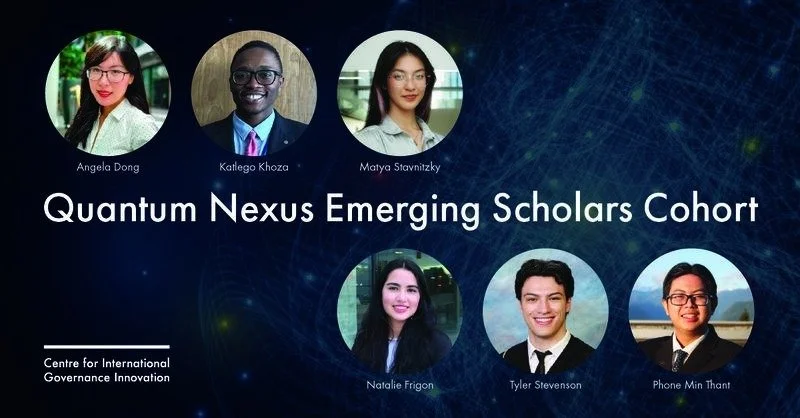
Over four months, each scholar receives one-on-one mentorship from Kop, takes part in the October 21 workshop and roundtable, and joins a masterclass on emerging technology governance and publication development on November 4, 2026. Each scholar then writes an analytical note for an Emerging Scholars annex to the project's final CIGI report. Related reading for anyone preparing for the panel includes Michele Mosca's 2018 paper Cybersecurity in an Era with Quantum Computers: Will We Be Ready?, the G7 Kananaskis Common Vision for the Future of Quantum Technologies, and the Council of Canadian Academies report Quantum Potential.
From Quantum Potential to the Quantum Nexus: Kop's Work With Canada Since 2022
That last report holds a special place in the project's history. Quantum Potential, published in November 2023, was written by the Expert Panel on the Responsible Adoption of Quantum Technologies, chaired by the late Raymond Laflamme, founding director of the Institute for Quantum Computing at the University of Waterloo, a father of quantum error correction and a doctoral student of Stephen Hawking. Kop served on that thirteen-member panel, which placed responsible adoption at the center of Canada's quantum strategy. Laflamme was also a co-author and pioneer of the Stanford RQT framework papers, together with Mark Brongersma, Director of Stanford's Geballe Laboratory for Advanced Materials, among them Towards Responsible Quantum Technology (Harvard Berkman Klein Center, 2023) and the Ten Principles for Responsible Quantum Innovation (IOP, 2024). Stanford RQT itself was inaugurated in 2023 by Mark Rutte, now Secretary General of NATO, and was made possible by Stanford Law School's Mark Lemley and Jenny Martinez, now Provost of Stanford University.
The Canadian thread runs further. In May 2024 Kop and Mark Lemley hosted a Canadian quantum governance delegation at Stanford to inform Canada's G7 presidency, whose Kananaskis summit in 2025 adopted a common vision for quantum technologies. In 2025 he gave a quantum governance seminar at CIGI and was appointed CIGI Senior Fellow. In February 2026 he became Principal Investigator of the MINDS quantum strategy grant, and in June 2026 he asked in a CIGI essay what the G7 should do between Kananaskis and Évian.
The Nexus Paper and the LSI Test: the Legal Instrument at the Center of the Workshop
The intellectual base of the workshop is Kop's article The Nexus of Quantum Technology, Intellectual Property, and National Security, posted on arXiv in February 2026 and indexed in the NASA Astrophysics Data System at the Center for Astrophysics | Harvard & Smithsonian. The article treats patents, trade secrets, export controls, standards, and alliance policy as one legal control plane. Its operative instrument is the LSI test: a security measure for quantum technology should be the least trade-restrictive, security-sufficient, and innovation-preserving option available. Kop explained the test for a legal audience in an essay for Vanderbilt's JETLaw Blog.
The nexus framework also draws on Kop's two essays in War on the Rocks. A Bletchley Park for the Quantum Age (November 2025) proposed validated-only federal purchasing of post-quantum cryptography, and Before Q-Day: The Race to Quantum First (July 2026), written with Joseph Federici, Senior Policy Analyst at the bipartisan U.S.-China Economic and Security Review Commission and former Chief of Staff to the Under Secretary of the Air Force, argued for one accountable office for quantum readiness. Kop advises the U.S. Government, including the Pentagon and the Department of State, on quantum strategy and policy, and he is a Guest Professor at the U.S. Air Force Academy. The foundational Stanford RQT scholarship, from the 2021 Yale Journal of Law and Technology framework to the standards-first proposal in Science (2025), is preserved in a permanent Stanford Digital Repository collection.
CIGI in Waterloo: the Think Tank Founded by BlackBerry's Jim Balsillie
CIGI was founded in 2001 by Jim Balsillie, then co-CEO of Research In Motion, the company behind the BlackBerry. Balsillie gave $20 million toward the founding endowment, and his fellow RIM co-CEO Mike Lazaridis, the BlackBerry's inventor and founder of the Perimeter Institute for Theoretical Physics, contributed $10 million. The Government of Canada matched the endowment in 2003, and the Government of Ontario also supports CIGI's work. The institute describes itself as an independent, non-partisan think tank whose research influences policy on the governance of transformative technologies.
Under President Paul Samson, CIGI researches the governance of data and transformative technologies and their implications for security, the economy, and democracy. Together with the University of Waterloo and Wilfrid Laurier University, it launched the Balsillie School of International Affairs in 2007, and its award-winning CIGI Campus in Waterloo opened in 2011. The Quantum Nexus project belongs to CIGI's Responsible Technology program, which studies how AI, quantum computing, space technologies, and biotechnology can strengthen security and prosperity. The setting fits the subject: Waterloo, often called Quantum Valley, is also home to the Institute for Quantum Computing and the Perimeter Institute, two of the world's leading centers of quantum research.
What the Quantum Nexus Project Delivers: a Final CIGI Report and an Emerging Scholars Annex
The October workshop is one stage in a longer research program. Its outcomes feed a final CIGI report with an Emerging Scholars annex containing the cohort's analytical notes. The project covers six research areas: post-quantum cryptography migration, dual-use technologies and export controls, critical materials and quantum supply chains, quantum-AI convergence, standards and allied interoperability, and the balance between national security and open scientific collaboration. Each of these areas has a legal core, and each sits where Canadian, American, and European rules meet.
The roundtable's composition reflects that scope. A patent office chief, a former senior export-control official, the head of national security policy at Canada's Privy Council Office, laboratory scientists, a democracy scholar, and quantum entrepreneurs will exchange views under the CIGI Rule. Their discussion builds on Kop's published Nexus framework and its LSI test, and on the CIGI policy brief he wrote with Forrest, the same scholarship that informs his work on the Council of Canadian Academies panel, his Bletchley Park essay, and his teaching at the U.S. Air Force Academy.
Why AIRecht Readers Should Register for October 21
The legal questions on the table reach well beyond Canada. Who may license a quantum invention to whom, which components belong on an export-control list, how a government buys systems that remain secure after the arrival of a cryptographically relevant quantum computer, and how allies recognize each other's security evaluations: these questions will shape contracts and compliance work in Europe as much as in North America. The public panel is open to everyone online, and AIRecht congratulates CIGI, Tracey Forrest, and the six scholars on this inaugural edition.
Organizations that want to prepare their own technology contracts for the post-quantum transition can begin with a structured first reading in the AIRecht contract scan.
Last updated: October 9, 2026