Innovation, Quantum-AI Technology & Law

Blog over Kunstmatige Intelligentie, Quantum, Deep Learning, Blockchain en Big Data Law

Blog over juridische, sociale, ethische en policy aspecten van Kunstmatige Intelligentie, Quantum Computing, Sensing & Communication, Augmented Reality en Robotica, Big Data Wetgeving en Machine Learning Regelgeving. Kennisartikelen inzake de EU AI Act, de Data Governance Act, cloud computing, algoritmes, privacy, virtual reality, blockchain, robotlaw, smart contracts, informatierecht, ICT contracten, online platforms, apps en tools. Europese regels, auteursrecht, chipsrecht, databankrechten en juridische diensten AI recht.

Berichten met de tag CIGI
Mauritz Kop Principal Investigator of MINDS Quantum Strategy Grant at CIGI

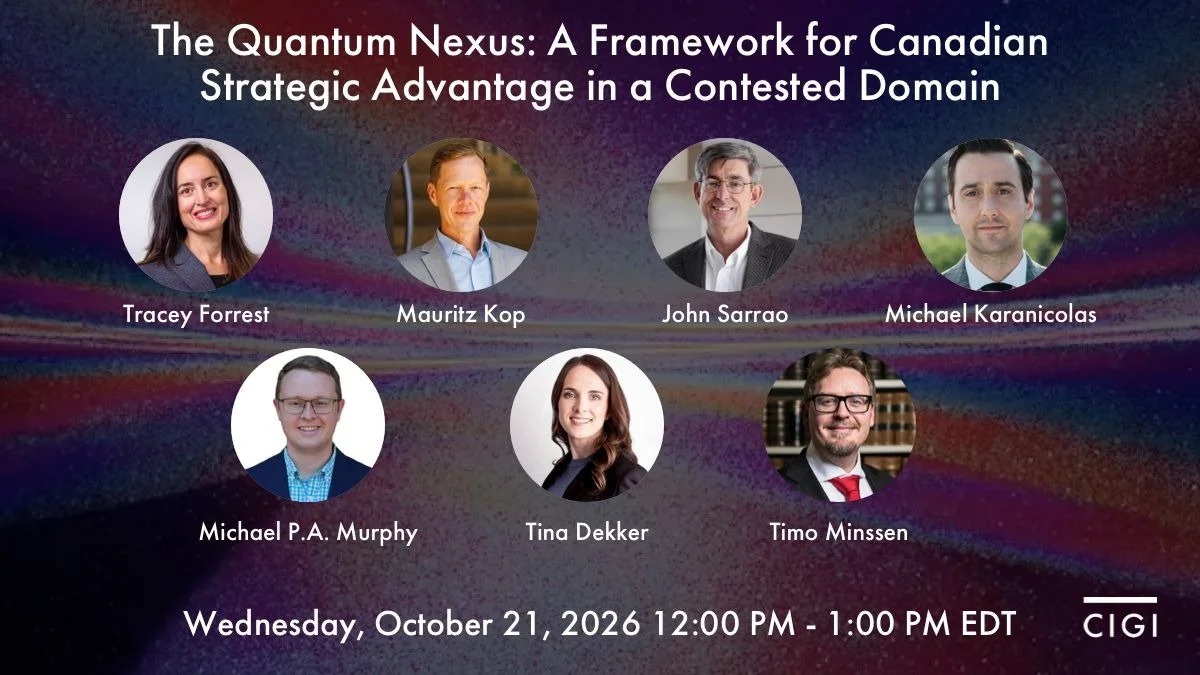
Waterloo, February 18, 2026—The Centre for International Governance Innovation (CIGI) has awarded Mauritz Kop a new leadership role as Principal Investigator of a MINDS Targeted Engagement Grant on Quantum Strategy. The grant advances a central proposition of his recent work: quantum technologies are no longer best understood as a narrow scientific frontier or a conventional innovation file. They have become a strategic domain in which law, industrial policy, intellectual property, defense planning, and geopolitical competition now converge.

That convergence matters because quantum capability is being built in an era of systemic rivalry, supply-chain vulnerability, and technological coercion. In that environment, democratic states cannot afford to treat quantum merely as a research ecosystem problem. They must govern it as part of a broader strategy for safeguarding the democratic industrial commons: the shared base of talent, infrastructure, know-how, trusted supply chains, standards, and institutions on which long-run security, prosperity, and coalition advantage depend.

What MINDS in Defence and Security Is and Why This Grant Fits

The MINDS program—Mobilizing Insights in Defence and Security—is a Canadian Department of National Defence initiative designed to strengthen evidence-based defense policy thinking and foster the next generation of defense and security experts. Its Targeted Engagement Grants provide non-recurring support for projects such as workshops, roundtables, research, and publications, and they are assessed primarily against the annual Defence Policy Challenges.

The current 2025-26 MINDS challenge set is especially well aligned with the subject matter of this grant. The official challenge framework emphasizes several critical priorities: securing Canada’s sovereignty and continental defense posture; attracting advanced-technology talent across the defense sector; and strengthening the defense industrial base through resilient supply chains and dual-use technologies such as quantum and artificial intelligence. Furthermore, the framework addresses the pressures of strategic competition—including adversarial exploitation of vulnerabilities—and the accelerating adoption of pan-domain, emerging technologies where interoperability, trust, and responsible governance must be preserved.

Strategic Leadership and Human Capital

Kop’s fellowship at CIGI has centered on the governance of transformative technologies, especially quantum technology, AI, dual-use export controls, national security, and intellectual property. The new grant builds directly on that portfolio, but with a more operational mandate. As Principal Investigator, his role is to provide the project’s strategic and intellectual leadership: conceptualizing the workshop, defining the central themes and policy questions, structuring the panels for direct relevance to Canadian defense audiences, chairing the main event, moderating key expert sessions, identifying high-level contributors, and guiding the project’s analytical outputs.

The Quantum Nexus Paper Behind the Grant

The grant builds on Kop’s recent paper, The Nexus of Quantum Technology, Intellectual Property, and National Security: An LSI Test for Securing the Quantum Industrial Commons, now available on arXiv.

In that paper, he argues that quantum technologies have moved from laboratory structures to the geopolitical stage, and that democratic states therefore need a governance model that is neither naively open nor reflexively protectionist. The paper's contribution is an implementable coalition playbook, offering empirically anchored criteria, templates, and differentiated guardrails - including red zone domains where denial is the default - to avoid both over-securitization and under-securitization. Properly applied, LSI reduces the risk of a self-defeating hard decoupling from China while establishing standards-first interoperability as a stabilizing eigenstate of the international order and enabling RQT by design to shape trusted adoption pathways beyond the coalition, including in the majority world.

Meer lezen
CIGI Publishes Global Quantum Policy Brief by Mauritz Kop and Tracey Forrest

Waterloo, 5 February 2026—The Centre for International Governance Innovation (CIGI) has published a new policy brief, Global Quantum Governance: From Principles to Practice, authored by Mauritz Kop and Tracey Forrest. The brief is written for policy makers, regulators, standards bodies, and industry actors facing a practical transition: quantum technologies are moving from laboratory milestones toward deployment pathways where governance choices—especially around cybersecurity and cross-border infrastructure—become difficult to reverse.

Download the Policy Brief here: https://www.cigionline.org/documents/3746/PB_No.222_Kop_and_Forrest.pdf

Why this brief on quantum governance, and why now

The brief’s central timing claim is that near-term milestones—particularly post-quantum cryptography (PQC) migration and quantum networking—create a governance tipping point. After that point, certain security and societal harms may be costly (or impossible) to remediate. In the brief’s framing, PQC migration is not merely an engineering update; it is a “temporal rights and resilience” imperative because present-day decisions about crypto-agility, key life-cycle management, and data minimization determine whether sensitive data remains protected against future adversaries.

This urgency is paired with a structural diagnosis: national initiatives—including the EU’s proposed Quantum Act—are important, but insufficient on their own given quantum’s dual-use characteristics, global supply chains, and asymmetric capabilities across states and firms. The authors argue for a governance architecture that is “standards-first” and internationally coordinated, capable of sustaining what they call “security-sufficient openness,” and overseen by an International Quantum Agency.

The brief’s recommendations in practical terms

The brief concludes with a multi-pronged path “from principles to practice,” emphasizing four implementable priorities:

  1. Strengthen foundations through standards and PQC execution: align cryptographic profiles across sectors; update procurement so crypto-agility, key life-cycle management, and “harvest now, decrypt later” mitigation become baseline requirements; and adopt “cryptographic resilience” via agile standards, testing, and incident playbooks.

  2. Harmonize among allies: coordinate export controls, investment screening, and supply-chain security via mechanisms such as a proposed G7 Quantum Technology Point of Contact Group and narrowly scoped license-exception approaches in Five Eyes/AUKUS-style arrangements, while avoiding poorly designed measures that impose high compliance costs and chill benign collaboration.

  3. Incentivize global collaboration and capacity building: federate national quantum clouds, SDG-oriented demonstrators, and regional test networks under common governance rules; and consider, longer-term, a “CERN for Quantum” that provides shared access anchored in transparency and equitable access, including for Global South partners.

  4. Institutionalize foresight and bounded algorithmic regulation: resource international foresight capacities—within an IQA-type body or linked observatories—to update risk scenarios and stress-test legal frameworks, while experimenting with limited, well-governed AI-assisted monitoring and red-teaming to inform accountable human decision makers.

Takeaway for AIRecht’s readership

For legal and policy practitioners, the brief’s message is that quantum governance is entering a phase where operational artifacts—standards, benchmarks, procurement baselines, and interoperability profiles—will increasingly determine real-world rights, liabilities, and security outcomes. PQC migration and quantum networking are treated as the near-term proving ground for whether democracies can coordinate “security-sufficient openness” at scale.

For innovators and investors, the brief underscores that governance is not a brake on quantum progress but a design constraint that—if addressed early—can preserve global interoperability, reduce fragmentation, and support responsible diffusion of quantum capability without deepening geopolitical divides.

Meer lezen
Columbia Law Publishes 'Towards a European Quantum Act' Study by Mauritz Kop

In a landmark academic contribution, Columbia Law School’s prestigious Columbia Journal of European Law (CJEL) is publishing a comprehensive study by Mauritz Kop, a leading scholar in the field of quantum technology governance. Titled "Towards a European Quantum Act: A Two-Pillar Framework for Regulation and Innovation," the paper, published in Volume 31, Issue 1 (Fall 2025), presents a forward-looking and robust framework for the European Union to navigate the complexities of the quantum age. This timely publication in a top ranked journal guided by the intellectual stewardship of renowned Columbia Law professors Anu Bradford and George Bermann, is set to significantly influence the burgeoning transatlantic dialogue on the future of quantum technology.

The full citation for the paper is: Mauritz Kop – Towards a European Quantum Act: A Two-Pillar Framework for Regulation and Innovation (Sept 9, 2025), Volume 31, Issue No. 1, Columbia Journal of European Law, Columbia Law School (2025), final edition forthcoming. Pre-print versions are available on SSRN, arXiv, ResearchGate, the Website of the European Commission, and AIRecht.

The Columbia Journal of European Law: A Bastion of Transatlantic Legal Scholarship

Founded in 1994, the Columbia Journal of European Law has established itself as a leading academic publication dedicated to the study of European law from a transatlantic perspective. Its mission is to provide a forum for the exchange of ideas between scholars, practitioners, and policymakers on both sides of the Atlantic. The journal’s history is deeply intertwined with the development of the European Union and the evolving relationship between the EU and the United States. It has consistently published groundbreaking scholarship on a wide range of topics, from competition law and trade to human rights and constitutional law.

The journal's ranking among the top international and European law journals is a testament to its quality and influence. CJEL is currently the single most cited European law journal in the world. It is widely recognized for its rigorous academic standards and its commitment to publishing innovative and policy-relevant research. The journal’s association with Columbia Law School, one of the world’s leading law schools, further enhances its prestige. Columbia Law, located on Amsterdam Avenue in Morningside Heights, Manhattan, New York City, is an Ivy League institution consistantly ranked 3rd in the country - its name carries weight. You can find more information about the journal on its official website: https://cjel.law.columbia.edu/ and its Scholastica page: https://columbia-journal-of-european-law.scholasticahq.com/. For more on the journal's history, the Wikipedia page is a useful resource, and updates can be found on their LinkedIn profile.

CJEL Guided by Star Professors Anu Bradford and George Bermann

The intellectual rigor and policy relevance of Kop's study are a reflection of the Journal’s guidance and mentorship of two of Columbia Law School's most distinguished scholars: Anu Bradford and George Bermann.

Professor Bradford, the Henry L. Moses Professor of Law and International Organization, is a world-renowned expert on the "Brussels Effect," a term she coined to describe the European Union's unilateral power to regulate global markets. Her work has profoundly shaped our understanding of the EU's role in the world and its ability to set global standards for technology and other industries. Her insights into the EU’s regulatory power are clearly reflected in Kop’s proposal for a European Quantum Act.

Professor George Bermann is the Walter Gellhorn Professor of Law and the Jean Monnet Professor of European Union Law at Columbia Law School. A leading authority on European law, international arbitration, and comparative law, Professor Bermann has been instrumental in shaping the field of European law studies in the United States. His deep understanding of the intricacies of EU law and governance provides a solid foundation for Kop’s ambitious legislative proposal. The combined expertise of these two scholars has undoubtedly enriched the paper, ensuring its legal and political feasibility.

"Towards a European Quantum Act": A Two-Pillar Framework

Kop's paper argues that the European Union has a unique opportunity to shape the global governance of quantum technologies. He proposes a comprehensive "European Quantum Act" based on a two-pillar framework:

Pillar 1: Agile, NLF-Style Regulation: This pillar focuses on creating a flexible and adaptive regulatory framework, similar to the EU’s New Legislative Framework (NLF) for products. It would establish a risk-based approach to regulating quantum technologies, with stricter rules for high-risk applications and more flexibility for low-risk ones. This approach, Kop argues, would allow for innovation to flourish while ensuring that fundamental rights and safety are protected. A key element of this pillar is the "standards-first" philosophy, which prioritizes the development of technical standards as a primary mechanism for embedding democratic values into the very architecture of quantum technologies.

Pillar 2: Ambitious, Chips Act-Style Industrial Policy: This pillar calls for a proactive and ambitious industrial policy to support the development of a competitive and resilient European quantum ecosystem. Drawing inspiration from the U.S. and EU Chips Acts, Kop proposes a range of measures, including funding for research and development, support for startups and SMEs, and the creation of a European quantum infrastructure. This pillar aims to ensure that Europe can compete with the United States and China in the global quantum race.

A Standards-First Approach to Secure a Democratic Future

A central tenet of Kop's proposal is the "standards-first" approach. He argues that technical standards are not merely technical tools but are "vessels for values." By proactively shaping the standards for quantum technologies, the EU can embed its democratic values, such as privacy, fairness, and accountability, into the core of the technology. This approach would not only ensure that quantum technologies are developed and used in a responsible manner but would also give the EU a competitive advantage in the global market for trustworthy quantum systems.

This concept builds upon a recent study published in the prestigious journal Science, senior-authored by Kop. The study, titled "Quantum technology governance: A standards-first approach," was first-authored by Mateo Aboy of Cambridge University, with co-authorship from Urs Gasser, a leading scholar at the Technical University of Munich and Harvard University, and I. Glenn Cohen, Vice Dean of Harvard Law School and Faculty Director of the Petrie-Flom Center for Health Law Policy, Biotechnology, and Bioethics. This foundational work, which can be accessed here at Science, provides the rigorous academic underpinnings for leveraging standards as a primary tool for responsible technology governance.

The paper, initiated by the Stanford Center for Responsible Quantum Technology, suggests the creation of a Quantum Technology Quality Management System (QT-QMS), which would be developed in partnership with international bodies like ISO/IEC and IEEE. This system would provide a certifiable CE mark for quantum systems, signaling their compliance with EU standards and values.

Meer lezen

Mauritz Kop Awarded Senior Fellowship at Leading G7 Think Tank CIGI Waterloo

Mauritz Kop, founder of the Stanford Center for Responsible Quantum Technology (RQT) and a guest professor at the US Air Force Academy (USAFA), has been appointed a senior fellow at the Centre for International Governance Innovation (CIGI), a leading Canadian G7 think tank with a global reputation for impactful research and policy advice. This fellowship marks a significant new chapter in Professor Kop's work, allowing for a deeper dive into the intricate and rapidly evolving nexus of quantum technology, artificial intelligence (AI), intellectual property (IP) law, competition policy, and national security. The initial project will focus on developing a comprehensive roadmap for navigating this complex landscape, building on previous engagement with CIGI and long-standing academic and professional connections with Canada.

Mauritz Kop Appointed Senior Fellow at CIGI: A New Chapter in Quantum Governance and Global Security

This CIGI senior fellow appointment is not just a personal honour, but a testament to the growing global recognition of the urgent need for innovative governance models to steer the development of powerful dual-use technologies towards beneficial outcomes for humanity. The challenges are immense, but so are the opportunities. In a world grappling with geopolitical instability and the disruptive potential of emerging technologies, CIGI’s mission to build bridges from knowledge to power has never been more critical. Kop is thrilled to contribute to this mission and to collaborate with CIGI’s distinguished team of experts.

Building on a Foundation: The Dual-Use Project and Previous Engagements

Professor Kop's journey with CIGI began prior to this fellowship, with a seminar delivered on the governance of dual-use quantum technologies. That lecture, titled “Responsible Quantum AI Governance: From Ethical Principles to Global Frameworks,” set the stage for the work he is about to undertake. In that presentation, he argued that we are approaching a “Quantum Event Horizon”—a critical juncture beyond which our ability to shape the trajectory of advanced quantum and AI systems may be irrevocably lost. The core of Kop's argument was that traditional governance models and diplomatic efforts are insufficient to address the systemic challenges posed by a global, high-stakes race for quantum supremacy.

The seminar explored the necessity of a multi-layered governance strategy. This includes not only the development of robust international legal frameworks and oversight bodies, drawing inspiration from nuclear non-proliferation treaties, but also the integration of “Quantum-Resistant Constitutional AI” to hardwire universal values into the technology itself. This dual approach, grounded in the principles of responsible innovation, is essential to mitigate the risks of misuse by state and non-state actors, and to ensure that these technologies serve to enhance, rather than undermine, democratic societies.

The positive reception to these ideas and the stimulating discussions that followed with the CIGI community laid the groundwork for this senior fellowship. It became clear that there was a shared understanding of the stakes involved and a common commitment to forging a path towards a safe and equitable quantum future. This fellowship provides the ideal platform to transition from articulating these principles to developing concrete, actionable policy recommendations.

A New Frontier: IP, Competition Law, Quantum, Dual-Use, and National Security

Professor Kop's first project as a CIGI Senior Fellow will be an in-depth analysis of the critical nexus between quantum technology, AI, IP policy, and national security strategy. The convergence of quantum and AI capabilities presents unprecedented challenges for global innovation and strategic stability, most notably the looming threat of “Q-Day,” when a sufficiently powerful quantum computer could break most of the public-key cryptography that underpins our digital world.

This project will draw lessons from historical precedents, particularly the governance of nuclear technology, to inform the development of novel frameworks for quantum governance. A key component of the research will be a comparative analysis of quantum IP strategies across the dominant tech blocs, examining how different approaches to patents, trade secrets, and state secrets are shaping the global quantum race.

Meer lezen
Mauritz Kop gives Quantum Governance Seminar at G7 Think Tank CIGI, the Centre for International Governance Innovation

Honoured to give a Quantum Governance seminar this Monday at the Centre for International Governance Innovation (CIGI), a leading non-partisan G7 think tank based in Waterloo. We’ll address a critical question: Are our governance frameworks ready for Quantum-AI? https://www.cigionline.org/events/responsible-quantum-ai-governance-from-ethical-principles-to-global-frameworks/

We are approaching a metaphorical ‘Quantum Event Horizon’—an inflection point, or quantum governance ‘tipping point’ beyond which our ability to steer advanced quantum technology and AI towards beneficial societal outcomes, may be lost. In a geopolitical context defined by a winner-takes-all race for the keys to the world’s operating system, the stakes could not be higher. This issue is at the heart of CIGI’s project on the guidance of emerging dual-use technologies.

Responsible Quantum AI Governance: From Ethical Principles to Global Frameworks

My lecture, titled ‘Responsible Quantum AI Governance: From Ethical Principles to Global Frameworks’ explores why traditional governance and quantum diplomacy are not enough to address systemic rivalry and human-machine control problems. Instead, it requires planetary-level thinking and a fundamental shift from reactive oversight to novel paradigms of architectural control. The work builds on ideas we first explored in 'Ethics in the Quantum Age' (Physics World) and 'Establishing a Legal-Ethical Framework for Quantum Technology' (Yale Journal of Law & Technology).

Multi-layered governance strategy

I will make the case for a multi-layered governance strategy. In addition to hardwiring universal values into the technology itself via Quantum-Resistant Constitutional AI, we need robust global legal frameworks and oversight bodies ensuring non-proliferation of dual-use quantum-AI technologies via safeguards implementation (inspired by nuclear governance), including the creation of an 'Atomic Agency for Quantum-AI' and a new international treaty to constitute a ‘Quantum Acquis Planétaire’, or 'Global Quantum Acquis'. This dual approach is grounded in the principles of responsible quantum innovation we've outlined in recent publications with Nature, Harvard Law, Stanford Law, and the Institute of Physics.

I will conclude my talk with emphasizing that building a safe and equitable quantum future requires unprecedented international collaboration, drawing inspiration from successful large-scale scientific cooperation models like CERN and ITER. Now is the critical window for the international community to design and build these innovative governance structures, steering the immense power of quantum science towards beneficial outcomes for all of humanity.

We hope you can join what promises to be a vital discussion.

Meer lezen